
RADIO CONTROL COMBAT
Greg Rose, 3429 Elm, Orion, MI 48359
We have recently had some great examples of how easy it is to have a "controversy." Even a cartoonist can draw more flak than he does cartoons. Like most humorists, cartoonists are always teetering back and forth across the line of controversy. Safety is another issue that teeters on the fine line of controversy. In RC Combat the "fine line" of controversy is called "fighting dry weight."
What is "fighting dry weight"?
Fighting dry weight is the weight of an RC Combat model without fuel in its tanks. In the past few years RC Combat has developed two major followings: "Scale" or "704" modelers, and "Non-Scale" or "Open Class" modelers.
704 (Scale) Combat
In 704, fighting dry weight is only a minor issue, for a number of reasons.
- The rules restrict the weight of single-engine airplanes to a maximum of 2.2 pounds. (The rarely used maximum weight for a twin is 2.5 pounds; I've only seen one twin fly.)
- A quick survey of contest entry forms shows that the typical single-engine 704 model weighs somewhere between 1 pound 13 ounces and 2 pounds 1 ounce.
- The most desired designs (the P-51, the Me 109, the Spitfire, and the Fw 190) can easily be built at less than two pounds using standard servos.
Larger designs are more difficult. For instance, the Zigg kit of the Grumman F6F Hellcat, a large model in 1/2-scale terms, requires mini servos and mini everything to make weight, but it can be done. It is a good thing that most designs come in at approximately two pounds, because in 1/2-scale Combat a typical wing has only about 200 square inches of area. The scale size of these models reinforces the weight limits, because at three pounds the heavy wing loading of that 1/2-scale design wouldn't fly well enough to be fun.
Open Class Combat
In "Open Class" no uniform rules have evolved. Controversy rages on about what fighting dry weight is "safe." Since Open Combat does not have wing-area or engine-size limits, the models do not help reinforce any type of "safe" weight. Before Open RC Combat can really take off in popularity like Scale RC Combat has, this issue must be resolved.
What weight is too heavy to be safe? Is six pounds, five pounds, four, or even three too much? No one can determine what is "too heavy" unless you first define "too heavy for what?"
There are four- and five-pound models marketed as "Open RC Combat" kits, yet there are no rules that focus on how those four- or five-pound airplanes will be used safely. Because there is not a set of safety rules protecting modelers from these heavier models — a set of rules limiting weights, limiting areas, or engine sizes; a set of rules that defines crowd and pilot spacing; a set of rules that prohibits hard-plastic or metal major components — no one can answer whether the models are too heavy to be safely flown in RC Combat.
It is perfectly feasible that a set of safe, fun rules can be drawn up that would allow these heavier models to compete in Open RC Combat. Lacking these rules, however, I cannot in good conscience recommend or promote models that carry an extra two or three pounds of needless weight.
I call that weight needless because hundreds of modelers have demonstrated that great-flying, intensely fun RC Combat models (in Scale and Open classes) can be built in the 1½–2½ pound range using standard servos and .10–.25-size engines. When the promoters of excessively heavy models step up and offer an event that goes with them, then we can review that event and debate whether the safeguards built into the rules are sufficient.
Prior to that time, debate as to whether a model is "too heavy" is pointless, and promotion of excessively heavy kits as "Open RC Combat" models is reckless.
Safety considerations
RC Combat, by its very nature, has inherent risk. The cold, hard facts are:
- There are occasional midair collisions.
- Models are no longer in control after a midair.
- Without a plan to minimize risk (weight limits, engine limits, crowd placement and spacing) you run a greater risk of hurting someone.
If this is the case, why continue to fly RC Combat? Because RC flying, in general, carries a similar set of inherent risks (the last two models I saw crash after a midair were both .40-size sport fliers that just happened to end up in the same place at the same time). Yet in most of the RC Combat movement we reduce those inherent risks by strictly enforcing weight limits and safety rules.
The unstated goal in the AMA 704 event is to have a lower accident rate and a lower severity of accidents than the modeling community in general. We are well on that road today, and we will continue to improve the safety of our events with each season.
Despite "all those rules," RC Combat is one of the fastest-growing and most exciting events in the air today. Our little models pack more fun per pound than most fliers are used to. You can't have any more fun with a heavier model and bigger engine, so why run a "heavier" risk of personal injury?
Although a simple disclaimer stuffed into a kit may suffice in a strictly legal sense, it does not free the manufacturer from responsibility to the modeling community. It is time for those promoting heavy RC Combat to show us their plan for a safe event.
Aviation Expo demonstration
A definite highlight of last summer was the great opportunity Combat fliers were given at the Aviation Expo in Ankeny, Iowa. Combat pilots flew several 704 dogfight demonstration flights for the crowds. The opportunity came quickly when a Scale RC racing event was removed from the program.
The local RC club, the Des Moines Modelers, came to the rescue, suggesting that they could sponsor a 704 event. The Aviation Expo air show is a unique blend of model airplanes, full-scale airplanes, and a bit of P.T. Barnum. Coordinating efforts with Ray Pick of the Modelaires was Scott Anderson of Eden Prairie, Minnesota, who took charge of arranging for Combat fliers from several states. Almost a half-dozen Combat segments were flown for the crowd that numbered in the thousands.
Despite being center stage for less than 15 minutes on any one day (not counting the long question-and-answer sessions, catapult demos, and the seemingly endless stream of questions from RC modelers) there was barely enough time to get everything done. Scott and his helpers did a great job serving as RC Combat ambassadors to a large audience made up of both modelers and non-modelers. They certainly have my thanks for their efforts.
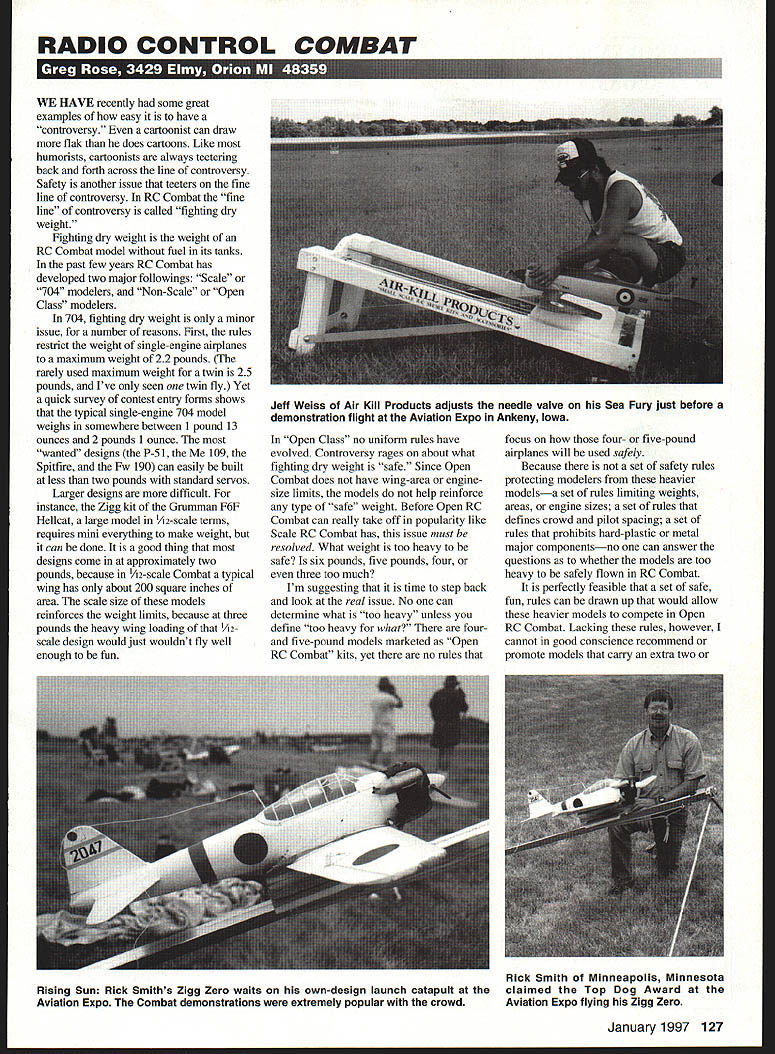
Although the Combat was primarily for the crowd, points were tallied as in a normal Combat event. The Top Dog Award for the show went to Rick Smith of Minneapolis, Minnesota. The support given by the Combat fliers and kit manufacturers (like Zigg's Originals and Air Kill Products) made the after-show trophies and prizes possible. Combat participation has an extremely popular element at most RC events, and I understand that another RC Combat demo has already been requested for next year's Aviation Expo!
Conclusion
Until next time, remember to build light, fly safe, and always check your six!
Transcribed from original scans by AI. Minor OCR errors may remain.

