
RADIO CONTROL COMBAT
Greg Rose 1312 NW 196th St., Edmond, OK 73003
I attended a local Oklahoma club's first 704 Scale Radio Control (RC) Combat meet, and what I saw reminded me to cover a very basic but very important item.
Things were going quite well for everyone except one "unlucky" modeler whose would-be fighter had trouble staying airborne. Yet a half-dozen other airplanes, all similar in size and weight and some with even less power, flew fine.
The "unlucky" model flew great straight and level; in a moderate climb it was fairly fast and true; but try to maneuver, and wham! It would stall, snap, point its nose toward terra firma, and drop like a bullet. When the pilot was high enough, a gradual pullout could save it, but when he maneuvered at low altitude after the snap, the hard pull-up caused the model to snap again and again, and then one final time before the bottom of his "figure J" put him into the grass.
Experienced RC pilots recognize this problem not as bad luck but as a small oversight regarding control movements. Major kit manufacturers and most cottage industry kit makers include information on maximum control throws; follow the manufacturer's recommendations. If you are scratch-building, a good rule of thumb is:
- Aileron travel: 1/8 inch each way (never more than 3/16 inch)
- Elevator movement: 1/4 inch each way (never more than 3/8 inch)
More is not better here; the idea is to control the flow of air over the wings and tail, not to disrupt it so much that your model stalls.
And while you are paying attention to control movements, don't forget to check that the ailerons and elevator aren't reversed in direction.
Celina Flying Sportsmen Club meet
I received a great picture from Lyn Green of the Celina Flying Sportsmen Club of Celina, Ohio, taken during the club's Summer Annual Combat Meet. Lyn wrote that there were 14 pilots, 38 airplanes, and 200 spectators!
Lyn gave the names of the top three winners shown in the photo: Curt Hunnicutt (kneeling, second from the left with a Ziggs Zero) from Indiana won first place; Don Veres Jr. (kneeling, fourth from left), a flying buddy of mine from Michigan, was second; and another old flying buddy from Indiana, Nick Jones (sandwiched between Curt and Don), won third place.
Nick is one of the original dogfighters in the U.S.; his club is in Richmond, Indiana. He was one of the first to really latch onto the excitement of 704 Combat. Nick is still flying his favorite mount — a House of Balsa T-6 Texan. I wonder if it's the same one that I flew my Tony against seven years ago. (I certainly have nothing left that is that old.)
Rule changes and ASDA
Lyn asked that I include his thoughts on some possible changes to the 704 rules:
"I've been hearing a lot on new Combat rule changes. Right now, you can take any O.S. .15 or .20-size engine and a balsa or foam kit and be competitive! I'm not sure these changes are good for the future of RC Combat. Don't take away the simplicity and ease to enter this new sport."
I think many people are working toward the goal of keeping 704 simple, fun, and inexpensive, but I do feel some changes in the original rules are necessary. Clubs with flying fields 3,000 feet or more in elevation have had difficulty because of the lower power outputs of their engines at higher altitudes. Therefore, I would expect to see "high altitude instructions" for engines much the same as "high altitude baking instructions" that cake mixes have on their boxes. Any slight increase in engine size for "high altitude rules" would affect only a small (but important) group of 704 Combat fliers who fly at those altitudes.
The biggest change that we "lowlanders" would like to see is some cleaning up of the scoring system, and the official elimination of the "first up" point bonus, which has proven to be unsafe.
If you or other 704 Combat fliers want to become more involved with the rules change proposals, join the American Scale Dogfighters Association (ASDA) — the special interest group for 704 Combat fliers. Contact the ASDA Membership Dept., 20300 Lochmoor, Harper Woods, MI 48225, or visit http://scalecombat.com/ for details.
Manufacturers' News
- WarZone Models (new ownership) is making improvements on its cut-foam 704 models — P-47D Thunderbolt, Nakajima Ki-84 Frank, and Grumman F8F Bearcat — before re-release. The new kits will offer simplified construction and improved assembly directions aimed at making the models easier for the first-time Combat kit builder. Contact WarZone at 17 Essla Dr., Rochester, NY 14612; Tel: (716) 227-0592.
- JDB AeroTec (2202 Beck Lane, Lafayette, IN 47905; Tel: (765) 474-1738) has added three new kits to its line of cut-foam and balsa kits: the Douglas SBD Dauntless (nicknamed "Slow But Deadly" but reported to be anything but slow), the Grumman F8F Bearcat, and the Kawasaki Ki-61 Tony. As with their P-40 Warhawk, F4F Wildcat, and the two Mustangs (the bubble-top "D" and the razorback "B"), each new kit features custom vacuum-formed canopies and fiberglassed wing and belly-skid sections.
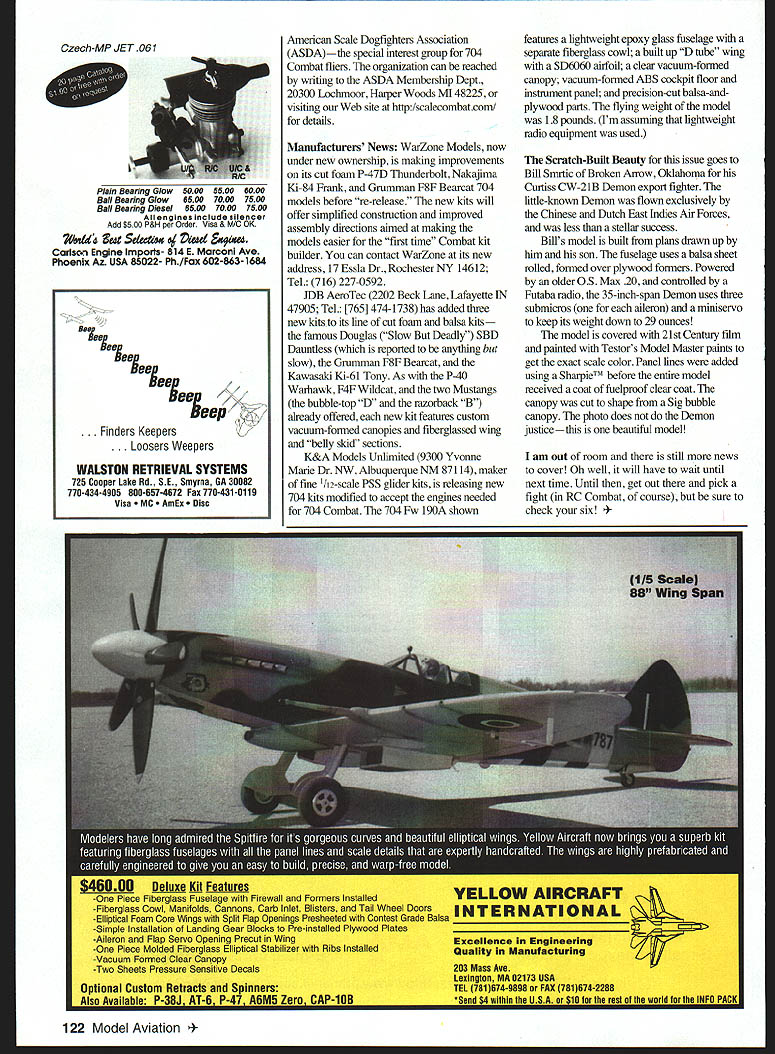
- K & A Models Unlimited (9300 Yvonne Marie Dr. NW, Albuquerque, NM 87114), maker of nine 1/2-scale PSS glider kits, is releasing new 704 kits modified to accept the engines needed for 704 Combat. The 704 Fw 190A shown features:
- Lightweight epoxy-glass fuselage with a separate fiberglass cowl
- Built-up "D" tube wing with an SD600 airfoil
- Clear vacuum-formed canopy
- Vacuum-formed ABS cockpit floor and instrument panel
- Precision-cut balsa-and-plywood parts
The flying weight of the model was 1.8 pounds (I'm assuming lightweight radio equipment was used).
Scratch-Built Beauty
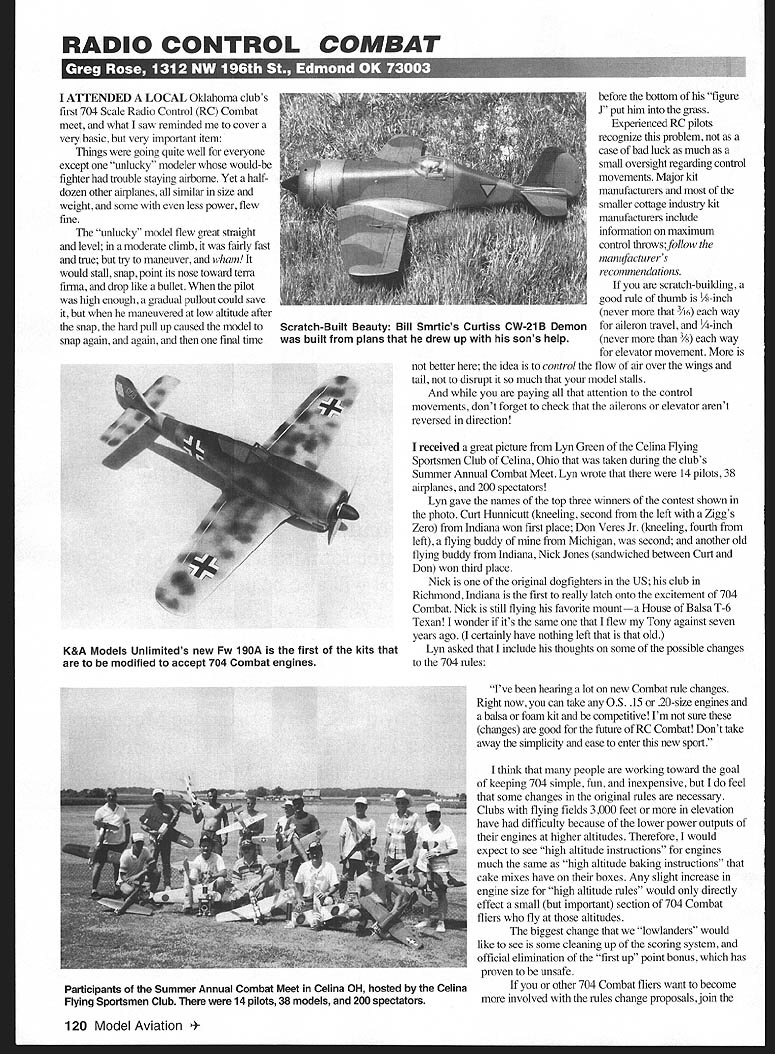
The Scratch-Built Beauty for this issue goes to Bill Smrtics of Broken Arrow, Oklahoma, for his Curtiss CW-21B Demon export fighter. The little-known Demon was flown by the Chinese and Dutch East Indies Air Forces and was a stellar success. Bill's model is built from plans drawn up by him and his son. Construction highlights:
- Fuselage: balsa sheet rolled and formed over plywood formers
- Engine: older O.S. Max .20
- Radio: Futaba
- Wingspan: 35 inches
- Servos: three submicro servos (one for each aileron) plus a miniservo
- Flying weight: 29 ounces
- Covering: 21st Century film
- Paint: Testor's Model Master paints for exact scale color; panel lines added with a Sharpie; finished with a fuelproof clear coat
- Canopy: cut to shape from a Sig bubble canopy
The photo does not do the Demon justice — this is one beautiful model!
I am out of room and there is still more news to cover. Oh well — I will have to wait until next time. Until then, get out there and pick a fight in RC Combat (of course), but be sure to check your six!
Transcribed from original scans by AI. Minor OCR errors may remain.

