
RADIO CONTROL: COMBAT
Greg Rose, 1312 NW 196th St., Edmond OK 73003
Radio control (RC) Combat in general, and specifically the 704-scale RC Combat AMA event, has become one of the fastest-growing areas in modeling. The upside of the growth is the sheer number of people who have become active in RC Combat; it's literally a "the more the merrier" type of event.
The other positive thing about so many people being involved is that the flow of ideas on all sorts of issues has become tremendous. Suggestions abound, including:
- Profile fuselages in 704 scale
- A "high altitude" version of Scale Combat
- A World War I version of the game with Sopwith Camels and Fokker Triplanes battling it out
- A fast-paced "jet age" version
- And more
Non-scale Combat has also been growing, and efforts are underway to develop the first nationally recognized set of non-scale Combat rules.
With so many good ideas floating around, it can become difficult to maintain a clear focus, but it's important to remember that RC Combat is still growing; there is plenty of space to create many enjoyable events, and RC Combat fliers share common goals. As with many other things in life, we should focus on our similarities more than our differences.
New JDB AeroTec kits
Good news for 704 kit builders: JDB AeroTec (2202 Beck Lane, Lafayette IN 47905; Tel.: (765) 474-1738) has added two new kits to its line, bringing the number of 1/12-scale kits to nine.
- Grumman F3F
The F3F is the tiny biplane fighter that predated the Wildcat. It may seem odd to have a biplane in a World War II Combat event, but several biplane fighters did render service during the war. As incredible as it may seem now, the U.S. Navy had accepted delivery on the last Grumman F3F for front-line duty only 82 days before Germany invaded Poland. At the time, the F3Fs were being rushed into service, equipping the carriers Yorktown and Wasp. Fortunately, by the time the U.S. entered the war, the F3F had been replaced by the next generation of Grumman fighters. As a 1/12-scale fighter the small F3F spans 32 inches, yet packs more than 250 square inches of wing area with four ailerons.
- Kawasaki Ki-100
The Ki-100, which was never given an Allied code name, was a radial-powered development of the inline-powered Ki-61 Tony. Arguably one of the finest fighters of the war on any side, JDB has reshaped the nose and firewall of the Ki-61 Tony kit to make the new Ki-100 kit.
As with JDB's previous kits, both designs use cut-foam construction with balsa tail feathers and a clear vacuum-formed canopy.
DBW Models short kits
Another new manufacturer of 704 kits is DBW Models (1063 West 125 South, Blackfoot ID 83221; Tel.: (208) 684-9365). DBW is offering three new "short kits":
- Bell P-39 Airacobra
- Nakajima Ki-43 Oscar
- Romanian IAR 80 fighter (rarely modeled)
DBW describes its short kits as "foam-cut wings, canopy and cowl (on radial models only), plus the plans to build the rest of the plane." For an additional charge, you can also order a kit that supplies the fuselage formers. Call or write DBW for details.
Battle for Madison
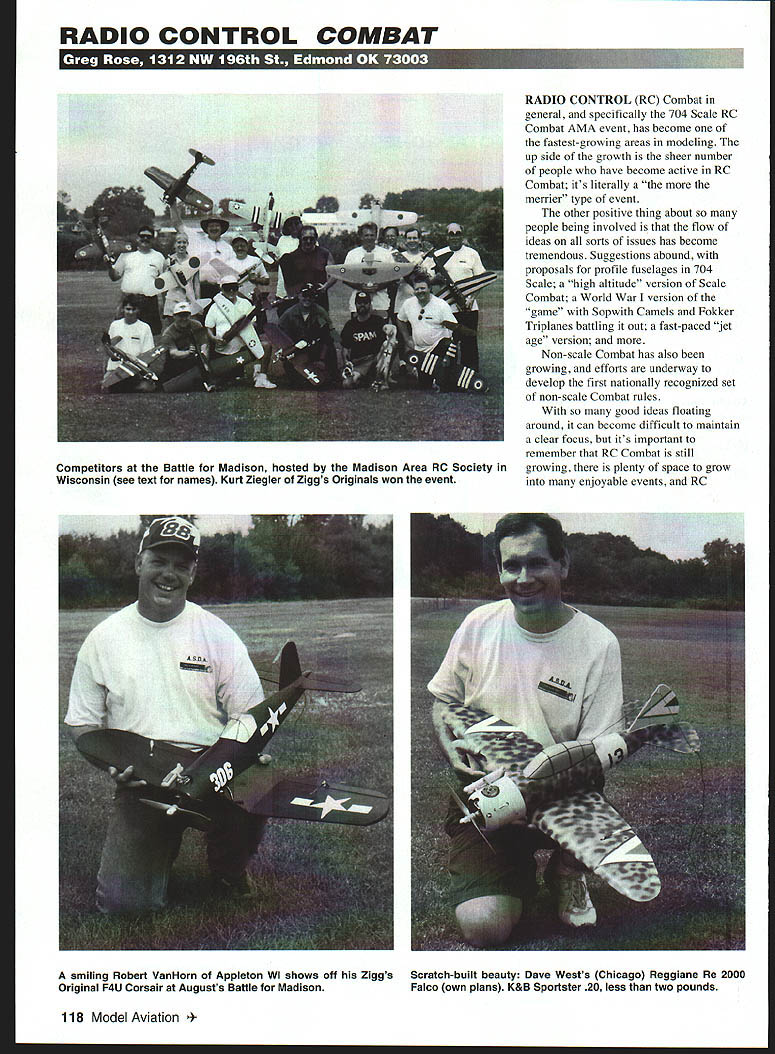
The Madison Area RC Society in Wisconsin sent a group photo from its Battle for Madison meet held in August. Kurt Ziegler of Zig's Originals came in first, newcomer Bryan Hesse took second, and Mike Fredricks placed third. The group photo includes two father/son and one father/daughter teams.
The photo doesn't show the real battle conditions that day: a Wisconsin 95°F heat wave, stifling 90%+ humidity, and eight-foot-tall nettles covering most of the fly-over zone. Just being at the event took its toll. Two models were abandoned in the nettles, never to be seen again (although a model apparently lost for months was found). The nettles also destroyed the engines of Dave Wagensomer's and Mike Fredricks' airplanes after they were ejected during a midair. As Scott Anderson said, "If it didn't have a streamer, you didn't find it."
The heat took the biggest toll on the fliers. The club had to call 911 to get paramedics to treat Kurt Ziegler for heat exhaustion. He protested, "But I've got a contest to fly!" He must have recovered—he came in first.
Scratch-built Reggiane Re 2000 Falco
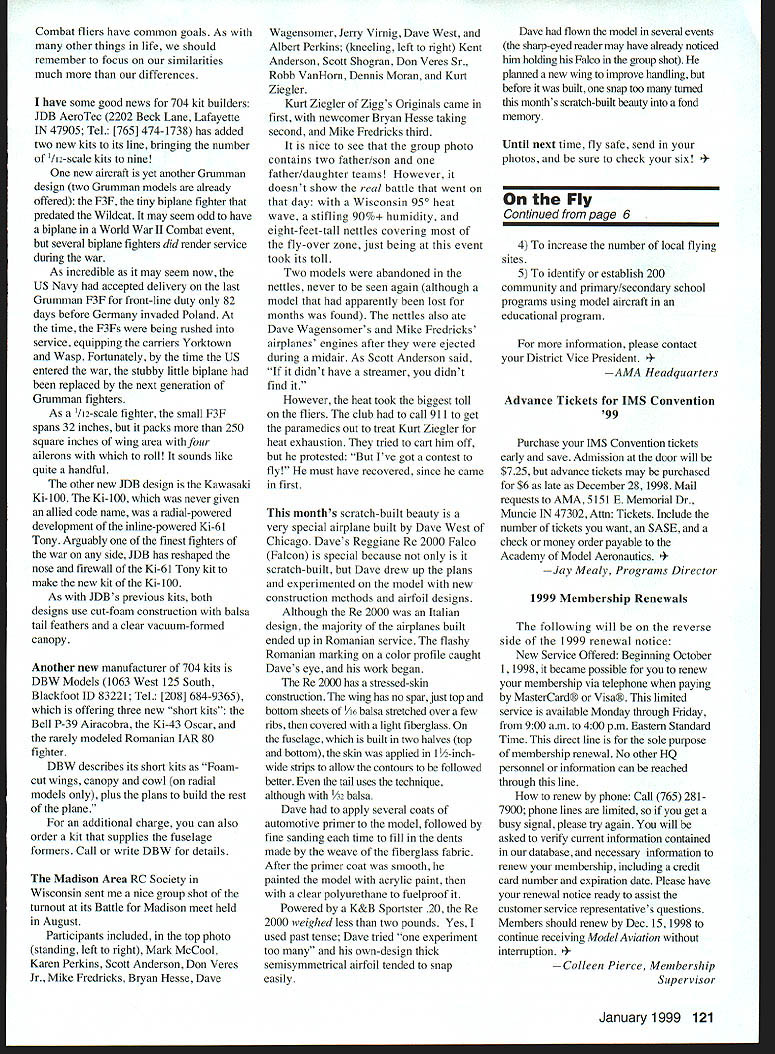
This month's scratch-built beauty is a very special airplane built by Dave West of Chicago. Dave's Reggiane Re 2000 Falco (Falcon) is special because he not only scratch-built it, but also drew the plans and experimented with new construction methods and airfoil designs.
Although the Re 2000 was an Italian design, the majority of the airplanes built ended up in Romanian service. A flashy Romanian marking on a color profile caught Dave's eye, and his work began.
The Re 2000 uses stressed-skin construction. The wing has no spar—just top and bottom sheets of 1/16" balsa stretched over a few ribs, then covered with light fiberglass. On the fuselage, the skin is built in two halves (top and bottom); the skin was applied in 1/32"-thick strips to follow the contours better. Even the tail uses the technique, though with 1/64" balsa.
Dave applied several coats of automotive primer to the model, sanding between coats to fill in the dents made by the weave of the fiberglass fabric. After the primer was smooth, he painted the model with acrylic paint, then finished with a clear polyurethane to make it fuel-proof.
Powered by a K&B Sportster .20, the Re 2000 weighed less than two pounds. Unfortunately, Dave tried "one experiment too many": his own-design thick, semi-symmetrical airfoil tended to snap easily. Dave had flown the model in several events (he can be seen holding his Falco in the group shot). He planned a new wing to improve handling, but before it was built, one snap too many turned this month's scratch-built beauty into a fond memory.
Until next time, fly safe, send in your photos, and be sure to check your six!
Transcribed from original scans by AI. Minor OCR errors may remain.

