
RADIO CONTROL COMBAT
Greg Rose
1312 NW 196th St., Edmond, OK 73003
A procedural glitch resulted in the "loss" of the March 1999 column; this is a make-up for the missing column. The regular bimonthly schedule for "RC Combat" will resume next month.
I've had many questions about changes in the 704 rules for Scale Radio Control (RC) Combat.
It's very difficult for me to talk about these changes in this column because of the time lag between when I sit down and type and the time that you actually see the column. About three months pass between those times, and, unfortunately, as I write today I know that some of the things in my last column have changed before you have even seen them.
So, after a brief reassurance that no upcoming change is going to dramatically alter the face of Scale RC Combat but rather will expand fliers' options, I'm going to stick to a more "timeless" subject for this column.
704 Rules and Scale Finishes
When 704 Scale RC Combat was first published in the AMA Competition Regulations handbook, one line read that the model had to be a "scale replica of a combat aircraft." That meant that the model's shape and color would reproduce that of the combat aircraft represented.
However, a scale-like finish on the model was not specifically defined, which resulted in some rather unique "high visibility" paint schemes. Although most pilots thought that a P-51 Mustang with a lime-green fuselage and hot-pink wings was "out of place," the 704 rules did not specifically prohibit such non-scale finishes.
As the new RC Combat SIG (Special Interest Group) considers the 704 rules, you can expect to see a greater emphasis on scale finishes. Current proposed wording states:
"Aircraft are to be finished in prototypical unit/squadron colors for that type of aircraft of the period. Unusual color schemes are allowed when supported with simple photograph or drawing documentation supplied by the pilot of the aircraft."
Editor's note
No formal Rules Change Proposals for 704 had been received by Technical Director Steve Kaluf at the time of this writing. The SIGs can work with individuals to propose changes, but the standard procedure for implementing changes is still followed.
This much-more-specific wording should help minimize misunderstandings.
Sources for Scale Color Information
So where can you get the information you need to find interesting paint schemes for your model? One of the biggest publishers of scale color information is Squadron/Signal Publications of Carrollton, Texas. With more than 100 books on scale aircraft documentation, Squadron is an excellent place to start.
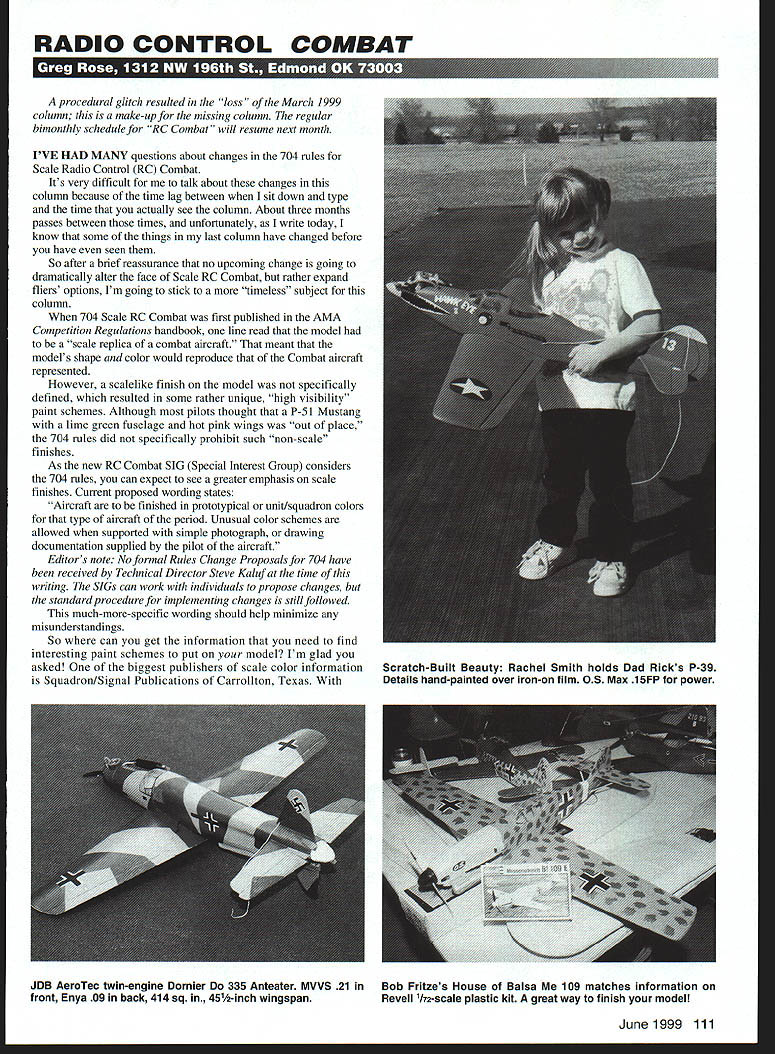
- Squadron/Signal — The In Action series gives photos, three-views, and color drawings for a large number of aircraft. (If the model chosen for the Scratch-Built Beauty this month looks familiar, perhaps that’s because it’s on the cover of Squadron’s P-39 Airacobra in Action.)
- Squadron/Signal — The Walk Around series can be extremely useful for detail and unusual markings (for example, the red-and-white striped bottom on some German Fw 190s can be found in Walk Around Fw 190). The series covers a number of WWII fighters and includes several books on smaller-nation air forces of WWII (Poland, Hungary, Finland), with numerous photos and color details.
Other good sources:
- Osprey Aero — Osprey Aircraft of the Series and the Schiffer Military History series, featuring a number of mostly German aircraft.
- Motorbooks International — The Enthusiast Color Series often contains a single color profile plus color photos. P-40 Warhawk in World War II Color includes more than 70 original WWII vintage color photos of the P-40, including a captured Warhawk in Japanese markings.
- Kalmbach Books — Building the P-40 Warhawk is written for plastic-model hobbyists and covers building, detailing, and painting several P-40 versions in 1/72 and 1/48 scale. The details are presented well enough that 1/2-scale RC modelers can find useful hints. That series includes the P-40 and the Messerschmitt Me 109.
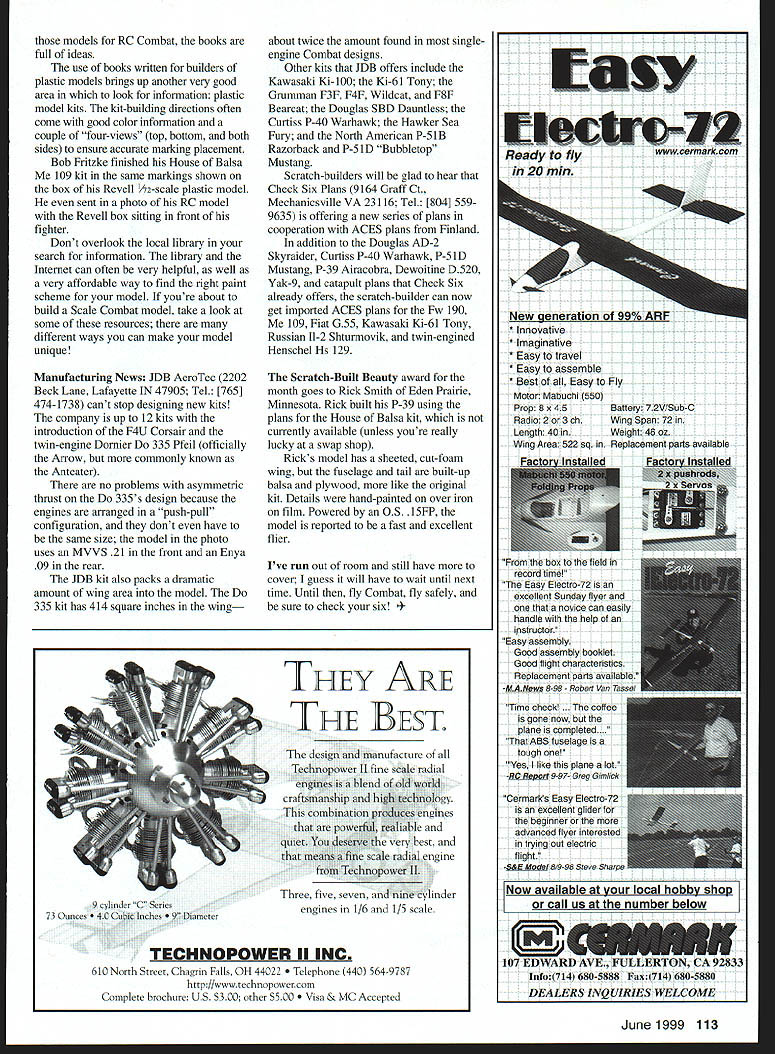
Plastic model kits are also a very good resource. Kit instructions often include color information and multiple views (top, bottom, and both sides) to ensure accurate marking placement. For example, Bob Fritzke finished his House of Balsa Me 109 kit in the same markings shown on the box of his Revell 1/72-scale plastic model and photographed his RC model with the Revell box in front.
Don't overlook the local library and the Internet; both can be very helpful and affordable ways to find the right paint scheme for your model. If you're about to build a Scale Combat model, take a look at some of these resources — there are many ways to make your model unique.
Manufacturing News
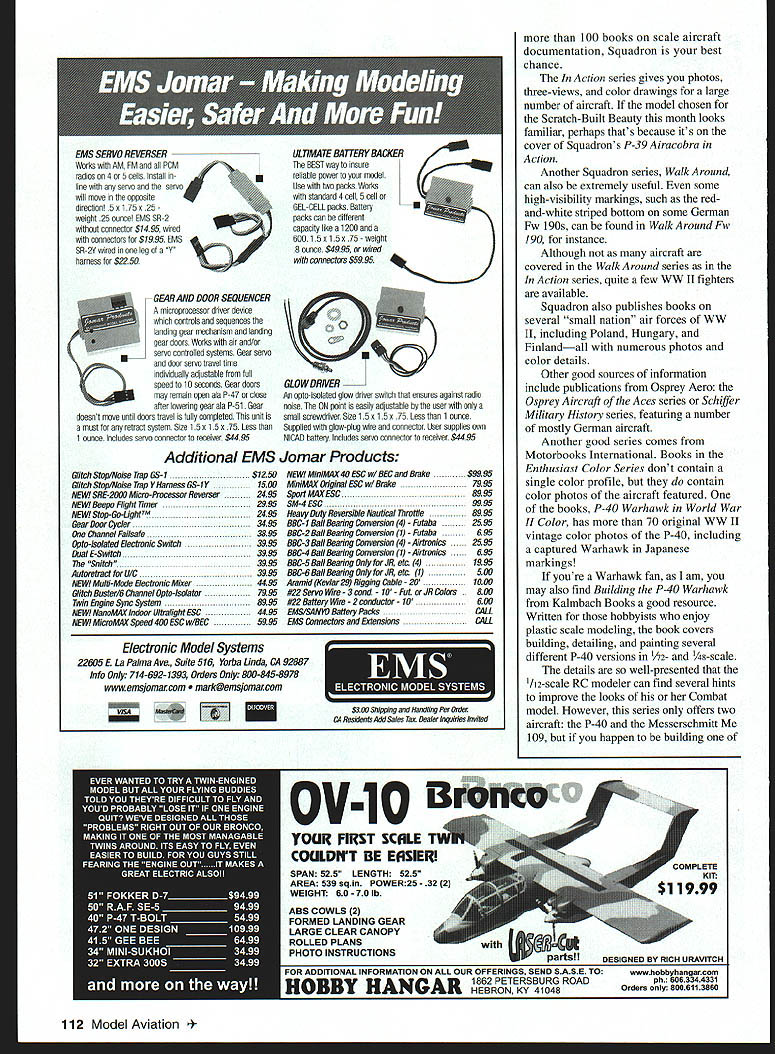
JDB AeroTec (2202 Beck Lane, Lafayette, IN 47905; Tel.: [765] 474-1730) isn't stopping new kits! The company is up to 12 kits with the introduction of the F4U Corsair and the twin-engine Dornier Do 335 Pfeil (officially the Arrow, but more commonly known as the Anteater).
There are no problems with asymmetric thrust on the Do 335's design because the engines are arranged in a "push-pull" configuration; they don't even have to be the same size—the model in the photo uses an MVVS .21 in the front and an Enya .09 in the rear. The JDB kit also packs a dramatic amount of wing area into the model. The Do 335's kit has 414 square inches of wing—about twice the amount found in most single-engine Combat designs.
Other kits JDB offers include:
- Kawasaki Ki-100
- Kawasaki Ki-61 Tony
- Grumman F3F
- Grumman F4F Wildcat
- Grumman F8F Bearcat
- Douglas SBD Dauntless
- Curtiss P-40 Warhawk
- Hawker Sea Fury
- North American P-51B Razorback
- North American P-51D "Bubbletop" Mustang
Scratch-Built Resources
Scratch-builders will be glad to hear that Check Six Plans (9164 Graff Ct., Mechanicsville, VA 23116; Tel.: [804] 559-9635) is offering a new series of plans in cooperation with ACES plans from Finland.
In addition to the Douglas AD-2 Skyraider, Curtiss P-40 Warhawk, P-51D Mustang, P-39 Airacobra, Dewoitine D.520, Yak-9, and catapult plans that Check Six already offers, the scratch-builder can now get imported ACES plans for:
- Fw 190
- Me 109
- Fiat G.55
- Kawasaki Ki-61 Tony
- Russian Il-2 Shturmovik
- Henschel Hs 129 (twin-engine)
Scratch-Built Beauty
The Scratch-Built Beauty award for the month goes to Rick Smith of Eden Prairie, Minnesota. Rick built his P-39 using plans for the House of Balsa kit, which is not currently available (unless you're really lucky at a swap shop).
Rick's model has a sheeted, cut-foam wing, but the fuselage and tail are built-up balsa and plywood, more like the original kit. Details were hand-painted over iron-on film. Powered by an O.S. .15 FP, the model is reported to be a fast and excellent flier.
Closing
I've run out of room and still have more to cover; it will have to wait until next time. Until then, fly Combat, fly safely, and be sure to check your six!
Transcribed from original scans by AI. Minor OCR errors may remain.

