
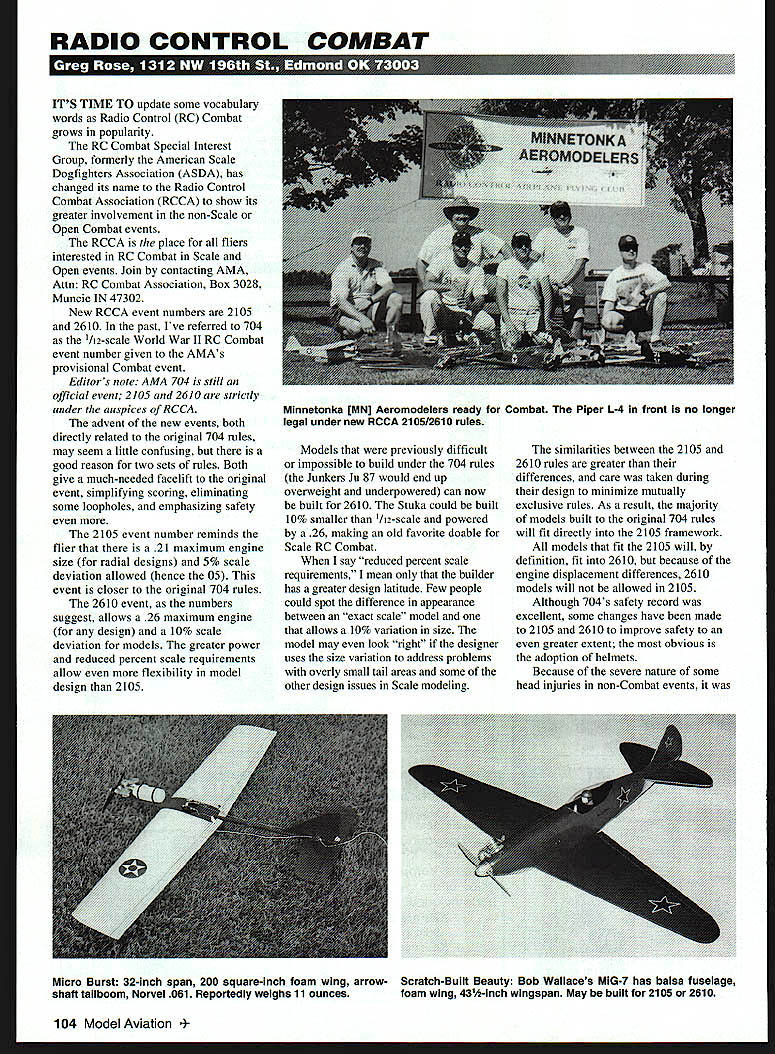
RADIO CONTROL COMBAT
Greg Rose, 1312 NW 196th St., Edmond, OK 73003
It's time to update some vocabulary words as Radio Control (RC) Combat grows in popularity.
The RC Combat Special Interest Group, formerly the American Scale Dogfighters Association (ASDA), has changed its name to the Radio Control Combat Association (RCCA) to show its greater involvement in non-scale or Open Combat events.
The RCCA is the place for all fliers interested in RC Combat in Scale and Open events. Join by contacting:
- AMA, Attn: RC Combat Association, Box 3028, Muncie, IN 47302
New RCCA event numbers are 2105 and 2610. In the past, I've referred to 704 as the 1/2-scale World War II RC Combat event number given to the AMA's provisional Combat event.
Editor's note
AMA 704 is still an official event; 2105 and 2610 are strictly under the auspices of the RCCA.
The advent of the new events, both directly related to the original 704 rules, may seem a little confusing, but there is a good reason for two sets of rules. Both give a much-needed facelift to the original event, simplifying scoring, eliminating some loopholes, and emphasizing safety even more.
The 2105 event number reminds the flier that there is a .21 maximum engine size (for radial designs) and 5% scale deviation allowed (hence the .05). This event is closer to the original 704 rules.
The 2610 event, as the numbers suggest, allows a .26 maximum engine size (for any design) and a 10% scale deviation for models. The greater power and reduced percent-scale requirements allow even more flexibility in model design than 2105.
Models that were previously difficult or impossible to build under the 704 rules (the Junkers Ju 87 would end up overweight and underpowered) can now be built for 2610. The Stuka could be built 10% smaller than 1/2-scale and powered by a .26, making an old favorite doable for Scale RC Combat.
When I say "reduced percent-scale requirements," I mean only that the builder has greater design latitude. Few people could spot the difference in appearance between an "exact scale" model and one that allows a 10% variation in size. The model may even look "right" if the designer uses the size variation to address problems with overly small tail areas and other design issues in scale modeling.
The similarities between the 2105 and 2610 rules are greater than their differences, and care was taken during their design to minimize mutually exclusive rules. As a result, the majority of models built to the original 704 rules will fit directly into the 2105 framework. All models that fit the 2105 will, by definition, fit into 2610, but because of the engine displacement differences, 2610 models will not be allowed in 2105.
Although 704's safety record was excellent, some changes have been made to 2105 and 2610 to improve safety to an even greater extent; the most obvious is the adoption of helmets.
Because of the severe nature of some head injuries in non-Combat events, it was considered wise to require head protection before an injury occurred. The Combat requirement includes the helmet outlined in the official AMA National Model Aircraft Safety Code and must be worn by anyone at the flightline.
Other important safety features include:
- A safety line 25 feet in front of the flightline, with a heavy scoring penalty for crossing, to help protect pilots from buzzing the flightline in an attempt to shake an opponent off their tail.
- Assignment of certain safety functions (Line Marshal).
- Prohibition on retrieval of downed models that land under the Combat area during a round.
- Workable procedures for handling models involved in a midair collision.
As fliers become familiar with the new unofficial Scale Combat events and the rules for non-Scale events, they will find the new safety rules workable and understandable — important improvements for RC Combat events. Nobody has fun if anybody gets hurt. Combat fliers and Contest Directors, please take the time to review the changes so competitors can fly safer events. I'll cover some rules changes next column.
Open Combat News
Have you ever heard of Micro-Combat? Some modelers in Colorado are flying it as a local event. Ace "Simple Series" P-51s, Me 109s, and T-6s powered by Norvel .061s are used for the Scale portion of the event, and the Micro Burst is used for the "non-scale unlimited" portion.
The Micro Burst, kitted by Master Mind Products, spans 32 inches with a 200-square-inch wing and is powered by a Norvel .061 engine. With microservos and a 110 mA battery, the Micro Burst reportedly weighs 11 ounces. The kit uses a foam wing and an arrow-shaft tailboom to aid construction; the build time for the kit is described as "rapid."
Master Mind Products contact:
- Master Mind Products, 4801 S. Wadsworth Blvd., Unit 9-105, Littleton, CO 80123
- Tel: (303) 948-2547
The letter that was sent to me did not mention the rules used in Micro-Combat; tell us more, guys!
Scale Combat heads north! RC Combat fliers in Canada have announced the Can/Am Combat Challenge at Otterville, Ontario, Canada, September 4–5, 1999.
The Can/Am is the first large Canadian/US Scale RC Combat meet, with entries limited to the first 40 fliers from each country. Using 2610 rules (all 2105 aircraft are permitted in 2610, but not the other way around), the event promises to be an exciting match.
Can/Am contact:
- Ron Daniels, 15 Tradewinds Pl., Kitchener, Ontario, Canada, N2N 3G4
- Tel: (519) 743-5549
If you're not one of the first 40, mark the date on the calendar anyway; it sounds like a show you won't want to miss.
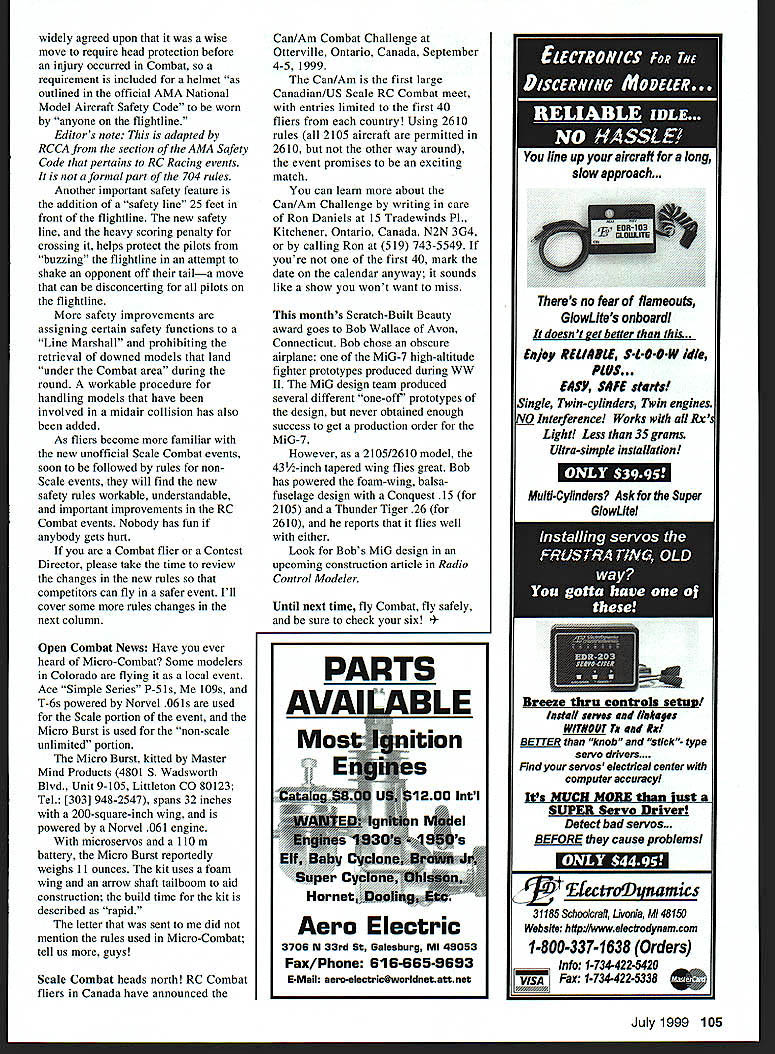
This month's Scratch-Built Beauty award goes to Bob Wallace of Avon, Connecticut. Bob chose an obscure airplane: one of the MiG-7 high-altitude fighter prototypes produced during WWII. The MiG design team produced several different one-off prototypes of the design but never obtained a production order for the MiG-7.
However, as a 2105/2610 model, the 43½-inch tapered-wing design flies great. Bob has powered the foam-wing, balsa-fuselage design with a Conquest .15 (for 2105) and a Thunder Tiger .26 (for 2610), and he reports that it flies well with either.
Look for Bob's MiG design in an upcoming construction article in Radio Control Modeler.
Until next time, fly Combat, fly safely, and be sure to check your six!
Transcribed from original scans by AI. Minor OCR errors may remain.

