
RADIO CONTROL: COMBAT
Greg Rose, 3429 Elmy, Orion, MI 48359
HAPPY NEW YEAR
1993 was a banner year for RC combat, with more events, in both 704-scale and nonscale, than ever before. The growth of this facet of the RC sport may be attributed to a number of things:
- More and more fliers who see these events realize that the small models fly well; the idea that only big models fly and little ones "flit" keeps many modelers from considering smaller designs.
- Size, weight, and power in 704 Combat models are balanced into a smooth, realistic flying package. Anyone who has seen one fly can attest that a one-twelfth-scale Me 109 with a .15 does not flit.
- The growing number of kits and plans sold solely for sport flying makes these models accessible to average fliers in terms of both skill level and budget. The use of sport engines, three- or four-channel radios, and small, inexpensive kits allows a modeler to enjoy the thrills of these events without overextending his or her modeling budget.
But the biggest reason for the growth in RC combat seems to be that the events are just plain fun. If you haven't tried combat yet, build one this winter and give it a try!
Speaking of Fun: Richmond Regional 704 Meet
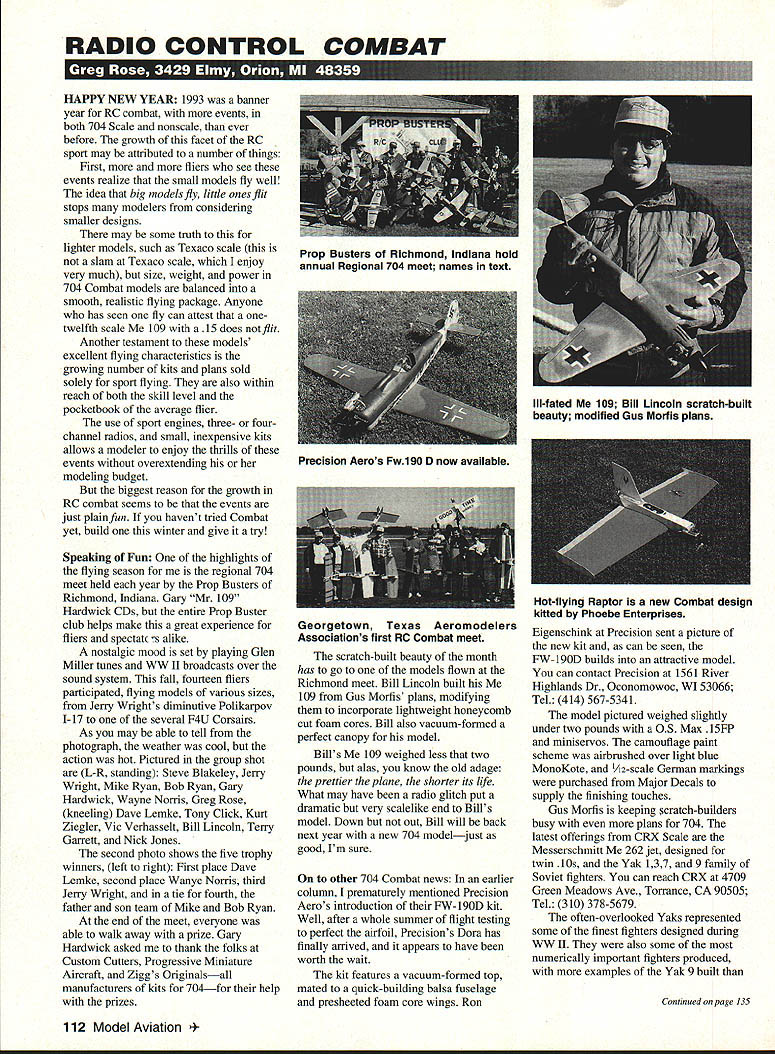
One of the highlights of the flying season for me is the regional 704 meet held each year by the Prop Busters of Richmond, Indiana. Gary "Mr. 109" Hardwick served as CD, but the entire Prop Buster club helps make this a great experience for fliers and spectators alike.
A nostalgic mood is set by playing Glenn Miller tunes and WWII broadcasts over the sound system. This fall, fourteen fliers participated, flying models of various sizes, from Jerry Wright's diminutive Polikarpov I-17 to one of several F4U Corsairs. The weather was cool, but the action was hot.
Group photo (L–R, standing):
- Steve Blakeley
- Jerry Wright
- Mike Ryan
- Bob Ryan
- Gary Hardwick
- Wayne Norris
- Greg Rose
Kneeling:
- Dave Lemke
- Tony Click
- Kurt Ziegler
- Vic Verhasselt
- Bill Lincoln
- Terry Garrett
- Nick Jones
Trophy winners (left to right):
- First place — Dave Lemke
- Second place — Wayne Norris
- Third place — Jerry Wright
- Tie for fourth — father-son team Mike & Bob Ryan
At the end of the meet, everyone was able to walk away with a prize. Gary Hardwick asked me to thank the folks at Custom Cutters, Progressive Miniature Aircraft, and Ziggs Originals — all manufacturers of kits for 704 — for their help with the prizes.
Scratch-built Beauty
Scratch-built beauty of the month goes to one of the models flown at the Richmond meet. Bill Lincoln built his Me 109 from Gus Morfis' plans, modifying them to incorporate lightweight honeycomb-cut foam cores. Bill also vacuum-formed a perfect canopy for his model.
Bill's Me 109 weighed less than two pounds, but, as you know, the old adage holds: the prettier the plane, the shorter its life. What may have been a radio glitch put a dramatic but very scale-like end to Bill's model. Down but not out, Bill will be back next year with a new 704 model — just as good, I'm sure.
New Kits and Plans
In an earlier column I prematurely mentioned Precision Aeros' introduction of their FW-190D kit. After a whole summer of flight testing to perfect the airfoil, Precision's Dora has finally arrived, and it appears to have been worth the wait.
The kit features a vacuum-formed top mated to a quick-building balsa fuselage and presheeted foam-core wings. Ron Eigenschink at Precision sent a picture of the new kit and, as can be seen, the FW-190D builds into an attractive model. The pictured model weighed slightly under two pounds with an O.S. Max .15FP and miniservos. The camouflage paint scheme was airbrushed over light-blue MonoKote, and 1/2-scale German markings were purchased from Major Decals to supply the finishing touches.
Contact Precision:
- Precision Aeros
- 1561 River Highlands Dr., Oconomowoc, WI 53066
- Tel.: (414) 567-5341
Gus Morfis is keeping scratch-builders busy with even more plans for 704. The latest offerings from CRX Scale are the Messerschmitt Me 262 jet, designed for twin .10s, and the Yak 1, 3, 7, and 9 family of Soviet fighters. The often-overlooked Yaks represented some of the finest fighters designed during WWII; they were also some of the most numerically important fighters produced, with more examples of the Yak 9 built than any U.S.-produced fighter.
Contact CRX Scale:
- CRX Scale
- 4709 Green Meadows Ave., Torrance, CA 90505
- Tel.: (310) 378-5679
Safety Suggestion
Although we never plan on placing our fingers in the propeller arc, it has been suggested to me that a wooden propeller may help if we do make such a mistake. I talked to Gary Shaw, who writes the "Safety Comes First" column for Model Aviation, and he concurs. Wooden props break upon impact more readily than their plastic counterparts and therefore may result in less injury. Although I don't plan on testing the theory, I've already converted my 704 fighters to wooden props. If anyone has experiences or opinions regarding the merits — if any — of wooden props, I'd be interested to hear them.
Georgetown, Texas — First RC Combat Meet
The Georgetown, Texas Aeromodelers Association held their first RC Combat meet last summer. Most models were built from the Bird of Prey kit offered by Phoebe Enterprises. The Bird of Prey is similar to the Gremlin popular in New England. Well-liked by the club's fliers, it turns out that several club members soloed using this design.
Contact Phoebe Enterprises:
- Phoebe Enterprises
- 1500 Wilson Heights Dr., Austin, TX 78746
- Tel.: (512) 327-4335
I received a copy of the rules used in Georgetown's meet; they are similar to many other Gremlin-type Combat events. A combat "box" is used to keep the models away from spectators and pilots, and a spot landing at the end of each one-on-one match can add as much as a streamer cut to the final score.
One interesting feature of the Georgetown rules is a handicap placed on engine displacement to even things up:
- A model with a .40-sized engine would pull a forty-foot streamer.
- A model with a .20-sized engine would pull a twenty-foot streamer.
Stan Douglas at Phoebe Enterprises is now offering a completely new combat design: the Raptor. Although the Raptor is the same size and weight as his earlier kit, the new design uses a double-tapered wing and a laminar airfoil that improves speed and stability over the already-popular Bird of Prey.
Gremlin Combat and NERCCA
Fliers in the New England area may be interested in the New England Radio Control Combat Association (NERCCA) newsletter that announces local Gremlin events and results. One item in the last newsletter regarded an event held in West Warwick, Rhode Island, early in October. Open to two divisions, .25 and Open, Barry Schubert reported in the NERCCA Newsletter:
"It became quite obvious you can have as much fun with a .25 as you can with an Unlimited. In reality, the .25s turn a lot tighter and 'play in a smaller box;' the competition was just as intense."
I agree completely: the lower the weight, the better the flying, the safer the flying, and the more fun in flying. The NERCCA Newsletter is published by Jim Reith at R.A. Cores, manufacturers of the Gremlin kit. For information contact R.A. Cores at P.O. Box 863, Southbridge, MA 01550; a nominal $1 fee covers the mailing cost.
That's all for this column; until next time, fly safely and remember to check your 6!
Transcribed from original scans by AI. Minor OCR errors may remain.

