
RADIO CONTROL COMBAT
By Greg Rose, 3429 Elmy, Orion, MI 48359
The quest to keep models lightweight does not go back to prehistoric times—it goes back to the first successful modeler. Lightweight models are critical in RC Combat for two reasons.
First, safety. Weight control is one element of the rules that builds safety into events. Successful Combat rules must incorporate safety and evolve as we learn how to write safer rules. The RC Combat community actively pursues safety improvements for our events, learning from mishaps and tragic events elsewhere in the modeling community.
Second, competitiveness. Building a lightweight model improves the design’s competitive potential. A good example of how not to build an RC Combat model was in a recent review of the Gremlin by another magazine. A typical stock Gremlin is powered by a .25 engine and weighs about 2 1/4 pounds, but the kit assembled for the review was powered by a .46 engine and weighed more than 4 1/2 pounds.
Jim Reith of RA Cores points out that although a .46-powered Gremlin becomes an excellent sport flyer, it wouldn’t be competitive against a stock version in RC Combat. The higher-powered version would be faster, but Jim stated that the .25-powered version can “cut inside” every time. Speed is good for racing, but none of the RC Combat rules I’ve seen gives points for running away—the larger engine just adds extra weight.
Gremlin events and highlights
Speaking of this popular design, a particularly spirited Gremlin Combat took place at the Southern New Hampshire Flying Eagles RC Club’s first annual Halloween Combat contest. The event had two classes: stock Gremlin with .25 engines, and an unlimited class open to any model design or engine displacement. Many of the sixteen fliers participating flew models in both classes.
Perhaps the most distinctive model at the meet was Jim Reith’s own unlimited-class Gremlin Twin—Jim built the twin out of his love for the P-38, not to be competitive. Joe Marrone, contest director for the event, sent photos and a letter stating everyone had a great time and a chance to “feel the adrenaline flow.” First place in both classes was taken by Eric Henderson. The results couldn’t have been more fitting, since Eric is the designer of the Gremlin.
Regional activity
In addition to activity in New England, RC Combat in the Midwest is heating up in both Scale and non-scale events. Mark McCool sent photos from Wisconsin of the ABC Flyers of Oconomowoc, who held their first dual Combat meet. Mark took first place in Scale Combat and said that everyone had a good time.
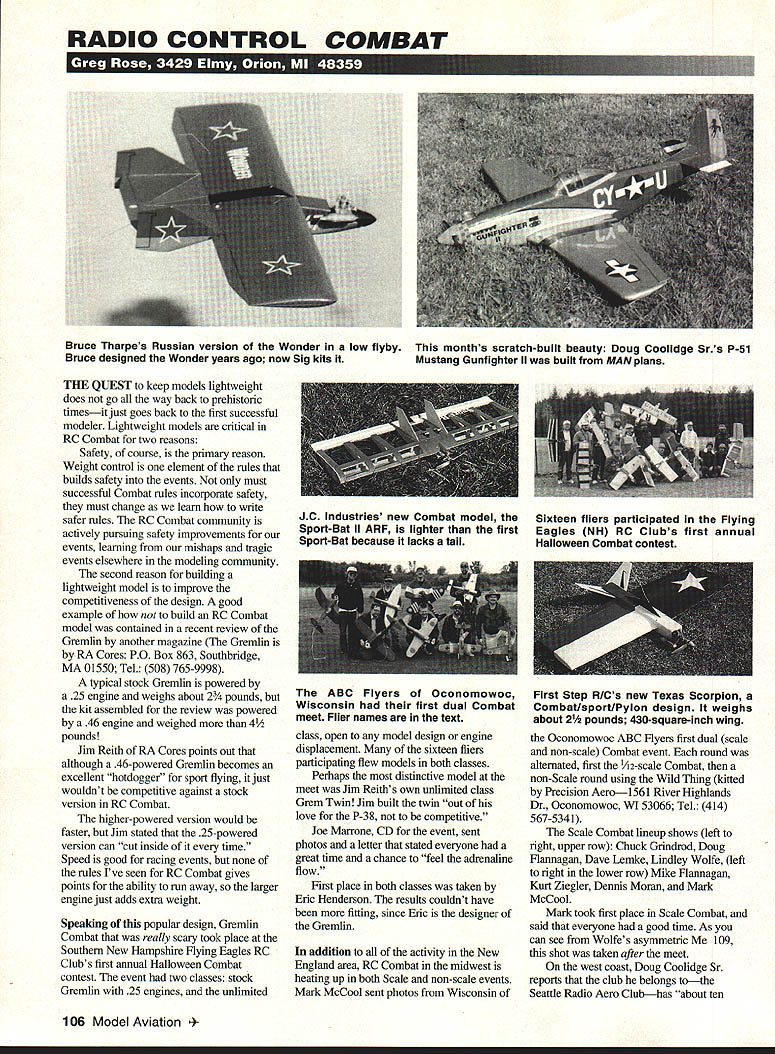
On the West Coast, Doug Coolidge Sr. reports that his club, the Seattle Radio Aero Club, has about ten active Combat fliers. The scratch-built beauty of the month goes to Doug’s superb P-51 Mustang Gunfighter II. Built from MAN plans, Doug’s Mustang draws plenty of interest when it flies because of the growing enthusiasm for Scale Combat in the area. Doug is currently scratch-building a Zero from a set of CRX Scale plans to add to his private air force, and he expects “a very good year of growth and expanded competition” for Scale RC Combat in 1994.
Manufacturers and new kits
A number of new non-scale Combat kits are available, although not all the designs are new. Highlights include:
- RA Cores
P.O. Box 863, Southbridge, MA 01550; Tel: (508) 765-9998. Producer of the Gremlin. Note on power: stock Gremlin uses a .25; larger engines increase weight and reduce Combat competitiveness.
- Sig Manufacturing
4017 South Front St., Montezuma, IA 50171; Tel: (515) 623-5154. Kits the Wonder (designed by Bruce Tharpe). An excellent flier with anything between a .09 to .21 engine. The balsa-and-plywood kit typically weighs between 26 and 38 ounces and has 338 square inches of wing area. The photo showed Bruce’s Russian version powered by an Enya .15. Bruce notes the model’s potential—“as long as you fly safely and within your abilities.”
- First Step R/C
P.O. Box 40023, Georgetown, TX 78627; Tel: (512) 863-7002. Makers of the F.S.20 Combat kit, they’ve announced the new “Combat/Sport/Pylon” design, the Texas Scorpion. The Scorpion features a foam-core wing and a precision-cut balsa-and-plywood fuselage. Typically weighing about 2½ pounds with three standard servos and a .25 engine, the butterfly-tailed model offers 430 square inches in its 39-inch wing.
- J.C. Industries
1051 Universal Rd., Pittsburgh, PA 15235; Tel: (412) 795-9344. Producer of the Sport-Bat ARF and introducer of the Sport-Bat II. Lacking the tail of the original Sport-Bat, the new design is even lighter, weighing 20 to 22 ounces when equipped with a .10–.15 engine and two mini servos.
- MVVS of America
7 Switchblade Pl., Suite 192-211, The Woodlands, TX 77380; Tel: (800) 599-MVVS. Importers of precision-built MVVS engines from the Czech Republic. Introducing a new side-exhaust version of the rear-exhaust MVVS BB ABC .15. The new engine will provide .85 horsepower at 21,000 rpm and weigh 6.4 ounces in the venturi version. MVVS of America also offers BB ABC .21-sized engines in rear and side exhaust, in glow or diesel.
That’s all for this time. Be sure to check the contest calendar for up-to-date information on events in your area, and whatever you do, don’t forget to check your six!
Transcribed from original scans by AI. Minor OCR errors may remain.

