
RADIO CONTROL COMBAT
Greg Rose, 3429 Elmy, Orion, MI 48359
WITH THE SUMMER flying season in full swing, RC fliers across the US and Canada have been getting involved with scale and non-scale RC Combat. It's great to have so many enthusiastic new fliers involved, but, as with any sport, there is a bit of a learning curve that first-time RC Combat fliers go through.
Often the surprise for a new flier is where he or she is most likely to lose a model—it's not during the Combat round, since midair collisions are rare. The loss of a fighter is most likely to occur during the launch. It can be frustrating to see experienced fliers successfully launch the same kit, at the same weight, with the same engine power as your model, while the best you can do is snap into the ground after a 15-foot climb. It's not magic, nor is it superior piloting skills; it's just that experienced Combat fliers have learned you can't ignore proper control throws.
When you first look at a model that is set up with the proper throws, the movement of the control surfaces seems too small. Therefore, many builders ignore the kit manufacturer's suggested throws when setting up their models. Believe me, sooner or later those models will display the classic stall-snap-spin maneuver that happens when one wing stops lifting its side of the model. You should always use the recommended control throws.
Recommended control throws
Ron Parchment of Progressive Miniature Aviation, which produces a half-dozen kits, suggests as little as:
- Aileron travel: 1/8 inch each way
- Elevator movement: 1/4 inch each way
If you are building or flying a kit or a scratch-built model that does not have proper throw recommendations, Ron's suggestions are a good starting point. In general, never go more than 3/8 inch each way for ailerons or 3/8 inch each way for the elevator.
I checked the models I fly and found that every one of them was below those maximum amounts, and they fly and launch quite well. During building or before your first flight on any Combat model, check the balance and make sure the ailerons and elevator aren't reversed. I forgot that step with my Spitfire and now always check the control throws to make sure you don't stall out a wing.
If your model has already flown successfully and has excessive control throws, consider reducing them to avoid unexpected stalls at low altitude. You may find you will get many more flights from your model.
Williamson County RC Fliers (Round Rock, Texas)
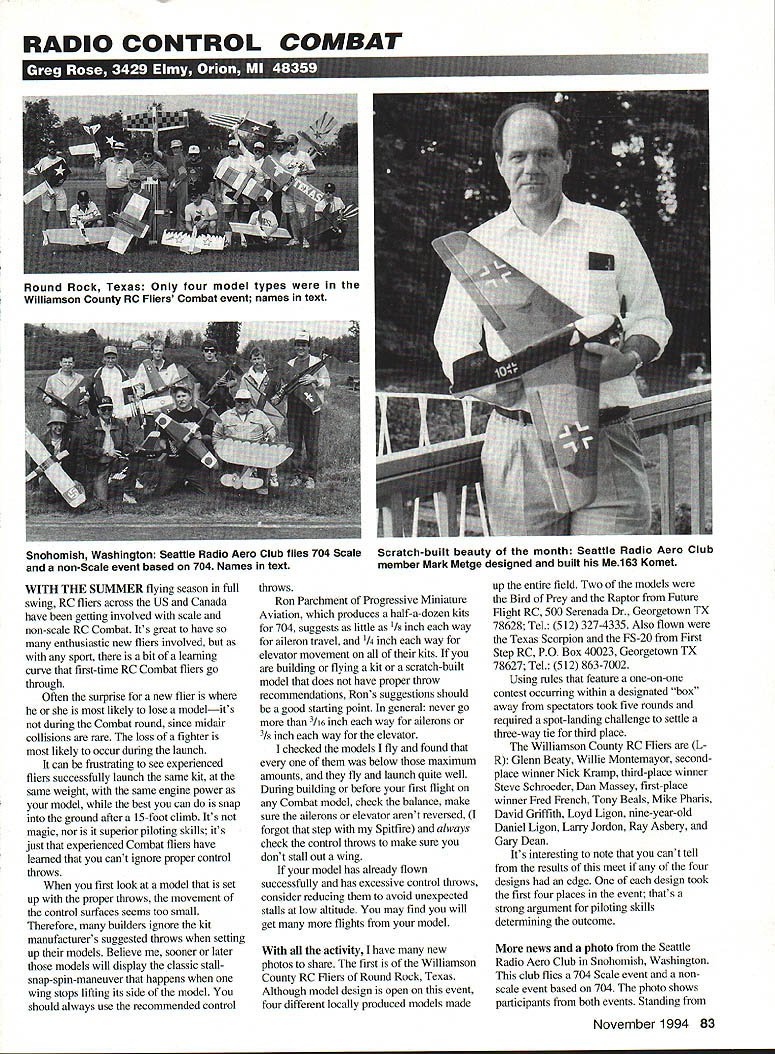
With all the activity, I have many new photos to share. The first is of the Williamson County RC Fliers of Round Rock, Texas. Although model design is open at this event, four different locally produced models made up the entire field. Two of the models were the Bird of Prey and the Raptor from Future Flight RC, 500 Serenada Dr., Georgetown, TX 78628; Tel: (512) 327-4335. Also flown were the Texas Scorpion and the FS-20 from First Step RC, P.O. Box 40023, Georgetown, TX 78627; Tel: (512) 863-7002.
Using rules that feature a one-on-one contest occurring within a designated "box" away from spectators, the event took five rounds and required a spot-landing challenge to settle a three-way tie for third place. The Williamson County RC Fliers pictured (L–R) are:
- Glenn Beaty
- Willie Montemayor
- Nick Kramp (second-place winner)
- Steve Schroeder (third-place winner)
- Dan Massey
- Fred French (first-place winner)
- Tony Beals
- Mike Pharis
- David Griffith
- Loyd Ligon
- Daniel Ligon (nine years old)
- Larry Jordon
- Ray Asbery
- Gary Dean
It's interesting to note that you can't tell from the results of this meet if any of the four designs had the edge; the first four places in the event were taken by four different models—that's a strong argument for piloting skills determining the outcome.
Seattle Radio Aero Club (Snohomish, Washington)
More news and a photo from the Seattle Radio Aero Club in Snohomish, Washington. This club flies a 704-scale event and a non-scale event based on 704. The photo shows participants from both events.
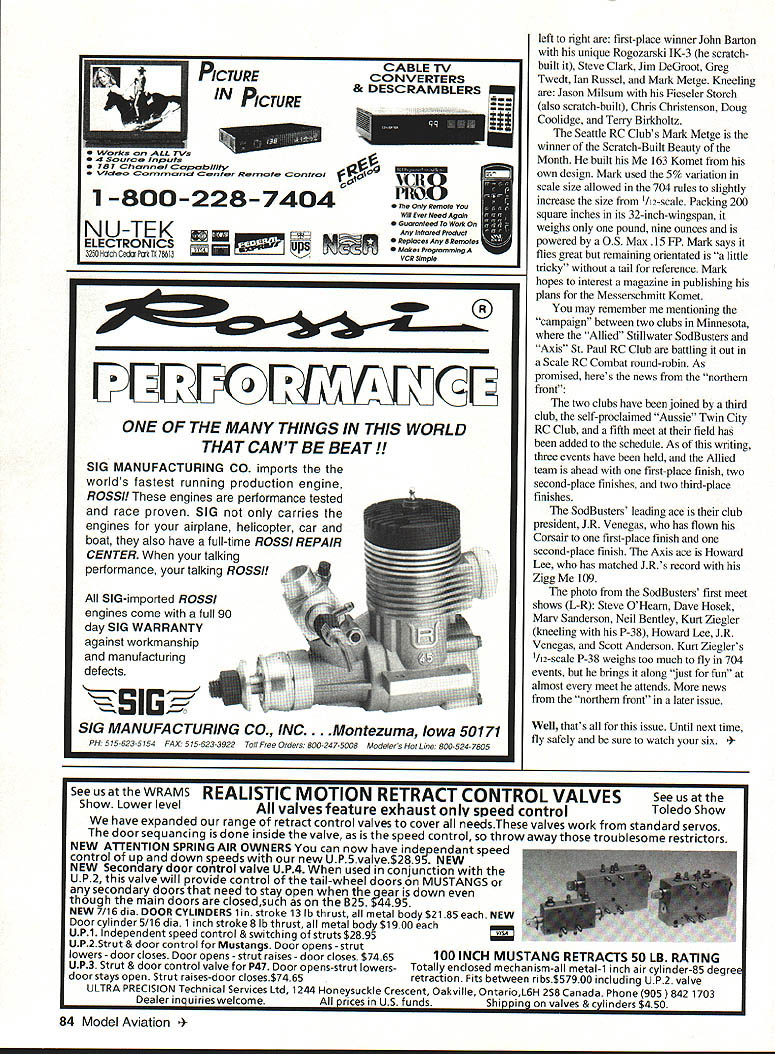
Scratch-built beauty of the month: Seattle Radio Aero Club member Mark Metge designed and built his Me.163 Komet. Specs:
- Wing area: 200 square inches
- Wingspan: 32 inches
- Weight: 1 lb 9 oz
- Power: OS Max 15 FP
Mark says it flies great but remaining oriented is "a little tricky" without a tail for reference. Mark hopes to interest a magazine in publishing his plans for the Messerschmitt Komet.
Minnesota campaign — "northern front"
You may remember me mentioning the campaign between two clubs in Minnesota, where the "Allied" Stillwater SodBusters and "Axis" St. Paul RC Club are battling it out in a Scale RC Combat round-robin. As promised, here's the news from the "northern front":
The two clubs have been joined by a third club, the self-proclaimed "Aussie" Twin City RC Club, and a fifth meet at their field has been added to the schedule. As of this writing, three events have been held, and the Allied team is ahead with one first-place finish, two second-place finishes, and two third-place finishes.
The SodBusters' leading ace is their club president, J.R. Vengas, who has flown his Corsair to one first-place finish and one second-place finish. The Axis ace is Howard Lee, who has matched J.R.'s record with his Zigg Me 109.
The photo from the SodBusters' first meet shows (L–R):
- Steve O'Hearn
- Dave Hosek
- Marv Sanderson
- Neil Bentley
- Kurt Ziegler (kneeling with his P-38)
- Howard Lee
- J.R. Vengas
- Scott Anderson
Kurt Ziegler's 1/2-scale P-38 weighs too much to fly in 704 events, but he brings it along "just for fun" at almost every meet he attends. More news from the "northern front" in a later issue.
Well, that's all for this issue. Until next time, fly safely and be sure to watch your six.
Transcribed from original scans by AI. Minor OCR errors may remain.

