
Radio Control
Electrics
Bob Kopski
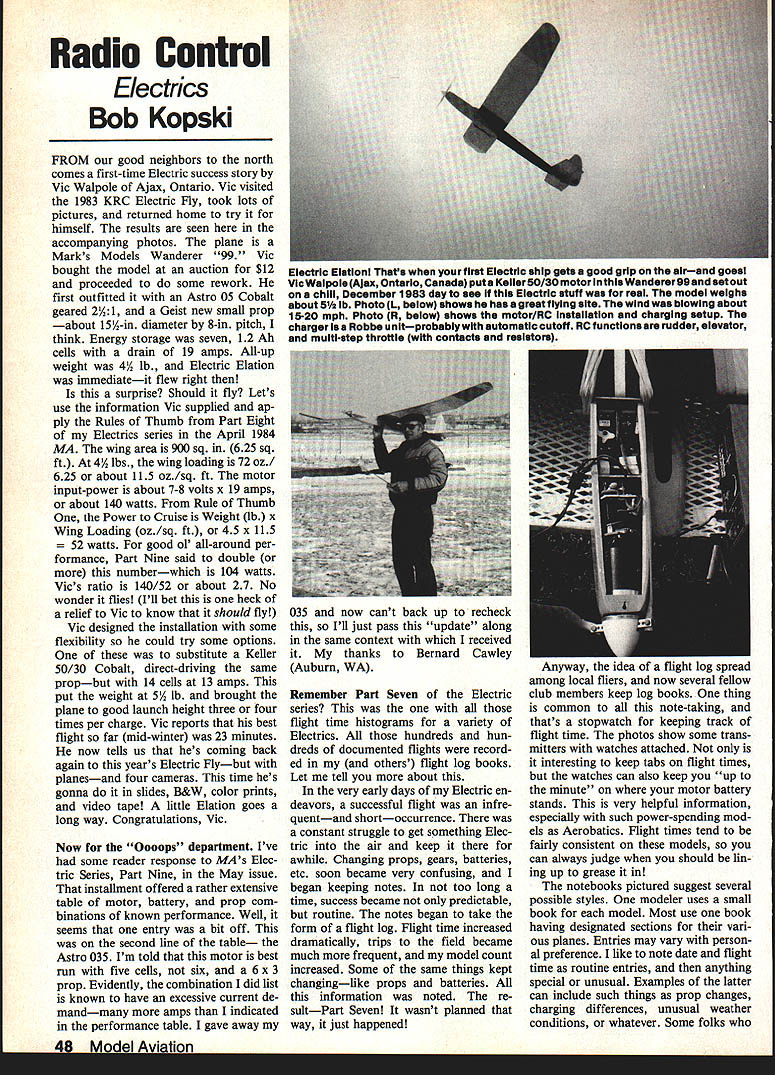
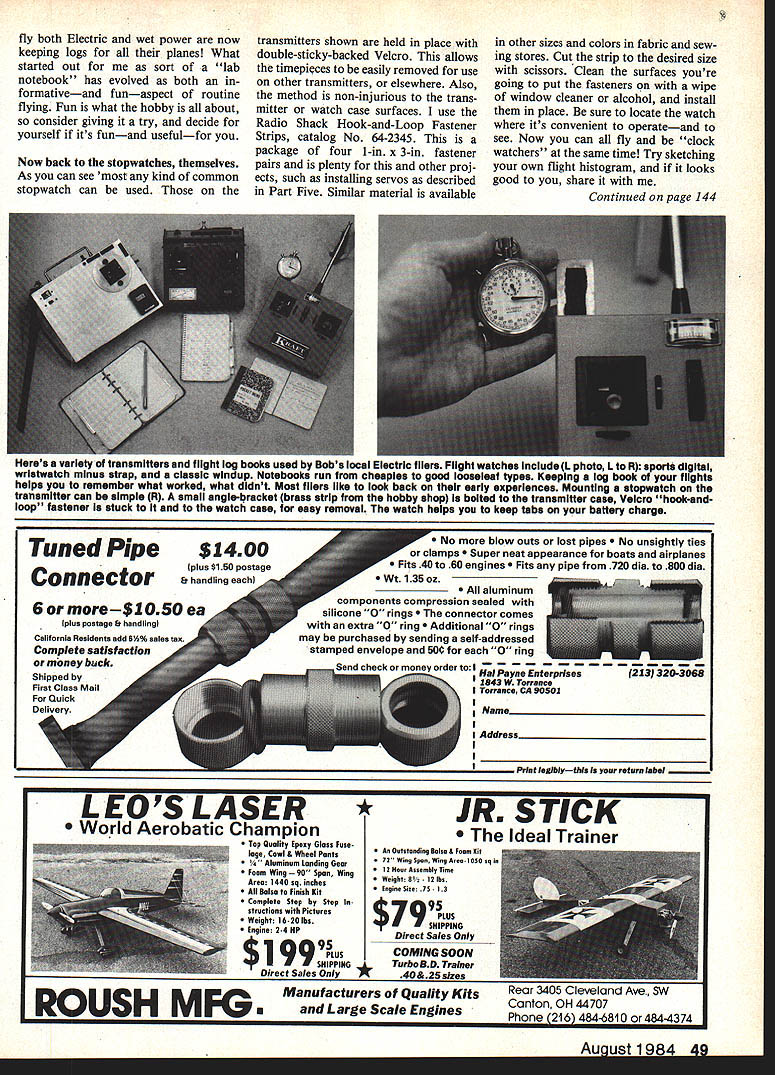
From our good neighbors to the north comes a first-time electric success story by Vic Walpole of Ajax, Ontario. Vic visited the 1983 KRC Electric Fly, took lots of pictures, and returned home to try it for himself. The results are seen in the accompanying photos. The plane is a Mark's Models Wanderer .99. Vic bought the model at an auction for $12 and proceeded to do some rework.
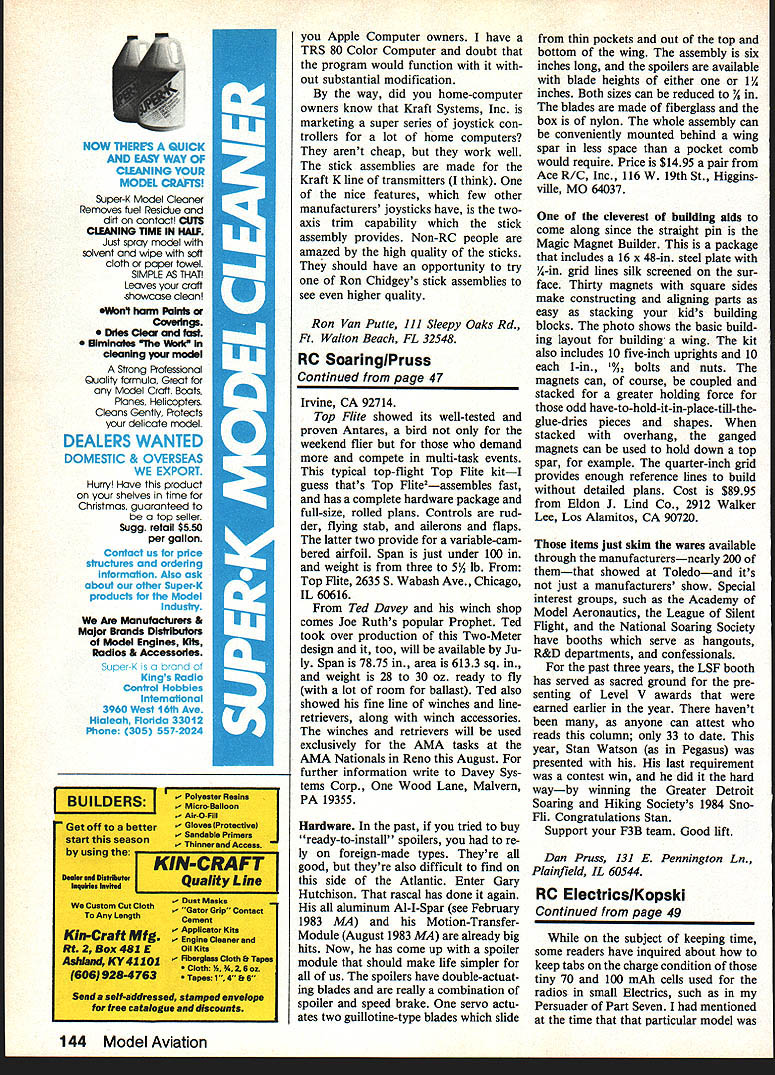
He first outfitted it with an Astro .05 Cobalt geared 2½:1 and a new small prop — about 15½ in. diameter by 8 in. pitch. Energy storage was seven 1.2 Ah (1200 mAh) cells with a current drain of about 19 amps. All-up weight was 4½ lb. The little electric elation was immediate — it flew right then!
Is this a surprise? Should it fly? Using the information Vic supplied and applying the Rules of Thumb from Part Eight of my Electrics series (April 1984 MA):
- Wing area: 900 sq. in. = 6.25 sq. ft.
- All-up weight: 4.5 lb. = 72 oz.
- Wing loading: 72 oz. / 6.25 sq. ft. ≈ 11.5 oz./sq. ft.
- Motor input power: about 7–8 V × 19 A ≈ 140 W.
Rule of Thumb One (Power to Cruise) in the series gives: Power ≈ Weight (lb.) × Wing loading (oz./sq. ft.) 4.5 × 11.5 ≈ 52 W (cruise). For good all-around performance, Part Nine recommended doubling (or more) this number ≈ 104 W. Vic’s installation puts about 140 W available, a ratio of 140/52 ≈ 2.7. No wonder it flies!
Vic designed the installation with some flexibility so he could try options. One substitution was a Keller 50/30 Cobalt, direct-driving the same prop, but using 14 cells at about 13 amps. This increased the all-up weight to about 5½ lb. and provided good launch height for three or four flights per charge. Vic reports his best flight so far (mid-winter) was 23 minutes. He now tells us he’s coming back to this year’s Electric Fly — but with planes and four cameras. This time he’s going to do it in slides, B&W and color prints, and video tape. A little elation goes a long way. Congratulations, Vic.
Oops — a correction
I’ve had reader response to MA’s Electric Series, Part Nine (May issue). That installment included a table of motor, battery, and prop combinations of known performance. One entry on the second line — the Astro .035 — was off. I’m told the .035 is best run with five cells and a 6×3 prop. The combination I originally listed (six cells, etc.) has an excessive current demand. Thanks to Bernard Cawley (Auburn, WA) for the heads-up.
Flight logs and timing
Remember Part Seven of the Electric series — the one with all those flight-time histograms for a variety of electrics? Those hundreds of documented flights were recorded in flight log books. A bit of background:
In the very early days of my electric endeavors, a successful flight was infrequent and short. There was a constant struggle to get something electric into the air and keep it there. Changing props, gears, batteries, etc., became confusing, so I began keeping notes. In time, success became predictable and routine. The notes took the form of a flight log; flight time increased dramatically, trips to the field became more frequent, and my model count grew.
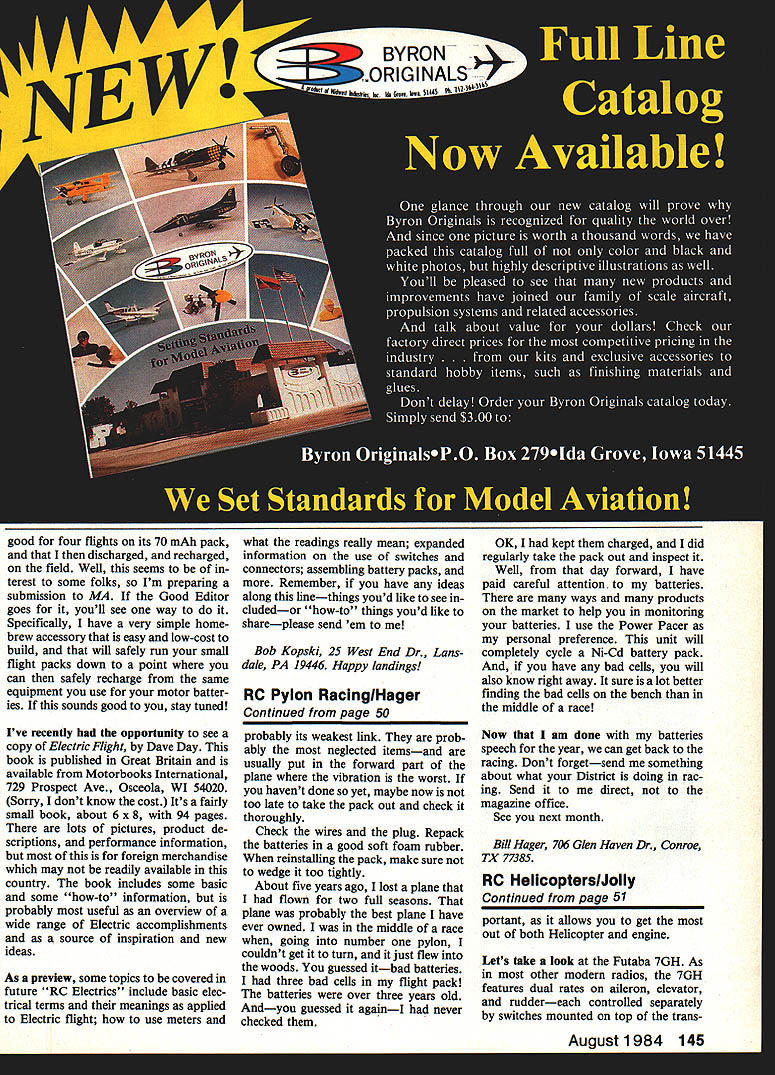
The flight-log idea spread among local fliers; now several fellow club members keep log books. Common to all this note-taking is the stopwatch for keeping track of flight time. Not only is it interesting to log flight times, but a watch also helps you judge remaining motor battery capacity and when to line up to "grease it in" and land. This is especially helpful with power-hungry aerobatic models, where flight times tend to be fairly consistent.
Suggested log entries:
- Date
- Flight time
- Anything special or unusual (prop changes, charging differences, unusual weather, etc.)
The notebooks pictured suggest several styles:
- A small book for each model.
- One book with designated sections for various planes.
Choose the style that works for you.
Watch mounting and accessories
Some transmitters have watches held in place with double-sided, sticky-backed Velcro. This allows the timepiece to be easily removed for use on other transmitters or elsewhere, and is non-injurious to transmitter or watch surfaces. I use Radio Shack Hook-and-Loop Fastener Strips, catalog No. 64-2345 (package of four 1 in. × 3 in. fastener pairs). Similar material is available in fabric and sewing stores. Cut the strip to the desired size with scissors, clean the surfaces with window cleaner or alcohol, and install. Be sure to locate the watch where it’s convenient to operate and see.
I’m also preparing a submission to MA describing a very simple, low-cost home-brew accessory that will safely run your small flight packs down to a point where you can then safely recharge them using the same equipment you use for your motor batteries. If the editor approves, you’ll see one way to do it — stay tuned.
Resources and what’s next
I recently saw a copy of Electric Flight by Dave Day (published in Great Britain). It’s available from Motorbooks International, 729 Prospect Ave., Osceola, WI 54020. It’s a small, 94-page book with lots of pictures, product descriptions, and performance information that may not be readily available in the U.S. It makes a good overview and source of inspiration.
Topics to be covered in future "RC Electrics" include:
- Basic electrical terms and their meanings as applied to electric flight
- How to use meters and what the readings really mean
- Expanded information on switches and connectors
- Assembling battery packs
- And more
If you have ideas or "how-to" items you’d like to see included or share, please send them to me.
Bob Kopski 25 West End Dr. Lansdale, PA 19446
Happy landings!
Transcribed from original scans by AI. Minor OCR errors may remain.

