


Radio Control: Electrics
Bob Kopski, 25 West End Drive, Lansdale, PA 19446
This Month's Topics
- The Electric Connection Service
- Motor/Prop Computer Program Followup
- REVOLT! Reader Reaction + Plans
- More Telemetry
- The SCRC Cell Followup
- Supplier Address Change
- SR Smart Charger Upgrade
- Winter Electric Flying
THIS MONTH'S ECS is a little different. Reader Donald Knight, 1765 Ala Moana, Apt. 1091, Honolulu, HI 96815, is very much interested in CL electrics, and he has been experimenting in this arena. In particular, Donald is interested in flying smaller models indoors or in small outdoor areas.
Not having any available reference, he's pursued the idea of running power up the lines as best he could devise. Donald is asking for any written reference on the subject and would be interested in reader contact with anyone who has the same interests. OK folks, let's show 'em the ECS really works—even with a challenging topic such as this unusual and creative electric application!
In a recent letter, Ken Rusnok, P.O. Box 4643, Fayetteville, AR 72702, updated me on MA's reader response to the PC program he's offering. This program allows evaluation of motor/propeller choices and is available free to those who send in a formatted disk and disk mailer.
I first discussed this in the December '92 column, and later in the June '93 and November '93 columns. You certainly have shown that many of you are heavily into computer-aided electric aeromodeling, because Ken now tells me he's up to 65 disk requests. This is a phenomenal level of interest and shows just how seriously this column's readers are "into" electrics.
Ken has a request: he's very much interested in hearing back from you regarding how well his program worked, and to get any suggestions you may have. He'd really like for you to share actual results with him. Ken is asking this in a most unselfish way; he wants to upgrade the program as time goes along, and your input can help him do this.
In fact, he has great plans for his program, such as adding mouse control, pull-down menus, disk files/handling, etc. Since Ken was so generous in the first place, let's return the kindness with some feedback to him. And do tell him "Bob made ya do it!"
Recent columns have presented several discussions on my REVOLT! design, and many readers have inquired about the availability of plans. As a result of this rather high interest level, I've had some plan sets printed and they are available to you at cost: $6 for two sheets, plus mailing envelope and postage (sorry, no mailing tubes). In fact, I've already sent out many sets.
The copy is like blueprint but in black ink and is without text. You may see the REVOLT! as an MA construction article, but it won't appear for quite some time. In the meantime, for you scratch-builders who just can't wait, I can help you out. As an aside, some readers have confused the Skyvolt (MA, 1/90) and REVOLT! designs. They are rather different.
The Skyvolt is the smaller of the two: about 400 square inches, with a semisymmetrical section, and designed for four-channel aerobatic flight for more experienced pilots. The REVOLT! is a 600 square-inch, flat-bottom-section, deep-cabin sport/trainer configuration—much more of a "pussycat" in the air.
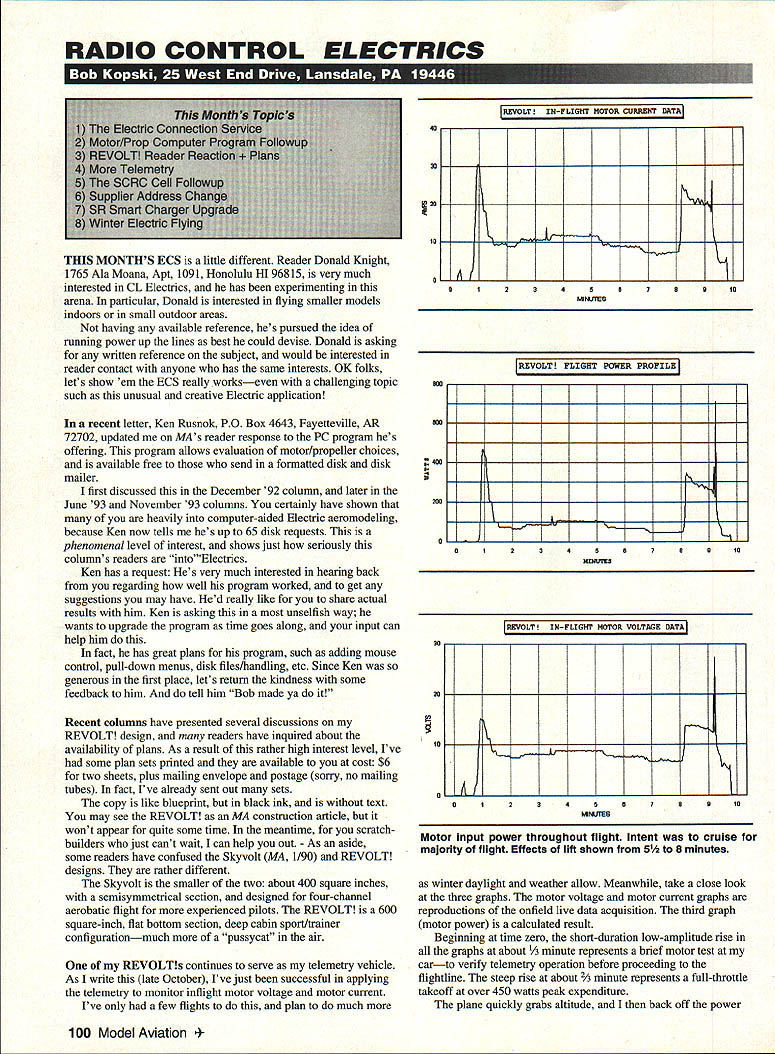
One of my REVOLT!s continues to serve as my telemetry vehicle. As I write this (late October), I've just been successful in applying the telemetry to monitor inflight motor voltage and motor current.
I've only had a few flights to do this, and plan to do much more as winter daylight and weather allow. Meanwhile, take a close look at the three graphs. The motor voltage and motor current graphs are reproductions of the on-field live data acquisition. The third graph (motor power) is a calculated result.
Beginning at time zero, the short-duration low-amplitude rise in all the graphs at about 1/2 minute represents a brief motor test at my car—to verify telemetry operation before proceeding to the flightline. The steep rise at about 2/3 minute represents a full-throttle takeoff at over 450 watts peak expenditure. The plane quickly grabs altitude, and I then back off the power and seek to attain level flight at "cruise" condition. By this I mean I'm trying to just maintain altitude—no more, no less—from about 1½ to 8 minutes on the graph.
Flightec's Data Logger allows acquisition, storage, and printing of battery charge/discharge data. For the flight described, the power system is a direct-drive Cobalt .25 on 14.4 V cells. The speed control is a manufacturer's new design I'm trying out.
The air during this flight was a bit turbulent, and in fact there was some widespread buoyancy beginning at about the 5½-minute mark. At this time the plane began to climb slowly, indicating some lift, so I reduced throttle to just maintain cruise condition. This is evident in the graphs.
Just after 8 minutes, I decided to go to full power, and the battery lasted a little over a minute more under these conditions. I powered down and landed just before the ten-minute mark. The small spike just before 3½ minutes and the very large spike at the end of flight are data-link glitches and can be disregarded. For those who may be wondering, voltage and current data is stored numerically on disk as well as displayed live on the PC screen.
The plot is the result of loading the numeric data into a spreadsheet program and multiplying the voltage and current numbers together to yield "watts." All three curves can be plotted from the spreadsheet program.
Now, long ago and far away in the Model Aviation Electric series (9/83 to 7/84), I offered some rules of thumb for electrics. Among those was an empiricism: Power to Cruise (in dead air) = Weight in Pounds × Wing Loading in Oz./Sq. Ft.
This REVOLT! weighs 77 ounces and has 600 square inches of area. The predicted cruise power requirement is 89 watts. Look at the power curve during the cruise phase, and remember that this air was turbulent and then also exhibited lift (i.e., it was not dead air), and notice how the average power during this period is not too far from the prediction.
I can hardly wait to try this again in "dead" air. Clearly, this is just the beginning! I feel that we (you and I) are at the threshold of many benefits of this telemetry resource.
The SCRC cell is of great interest to readers because it promises to significantly extend flight times over the more familiar SCRs. I've had some very disappointing experiences with this cell type, as graphically reported in the August '93 column. I also reported some much better results in the January '94 column for an SCRC pack loaned to me by RC Report columnist John Mountjoy.
Since that was written, friend John has loaned me yet another pack of SCRCs to evaluate (from another supplier). This pack performed almost exactly as his first one and much better than my own first experience. John got this last seven-cell pack—made of individually tested cells—at a very reasonable price ($30.81 + shipping).
Each cell had a label indicating the measured capacity, so you know what you're getting. These read: "330+?" This is a numerical result based on a measurement methodology used by car folks and represents the number of seconds each cell supported a 20 amp load. B & T will supply a catalog/price list for this and other batteries on request. I just ordered some B & T SCRC packs of my own. Thanks again to friend John; he's helped me, and now perhaps many of you as well.
B & T RC Products, 2905 Guess Rd, Suite 1, Durham, NC 27705; Tel.: (919) 471-2060.
Bob Markle of RJM Systems, a supplier of electric goodies including speed controls and on/off controls, wrote to tell me of some recent changes. Bob has just moved his business to a new location, and there was some disruption in his normal service; there was some delay in filling existing orders. Beyond that, however, it looks like some orders never made it to Bob in the mail-forwarding process.
Bob acknowledges there was some in-process customer paperwork that got misplaced, leaving him unable to communicate with these persons. If you've had some "disconnect" with RJM, please get in touch with Bob again at RJM Systems, 10117 Washington Ave., North Huntingdon, PA 15642; Tel.: (412) 864-6123.
The November '93 column described my accumulated experience with the SR Smart Charger and indicated that an upgrade was in the works. SR is now notifying all registered owners of the upgrade's availability, and in fact I've just had mine done at the factory. SR now offers the Smart Charger in two versions: the original or Standard version, and the newer or Deluxe model. The prices are $299.95 and $349.95 respectively, plus $7 shipping and handling. The separately available upgrade converts a Standard to the Deluxe level and can be added at any time. The upgrade material is available directly to the user for $50 + $5 shipping and handling, or as a factory installation for $70 + $7.
Among other things, the upgrade includes a new panel overlay (a self-adhesive plate that must be attached exactly the first time), so nervous owners may do well to opt for the factory installation, which includes a complete going-over and alignment. The Deluxe Smart Charger adds several features to the Standard version, including the ability to charge up to 36 cells instead of 28. It also adds an OverTemp Charge Inhibit function, which assesses battery temperature before you commence charging and warns you ahead of time (BEEP!! + readout) if it's too hot to start.
At this point you have the option of setting the charge rate you will want, and the charger will automatically determine when the pack has cooled sufficiently to self-start the charge at this chosen value.
The Deluxe version also has an Expanded Scale Voltage Meter function, designed to determine the charge remaining in your receiver and transmitter packs (at a test load current you select) to determine if it's safe to fly. Each charger can safely fast-charge four-cell receiver packs, but the Deluxe can also charge five-cell and eight-cell transmitter packs.
The Deluxe unit includes a user-selectable Low Voltage Warning level for the source (fixed in the Standard version) to help further ensure there's enough charge left in your car battery to get you home after all that happy electric flying.
Of course, both the Standard and Deluxe chargers still include all the familiar features: adjustable charge current up to 5 amps, an excellent working peak-detection system, pack temperature monitor during charge (for safety), maximum charge time set (for safety), precision adjustable constant-current cycling, digital current meter, reverse polarity protection, smart cooling system (internal fan runs only when needed), etc., all under microprocessor control.
Both models employ a temperature probe to monitor battery temperature. Except for this probe, all charger connections are via Sernos connectors—the de facto connector standard of the U.S. electric scene (I've got 'em on everything!).
There is one more aspect of the Smart Charger that I really like: it works just "super" on the road. I've been routinely charging while on the way to the field, so I'm ready to fly when I get there. Implicit in this is the fact that the charger has been functioning unaffected by the normal car-battery voltage variation that occurs as one is traveling, whether at steady speed on the highway or in stop-and-go traffic situations.
I really appreciate this ability; in effect, it increases my time to fly. I like this charger so much that I'm now looking to see how I can fit a second Smart Charger into my crowded van. I think I'm going to remove something else just to make room for it!
Cold-weather flying is relatively easy with electrics; I've flown in near-zero conditions for many years with no problems.
The first flight (first charge, really) of the day may be "below normal," as evidenced in both in-flight power and duration. This is more true for colder packs, such as those stored in colder parts of the car. I know this 'cause my planes are stored in the garage, and all my packs are cold during winter months.
Flying usually returns to normal for the second flight (charge) because the pack will warm up from first-flight use. So if you're up to flying in the winter chill, be confident that your electric is, too. Besides all the flying fun you can have, you can also enjoy a chuckle watching the wet-power crowd trying to clean the cold, semi-solid gloop from their planes when the day's flying is done!
So ends another column. Please include a SASE with any correspondence for which you'd like a reply. Happy electric landings, everyone, be they in the snow or whatever!
Transcribed from original scans by AI. Minor OCR errors may remain.

