

RADIO CONTROL ELECTRICS
Bob Kopski, 25 West End Drive, Lansdale, PA 19446
This Month's Topics
- License Plate Contest Winner
- Skyvolt—Followup
- Meets, Symposium Info
- A Transport Suggestion
- Another Noise Fix
- January Reader Reaction: Telemetry and SCRC Cells
- New Speed Controls
1) License Plate Contest Winner
The July and August 1991 columns announced a License Plate Contest to encourage readers to design and install electric-promoting vanity plates on their family wheels. The contest was open to photo submissions until December 31, 1992. Entries were judged by reader vote, and the most popular won a Today's Hobbies Skyvolt kit.
Five license plate photos appeared in the August '93 column. Reader votes were tallied until October 30, 1993. Reader response trickled in more or less steadily during the allowed time period. A clear winner did finally emerge: "FLY-E."
The winning modeler is Charlie Sylvia of CS Flight Systems, Middleboro, MA. Interestingly, Connie Sylvia won one of the original (January 1990 Model Aviation cover) Skyvolt kits at the 1990 KRC Electric Fly raffle. Charlie, here's your chance to catch up with Connie—happy Skyvolting to you both! A sincere thank you to everyone who participated in the contest.
2) Skyvolt—Followup
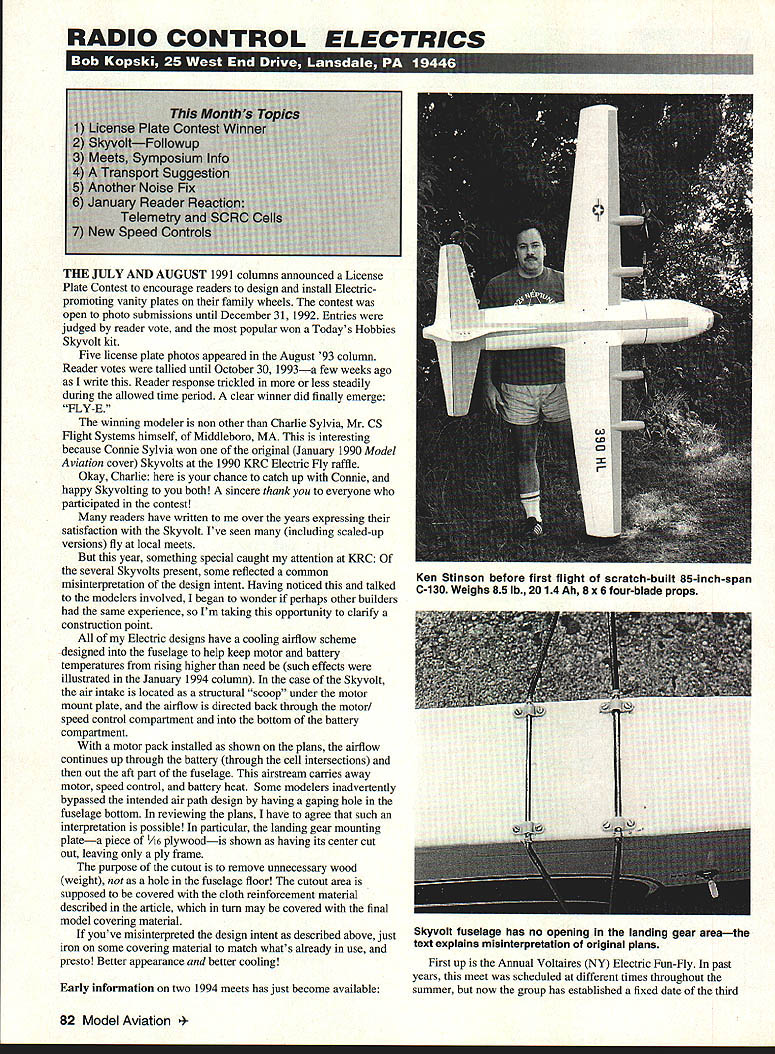
Many readers have written over the years expressing their satisfaction with the Skyvolt. I've seen many (including scaled-up versions) fly at local meets. This year at KRC, however, several Skyvolts reflected a common misinterpretation of the design intent, and I want to clarify a construction point.
All of my electric designs have a cooling airflow scheme built into the fuselage to help keep motor and battery temperatures down (these effects were illustrated in the January 1994 column). On the Skyvolt, the air intake is a structural "scoop" under the motor mount plate, and airflow is directed back through the motor/speed-control compartment and into the bottom of the battery compartment.
With a motor pack installed as shown on the plans, the airflow continues up through the battery (through the cell intersections) and then out the aft part of the fuselage. This airstream carries away motor, speed-control, and battery heat. Some modelers inadvertently bypassed the intended air path by leaving a gaping hole in the fuselage bottom. In reviewing the plans, I have to agree that such an interpretation is possible. In particular, the landing gear mounting plate—a piece of 1/16" plywood—is shown with its center cut out, leaving only a ply frame.
The purpose of the cutout is to remove unnecessary wood (weight), not to create a hole in the fuselage floor. The cutout area is supposed to be covered with the cloth reinforcement material described in the article, which in turn may be covered with the final model covering material.
If you've misinterpreted the design intent, simply iron on some covering material to match what's already in use—presto! Better appearance and better cooling.
3) Meets, Symposium Info
Early information on two 1994 meets has become available.
- Annual Voltaires (NY) Electric Fun-Fly: The group has established a fixed date of the third weekend of July. Details other than the date are still in development. Contact Bill Griggs, 206 State St., Canastota, NY 13032; Tel.: (315) 697-8152.
I think a fixed annual schedule is a great idea. Last year there was an inadvertent conflict between the Voltaires' meet and the Northern Connecticut Radio Control Club Electric Fun-Fly, and both meets suffered reduced attendance. I encourage groups with established meets to home in on a preferred annual date and plan cooperatively to avoid regional conflicts.
- Fifteenth Annual KRC Electric Fly: Planning is underway and the big news is that it will be a three-day affair. In addition to the traditional formal meet on Saturday, September 17 and Sunday, September 18, there will be a full day and evening of Friday activities.
- The field will be open to informal flying on Friday through the courtesy of the Buc-Lc Aerosportsmen club, whose field is used for the meet.
- A full-day Electric Symposium will be held at the Quakertown Best Western Motor Inn meeting room, just a few miles from the field. The symposium (organized by Larry Sribnick of SR Batteries) is scheduled from 9 a.m. to 5 p.m. Tentative topics and speakers include:
- "Shattering the Electric Flight Myths" — Dave Baron (MAN)
- "Prop/Motor Matching and Selection" — Bob Kress (Kress Jets)
- "Lost Foam Process" — Bob Hunt (FMF)
- "Electric Kit Design" — Ted Davey (RCM/DSC)
- "Electronic Motor Control Systems" — John Mountjoy and Charlie Spear (RC/?)
- "Electric Flight Telemetry" — Bob Kopski (MA)
- "Electric Scale Design" — Keith Shaw
- "High Performance Electric Soaring" — Tim Renaud (Airtronics)
- "Composite Construction" — George Spar (Aero Space Composites)
- "Micro Electric Flight" — Clyde Geist (AMP Graphics)
- "Battery Pack Care" — Larry Sribnick (SR Batteries)
- Time is included for lunch and Q&A. Seating is limited and attendance is first-come, first-served. To register, send $10 and a self-addressed stamped envelope to SR Batteries, Box 287, Bellport, NY 11713. This gets you a detailed schedule, admission to the symposium, and a chance at door prizes.
- The Friday evening activity moves to the field for the second annual SR Batteries Night Fly at dark (around 7 p.m.). The '93 Night Fly was a huge success, drawing 22 pilots and several times that number of spectators in rain-threatening conditions. I expect this year's Night Fly to at least double those numbers.
About meet announcements: I'm always happy to promote your electric meet in this column, but I must have the information well in advance to do any good. For calibration, these words were written on December 2, 1993—get the idea?
4) A Transport Suggestion
Some things slide around easily on the carpeted rear floor of my minivan—especially smooth objects like plastic-cased chargers. I recently discovered a simple fix: buy self-adhesive rubberized antislip material (used on steps or walkways) from your local hardware store. I bought some 3M brand by the foot and applied one-inch squares to the four corners of my SR charger. That really stopped any sliding, no matter how hard I cornered the car.
The same idea works well on transmitters and likely for many other items modelers haul to the field. It may not work equally on all kinds of car carpet, but it's easy and inexpensive to try.
5) Another Noise Fix
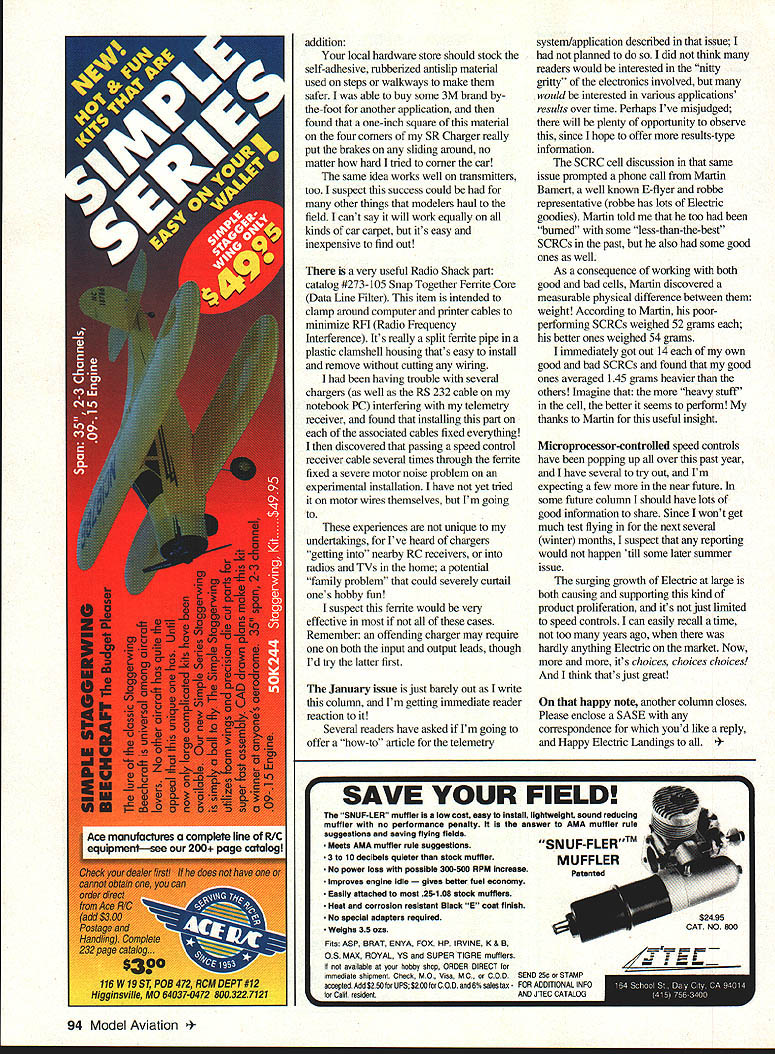
Radio Shack catalog #273-105 Snap-Together Ferrite Core (Data Line Filter) is very useful. It's a split ferrite pipe in a plastic clamshell housing that clamps around cables to minimize RFI and is easy to install and remove without cutting wires.
I had trouble with several chargers (and the RS-232 cable on my notebook PC) interfering with my telemetry receiver. Installing this part on each associated cable fixed everything. Passing a speed-control receiver cable several times through the ferrite also fixed a severe motor-noise problem on an experimental installation. I haven't yet tried it on motor wires themselves, but I will.
These experiences aren't unique—chargers can "get into" nearby RC receivers or home radios/TVs, which could become a family problem. A ferrite clamp is often effective; an offending charger may require one on both input and output leads, though try the output lead first.
6) January Reader Reaction: Telemetry and SCRC Cells
The January issue is just out, and I'm getting immediate reader reaction.
Several readers asked if I plan to offer a "how-to" article for the telemetry system described in that issue. I had not planned such an article because I didn't think many readers would want the electronics "nitty-gritty." I did expect interest in application results over time, and perhaps I misjudged. There will be opportunities to report results as I gather them.
The SCRC cell discussion prompted a call from Martin Barnett (well-known e-flyer and Robbe representative). Martin told me he'd been pummeled with some "less-than-the-best" SCRCs and had some good ones as well. He discovered a measurable physical difference: worst-performing SCRCs weighed 92 grams each; his better ones weighed 54 grams.
I immediately got out 14 each of my own good and bad SCRCs and found that my good ones averaged 1.45 grams heavier than the others. Imagine that: the more "heavy stuff" in the cell, the better it seems to perform. Thanks to Martin for this useful insight.
7) New Speed Controls
Microprocessor-controlled speed controls have been appearing all over this past year. I've seen several to try out and expect a few more soon. In a future column I should have a lot of useful information to share. Since I won't get much test flying in for the next several winter months, detailed reporting may not happen until later in the summer.
The surging growth of electric flight is both causing and supporting this product proliferation—not just speed controls but many other items. I can recall a time when there was hardly anything electric on the market; now there are more and more choices, and I think that's just great.
Please enclose a SASE with any correspondence for which you'd like a reply. Happy Electric Landings to all.
Transcribed from original scans by AI. Minor OCR errors may remain.

