
RADIO CONTROL ELECTRICS
Bob Kopski 25 West End Drive, Lansdale, PA 19446
Simsbury, Connecticut field
A reader, Jim Marinelli, wrote about a small group of E-fliers who meet Wednesday evenings and Sunday mornings at a city-owned flying field in Simsbury, CT. The group includes beginners and veteran modelers and is looking to increase its membership. The field is available for Electrics only (with proper insurance—AMA, etc.). For more information contact:
- Jim Marinelli, 75 Rosen Ave., Torrington, CT 06790; Tel.: (203) 496-1373
- Dick Bauer, Star Route, N. Canton, CT 06059; Tel.: (203) 379-2856
Burlington County Electric Fly (May 21, 1994)
Well-known east-coast E-modeler Bob Afflerback reports the Sixth Annual Burlington County (NJ) Electric Fly is scheduled for May 21, 1994. Note the earlier date and that the meet is at the Burlington County RC Club field, about two miles from the usual location. Several fun-fly activities and open flying are planned; full details will be available later. Contact:
- Bob Afflerback, 123 Harrington Circle, Willingboro, NJ 08046; Tel.: (609) 871-8777
License-plate contest and Skyvolt prize
Charlie Sylvia of CS Flight Systems (major source for electric supplies) was the winner of the license-plate contest described in last month’s column. Contact:
- CS Flight Systems, 31 Perry St., Middleboro, MA 02346; Tel.: (508) 947-2805 (6–9 p.m.)
I shipped the Today's Hobbies Skyvolt kit prize and a copy of the April column to Charlie in time for Christmas to notify him of his win. Charlie was surprised and pleased; he intends to donate the kit back to the ’94 KRC meet.
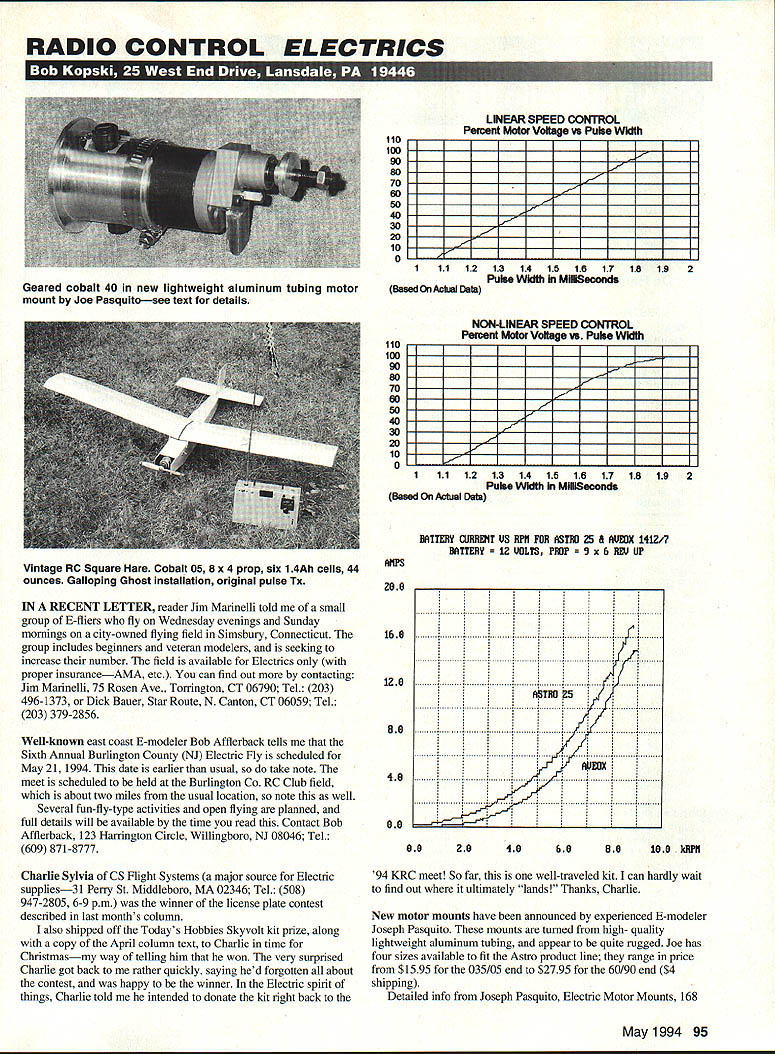
New motor mounts from Joseph Pasquito
Experienced E-modeler Joseph Pasquito has announced new motor mounts turned from lightweight aluminum tubing. They appear rugged and are available in four sizes to fit the Astro product line. Prices range from $15.95 for the .035/.05 end to $27.95 for the .60/.90 end. Shipping is $4. Detailed info:
- Joseph Pasquito, Electric Motor Mounts, 168 Gainsboro Rd., Lawrenceville, NJ 08648; Tel.: (609) 882-9049
Vintage Electrics and VRCS photo contest
I enjoy flying many kinds of Electrics; one specialty is Vintage. "Vintage" refers to RC models designed and/or kitted up to the end of 1969. It is distinct from Old-Timers, which are mostly free-flight designs dating to WWII (now generally flown with RC assist). Electric Old-Timers are popular at E-meets; Vintage is a relatively new category and less well known.
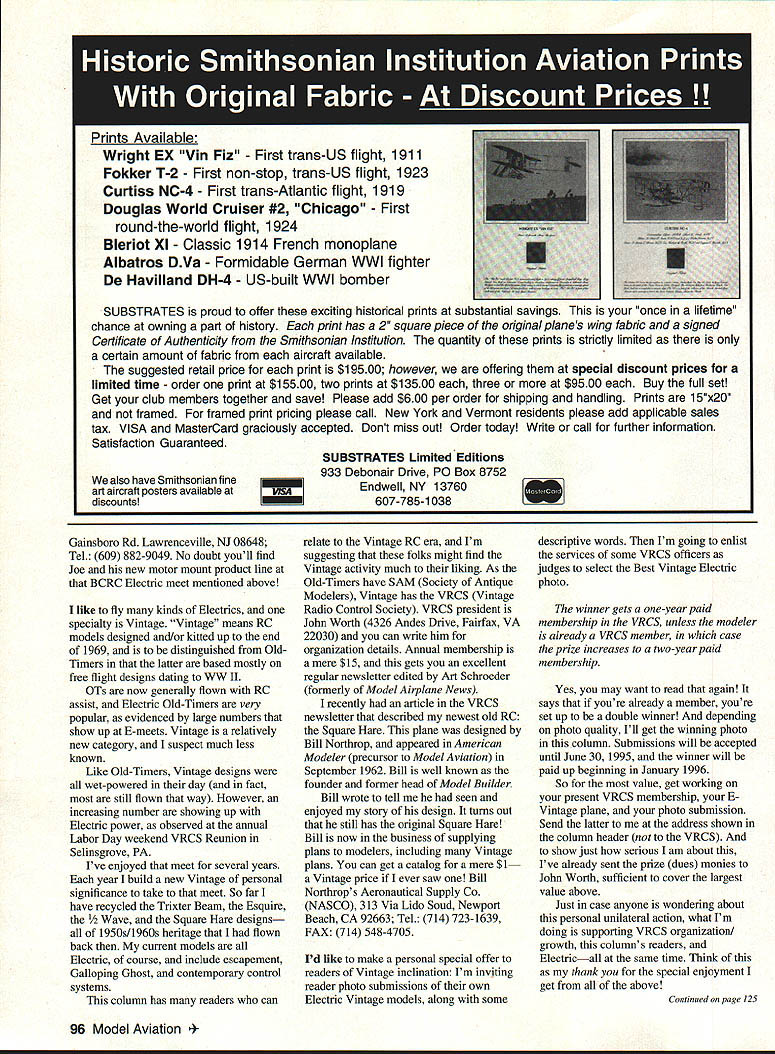
Vintage designs were well powered in their day, and an increasing number are now showing up with Electric power. I see many such entries at the annual Labor Day VRCS Reunion in Selinsgrove, PA. Each year I build a Vintage model of personal significance for that meet. Past builds include the Trixter Beam, Esquire, 2-Wave, and Square Hare designs (1950s/1960s heritage). My current models are all Electric and include escapement, Galloping Ghost, and contemporary control systems.
Vintage has the VRCS (Vintage Radio Control Society). VRCS president:
- John Worth, 4326 Adens Drive, Fairfax, VA 22030
Annual membership is $15 and includes an excellent newsletter edited by Art Schroeder.
Bill Northrop (designer of the Square Hare) wrote to say he still has the original Square Hare and supplies Vintage plans. Catalogs are available for $1. Contact:
- Bill Northrop's Aeronautical Supply Co. (NASCO), 313 Via Lido South, Newport Beach, CA 92663; Tel.: (714) 723-1639; FAX: (714) 548-4705
VRCS Photo Contest (my personal offer)
I invite readers of Vintage inclinations to submit photos of their Electric Vintage models with some descriptive words. VRCS officers will judge and select the Best Vintage Electric photo. Prize:
- One-year paid VRCS membership for the winner.
- If the winner is already a VRCS member, the prize increases to a two-year paid membership.
Submissions accepted until June 30, 1995. The winner will be announced in the July issue. Send photos and entries to me at the address in the column header (not to the VRCS). I have already sent the dues to John Worth to cover the prize.
This is my way of supporting VRCS, the column’s readers, and Electric modeling.
RC Electrics — speed-control testing and bench work
Swept pulse-width generator (SPWG) and ESC transfer characteristics
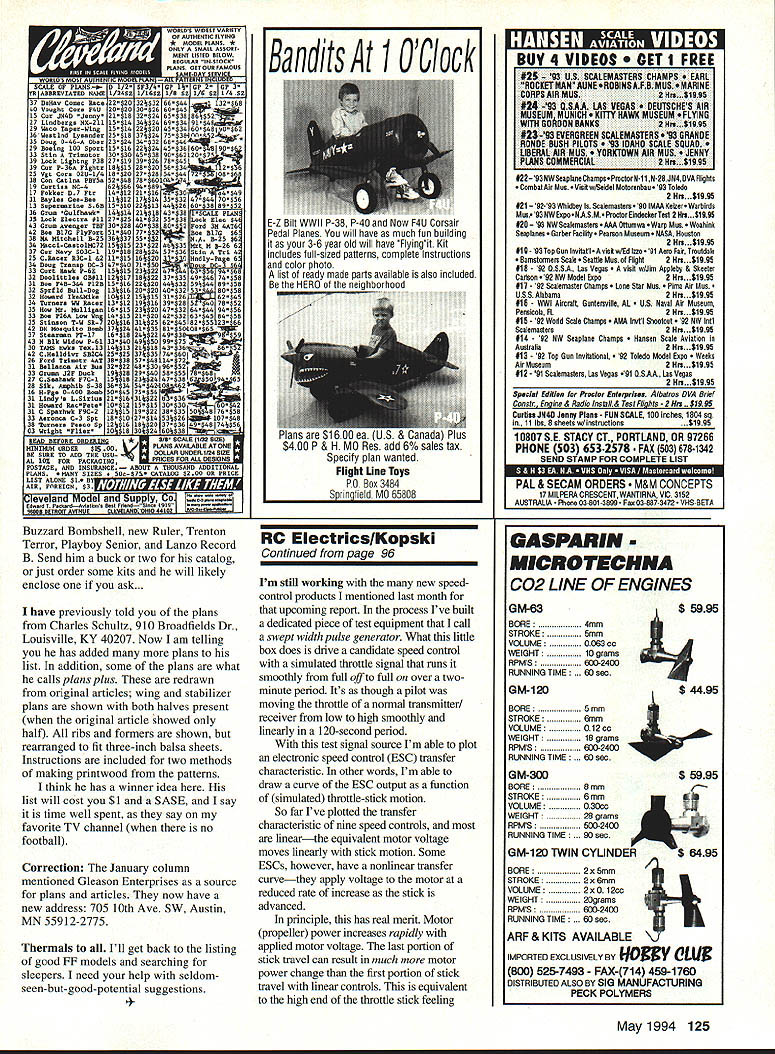
I’m continuing work on new speed-control products mentioned last month. I built a dedicated test box I call a swept pulse-width generator (SPWG). This device drives a candidate speed control with a simulated throttle signal that runs smoothly from full off to full on over a two-minute period — equivalent to a pilot moving a transmitter throttle stick linearly from low to high in 120 seconds.
Using the SPWG I can plot an ESC transfer characteristic: the ESC output (motor voltage) as a function of simulated throttle-stick motion. So far I’ve plotted nine speed controls. Most are linear (motor voltage changes linearly with stick motion). Some ESCs, however, have nonlinear transfer curves — they apply voltage at a reduced rate of increase as the stick is advanced. In practice this can be useful: motor (propeller) power increases rapidly with applied voltage, so linear controls can make the high end of the stick feel overly sensitive. Nonlinear controls can reduce that twitchy feeling at the high end.
This investigation will require more time and in-air testing in the coming months. Meanwhile, it’s worth thinking about what you mean when you say "I’m only at half throttle."
Bench comparison: Astro Cobalt 25 vs Aveox 1412/7
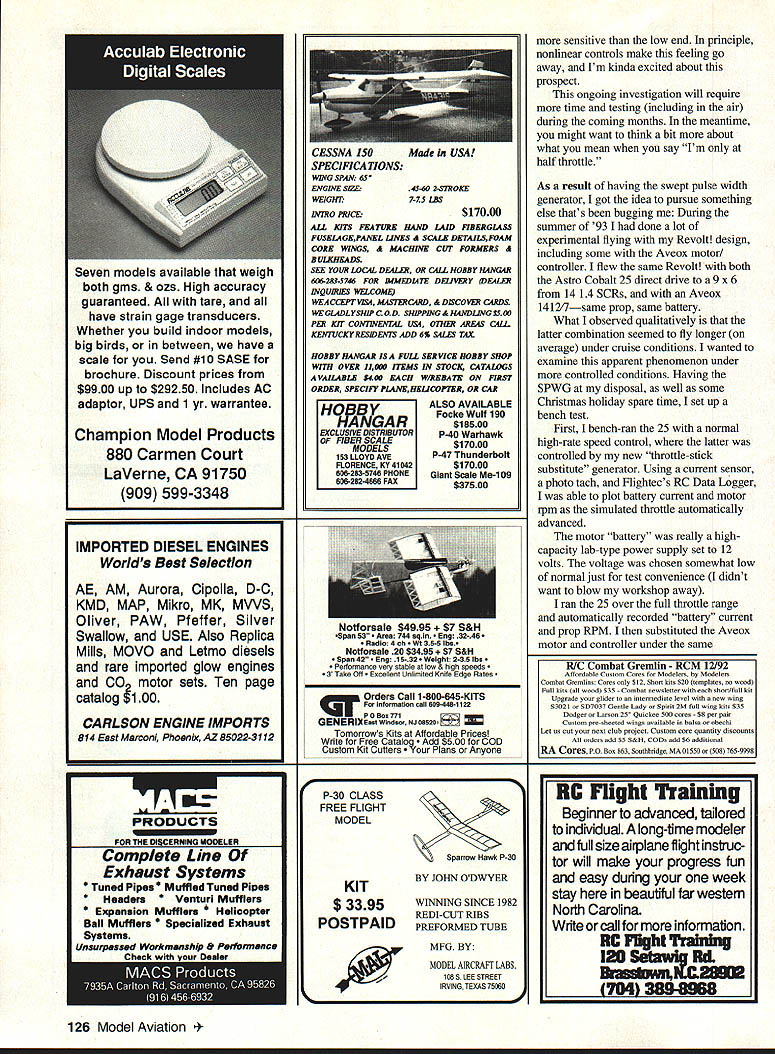
During summer 1993 I did experimental flying with my Revolt! design using both the Astro Cobalt 25 (direct drive) and an Aveox 1412/7 motor/controller with the same prop and battery. The Aveox combination seemed to give longer flights under cruise conditions. To examine this I used the SPWG and set up a bench test.
Test setup:
- The SPWG simulated throttle-stick motion over the full range (two minutes).
- I measured battery current and prop RPM using a current sensor, a photo tachometer, and an RC data logger.
- The "battery" was a high-capacity lab power supply set to 12 volts for test convenience.
Results:
- The curves confirmed the field impression: the Aveox combination required less current over the tested range, indicating potential for longer flights under similar conditions.
This finding aligns with reports of Aveox performance in high-power applications and is relevant to sport flyers and competitors in events (e.g., All-Up-Last-Down) where extended low-power operation is beneficial. In discussion with David Palombo of Aveox, the lower current is associated with the absence of brush friction and is especially noticeable at lower power conditions.
Aveox controller upgrade and offer
Aveox announced an upgraded controller for their brushless motor line designated 120LY-2, electrically and mechanically improved. Aveox extended an earlier reduced-price introductory offer for motor/controller combinations until June 1994. Contact:
- Aveox Inc., P.O. Box 1287, Agoura Hills, CA 91376-1287; Tel.: (818) 597-8915
My apology to David for previously misspelling his name (it is Palombo, not Palumbo). He took it in good humor.
Closing
Please include a SASE with any correspondence for which you’d like a reply. Happy springtime electric landings, everyone!
Transcribed from original scans by AI. Minor OCR errors may remain.

