

Radio Control: Electrics
Bob Kopski, 25 West End Drive, Lansdale, PA 19446
Events
- The seventh annual Lehigh Valley RC Society (LVRCS) Electric Fun Fly is scheduled for June 18–19 at Easton, Pennsylvania. This is an excellent meet, and I'm happy to see it back on a two-day schedule. Write Ellis Grumer, 321 Aurora St., Phillipsburg, NJ 08865 for details.
- The second annual Kansas City Regional Electric Meet is scheduled for June 25–26. Please contact Dick Hinckle, 6406 E. 140th Terrace, Grandview, MO 64030; Tel.: (816) 763-7207 for details.
Many of you have probably noticed the large number of motor speed controls on the market. Indeed, there are many—offhand I can think of seven or eight manufacturers, and most have more than one product version to offer. Not only that, for the most part these folks have been around for a relatively long time. Over most of this time there have been only one or two U.S. manufacturers of motors—far fewer than the number of suppliers of controls. Well, this scenario is repeating itself in a parallel way.
Most serious E-modelers know that the latest hot topic in motors is the brushless motor. This motor was introduced by Aveox about a year ago and is available in several versions. Aveox supplies a companion brushless motor controller that is a must since ordinary speed controls won't work with brushless motors.
I'm now aware that there are two competitive motor controls for brushless motors. Flightec, an established speed control supplier, has announced a new brushless controller, and Baylor Electric Products is developing one. I've heard rumors of even more folks working on them as well.
Flightec's new brushless controller is designated the SEC-BR. It is a microprocessor-controlled, high-rate, delta-switching design with BEC. This controller is designed for the smaller brushless motors operating in the six- to ten-cell range. Priced at $139.95, this is a very competitive product that should find widespread use, particularly in the increasingly popular nine-cell sailplane arena. You can get more information from Flightec at 21 Juniper Way, Hamilton, NJ 08619.
HiLine Blue Flame Blaster
HiLine, a well-known supplier of small electric power systems, has announced a new product: the Blue Flame Blaster. It's a 2-1/2-inch ducted-fan assembly incorporating their popular 30-watt motor. It is designed to power free-flight (FF) electrics in the 150–200-square-inch range, weighing about eight ounces total.
A complete power system with four 270 mAh cells, wiring, and switch weighs about 4.8 ounces, so the all-up weight is not hard to attain. Specified thrust is 71 grams (about 2-1/2 ounces). The product is available in several versions, including a twin. HiLine also has a larger version in the works—the Red Flame Blaster—that utilizes their Elf 50 motor and should be available by the time you read this.
You can get detailed information on the entire HiLine electric product line from Dave and Marie Rees. Their new 1994 catalog can be yours for a buck. Write to P.O. Box 11558, Goldsboro, NC 27532.
Connectors and a proposed color standard
I've observed that, without a doubt, the most popular electric connector is the Sermos—and for good reasons. They work great, are easy to use, are readily available, and are reasonably priced. In fact, most speed controls and related items on the market use Sermos connectors as standard supplied items.
I have them on everything I use—11 fully equipped ready-to-fly electrics, various chargers, accessories such as shunts, meters, and more. In fact, I have them in nine colors, and while red and black Sermos connectors are common, some manufacturers use other colors. This has given me an idea to share: I propose a speed-control-connector color standard. I think it would be beneficial to the electric industry and modeling consumers to adopt specific colors for the battery and motor connections.
A simple and readily distinguished coding scheme would eliminate the head-scratching that sometimes occurs with all those loose red and black connectors floating about inside of a fuselage. A simple mixup can destroy a controller, so I think an informal and voluntary standard would be well worth it.
Given the above, I propose using:
- Red and black for the battery connectors.
- Blue and orange for the motor connectors on speed controls.
The bright colors—red and orange—would be positive, and the black and blue would be negative. Actually, all controls I know of really have a single positive electrical path with two connectorized leads attached, so just two reds would do as well as a red and an orange. It's just a thought. Maybe there are "negatives" to this of which I'm unaware. What do you think? Maybe we can hash this out at the '94 KRC Friday Electric Symposium, where many of the electric heavyweights are bound to be.
Speed controls
Last month's column offered graphic data on speed control transfer characteristics and a performance comparison of a brushed and a brushless motor. I also described some test equipment I used to obtain this data, which included a test signal generator to simulate transmitter stick motion and the Flightec RC Data Logger.
These test resources continue to provide some rather interesting results in the electric speed-control area, and the graph printed this month is another example. But first, a quick review of the workings of speed controls for those newer readers.
Speed controls regulate motor RPM by continually switching the battery voltage on and off to the motor—fast. Imagine the speed control as a magic switch that is being actuated on and off for equal time intervals; the motor sees the average voltage over those periods many times each second.
If the on and off times are equal, the motor would experience half the battery voltage on average, and the motor RPM would be about half the full-voltage value. Now imagine this on/off cycle having an uneven duty cycle; for example, a condition of 10% on time and 90% off time. This causes only a small average voltage to appear at the motor—about 10% of the battery voltage. In fact, speed controls permit all possible duty cycles from 0–100% to 100–0% (full off to full on) to be applied as a function of your transmitter throttle stick position.
The frequency or repetition rate at which this cycling occurs is normally either frame rate or high rate. Frame rate, also known as low rate, is almost always about 50 times per second. It is the rate at which an ordinary RC transmitter repeats its output signal train and the rate at which ordinary RC servos get updated command information from the transmitter via the receiver.
High rate does not have a single usual number, but typically falls between about 500 and 6,000 Hz (cycles per second), depending on the manufacturer. Generally, high-rate controls require more circuitry and so are likely to cost more. But there is a real payback in that the power-system efficiency can be significantly higher than with low-rate designs. This translates to longer flights, less motor and battery heat, usually quieter operation, and less abuse on gear drives where used.
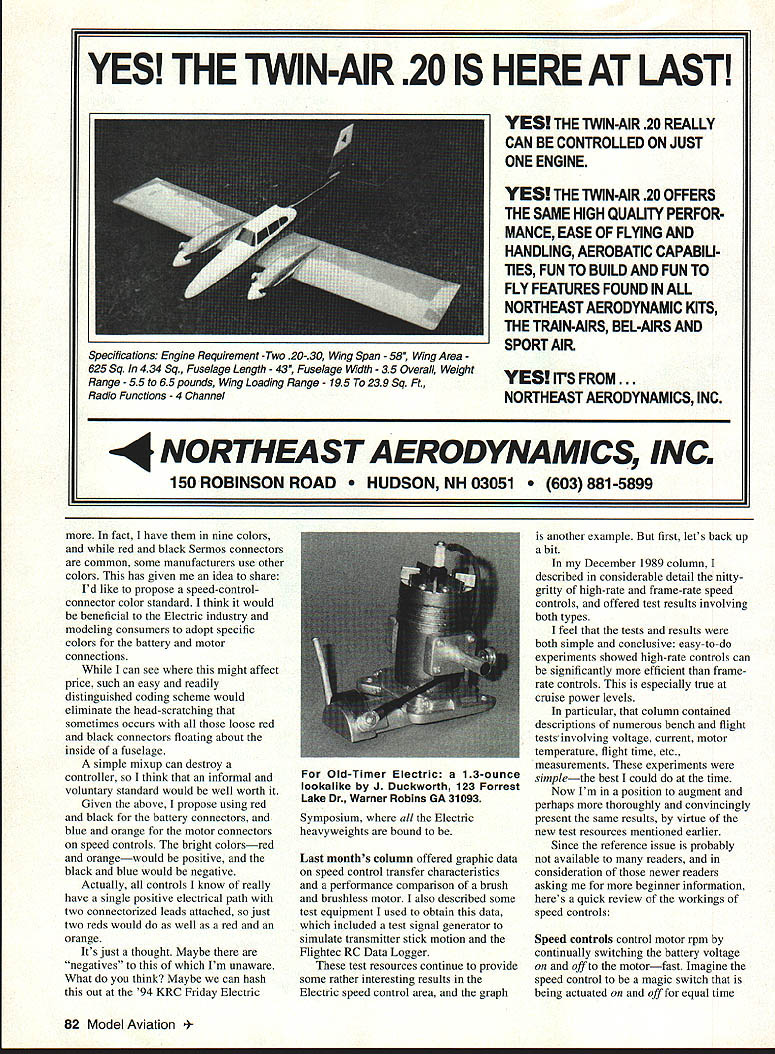
This month's graph is a computer screen dump printed on a dot-matrix printer. It presents automatically acquired battery-current and RPM data for both a frame-rate control and a high-rate control applied to the same motor and prop operating off the same 12-volt power supply (a battery substitute).
As before, the Astro 25 was purposely not run to its full capability for practical reasons; the air blast would have rearranged my shop!
So what does this chart show? For any RPM between zero and maximum, the high-rate control requires measurably less current to turn the prop at a given RPM. And everyone knows that the less current used, the longer the battery lasts, on average, per charge.
While I'm well familiar with the concepts involved and the general result, I found this graph rather dramatic. Because my earlier experiments were simple one-point sorts of endeavors, I really didn't know the shape of the whole performance envelope as shown here. These results, and the success of the techniques used in obtaining them, have given me bigger and better ideas to pursue.
For example: just what is the "best" rate? Is best rate a variable depending on the motor, prop, or battery? What are the tradeoffs? I guess you can guess what some future column topics will be—but it will all take a while.
By the way, the referenced December 1989 issue brought much reader reaction, with some folks making contributions of their own to the rate subject. Several subsequent columns supplemented the information first presented, and I recall seeing a feature article on the subject by Bob Boucher of Astro Flight in another magazine. More recently, in the April 1993 issue, this column offered some thoughts on other aspects of speed-control selection. For those with the interest, time, and access to back issues of Model Aviation, there's lots of information on many aspects of motor controls. Because of the recent appearance of microprocessor-controlled controls, there's more to come!
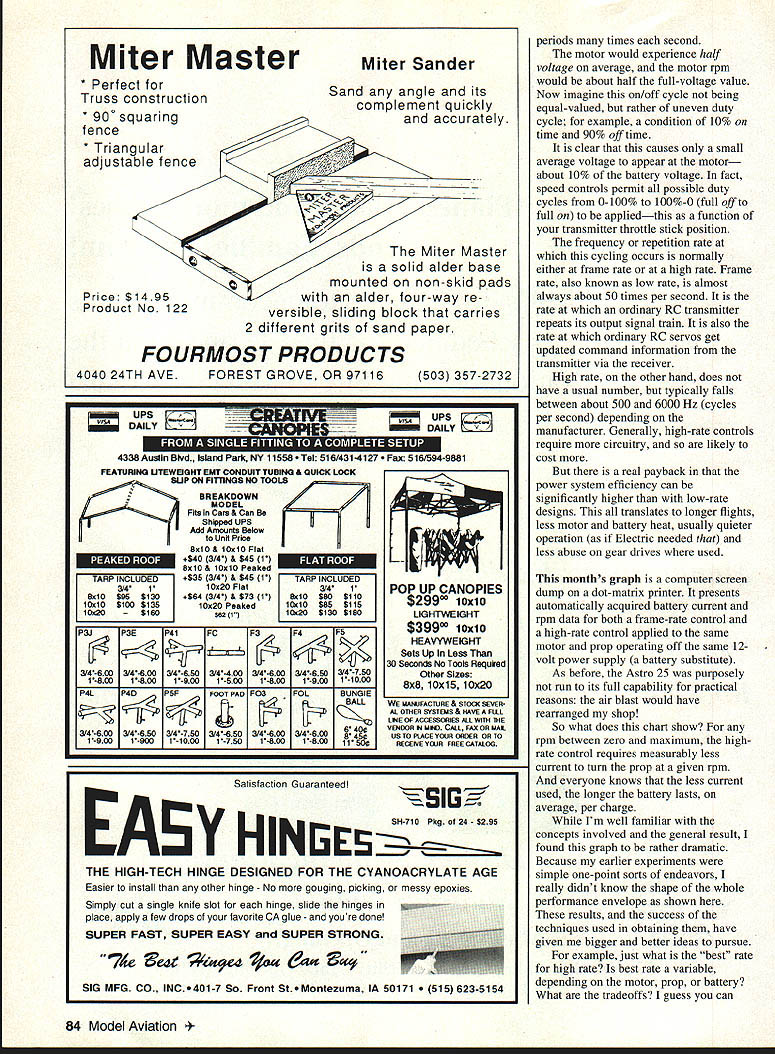
In closing this topic for this month, note that one of the photos shows the innards of the Flightec Data Logger box pictured in the March column. In response to reader demand, Phil Thayer of Flightec has decided to offer the board assembly (all the electronic stuff) of the Data Logger at a lower price than the complete housed unit. Recommended for more experienced readers, the board and software are available this way for $89.95. Contact Flightec at the address given earlier.
I'm constantly reminded by my incoming mail of a Model Aviation feature article that was not electric per se, but did involve some electrical things: the Miniature Disk Sander presented in the May 1991 issue. Given the magnitude of past reader interest, I have to assume some new readers would also like the information. I think this article has brought in more letters and phone calls than anything else I've written. This may be due to the fact that the simple tool described is useful in nearly all of aeromodeling, not just electric.
The sander construction article was based on an inexpensive car or airplane motor, some flashlight cells, some hardware, and a small wooden housing that almost anyone can assemble. This easy-to-make tool can do a highly accurate job on balsa stick ends, small hardwood pieces, etc. If this sounds interesting to you, see if you can dig up the issue and check it out. So far—after a vast reader response—everyone seems to love it.
With that, half this year's columns are done, and I can start planning the next half—beginning with July! Happy electric summertime landings to you all!
Please enclose an SASE with any correspondence for which you'd like a reply.
Transcribed from original scans by AI. Minor OCR errors may remain.

