
RADIO CONTROL ELECTRICS
Bob Kopski 25 West End Drive, Lansdale, PA 19446
This month I'll cover three meet announcements, April errata, understanding brushless motors and controllers, a prop-mount suggestion, battery accessories, and more speed-control information.
Meet Announcements
- ### Fourth Annual Southeastern ElectriFly
- Date: Saturday, June 4
- Location: Near Dallas, Georgia
- Sponsor: North Georgia Flying Circus
- Events: Pylon racing, Climb and Glide, slow and fast flying competitions, plus open flying
- Notes: Attendance has been growing at about 30% per year.
- Contacts: Gene Norman, 1031 Pinecrest Drive, Forest Park, GA 30050-3334; Tel: (404) 960-0863. Mike Green: (404) 386-5016.
- ### Seventh Annual Northern Connecticut Radio Control Club Electric Fun-Fly
- Date: July 23, 1994
- Events: 610, 612, and 618; Larry Sribnick and John Sermos will discuss their offerings to the electric community
- Contact: Ron Torrito (CD), 1625 Main St., East Hartford, CT 06108; Tel: (203) 528-2227.
- ### Competition Fun-Fly Nationals — Shootout at Indy '94
- Date: Labor Day weekend, September 3–4
- Location: Indianapolis, Indiana
- Notes: Traditionally for wet-powered Fun-Fly designs, but this year electric power is invited. There is no special class — just fly against the rest of the field. A special award will be given to the highest-placing electric entry. Many Fun-Fly tasks take less than 30 seconds, so relatively light battery installations are often adequate. Aircraft/engine/motor rules are otherwise unlimited; only the AMA Safety Code prevails.
- Contact: Azarr, 1750 Lundgren Rd., New Carlisle, OH 45344; Tel: (513) 849-0411.
Examples of successful wet-to-electric conversions include the Stickit IV and Stickit V; converted examples provide quiet, pleasant flying.
April Errata
In the April column I passed along some information from reader Martin Bamert about measurable differences in individual SCRC cell weights between good and "good" cells. The numbers I reported as 54 and 52 grams should have read 56 and 54 grams respectively.
Brushless Motors and Controllers
Many readers have trouble accepting that ordinary (brushed) speed controls cannot be used with brushless motors. Here’s a concise explanation of why:
- Wiring differences
- Brushed motor control: typically two heavy wires to the motor (plus the usual two wires to the battery/arming switch and the three-wire cable to the receiver).
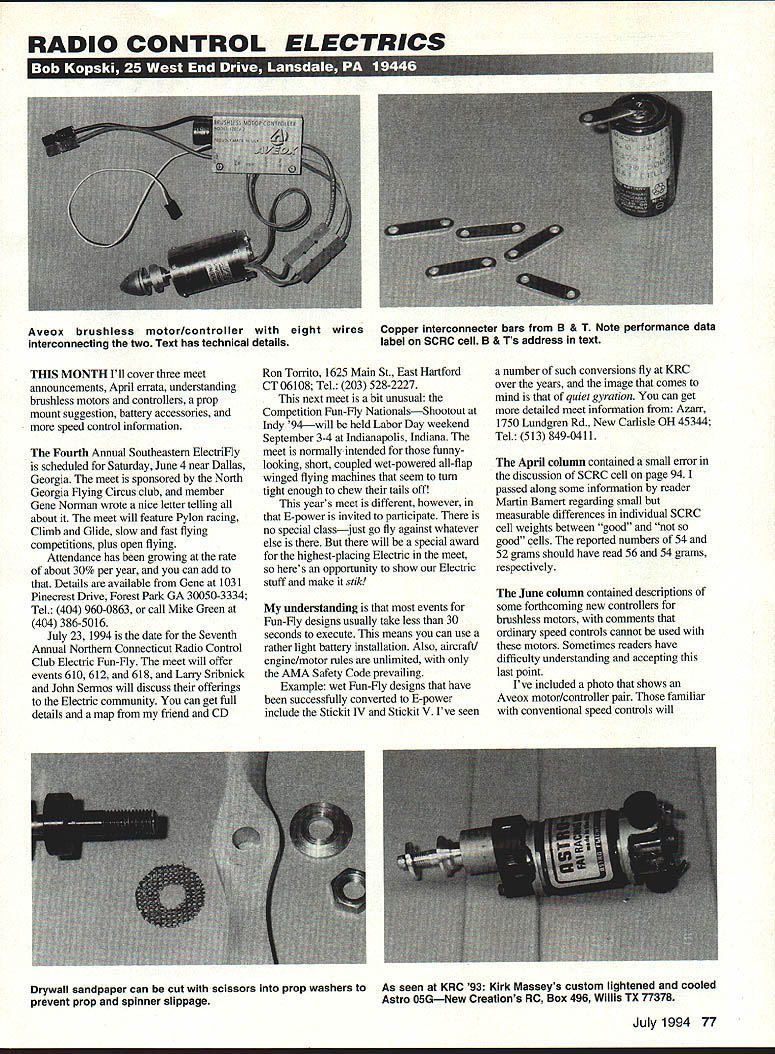
- Brushless motor control: typically eight wires to the motor area — three heavier power wires and five light-gauge sensor wires (plus the battery/arming and receiver leads).
- What the extra wires do
- Three heavier wires (with servo-type/Sermos connectors) are power leads. They carry a three-phase drive from MOSFETs in the controller to the motor windings.
- Five light-gauge wires connect Hall-effect magnetic sensors in the motor to the controller. These sensors provide timing feedback so the controller can commutate the phases correctly.
- How brushless motors work (brief)
- The motor windings are fixed to the housing; the permanent cobalt magnets are on the rotating armature (rotor).
- The controller electronically "clocks" three-phase power in timed pulses to successive windings, producing a revolving magnetic field that drags the rotor magnets and causes rotation.
- Speed is controlled by altering the nature of the power pulses in response to throttle input from the transmitter.
- Direction and timing
- Brushed motors are reversed by swapping plus and minus at the brushes (sometimes with timing adjustment).
- Brushless motors are reversed electronically by the controller (for example, some controllers use a jumper to select reverse). The Hall sensors and controller keep timing correct automatically, so there is no brush-angle adjustment.
- Advantages of brushless designs
- No brushes: no brush resistance (better efficiency), no brush drag (lower current at light loads), no brush/commutator wear, no sparking (less electrical noise), no brush-angle adjustment, no brush protrusions on the case, no brush capacitors, and no carbon brush dust.
Given these differences, you must use a brushless motor controller with a brushless motor. The apparent complexity simply replaces mechanical brushes with electronic commutation, yielding better performance and less maintenance.
Prop Mount Suggestion
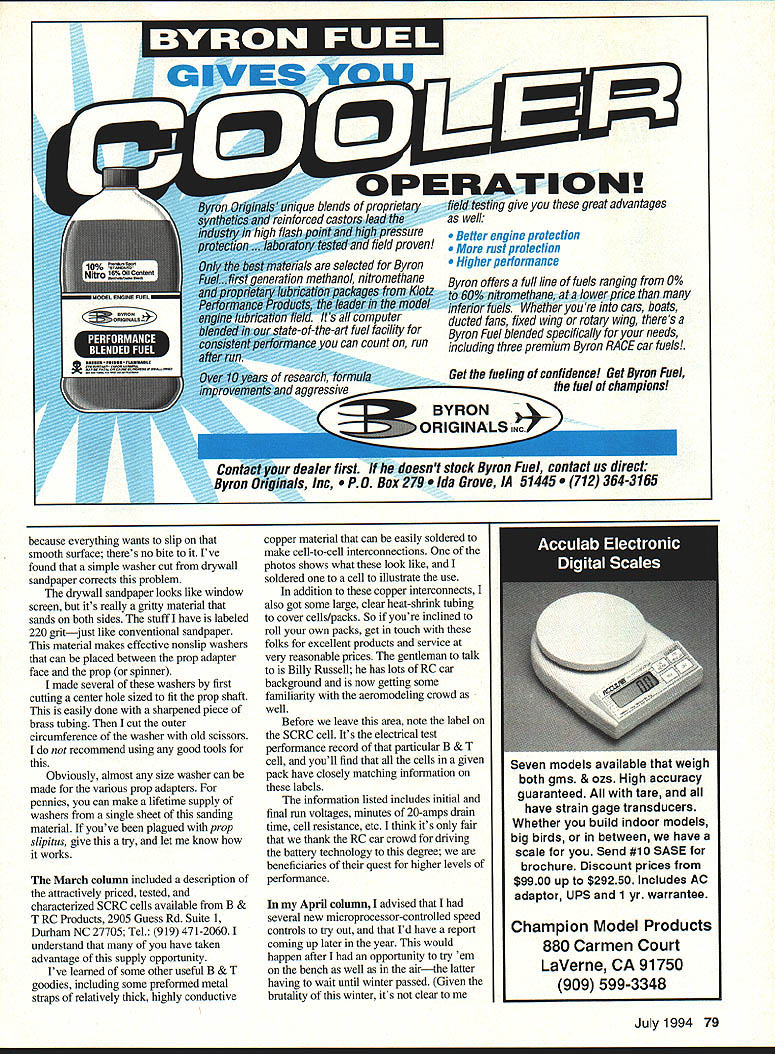
Wet engines often have knurled prop drives to prevent prop and spinner slippage. Many electric prop adapters have smooth faces and can be difficult to tighten securely. A simple, inexpensive fix:
- Material: cut washers from drywall sandpaper (the window-screen-like gritty material; 220 grit works well).
- How to make:
- Cut a center hole sized to the prop shaft (a sharpened piece of brass tubing works well for this).
- Cut the outer circumference with old scissors (don’t use valuable tools for this job).
- Use: place the sandpaper washer between the prop adapter face and the prop or spinner to prevent slipping.
- Cost: pennies — a single sheet yields a lifetime supply of washers.
If you’ve had prop slippage problems, try this and let me know how it works.
Battery Accessories and SCRC Cells
The March column described attractively priced, rugged SCRC cells available from B & T RC Products, 2905 Guess Rd., Suite 1, Durham, NC 27705; Tel: (919) 471-2060. Many readers have taken advantage of this supply.
Other useful products from B & T:
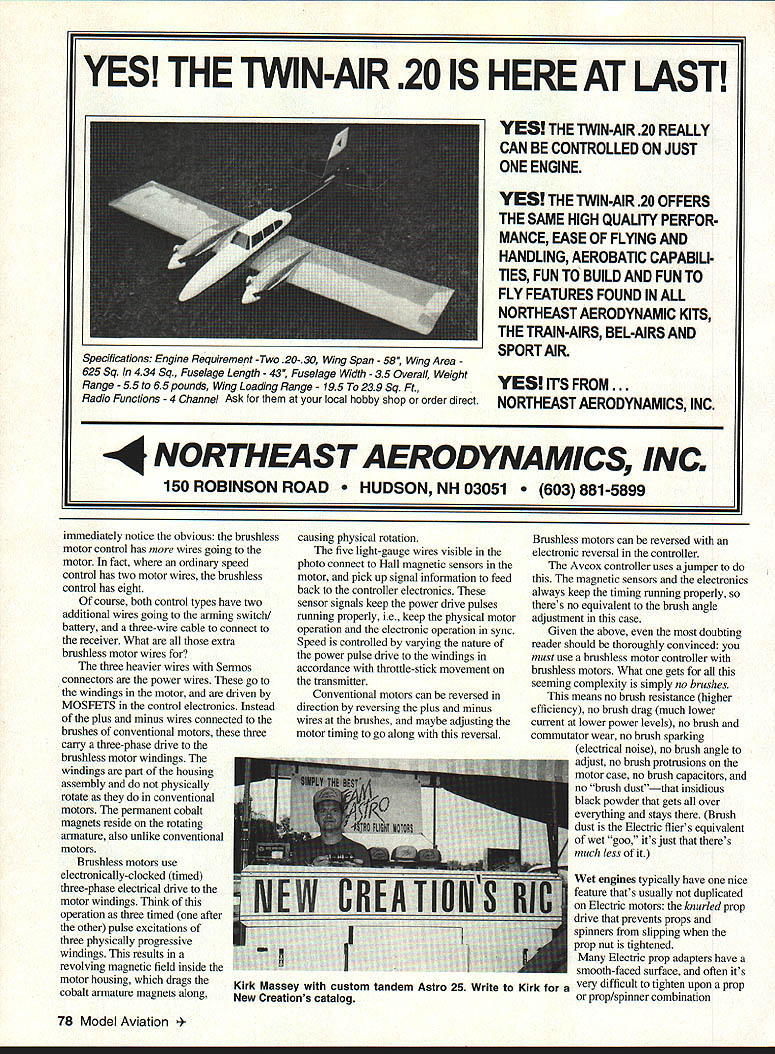
- Preformed copper straps (thick, highly conductive) for easy soldered cell-to-cell interconnections.
- Large clear heat-shrink tubing to cover cells or packs.
If you roll your own packs, these are handy items. Contact: Billy Russell at B & T — he has RC car background and is building familiarity with the aeromodeling crowd.
Note the label on each SCRC cell: it records the electrical test performance of that particular cell (initial/final run voltages, minutes at 20-amp drain, cell resistance, etc.). Cells in a given pack typically have closely matching data. We owe thanks to the RC car community for driving battery technology forward; aeromodelers benefit from their efforts.
Speed-Control Testing and Product Notes
I have several new microprocessor-controlled speed controls to evaluate. Testing includes bench runs and flight trials; flight testing was delayed by a harsh winter. A few points from my bench work and discussions with manufacturers:
- Some of the newest controls are already being revised in design; product evolution is fast.
- Manufacturers often supply samples to columnists and experienced flyers for field testing under varied conditions (different radios, varied usage), which helps drive improvements.
- I maintain a policy of separating proprietary or private information that suppliers share from what I publish; that’s why sometimes I can’t disclose specific details readers ask about.
This testing is part of my E-modeling fun: helping advance product design and sharing practical results with you.
Personal Project
In the September 1993 column I mentioned I had some speed-control design ideas to try — part of a broader effort with my REVOLT design (an electric model tuned for easy trimming in flight). I’ve started a small mini-project to explore these ideas. I’m not competing seriously; I’m experimenting for fun and learning.
It’s possible something useful or even dramatic may come of this work, but I’m not ready to detail it yet. Only one other person knows the specifics so far; we’ll see how things develop. If any idea proves worthwhile, I’ll share it here.
Please include a self-addressed, stamped envelope (SASE) with any inquiry for which you'd like a reply. Happy summertime electric landings!
— Bob Kopski
Transcribed from original scans by AI. Minor OCR errors may remain.

