
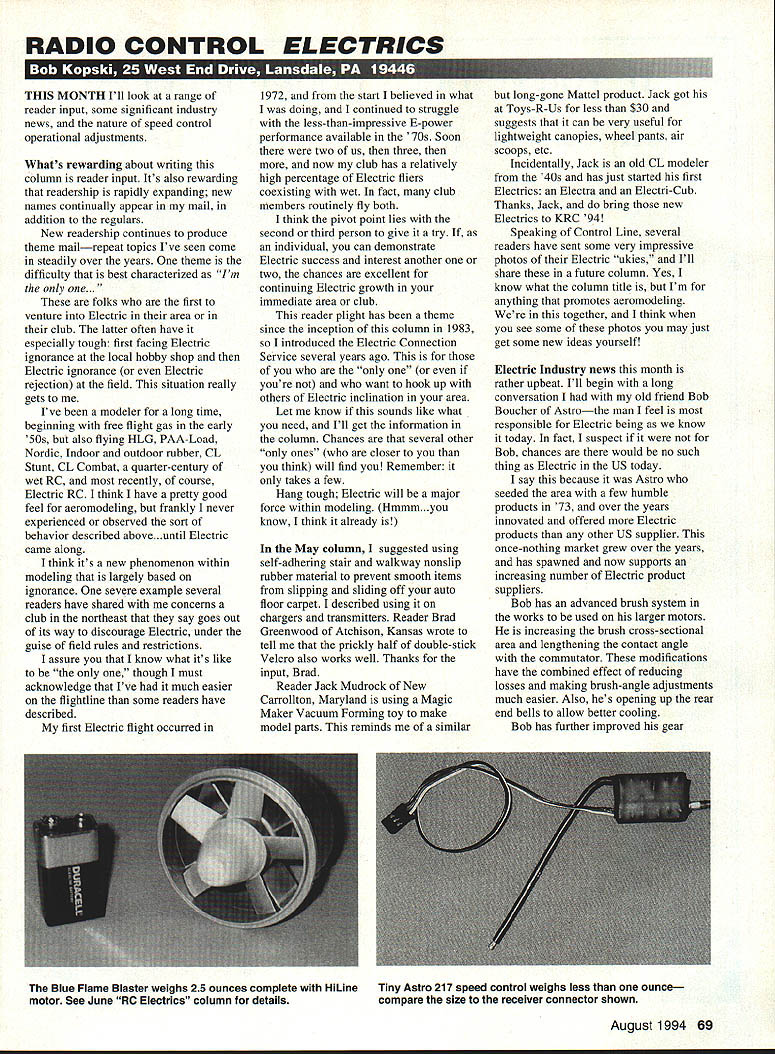
RADIO CONTROL ELECTRICS
Bob Kopski — 25 West End Drive, Lansdale, PA 19446
THIS MONTH I'll look at a range of reader input, some significant industry news, and the nature of speed-control operational adjustments.
Reader input and new readership
What's rewarding about writing this column is reader input. It's also rewarding that readership is rapidly expanding; new names continually appear in my mail, in addition to the regulars.
New readership continues to produce theme mail—repeat topics I've seen come in steadily over the years. One theme is the difficulty that is best characterized as "I'm the only one..." These are folks who are the first to venture into Electric in their area or in their club. The latter often have it especially tough: first facing Electric ignorance at the local hobby shop and then Electric ignorance (or even Electric rejection) at the field. This situation really gets to me.
I've been a modeler for a long time, beginning with free flight gas in the early '50s, but also flying:
- HLG (hand-launch gliders)
- PAA-Load, Nordic, indoor and outdoor rubber
- CL stunt and CL combat
- a quarter-century of wet RC
- and most recently, of course, Electric RC
I think I have a pretty good feel for aeromodeling, but frankly I never experienced or observed the sort of behavior described above... until Electric came along. I think it's a new phenomenon within modeling that is largely based on ignorance. One severe example several readers have shared with me concerns a club in the northeast that they say goes out of its way to discourage Electric, under the guise of field rules and restrictions.
I assure you that I know what it's like to be "the only one," though I must acknowledge that I've had it much easier on the flightline than some readers have described.
My first Electric flight occurred in 1972, and from the start I believed in what I was doing. I continued to struggle with the less-than-impressive electric performance available in the '70s. Soon there were two of us, then three, then more, and now my club has a relatively high percentage of Electric fliers coexisting with wet. In fact, many club members routinely fly both.
I think the pivot point lies with the second or third person to give it a try. If, as an individual, you can demonstrate Electric success and interest another one or two, the chances are excellent for continuing Electric growth in your immediate area or club.
This reader plight has been a theme since the inception of this column in 1983, so I introduced the Electric Connection Service several years ago. This is for those of you who are the "only one" (or even if you're not) and who want to hook up with others of Electric inclination in your area. Let me know if this sounds like what you need, and I'll get the information in the column. Chances are that several other "only ones" (who are closer to you than you think) will find you! Remember: it only takes a few.
Hang tough; Electric will be a major force within modeling. (Hmmm... you know, I think it already is!)
Reader tips and projects
In the May column, I suggested using self-adhering stair and walkway nonslip rubber material to prevent smooth items from slipping and sliding off your auto floor carpet. I described using it on chargers and transmitters. Reader Brad Greenwood of Atchison, Kansas wrote to tell me that the prickly half of double-stick Velcro also works well. Thanks for the input, Brad.
Reader Jack Mudrock of New Carrollton, Maryland is using a Magic Maker vacuum-forming toy to make model parts. This reminds me of a similar but long-gone Mattel product. Jack got his at Toys-R-Us for less than $30 and he suggests that it can be very useful for lightweight canopies, wheel pants, air scoops, etc.
Incidentally, Jack is an old CL modeler from the '40s and has just started his first Electrics: an Electra and an Electri-Cub. Thanks, Jack, and do bring those new Electrics to KRC '94!
Speaking of control line, several readers have sent some very impressive photos of their Electric "ukies," and I'll share these in a future column. Yes, I know what the column title is, but I'm in favor of anything that promotes aeromodeling. We're in this together, and I think when you see some of these photos you may just get some new ideas yourself!
Industry news
Electric industry news this month is rather upbeat.
I had a long conversation with my old friend Bob Boucher of Astro—the man I feel is most responsible for Electric being as we know it today. In fact, I suspect if it were not for Bob, chances are there would be no such thing as Electric in the US today. Astro seeded the area with a few humble products in '73 and over the years innovated and offered more Electric products than any other US supplier. This once-nothing market grew and has spawned and now supports an increasing number of Electric product suppliers.
Highlights from Bob Boucher / Astro:
- An advanced brush system is in the works for his larger motors: increased brush cross-sectional area and a lengthened contact angle on the commutator. These modifications reduce losses and make brush-angle adjustments much easier.
- He is opening up rear endbells to allow better cooling.
- Bob has further improved his gear drives by going to a helical design. This reduces gear noise (usually the noisiest part of Electric power) and increases durability.
- He is adding drives for the 60- and 90-sized Cobalts. These large motors are selling well, indicating the maturity of Electric.
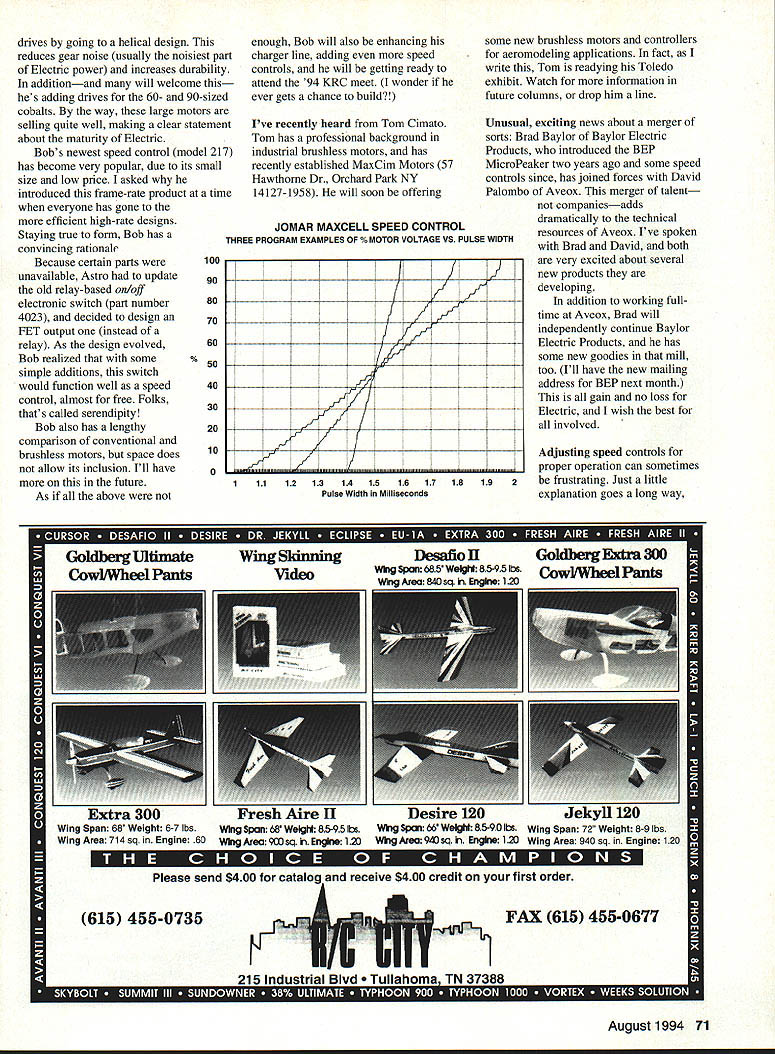
- His newest speed control (model 217) has become very popular due to its small size and low price. When I asked why he introduced this product at a time when many have gone to high-rate designs, he explained it grew out of necessity: certain parts were unavailable, so Astro updated an old relay-based on/off electronic switch (part number 4023) to an FET-output design. As the design evolved, it became a cost-effective speed control as well—serendipity!
Bob also has a lengthy comparison of conventional and brushless motors; space does not allow inclusion here, but I'll have more on it in the future. He will also be enhancing his charger line, adding more speed controls, and attending the '94 KRC meet.
Other industry notes:
- Tom Cimato, who has a professional background in industrial brushless motors, has established MaxCim Motors (57 Hawthorne Dr., Orchard Park, NY 14127-1958). He will soon be offering new brushless motors and controllers for aeromodeling applications.
- Brad Baylor of Baylor Electric Products, who introduced the BEP MicroPeaker two years ago and some speed controls since, has joined forces (as talent, not companies) with David Palombo of Aveox. This adds dramatically to Aveox's technical resources. Brad will continue Baylor Electric Products independently while working full-time at Aveox. I'll have the new mailing address for BEP next month.
All this is good news for Electrics.
Speed-control adjustments — classic designs
Adjusting speed controls for proper operation can sometimes be frustrating. A little explanation goes a long way, and since some new microprocessor-based speed controls are supposed to eliminate these nasties, it's useful to understand the older behavior.
Classic speed controls typically have either one or two adjustment screws that set up proper operation in conjunction with your radio. The purpose of the adjustments is to tune the control so that the full motor power range is available from stick (and maybe trim) motion on the transmitter, whichever you prefer.
Two basic approaches:
- Two-screw controls
- Use two adjustments to set low and high power (voltage) limits.
- Sometimes labeled with confusing terms like "neutral" and "range," but the idea is to make the stick throw and the speed-control range line up.
- Preferred by me: I like the control to go full off to full on just before the stick limits at both extremes, using the whole stick with perhaps a one- or two-degree margin at each end.
- Single-screw controls
- Usually establish the start point of the motor relative to throttle-stick position.
- These controls then have a preset control range designed to work with almost any transmitter.
- To guarantee full off-to-full-on for all radios, a single-screw design must cover transmitters with the shortest electrical throttle-stick throw. As a result, on radios with larger stick throws the control can feel touchy because full power occurs before full stick travel.
Some additional points:
- Not all transmitters are created equal. Throttle-stick mechanical and electrical travel varies by manufacturer; a servo motion achieved on aileron may be larger than the same stick in the throttle channel.
- Two-screw controls are more difficult to tune because the adjustments interact. Set one, then the other, then iterate between them until they converge. A little care, patience, and insight is all it takes.
- In my August 1990 column I described a helpful accessory I use when doing this: a motor substitute that uses a meter to achieve the desired speed-control tune-up. It simplifies the process and readers have written back with appreciation.
Microprocessor speed controls
Enter the new breed of microprocessor-controlled controls. Many of these have no adjustment screw.
- Typical behavior: When you power up, the microprocessor control recognizes where the throttle stick is (i.e., the starting pulse width) and begins from that point. Any advancement of the stick advances motor power from zero. Essentially, these controls automatically handle the starting adjustment usually set by a single-screw speed control.
- Limitation: Like single-adjustment designs, some microprocessor controls have a fixed range of operation. The effectiveness of the transmitter stick past the start point can still vary with radio brand.
- Discreteness: Some newer controls do not vary motor power smoothly but rather in noticeable steps—motor voltage is staircased from full off to full on. The fewer the control steps, the less smooth the application of motor power.
- Interaction with stick indents: Many transmitter throttle sticks have indent mechanisms. The combination of mechanical indents and electronic steps can produce small and occasional large jumps in motor response, which feels unpleasant to fly with. Some transmitters have as few as 12 indents; most offer about 25–30.
- Resolution tradeoffs: Early microprocessor speed controls had as few as 20 electronic steps. Most manufacturers have recognized and corrected this, and some modern controls have so many discrete steps that they feel very smooth—approaching analog behavior. However, higher resolution consumes microprocessor resources that manufacturers might prefer to allocate to other features, like glitch rejection. It's a tradeoff.
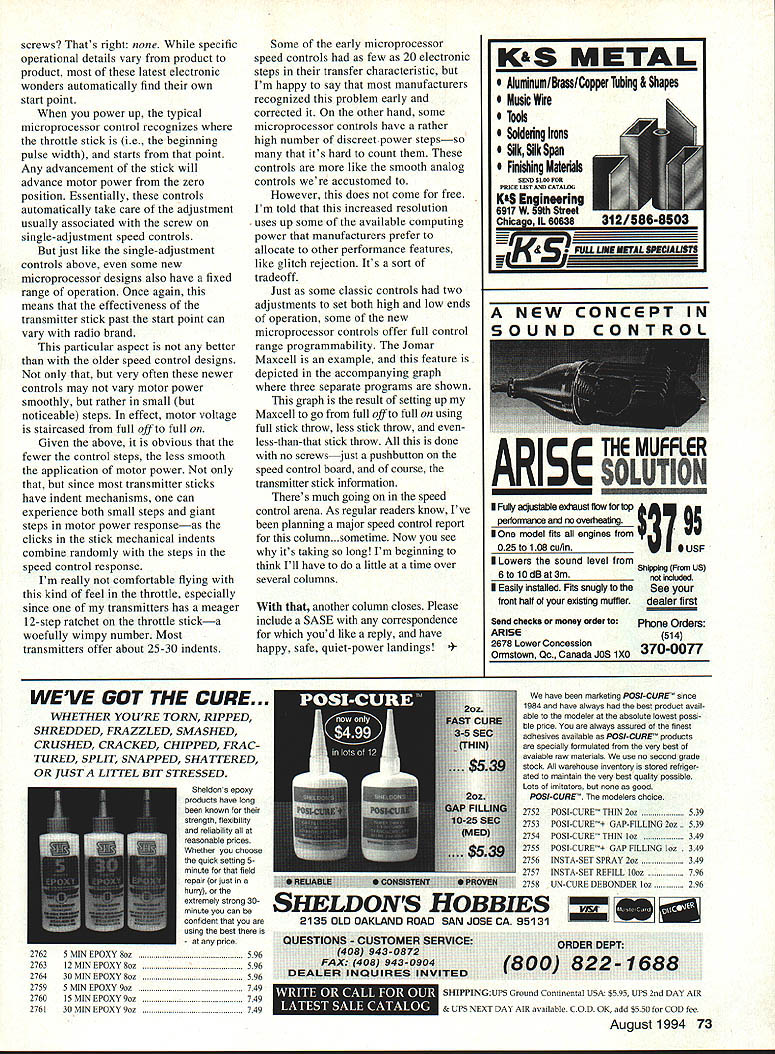
- Programmability: Some modern microprocessor controls offer full control range programmability, analogous to the two-screw classic controls but done with pushbuttons and software. The Jomar Maxcell is an example. With it I set the Maxcell to go from full off to full on using full stick throw, less stick throw, and even less-than-that stick throw—all without screws, using a pushbutton on the speed control board and the transmitter stick information. (This was illustrated by an accompanying graph in my notes.)
There's much going on in the speed-control arena. As regular readers know, I've been planning a major speed-control report for this column... sometime. Now you see why it's taking so long! I'll likely present it a little at a time over several columns.
Closing
Please include a SASE with any correspondence for which you'd like a reply, and have happy, safe, quiet-power landings!
Transcribed from original scans by AI. Minor OCR errors may remain.

