



Radio Control: Electrics
Bob Kopski, 25 West End Drive, Lansdale, PA 19446
Meet Announcements
- The Westmoreland (PA) Electric Soaring Society (WESS) annual Electric Fly-In is August 14. Details are still in development but will be firm by the time you read this. Check with the CD: George Minnear, 118 Jay Drive, Verona, PA 15147; Tel.: (412) 793-3965.
- Everything you need to know about the '94 Fifteenth KRC Electric Fly is available in a six-page mailer from the Electric Fly Manager: Rich Samuels, 716 Shadywood Drive, Perkasie, PA 18944; Tel: home (215) 257-5593; work (215) 822-3238, ext. 2456. For those wishing to participate in the popular All-Up/Last-Down event, call the KRC Hotline at (215) 234-4618 for preregistration/frequency allocation. Remember that this year's activities span three days: September 16–18. See the April column for the SR Friday Symposium/Night Fly details.
The Electric Connection
The Electric Connection Service announces the availability of a large field for electric and sailplane use in Zephyrhills, Florida—about 30 miles north of Tampa. Larry and Doris Burnette of Country Crafts and Hobbies provided this information. This hobby shop carries a large inventory of electric gear. Call them at (813) 782-9166 for more information on the field and shop.
June Errata and Motor Control Efficiency
Erratum
The June column had a misprint in the graph caption on page 81. The caption should read "Battery Current..." not "Motor Current..."
Background and Reader Prompt
A reader questioned the efficiency of high-rate speed controls and preferred series/parallel pack switching (see MA, February 1993) for longer duration in All-Up/Last-Down events. He reported much longer duration when using pack switching, which prompted me to test and compare control methods.
Test Setup
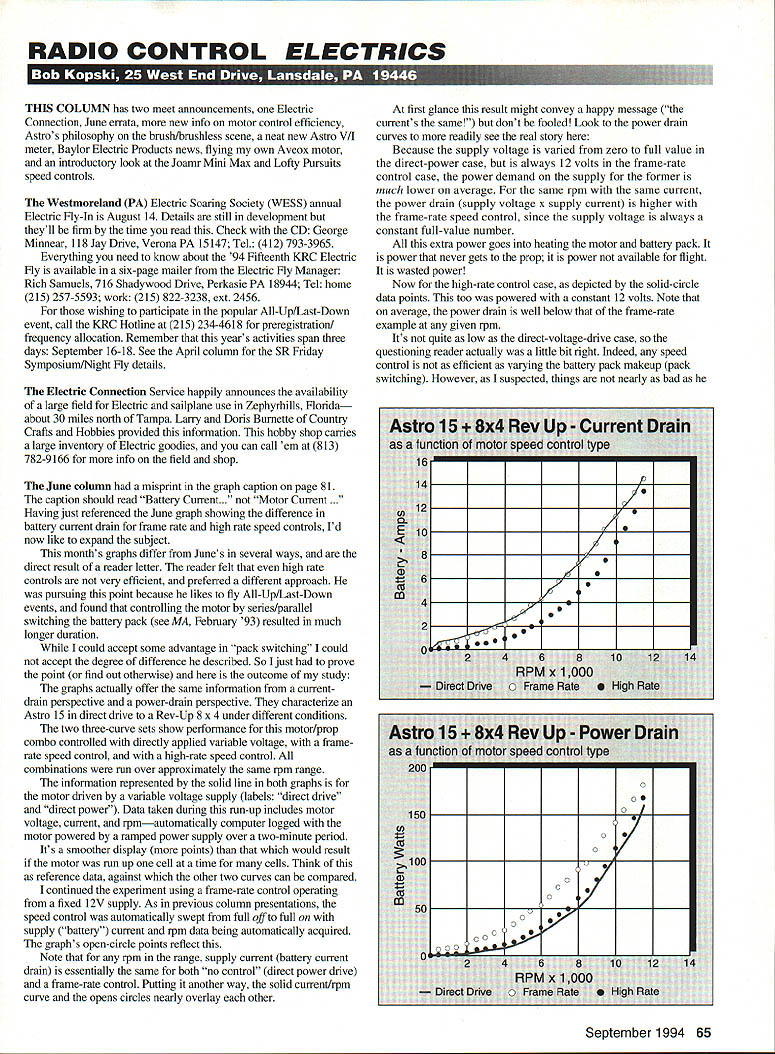
- Motor/prop: Astro 15 in direct drive to a Rev-Up 8×4.
- Three control methods were compared:
- Direct variable voltage applied to the motor ("direct drive"/"direct power").
- Frame-rate speed control powered from a fixed 12 V supply.
- High-rate speed control powered from a fixed 12 V supply.
- All combinations were run over approximately the same RPM range.
- Data logged automatically: motor voltage, supply (battery) current, and RPM.
- Data acquisition used the Flightde Data Logger; files were imported into Lotus 1-2-3 to produce graphs.
Results
- From a current-drain perspective, the supply current vs. RPM for the direct-power case (variable supply voltage) and the frame-rate control case (fixed 12 V) are nearly the same—solid curve and open-circle points nearly overlay.
- From a power-drain perspective (supply voltage × supply current), the direct-power case shows much lower average power demand because the supply voltage varies from zero to full value during the run-up.
- With the frame-rate control (supply always 12 V), the power drain is higher at a given RPM because the supply voltage remains at full value while current is similar to the direct case. That extra power is dissipated as heat in the motor and battery and is not available for propulsion—i.e., wasted energy.
- The high-rate control case (solid-circle points), also powered at constant 12 V, shows average power drain well below that of the frame-rate example at the same RPM. While not quite as low as the direct-voltage-drive case, the high-rate control closely approaches the efficiency of a no-control system.
Conclusions
- High-rate speed controls only slightly impair overall power-system efficiency in most cases.
- For maximum duration in AULD events, pack switching (series/parallel battery switching) yields the least power loss, but to fully benefit requires careful matching of motor, prop, airframe, and battery configuration.
- For typical sport flying, a high-rate speed control is recommended.
AstroFlight: Brush vs. Brushless Thoughts
From a recent conversation with Bob Boucher of AstroFlight: he believes conventional cobalt (brushed) motors have a distinct power-system advantage in many cases. On average, a comparable brushless motor, its controller, and required battery weigh more than a conventional motor, speed control, and battery. If you add cells to the conventional system to match the brushless system weight, the conventional system gains a performance advantage from the increased energy storage. This argument is especially convincing for installations using smaller props and direct-drive setups.
Astro Mini V/I Meter
AstroFlight has announced the mini-sized digital volt/ammeter Model 100. Key points:
- Intended to insert in-line with a motor or speed-control/motor combination to measure actual circuit voltage and current.
- Volts and amps are selected with a switch on the unit.
- Specified ranges: 60 V and 60 A—adequate for virtually all model power systems.
- The unit derives operating power from the motor circuit; no internal battery needed.
- Astro connectors are supplied; wiring is short and heavy to minimize insertion loss.
- List price: $69.95.
- Tip: make adapter cords so you can also use the voltmeter as a quick check on receiver and transmitter packs.
Baylor Electric Products (BEP) and Aveox
Brad Baylor of Baylor Electric Products has joined forces with Aveox but will continue operating BEP. New BEP contact:
- P.O. Box 1576, Agoura, CA 91376
- Orders and literature: (800) 255-5237
- Technical assistance: (818) 878-9147
There is no conflict of interest in the arrangement. Brad is developing a microprocessor-based motor control for the Aveox brushless motor as part of Aveox, while expanding his own microprocessor speed-control line for brushed motors under BEP. Both product lines will be developed without competing with each other.
I have been flying the BEP Micro-FET LV speed control. It is highly programmable, offers many features per dollar, and includes an exponential option I like. The 7–21 cell version sells for $69.95; a higher-voltage version is $89.95.
Flying the Aveox 1412/7
I’ve been flying an Aveox 1412/7 on a Revolt airframe for several months, currently on 14 cells. Props tried: 9×6, 10×6, and 11×6 with dramatic differences:
- The motor handles a wide range of prop loads and keeps pulling as props get larger.
- With the 11×6, the Revolt launches strongly and sustains 60°–70° climb angles.
- Backing off power returns the model to docile handling. The motor offers a large dynamic range and lots of flight excitement.
JoMar Mini Max and Lofty Pursuits LPSC-1
One photo shows both the JoMar Mini Max and the Lofty Pursuits LPSC-1 microprocessor-controlled speed controls. They are similar in footprint, though the LPSC-1 is thicker. Both are members of the new breed of controls that have appeared recently and have performed well in flight tests.
Highlights:
- JoMar Mini Max:
- A departure for Joe Utasi because this control is not opto-coupled.
- Despite my preference for opto-coupling, I have experienced no perceptible glitching over many flights, even when attempting to provoke one.
- The control relies on a "smart" microprocessor signal-handling routine.
- Lofty Pursuits LPSC-1:
- Doug Ingraham (Lofty Pursuits) designed a different approach to motor-noise problems.
- In addition to microprocessor monitoring for valid signals, the unit uses ferrite filters (line chokes) in the signal leads instead of opto-coupling to attenuate electrical motor noise.
- The LPSC-1 has a somewhat larger volume and is built from conventional discrete components, making field repairs and tinkering feasible.
- Doug provides excellent literature that serves as a mini-course in speed-control installation, modification, operation, and maintenance.
Both controls have worked very well for me; the LPSC-1’s build/repairability and documentation are particular strengths.
Closing
So ends this 11th Anniversary column. Please include a SASE with any correspondence for which you'd like a reply.
Happy, safe, quiet electric landings, everyone.
Transcribed from original scans by AI. Minor OCR errors may remain.

