
RADIO CONTROL ELECTRICS
Bob Kopski, 25 West End Drive, Lansdale, PA 19446
This month's topics include two meet announcements, an amazing story, a perceived Electric contradiction, Electric CL, and some thoughts on Electric competition events.
Dallas Electric Aircraft Fliers — Eighth Annual DEAF Electric Fly-In (October 1–2)
- Location: Dallas RC Field
- Events: LMR (Limited Motor Run), 7-Cell Sailplane (LMR), 7-Cell Old-Timer (LMR), Longest Flight, Rise-Off-Water (Saturday), eat-in at a local spot (Saturday evening).
- Sunday events: LMR 30-Cell Sailplane, Most Aerobatic, Best Stand-Off Scale, Lightest RC Electric (fly 10 minutes) — a neat idea intended to promote the "wee-watters."
- Note: There will be plenty of sport flying time so non-competing folks are welcome.
- Series: This meet is the second of a three-meet series in the AstroFlight Southern Electric Championship (began with Memphis in May; concludes with the Gulf States Electric Fly-In). Accumulated points from the three affairs determine the '94 title holder.
- Contact: Frank Korman, 5834 Goodwin, Dallas, TX 75206; Tel.: (214) 821-0393.
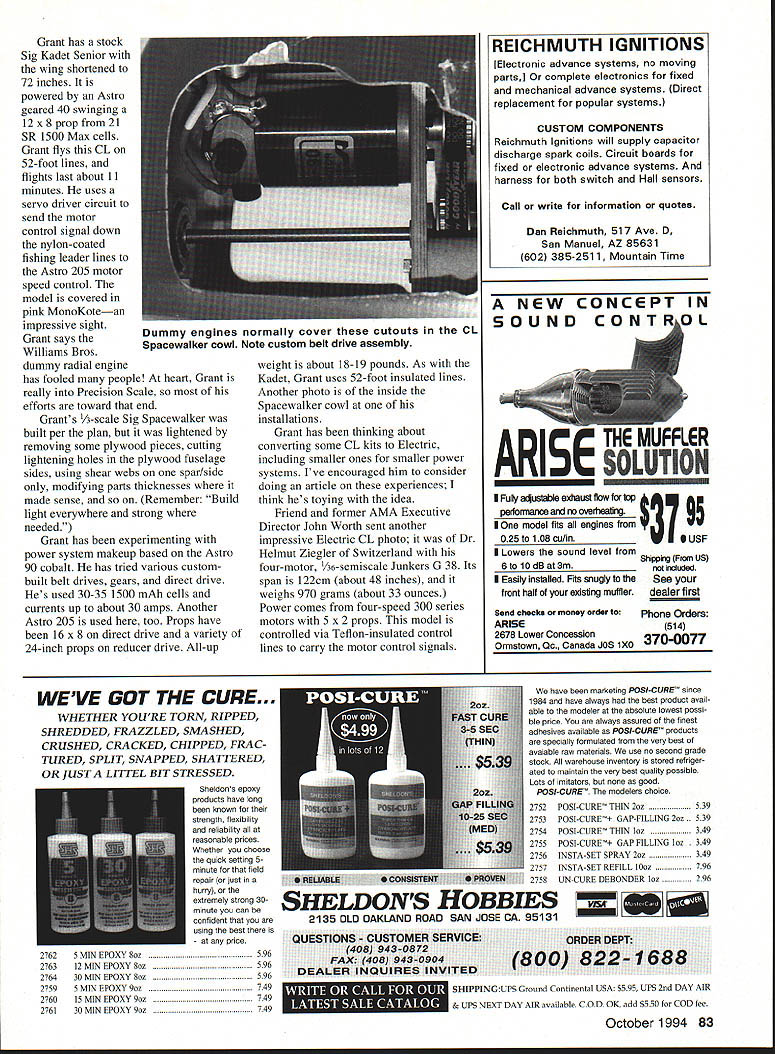
Sixth Annual Gulf States Electric Fly-In (October 22–23)
- Host: Ozone RC Club
- Location: Louisiana Polo Field
- Events: Class A Sailplane (LMR), Class A Old-Timer (LMR), Class B Sailplane (LMR), Scale, All-Up Last-Down (anything goes except extension cords).
- Additional: Open fun-flying and a Cajun cookout.
- Contact: Ben Mathews, 101 Mulberry Drive, Metairie, LA 70005; Tel.: (504) 366-4511.
- Note: This year's meet has two CDs — Paul Frederick and Stan John.
An amazing field story
Early one May morning at the local field I was flying three REVOLTs, one right after the other, testing electric products. I would charge two battery packs while I flew the third. I was having so much fun that I forgot my old car battery was being rapidly depleted.
When I returned to the car the digital voltmeter (DVM) read about 5–6 volts. Turning the ignition produced nothing — not even a starter-relay click. I could wait for help or try to use whatever charge remained in the models. I decided to attempt charging the car battery from a 12-cell REVOLT: I unplugged the model, connected its motor to the speed-control output and the car wiring to the transmitter/receiver, turned everything on, and advanced the throttle just a little. Charge began to flow into the motor/battery and the DVM slowly rose. I kept the throttle very low; after about 10–12 minutes the DVM stopped rising at about 12.8 volts.
Being preoccupied, I forgot that one speed control's brake function simply shut off the throttle — which effectively put a short across the car battery. Oblivious, I shut off the receiver and transmitter, got in the car and turned the key. The minivan started immediately. I kept my foot on the throttle while the car ammeter pegged over 50 amps to let the alternator work and the battery charge.
Back at the rear of the van I noticed no power to the rear charge point and realized what I'd done: the speed control brake had shorted the line and blown the 80-amp fuse in the van power line. I told the speed-control manufacturer, and they took the unit for evaluation. Although the microprocessor-controlled speed control was not intended for such abuse, the manufacturer asked that his product name not be mentioned. I replaced the car battery and all is well now. I share this so no one else will get the idea of using a small speed control as an emergency charger.
Build light everywhere — is that a contradiction?
"Build light everywhere, and strong where needed" is advice I've repeated for years. Because electric models tend to be heavier, attention to construction technique is even more important.
Some readers ask: if modern Electrics have "plenty of power," why bother building lighter? The answer: lighter flies better. A lighter model usually flies longer, more comfortably, and more rewardingly. While electric power can haul an overweight model, careful weight control improves flyability. Many modelers have converted glow kits to Electric and then lightened structures to get the best performance.
Also remember: "build to fly, not to crash." You cannot build a model to survive every crash — there is an impact level that will destroy any structure. I encourage selectively strong construction that avoids unnecessary mass for the most fun and longevity.
Electric Control Line (CL)
Aeromodeling includes many categories beyond RC. Control Line (CL) combined with Electric power has produced some impressive models. A few readers have sent photos and details.
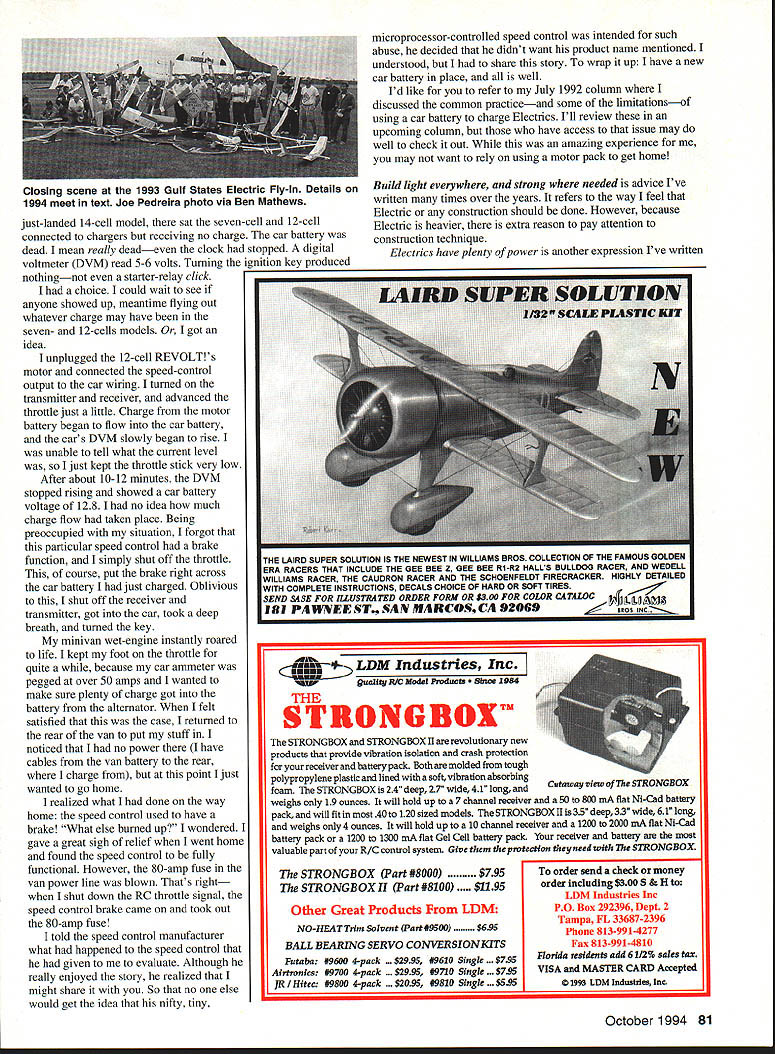
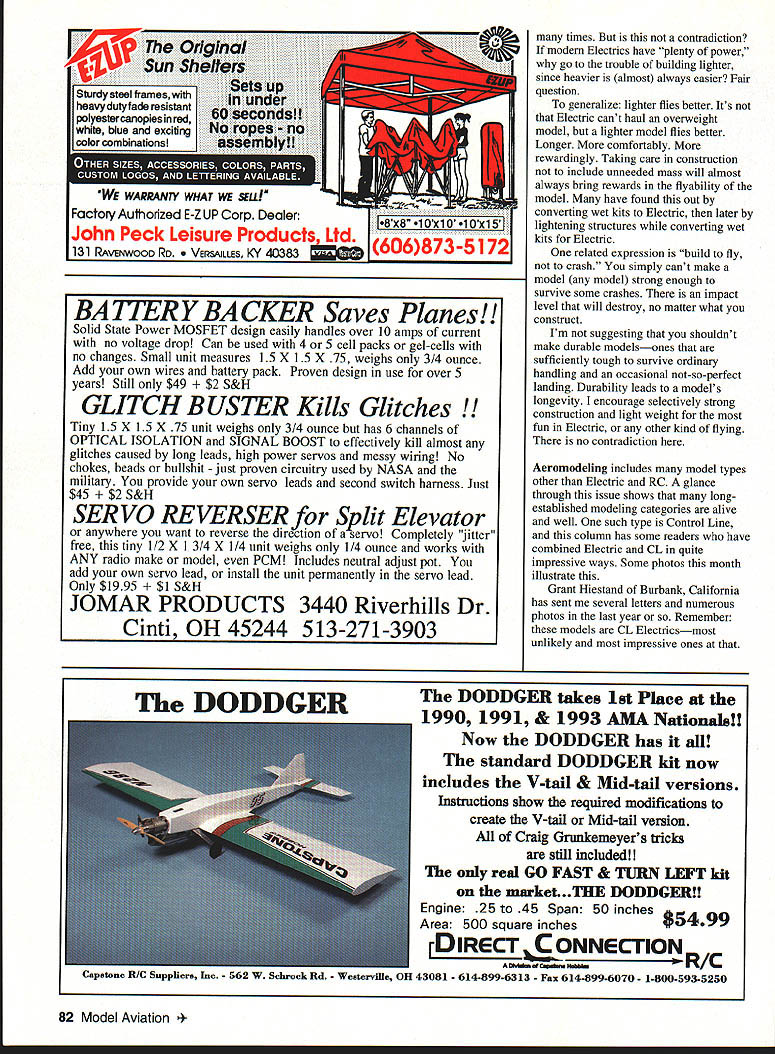
Grant Hiestand (Burbank, CA)
- Kadet Senior (stock Sig) shortened to 72" wing. Powered by an Astro geared 40 swinging a 12x8 prop from 21 SR 1500 mAh cells. Flown on 52-foot lines; flights last about 11 minutes. Grant uses a servo-driver circuit to send the motor control signal down nylon-coated fishing leader lines to an Astro 205 speed control. Covered in pink MonoKote, with a Williams Bros. dummy radial that fools many people.
- 3/4-scale Sig Spacewalker lightened (removed plywood pieces, cut lightening holes in fuselage sides, used shear webs on one spar side only, modified part thicknesses). Power systems based on the Astro 90 cobalt: custom belt drives, gears, and direct drive tested. Used 30–35 of 1500 mAh cells with currents up to about 30 amps and an Astro 205 in another installation. Props ranged from 16x8 (direct drive) to various 24" props on reducer drives. All-up weight ≈ 18–19 lb. Uses 52-foot insulated lines.
Grant is considering converting more CL kits to Electric — including smaller ones — and may write an article on his experiences.
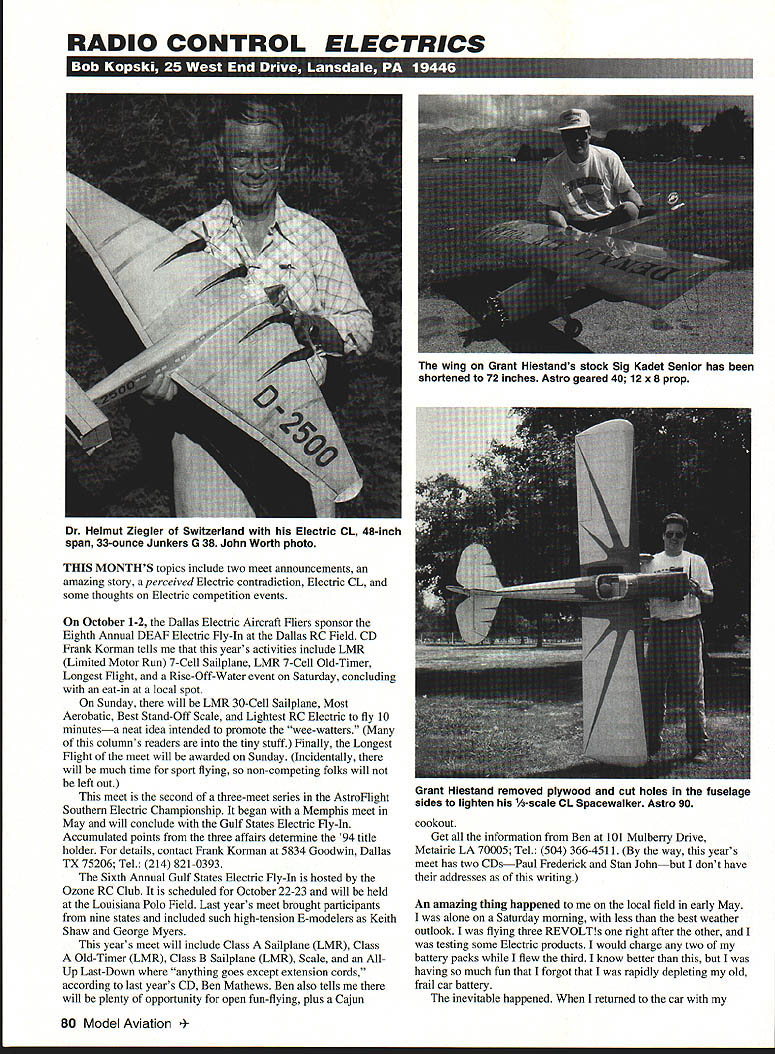
Helmut Ziegler (Switzerland) — reported by John Worrall
- Four-motor 1/36-scale Junkers G 38: span 122 cm (≈48"), weight 970 g (≈33 oz). Powered by four Speed 300 series motors with 5x2 props. The model is controlled via Teflon-insulated control lines that carry motor control signals. Helmut chaired the FAI Control Line Subcommittee of CIAM for many years and later the Scale Subcommittee.
Other items
- Bob Markle (RJM) has developed a small handle for Electric with a speed-control signal thumbwheel built in. Contact: RJM, 1017 Washington Ave. North, Huntingdon, PA 15642; Tel.: (412) 864-6123.
Electric CL has potential to attract youth: it's quiet, can be flown in confined areas, and can be economical using batteries, chargers, motors, and other gear many kids already have for electric cars. Modifying CL kits to accept readily available electric components could be a good entry path.
Electric competition events
Interest in E-power contest events is slowly growing. More meets are including electric-oriented activities in addition to the familiar fun events. Electric is past the curiosity stage and is becoming more popular and widespread; Electrics can perform impressively, and the time is right for increasing contest-oriented activity.
Having been close to the KRC Electric-Fly for 15 years and drafting occasional meet questionnaires, I know historically there was little interest in contest formats at that laid-back fun meet. It will be interesting to see if future surveys show increased appetite for contest opportunities — it will likely require attendees' insistence.
This closes another column. Please include a SASE with any correspondence for which you'd like a reply, and happy, quiet, powerful Electric landings!
Transcribed from original scans by AI. Minor OCR errors may remain.

