
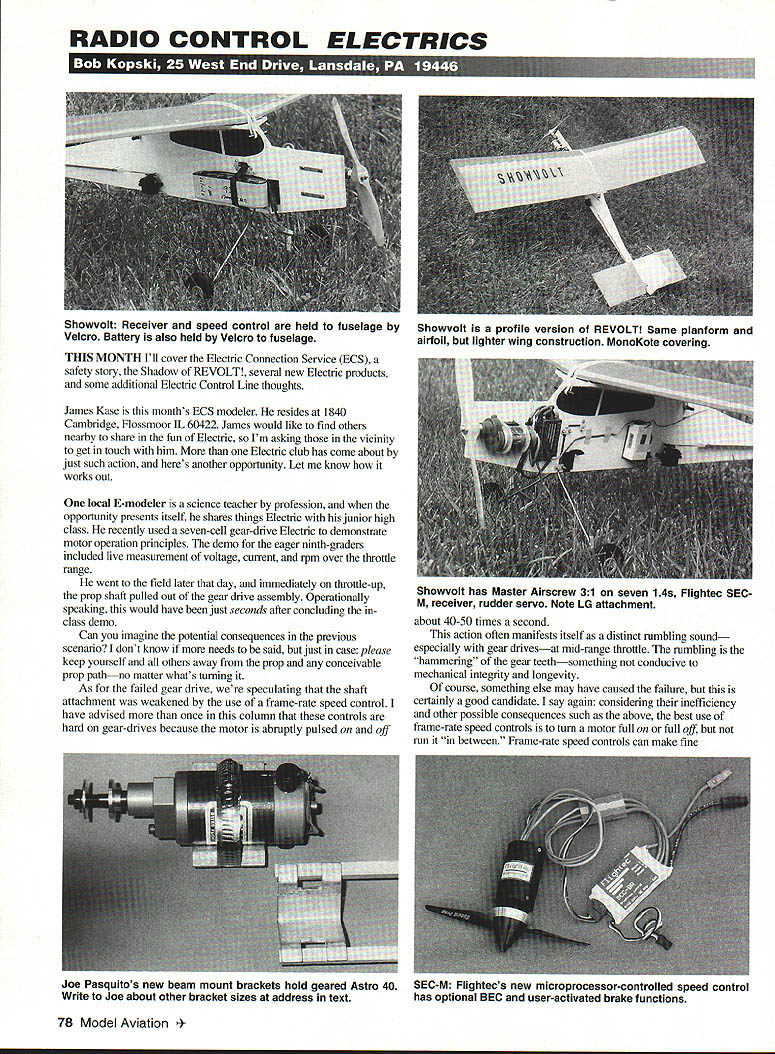
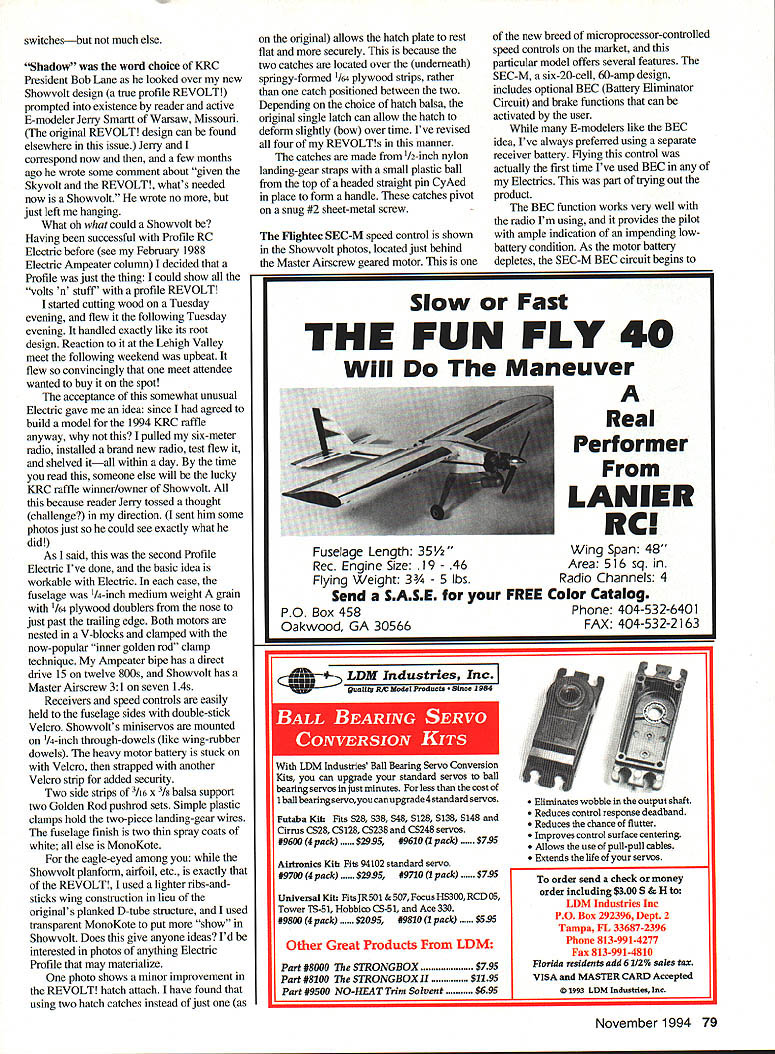
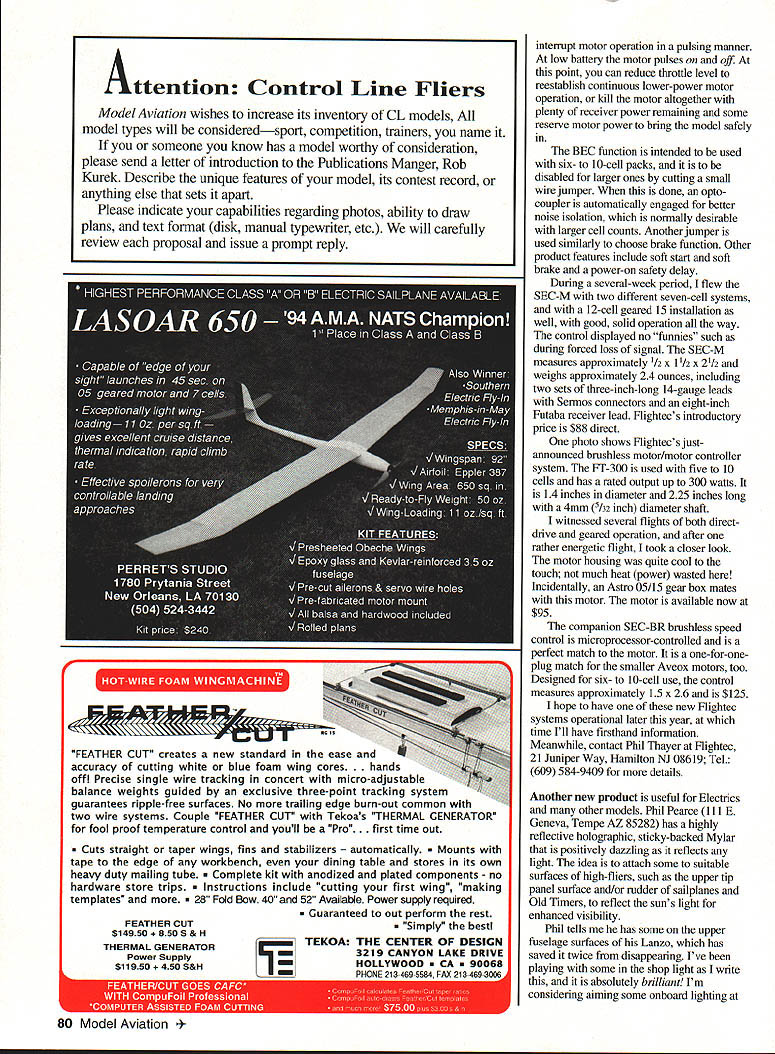
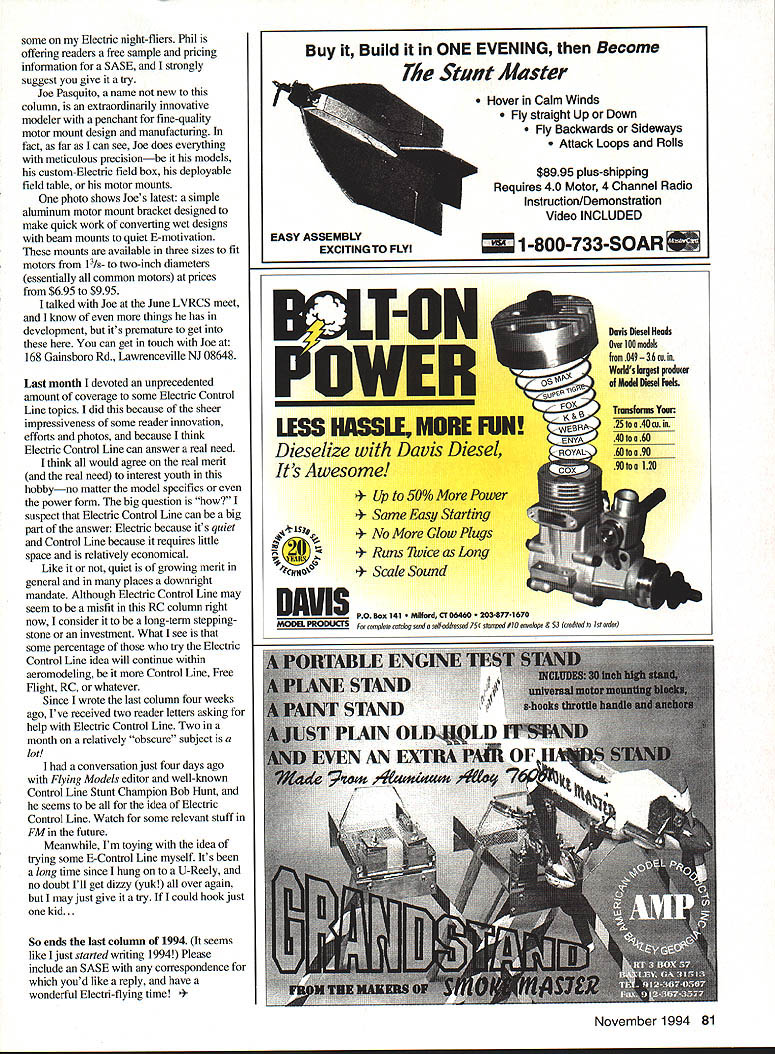
RADIO CONTROL ELECTRICS
Bob Kopski 25 West End Drive, Lansdale, PA 19446
This month I'll cover the Electric Connection Service (ECS), a safety story, the Shadow of REVOLT!, several new electric products, and some additional Electric Control Line thoughts.
Electric Connection Service (ECS)
James Kase is this month's ECS modeler. He resides at 1840 Cambridge, Flossmoor, IL 60422. James would like to find others nearby to share in the fun of electric flight, so I'm asking those in the vicinity to get in touch with him. More than one electric club has come about by just such action, and here's another opportunity. Let me know how it works out.
Safety story
One local E-modeler is a science teacher by profession, and when the opportunity presents itself he shares electric flight with his junior high class. He recently used a seven-cell gear-drive electric to demonstrate motor operation principles. The demo for the eager ninth-graders included live measurement of voltage, current, and rpm over the throttle range.
He went to the field later that day and, immediately on throttle-up, the prop shaft pulled out of the gear drive assembly. Operationally speaking, this would have been just seconds after concluding the in-class demo.
Can you imagine the potential consequences in that scenario? I don't know if more needs to be said, but just in case: please keep yourself and all others away from the prop and any conceivable prop path—no matter what's turning it.
As for the failed gear drive, we’re speculating that the shaft attachment was weakened by the use of a frame-rate speed control. I have advised more than once in this column that these controls are hard on gear drives because the motor is abruptly pulsed on and off about 40–50 times a second. This action often manifests itself as a distinct rumbling sound—especially with gear-drives—at mid-range throttle. The rumbling is the "hammering" of the gear teeth—something not conducive to mechanical integrity and longevity.
Of course, something else may have caused the failure, but this is certainly a good candidate. I say again: considering their inefficiency and other possible consequences such as the above, the best use of frame-rate speed controls is to turn a motor full on or full off, but not to run it in between. Frame-rate speed controls can make fine on/off switches, but are not suitable for running motors at intermediate throttle settings.
Shadow of REVOLT! — hatch catch modification
On the original REVOLT the hatch plate could deform slightly (bow) over time because the single latch was positioned between the two spring-formed 1/4" plywood strips. I revised all four of my REVOLT's so the hatch plate rests flat and more securely. The two catches are located over the underneath spring-formed plywood strips rather than one catch positioned between the two.
The catches are made from 1/2-inch nylon landing-gear straps with a small plastic ball on the top of a headed straight pin to form a handle. These catches pivot on a snug #2 sheet-metal screw.
New electric products and hardware
Flightec SEC-M speed control (ShowVolt photos)
The Flightec SEC-M is one of the new breed of microprocessor-controlled speed controls. The SEC-M is a 30-amp design and includes optional BEC (Battery Eliminator Circuit) and brake functions that can be activated by the user.
While many R/C modelers like the BEC idea, I have always preferred using a separate receiver battery. Flying with this control was actually the first time I used BEC in any of my electrics—part of trying out the product.
The BEC function works very well with the radio I'm using and provides the pilot with ample indication of an impending low-battery condition. As the motor battery depletes, the SEC-M BEC circuit begins to interrupt motor operation in a pulsing manner. At low battery the motor pulses on and off. At this point you can reduce throttle level to reestablish continuous lower-power motor operation, or kill the motor altogether with plenty of receiver power remaining and some reserve motor power to bring the model in safely.
The BEC function is intended to be used with six- to 10-cell packs and is to be disabled for larger ones by cutting a small wire jumper. When this is done, an opto-coupler is automatically engaged for better noise isolation, which is normally desirable with larger cell counts. Another jumper is used similarly to choose brake function. Other product features include soft start, soft brake, and a power-on safety delay.
During a several-week period, I flew the SEC-M with two different seven-cell systems and with a 12-cell geared .15 installation as well, with good, solid operation all the way. The control displayed no "funny" behavior during forced loss of signal. The SEC-M measures approximately 1/2" x 1-1/2" x 2-1/2" and weighs approximately 2.4 ounces, including two sets of three-inch-long 14-gauge leads with Semco connectors and an eight-inch Futaba receiver lead. Flightec's introductory price is $88 direct.
Flightec brushless system — FT-300 motor and SEC-BR controller
One photo shows Flightec's just-announced brushless motor/motor controller system. The FT-300 is used with five to 10 cells and has a rated output up to 300 watts. It is 1.4 inches in diameter and 2.25 inches long with a 4mm (5/32 inch) diameter shaft.
I witnessed several flights of both direct-drive and geared operation, and after one rather energetic flight I took a closer look. The motor housing was quite cool to the touch—not much heat lost here. Incidentally, an Astro 05/15 gearbox mates with this motor. The motor is available now at $95.
The companion SEC-BR brushless speed control is microprocessor-controlled and is a perfect match for the motor. It is a one-for-one plug match for the smaller Avemco motors, too. Designed for six- to 10-cell use, the control measures approximately 1.5" x 2.6" and is $125.
I hope to have one of these new Flightec systems operational later this year, at which time I'll have firsthand information.
Contact: Phil Thayer, Flightec, 21 Juniper Way, Hamilton, NJ 08619; Tel: (609) 584-9409.
Holographic reflective Mylar (Phil Pearce)
Phil Pearce (111 E. Geneva, Tempe, AZ 85282) has a highly reflective holographic, sticky-backed Mylar that is wonderfully dazzling and reflects any light. The idea is to attach some to suitable surfaces of high-flyers—such as the upper surface of the vertical fin/rudder of sailplanes and Old Timers—to reflect the sun's light for enhanced visibility.
Phil tells me he has some on the upper fuselage surfaces of his Lanzo, which has saved it twice from disappearing. I'm considering attaching some on my electric night-fliers. Phil is offering readers a free sample and pricing information for a SASE.
Joe Pasquito motor mounts
Joe Pasquito is an extraordinarily innovative modeler with a penchant for fine-quality motor mount design and manufacturing. Joe does everything with meticulous precision—his models, his custom electric field box, his deployable field table, and his motor mounts.
One photo shows Joe's latest: a simple aluminum motor mount bracket designed to make quick work of converting beam mounts to quiet E-motivation. These mounts are available in three sizes to fit motors from 1-3/8" to 2" diameters (essentially all common motors) at prices from $6.95 to $9.95.
Contact: Joe Pasquito, 168 Gainsboro Rd., Lawrenceville, NJ 08648.
Electric Control Line thoughts
Last month I devoted an unprecedented amount of coverage to some Electric Control Line topics because of the sheer impressiveness of reader innovation, efforts, and photos, and because I think Electric Control Line can answer a real need. I think all would agree on the merit (and the real need) to interest youth in this hobby—no matter the model specifics or even the power form. The big question is "how?" I suspect that Electric Control Line can be a big part of the answer. Electric because it's quiet, and Control Line because it requires little space and is relatively economical.
Like it or not, quiet is of growing merit in general and in many places a downright mandate. Although Electric Control Line may seem to be a misfit in this RC column right now, I consider it to be a long-term stepping-stone or an investment. What I see is that some percentage of those who try the Electric Control Line idea will continue with aeromodeling, be it more Control Line, Free Flight, RC, or whatever.
Since I wrote the last column four weeks ago, I've received two reader letters asking for help with Electric Control Line. Two in a month on a relatively "obscure" subject is a lot!
I had a conversation just four days ago with Flying Models editor and well-known Control Line stunt champion Bob Hunt, and he seems to be all for the idea of Electric Control Line. Watch for some relevant stuff in Flying Models in the future.
Meanwhile, I'm toying with the idea of trying some E-Control Line myself. It's been a long time since I hung on to a U-Reely, and no doubt I'll get dizzy (yuk!) all over again, but I may just give it a try. If I could hook just one kid...
So ends the last column of 1994. (It seems like I just started writing 1994!) Please include an SASE with any correspondence for which you'd like a reply, and have a wonderful electri-flying time!
—JY
Transcribed from original scans by AI. Minor OCR errors may remain.

