
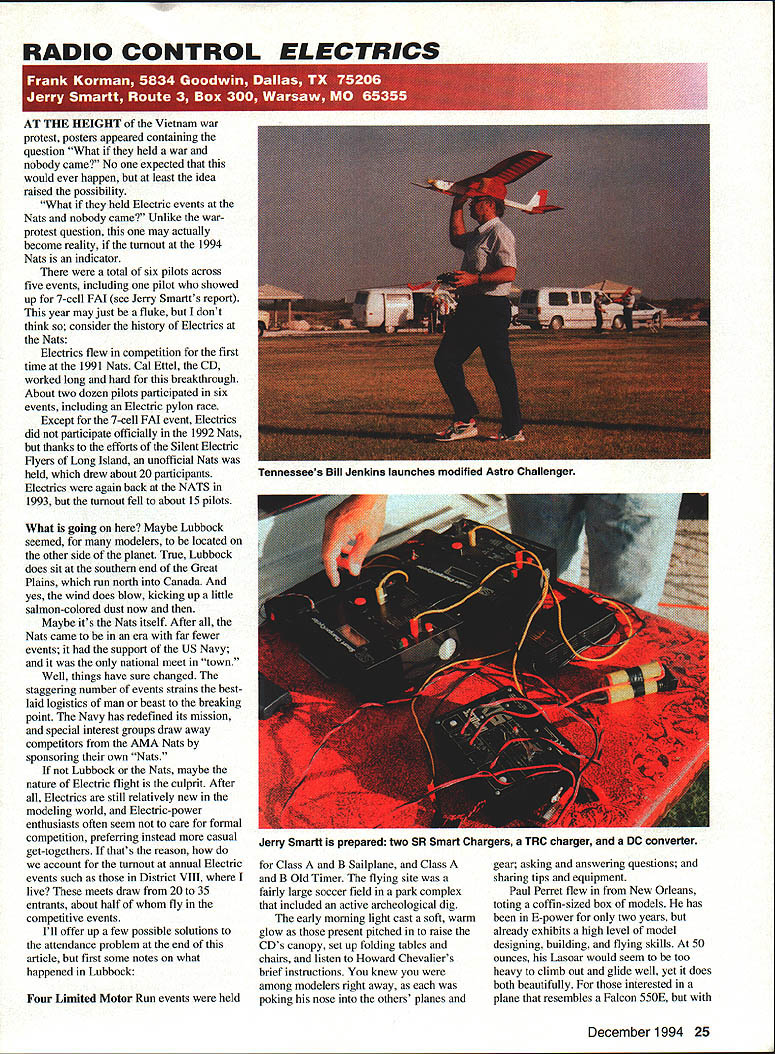
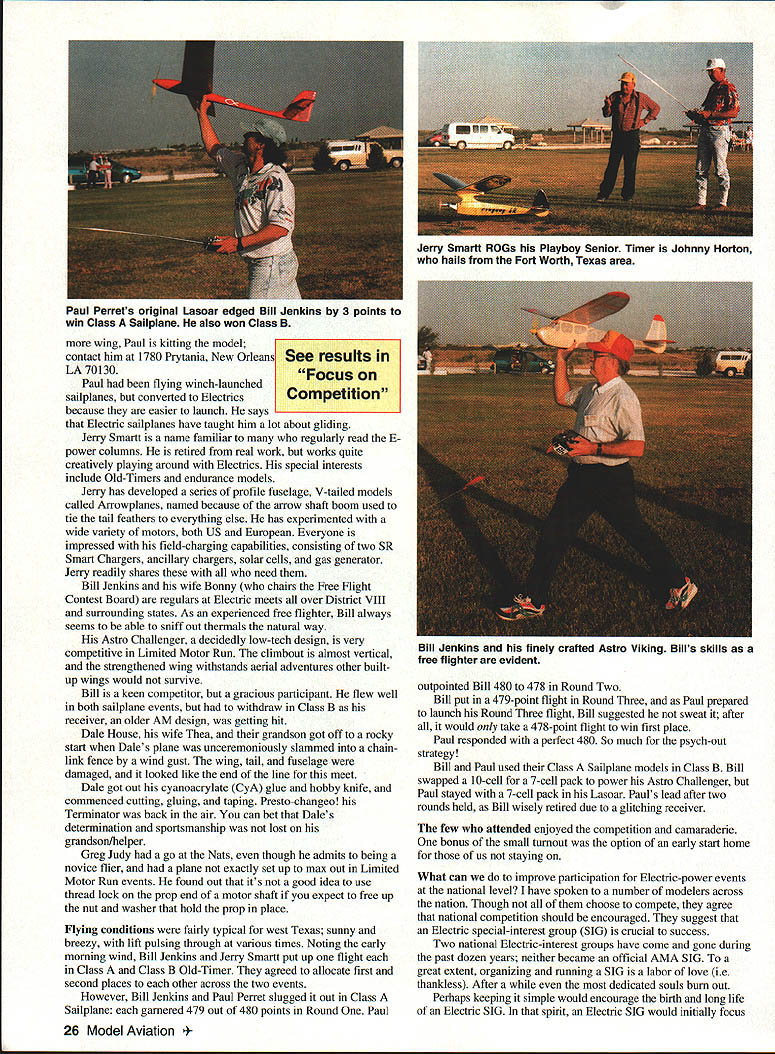
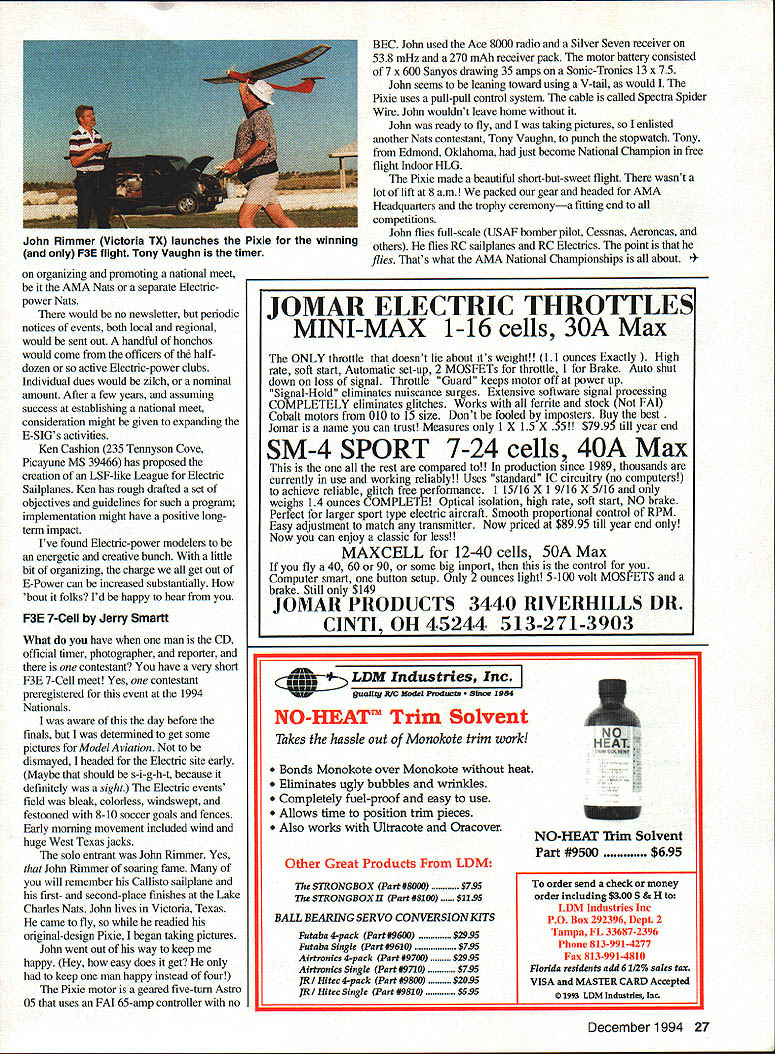
RADIO CONTROL ELECTRICS
Frank Korman, 5834 Goodwin, Dallas, TX 75206 Jerry Smartt, Route 3, Box 300, Warsaw, MO 65355
At the height of the Vietnam War protest, posters appeared containing the question, "What if they held a war and nobody came?" No one expected that to happen, but at least the idea raised the possibility.
What if they held Electric events at the Nats and nobody came? Unlike the war-protest question, this one may actually become reality if the turnout at the 1994 Nats is any indicator. There were a total of six pilots across five events, including one pilot who showed up for the 7-cell FAI event. This year may be a fluke, but consider the recent history of Electrics at the Nats:
- 1991: Electrics flew in competition for the first time at the Nats. About two dozen pilots participated in six events, including an Electric pylon race.
- 1992: Except for the 7-cell FAI event, Electrics did not participate officially. An unofficial Nats, organized by the Silent Electric Flyers of Long Island, drew about 20 participants.
- 1993: Electrics were back at the Nats, but turnout fell to about 15 pilots.
- 1994: Only six pilots across five events.
What is going on? Maybe Lubbock seems remote to many modelers. True, Lubbock sits at the southern end of the Great Plains and the wind kicks up a little salmon-colored dust now and then. Maybe it's the Nats itself: the meet has expanded enormously since its early days, the Navy no longer provides the same support, and many special-interest groups now sponsor their own "Nats."
If not Lubbock or the Nats, perhaps the nature of Electric flight is the culprit. Electrics are still relatively new in the modeling world, and Electric-power enthusiasts often prefer casual get-togethers to formal competition. Yet annual Electric events in districts such as District VIII draw 20 to 35 entrants, about half of whom fly in competitive events. That shows competitive interest exists at regional levels.
Below are notes on what happened in Lubbock and some suggestions for improving national Electric-power participation.
Lubbock Nats: Limited Motor Run events and the field
Four Limited Motor Run events were held: Class A Sailplane, Class B Sailplane, Class A Old Timer, and Class B Old Timer. The flying site was a fairly large soccer-field park complex that included an active archaeological dig. Early morning light cast a soft, warm glow as those present pitched in to raise the CD's canopy, set up folding tables and chairs, and listen to Howard Chevalier's brief instructions.
You knew you were among modelers right away: people poking noses into each other's planes and gear; asking and answering questions; and sharing tips and equipment.
Paul Perret flew in from New Orleans, toting a coffin-sized box of models. He has been into E-power for two years and already exhibits a high level of model designing, building, and flying skills. At 50 ounces his Lasoar would seem too heavy to climb out and glide well, yet it does both beautifully. For those interested in a plane that resembles a Falcon 550E, Paul is a kitting-model contact (1780 Prytania, New Orleans, LA 70130). Paul flies winch-launched Focus sailplanes converted to Electrics—"competition because easier launch," he says. Electric sailplanes have taught him a lot about gliding.
Jerry Smartt is familiar to readers of E-Power columns. Retired from real work, he plays creatively with Electrics. His special interests include Old-Timers and endurance models. Jerry has developed a series of profile-fuselage, V-tailed models called Arrowplanes—named because an arrow-shaft boom is used to tie the tail feathers. He has experimented with a wide variety of motors, both U.S. and European. Everyone was impressed with his field-charging setup: two SR Smart Chargers, ancillary chargers, solar cells, and a gas generator. Jerry readily shares his knowledge and gear.
Bill Jenkins, whose wife Bonny chairs the Free Flight Contest Board, is a regular at Electric meets in District VIII and surrounding states. As an experienced free-flighter, Bill always seems able to sniff out thermals. The Astro Challenger is a decidedly low-tech design but very competitive in Limited Motor Run: its climbout is almost vertical, and the strengthened wing withstands aerial adventures that other built-up wings might not survive. Bill is a keen competitor and a gracious participant.
Dale House, his wife Thea, and their grandson got off to a rocky start when a wind gust slammed Dale's plane into a chain-link fence. The wing, tail, and fuselage were damaged, and it looked like the end of the line for this meet. Dale pulled out cyanoacrylate (CyA) glue and a hobby knife, commenced cutting, gluing, and taping—and presto change-o, his Terminator was back in the air. Dale's determination and sportsmanship were not lost on his grandson/helper.
Greg Judy, a novice flier, had a go at the Nats with a plane not set up to max out in Limited Motor Run events. He learned it's not a good idea to use a thread lock on the prop end of a motor shaft if you expect to free the nut and washer that hold the prop in place.
Flying conditions were fairly typical for west Texas: sunny and breezy, with lift pulsing through at various times. Noting the early-morning wind, Bill Jenkins and Jerry Smartt each put up one flight in Class A and Class B Old-Timer, and they agreed to allocate first and second places to each other across the two events.
Bill Jenkins and Paul Perret slugged it out in Class A Sailplane: each garnered 479 out of 480 points in Round One. Paul outpointed Bill 480 to 478 in Round Two. Bill put in a 479-point flight in Round Three, and as Paul prepared to launch his Round Three flight, Bill suggested he not sweat it; after all, it would only take a 478-point flight to win first place. Paul responded with a perfect 480. So much for the psych-out strategy!
Bill and Paul used their Class A Sailplane models in Class B. Bill swapped a 10-cell for a 7-cell pack to power his Astro Challenger, but Paul stayed with a 7-cell pack in his Lasoar. Paul's lead held after two rounds, as Bill wisely retired due to a glitching receiver.
The few who attended enjoyed the competition and camaraderie. One bonus of the small turnout was the option of an early start home for those not staying on.
F3E 7-Cell by Jerry Smartt
What do you have when one man is the CD, official timer, photographer, and reporter, and there is one contestant? You have a very short F3E 7-Cell meet. One contestant preregistered for this event at the 1994 Nationals.
I was aware of this the day before the finals, but I was determined to get some pictures for Model Aviation. The Electric events field was black, colorless, windswept, and festooned with 8–10 soccer goals and fences. Early morning movement included wind and huge West Texas jackrabbits.
The sole entrant was John Rimmer—yes, that John Rimmer of soaring fame. Many will remember his Callisto sailplane and his first- and second-place finishes at the Lake Charles Nats. John lives in Victoria, Texas. He came to fly, so while he readied his original-designed Pixie, I began taking pictures. John went out of his way to keep me happy.
The Pixie motor is a geared five-turn Astro 05 that uses an FAA 65-amp controller with no BEC. John used an Ace 8000 radio and a Silver Seven receiver on 53.8 MHz and a 270 mAh receiver pack. The motor battery consisted of 7 × 600 Sanyos drawing 35 amps on a Sonic-Tronics 13 × 7.5 prop. John seems to favor a V-tail; the Pixie uses a pull-pull control system with Spectra Spider Wire for the cables.
John was ready to fly, and I was taking pictures, so I enlisted another Nats contestant, Tony Vaughn of Edmond, Oklahoma, to punch the stopwatch. Tony had just become National Champion in free-flight Indoor HLG. The Pixie made a beautiful short-but-sweet flight—there wasn't a lot of lift at 8 a.m.! We packed our gear and headed for AMA Headquarters and the trophy ceremony—a fitting end to all competitions.
John flies full-scale (USAF bomber pilot, Cessnas, Aeroncas, and others), RC sailplanes, and RC Electrics. The point is, he flies. That's what the AMA National Championships is all about.
How to improve national Electric participation
I have spoken to a number of modelers across the nation. Though not all choose to compete, they agree that national competition should be encouraged. The biggest incentive seems to be an Electric special-interest group (SIG). Two national Electric-interest groups have come and gone over the past dozen years; neither became an official AMA SIG. Organizing and running a SIG is largely a labor of love, and over time even the most dedicated people burn out.
Perhaps keeping it simple would encourage the birth and long life of an Electric SIG. In that spirit, an Electric SIG could initially focus on organizing and promoting a national meet—whether at the AMA Nats or as a separate Electric-power Nats. Proposed features:
- No newsletter at first; instead, periodic notices of events (local and regional) sent out as needed.
- A small group of officers drawn from active Electric-power clubs to handle organization.
- Nominal individual dues (e.g., $2) to cover basic expenses.
- After a few years and demonstrable success in establishing a national meet, consider expanding the SIG's activities.
Ken Cashion (235 Tennyson Cove, Picayune, MS 39466) has proposed creating an LSF-like league for Electric sailplanes. He has rough-drafted objectives and guidelines; implementation might have a positive long-term impact.
I've found Electric-power modelers to be energetic and creative. With a little organizing, participation in E-Power events can be increased substantially. How 'bout it, folks? We'd be happy to hear from you.
Transcribed from original scans by AI. Minor OCR errors may remain.

