
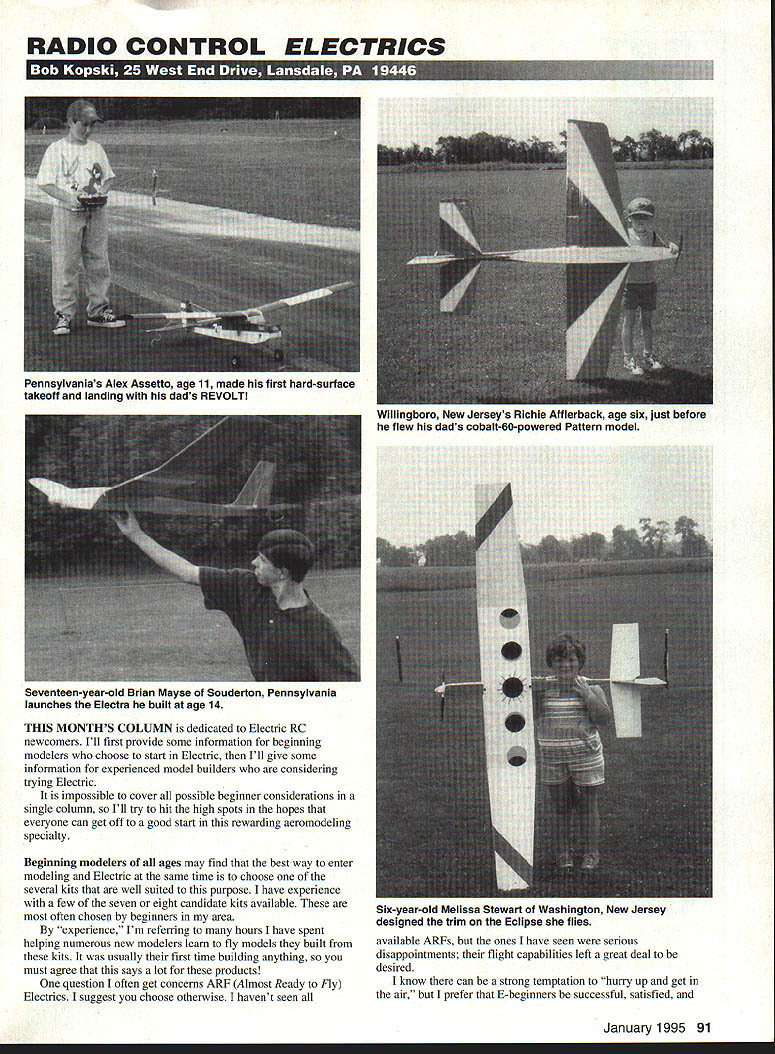
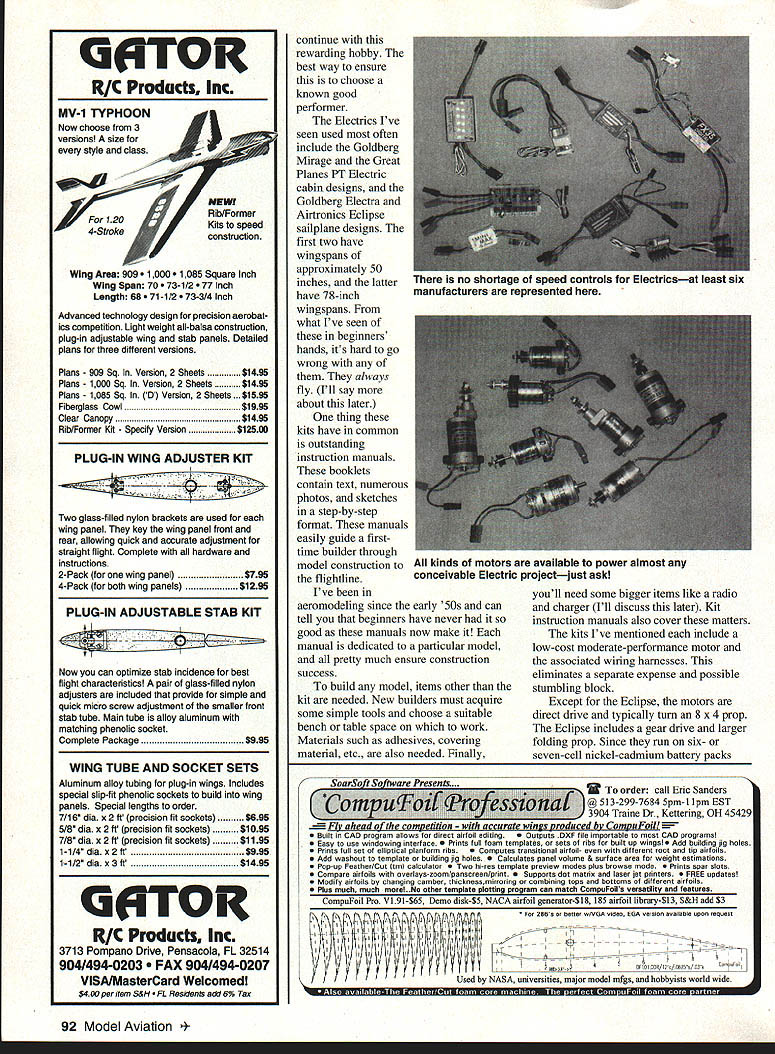
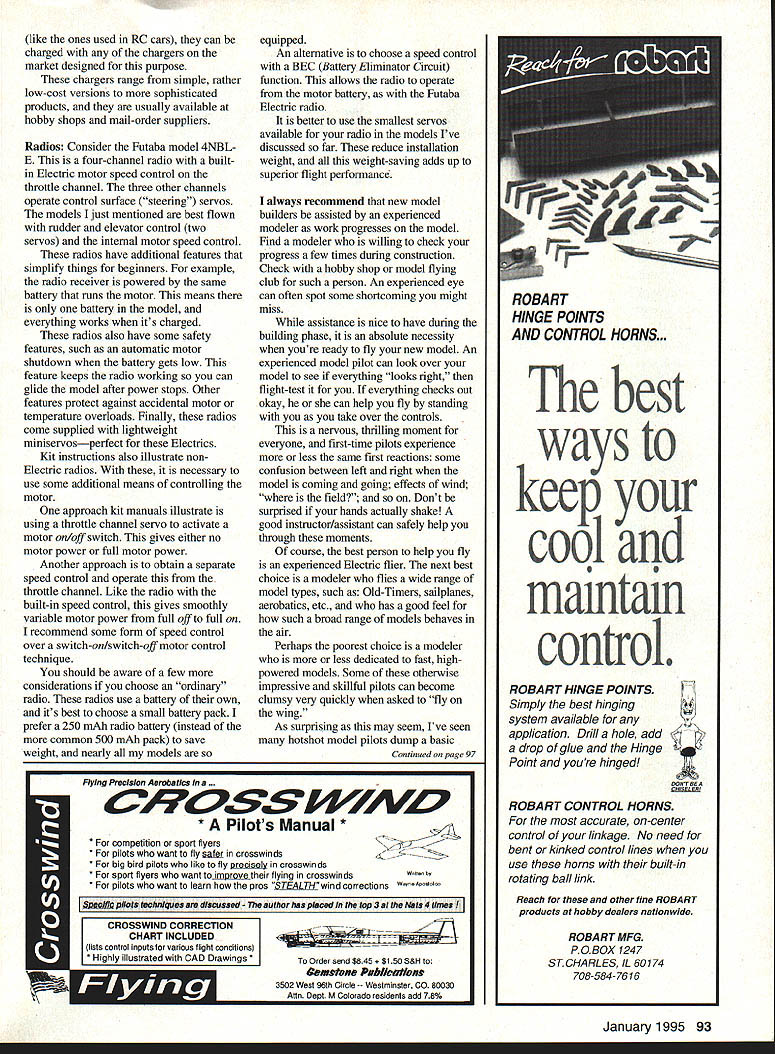
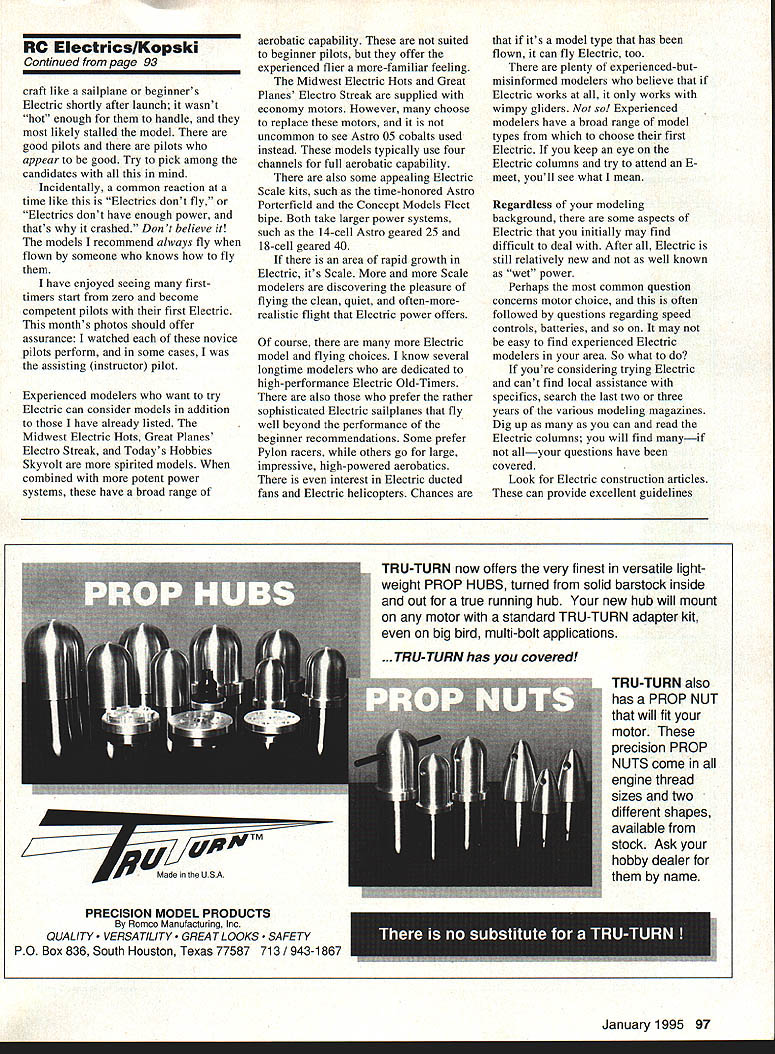
RADIO CONTROL: ELECTRICS
Bob Kopski 25 West End Drive, Lansdale, PA 19446
Introduction
This column is dedicated to newcomers to Electric RC. I’ll first provide information for beginning modelers who choose to start in Electric, then give pointers for experienced builders considering a switch. It’s impossible to cover every beginner consideration here, so I’ll hit the high spots to help you get off to a good start in this rewarding aeromodeling specialty.
Choosing a starter model
For beginners of all ages, the best way to enter modeling and Electric at the same time is often to choose one of several kits well suited to this purpose. From my experience helping many new modelers, these kits are commonly chosen and perform reliably in novice hands.
Recommended beginner kits (typical, reliable performers):
- Goldberg Mirage
- Great Planes PT (electric cabin designs)
- Goldberg Electra
- Airtronics Eclipse (sailplane)
Notes:
- The PT/Mirage styles have wingspans around 50 inches; the Electra/Eclipse sailplanes are about 78 inches.
- These kits typically include low-cost, moderate-performance motors and wiring harnesses, which removes a separate expense and a possible stumbling block.
- Avoid most ARF (Almost Ready to Fly) Electrics for beginners; many I’ve seen were disappointing in flight capability. Choose a known good performer to ensure satisfaction and continued enjoyment.
Instruction manuals and building
One thing these kits have in common is outstanding instruction manuals. The booklets contain step-by-step text, photos, and sketches that easily guide a first-time builder through construction and flight preparation. Beginners have never had it so good—model-dedicated manuals greatly increase the chance of construction success.
What else you’ll need:
- Simple tools and a suitable bench or table.
- Materials such as adhesives, covering material, etc.
- Larger items such as a radio and a charger (see below).
Kit manuals often cover radio setup, balance and center of gravity, and flying tips. If you buy a kit from a reputable maker, much of this information is already included.
Motors, props, and batteries
- Most kit motors (except the Eclipse) are direct-drive and typically turn an 8x4 prop.
- The Eclipse uses a gear drive and a larger folding prop.
- These motors run on six- or seven-cell nickel-cadmium (NiCd) battery packs. NiCd packs can be charged with any charger designed for such cells.
Chargers
- Chargers range from simple, low-cost versions to more sophisticated units.
- They’re available at hobby shops and from mail-order suppliers.
- Choose a charger appropriate for NiCd packs and the pack size you’ll use.
Radios and motor control
Recommended radio example:
- Futaba model 4NBL-E — a four-channel radio with a built-in electric motor speed control on the throttle channel. The other three channels operate control-surface servos.
Advantages of an electric-specific radio with built-in speed control:
- Receiver can be powered from the motor battery, so the model uses only one battery.
- Built-in safety features (e.g., automatic motor shutdown when battery becomes low) let the radio remain powered so you can glide in after power loss.
- Protections against accidental motor overloads and temperature issues.
- Often supplied with lightweight miniservos suitable for beginner Electrics.
Alternatives if you use an "ordinary" radio:
- Use a throttle-channel servo to activate a motor on/off switch (gives either no motor power or full motor power).
- Use a separate speed control operated from the throttle channel (recommended). This provides smoothly variable motor power from off to full.
- Consider a speed control with a BEC (Battery Eliminator Circuit) to allow the radio to operate from the motor battery (like the Futaba Electric radio).
Radio battery and servos:
- Ordinary radios use their own battery. I prefer a small 250 mAh radio battery instead of the more common 500 mAh pack to save weight.
- Use the smallest servos appropriate for the model to reduce installation weight and improve flight performance.
Assistance and first flights
- I strongly recommend that new builders be assisted by an experienced modeler during construction and especially for the first flights.
- Ask a hobby shop or flying club to recommend someone who will check your progress a few times during construction.
- When ready to fly, an experienced pilot should inspect and flight-test the model and stand with you as you take over the controls.
Choosing an assistant:
- Best: an experienced Electric flier.
- Next best: a modeler who flies a wide range of types (Old-Timers, sailplanes, aerobatics) and has a feel for different flight behaviors.
- Poor choice: someone dedicated mainly to fast, high-powered models. Some of these pilots can mishandle basic, low-speed craft and inadvertently stall them.
What to expect on your first flights:
- Nervousness and physical reactions (e.g., shaking hands).
- Confusion about left/right orientation and wind effects.
- A good instructor will safely guide you through these moments.
Don’t believe the myth that “Electrics don’t fly” or “don’t have enough power.” The recommended models will fly when flown by someone who knows how to handle them.
For experienced modelers trying Electric
If you already have flying experience and want more spirited Electrics, consider:
- Midwest Electric Hots
- Great Planes Electro Streak
- Today’s Hobbies Skyvolt
Notes:
- These are supplied with economy motors but are often re-motored (e.g., with Astro 05 cobalts) for better performance.
- They typically use four channels for full aerobatic capability.
- Electric Scale kits (e.g., Astro Porterfield, Concept Models Fleet biplane) accept larger power systems (14-cell Astro geared 25, 18-cell geared 40) and showcase the quiet, realistic flight Electric power can offer.
There are many Electric niches: high-performance Old-Timers, advanced sailplanes, pylon racers, large high-powered aerobatics, ducted fans, and helicopters. If a model type has been flown, it can probably be converted to Electric.
Resources and community
- If local Electric expertise is scarce, search recent modeling magazines for Electric columns and construction articles—many questions are covered.
- Electric columnists often answer reader mail and can provide experience-based advice or referrals.
- Electric meets are increasingly common and are excellent places to see current Electric RC, ask questions, and meet accommodating E-modelers and manufacturers.
- Don’t let lack of information stop you—ask questions and attend meets.
Final advice and closing
- Continue enjoying the hobby by choosing a known good performer and by seeking assistance when needed.
- When writing to columnists or manufacturers, include a stamped, self-addressed envelope (SASE) for replies.
- Happy holidays and happy Electric landings to all—especially beginning E-modelers!
Transcribed from original scans by AI. Minor OCR errors may remain.

