
RADIO CONTROL ELECTRICS
Bob Kopski 25 West End Drive, Lansdale, PA 19446
This month: one Electric Connection, a meet announcement, several new electric products, a new Electric video, REVOLT followup, and a unique speed-control study.
---
Electric Connection
Contact
Bill Thomas Box 284 Otis, KS 67565 Tel: 913-387-2577
Bill has been a modeler for 20+ years. Two years ago he tried electric flight and it quickly became a major interest. He describes himself as one of the unfortunate ones who can't find anyone nearby interested in electric flying. He would like to hear from other electric-minded modelers in his area.
---
Upcoming Meet
- Watts Happening 1995 — February 25–26
- Electric R/C aircraft contest presented by the Las Vegas Radio Control Club.
- Low-key fun-fly format: Best of Show, Best in Scale, daily All-Up Last-Down, etc.
- Information: Dick Corby, 6209 Alta Dr., Las Vegas, NV 89107. Tel: 702-870-9522.
---
New Electric Goodies
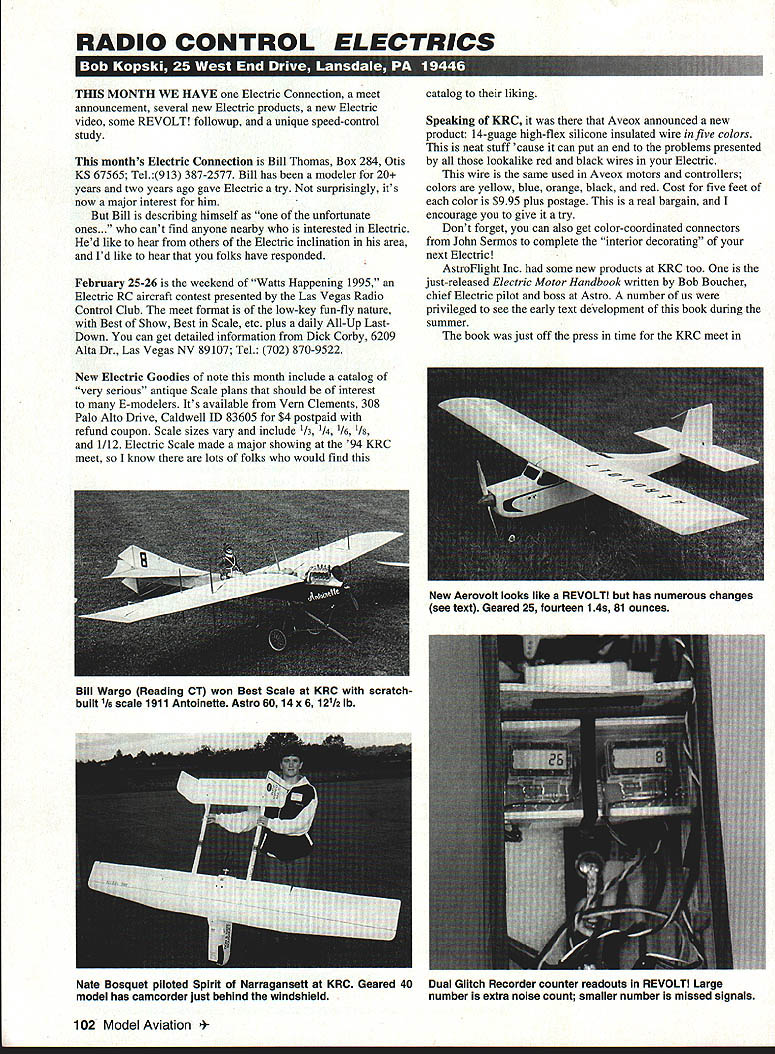
- Antique Scale Plans Catalog
- A catalog of serious antique scale plans (1/3, 1/4, 1/6, 1/8, 1/12) from Vern Clements.
- Contact: Vern Clements, 308 Palo Alto Drive, Caldwell, ID 83605.
- Price: $4 postpaid (refund coupon included).
- Aveox 14-gauge High-Flex Silicone Wire
- Five colors: yellow, blue, orange, black, red (same wire used in Aveox motors/controllers).
- Five feet of each color: $9.95 plus postage.
- Useful to avoid the look-alike red/black wiring confusion. Color-coordinated connectors are also available from John Sermos.
- AstroFlight, Inc. New Products
- Electric Motor Handbook by Bob Boucher — covers motor timing, speed-control operation, prop selection, batteries, etc. Recommended for serious electric modelers. Price: $14.95.
- Other AstroFlight items: new catalog, helical-cut gear drives, heavily vented cooling motors, oval machined housings for weight reduction, and two new microprocessor-controlled speed controls.
- Electric Fly Video (KRC)
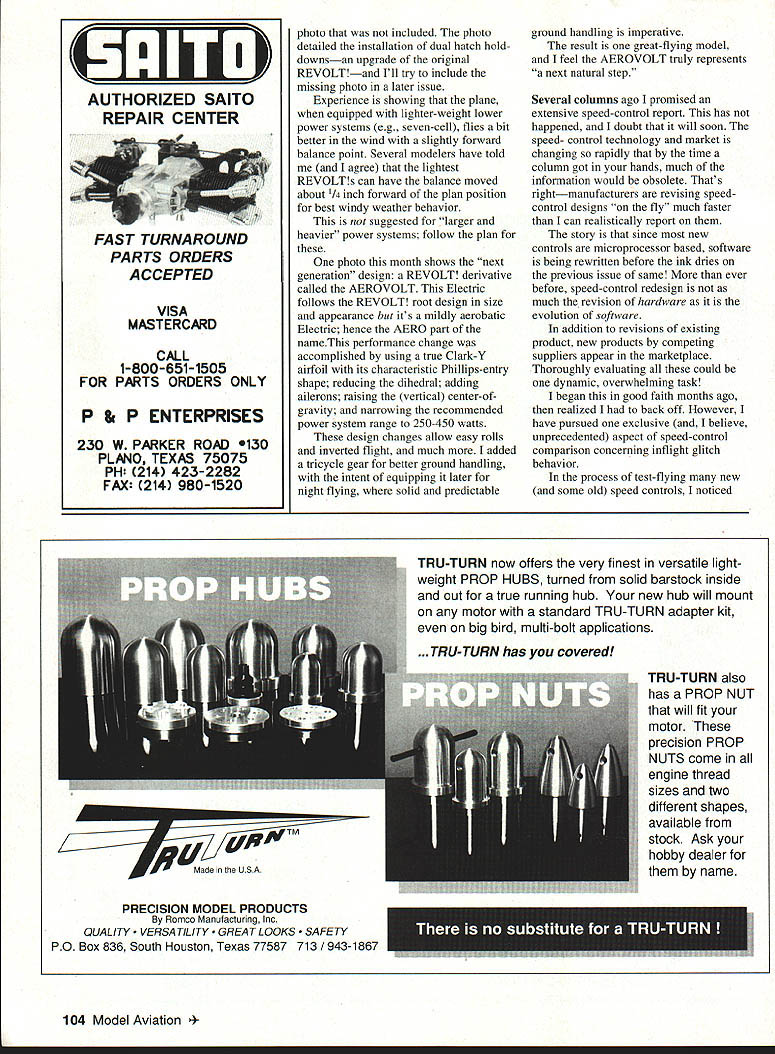
- Professionally produced tape celebrating electric flight and the 15th-anniversary KRC event. Covers three days of activities with highlights, interviews, and airborne camera footage by Nate Bosquet.
- Order from: John Hickey, 1624 Maple Ave., Hatfield, PA 19440.
- Cost: $23 ($20 + S/H; shipping/foreign extra). John reported 72 orders from attendees; the tape is recommended for personal enjoyment or club programs.
---
REVOLT Followup and Clarifications
- Clarifications from the November 1994 Model Aviation REVOLT feature:
- No cross-sheeting of top to bottom of the fuselage aft of the wing trailing-edge location except for the minimal amount shown on the plans.
- Battery area is designed to accept packs either standing up or laying down.
- Proper cooling of the power system is required.
- Dihedral instruction correction: the text should read "...propping up the wing tips 3"–3 1/4" from the bench."
- Dual hatch hold-down photo referenced in the column was omitted; that installation (an upgrade) may be published in a later issue.
- Balance note: when using lighter-weight, lower-power systems (e.g., seven-cell), the lightest REVOLT!s can handle a balance point moved about 1/4" forward of the plan position for improved windy-weather behavior. Do not move the balance forward for larger/heavier power systems — follow the plan.
---
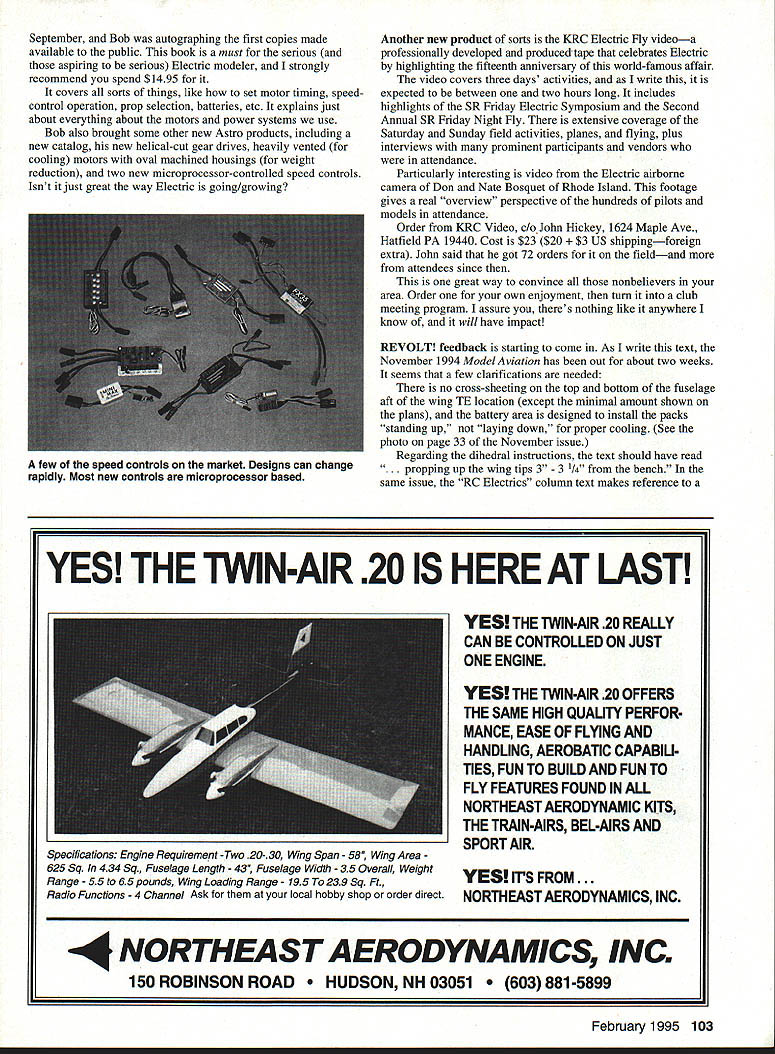
AEROVOLT — A REVOLT Derivative
- AEROVOLT description: a mildly aerobatic evolution of the REVOLT, similar in size and appearance but capable of rolls and inverted flight. Key design changes:
- True Clark-Y airfoil (Phillips-entry shape)
- Reduced dihedral
- Added ailerons
- Raised vertical center of gravity
- Narrowed recommended power range to 250–450 watts
- Optional tricycle gear for improved ground handling and planned night-flying capability
The result is a well-performing model that represents a logical next step from the REVOLT.
---
Speed-Control Glitch Study
Purpose
To quantify inflight radio "glitches" caused or influenced by speed controls and to provide numeric data to suppliers.
Method
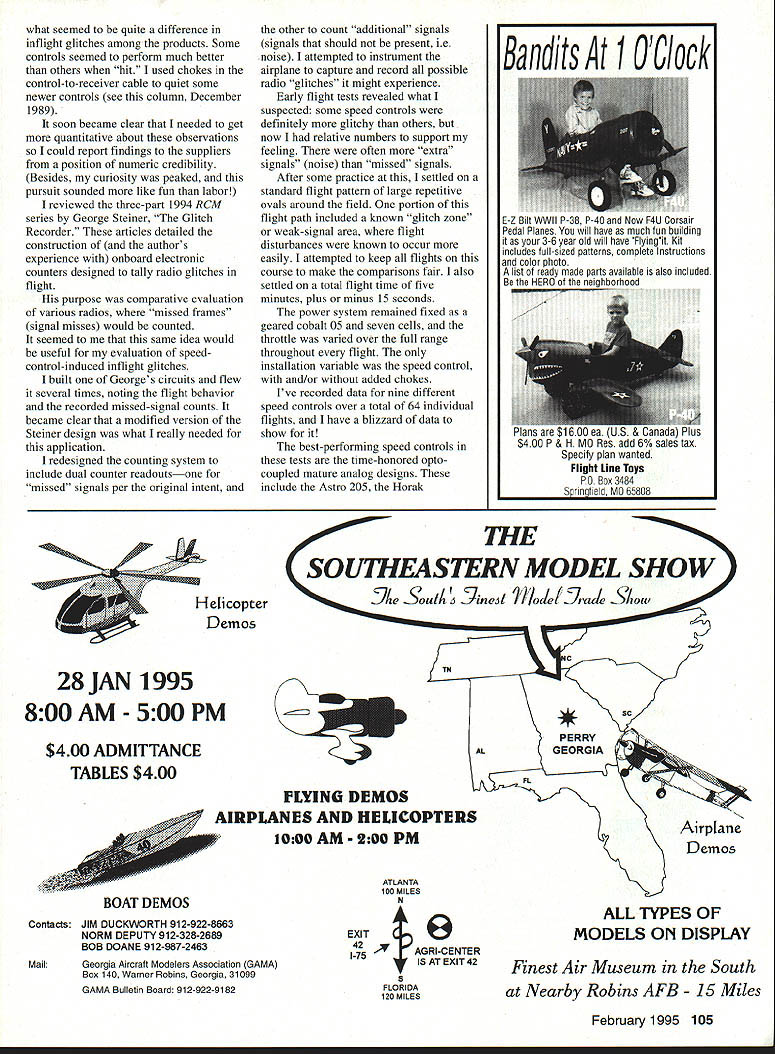
- Based on George Steiner's three-part 1994 RCM series, "The Glitch Recorder." Built and modified Steiner's circuit to include dual counters:
- One counter for "missed" signals (signal misses)
- One counter for "extra" signals (spurious signals/noise)
- Standard flight pattern: large repetitive ovals including a known weak-signal "glitch zone."
- Flight duration: target 5 minutes ±15 seconds.
- Power system: fixed (geared Cobalt .05 with seven cells). Throttle varied over full range.
- Variable: speed control model (with and without added chokes in the control-to-receiver lead).
- Data set: 9 different speed controls, 64 individual flights.
Findings
- Best performers: mature opto-coupled analog designs (Astro 205, Horak (Canadian) control, Jomar SM-4). These typically recorded zero to only a few counts per flight and produced solid flight behavior.
- Opto-coupling demonstration: intentionally connecting motor power (+) to receiver (–) drastically increased counts from near zero to the low tens, proving interference often couples into the receiver.
- New microprocessor-based speed controls: generally much noisier — counts ranged from tens to the hundreds, with corresponding degraded flight behavior. None of the noisy units were optically coupled.
- Chokes: inserting chokes in the control/receiver lead dramatically improved many microprocessor controls; most became as quiet as the best analog units with chokes installed.
- Worst offender: one microprocessor control still produced counts in the tens even with chokes. Spectrum analysis showed it emitted broad radio clutter from low frequencies well past 100 MHz — effectively jamming through our radio bands. That manufacturer is revising the product.
- Software/hardware evolution: many speed controls are microprocessor controlled and undergoing rapid software-driven changes; manufacturers are updating designs frequently.
Interpretation of Counts
- Low counts: unlikely to cause noticeable flight perturbations.
- Counts in the tens: somewhat noticeable in flight path disturbances.
- Counts in the hundreds: can produce serious and frightening flight behavior.
---
Please enclose a SASE with any correspondence for which you'd like a reply. Enjoy your wintertime electric flying!
Transcribed from original scans by AI. Minor OCR errors may remain.

