

RADIO CONTROL ELECTRICS
Bob Kopski — 25 West End Drive, Lansdale, PA 19446
This column will cover:
- Electric Connection Service (ECS) and local contacts
- A November 1994 caption clarification
- A Vintage RC photo contest reminder
- New electric products (including a microprocessor-controlled glitch recorder)
- Microprocessor-controlled speed-control tests and upgrades
- A seasonal closing query
Electric Connection Service (ECS)
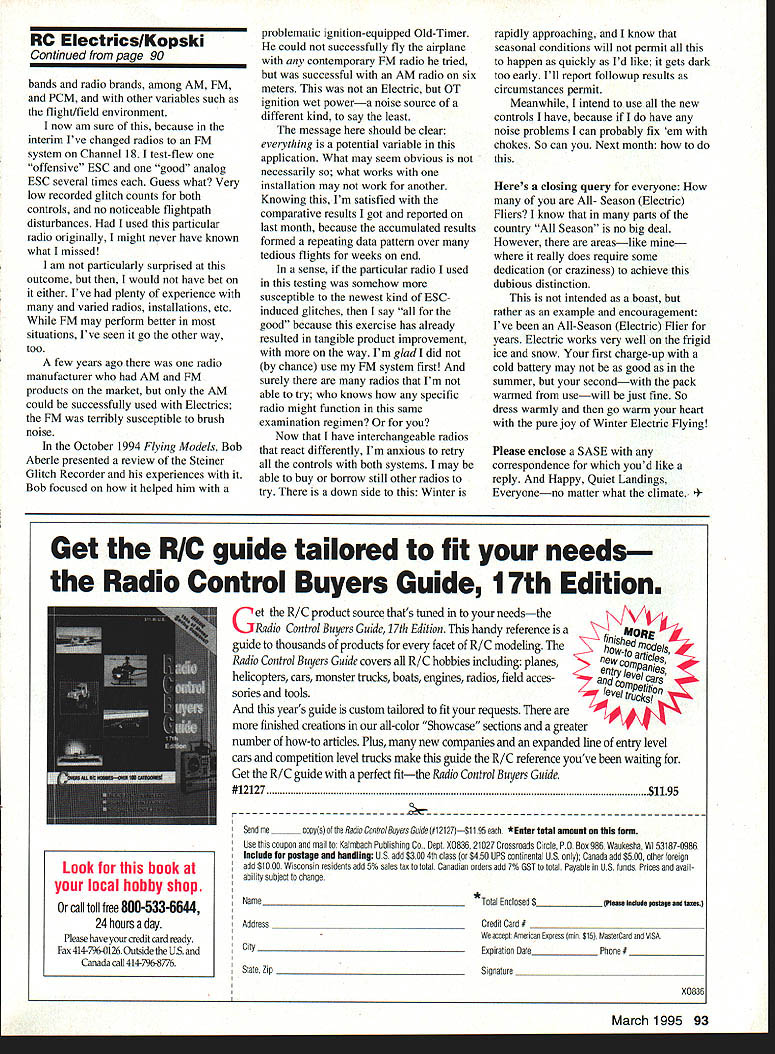
Doug Ingraham leads off this month's ECS. Doug is the modeler behind Lofty Pursuits speed-control products (2274 Aster Ct., Rapid City, SD 57702) and serves as a design consultant for at least one major speed-control manufacturer. Although Doug is in the electric-supply arena, he welcomes the association of more electric fliers at the local field. I am in regular contact with Doug and will know how well you respond—so please get in touch. You'll find Doug to be a fine gentleman, modeler, and flier. When you connect, ask him to show you his E-powered Fun-Fly competition airplane—very impressive.
Tyler West (5 Eastern Ave., Northampton, MA 01060) is a member of the Hampshire County R/C Club, is well into electric flying, and is persuading others locally to try E-flying. Tyler would like any interested local modelers to contact him and share the fun and excitement electric flight brings.
November 1994 caption clarification
I want to clarify a caption in the November 1994 column (page 78) showing the new Flightec brushless motor and associated controller. The caption should read, in part: "New Flightec brushless motor; microprocessor-controlled controller..." The product was discussed in the column text; this is a brief follow-up. Flightec has several high-tech products dedicated to electric flight—request catalog information from Phil Thayer, 21 Juniper Way, Hamilton, NJ 08619; Tel.: (609) 584-9409.
Vintage RC photo contest reminder
In May 1994 I discussed Electrified Vintage RC designs, provided VRCS (Vintage RC Society) information, and asked readers to send photos of their own Electrified Vintage designs. Photos are due by June 30, 1995, and will be judged by VRCS officers who are top names in the history of RC modeling.
- Prize: The best photo wins a free one-year VRCS membership; if the winner already is a member, the prize becomes a two-year membership. VRCS already has the prize/dues funds.
I've been receiving photos, but this is a reminder not to let the due date fly by. Dig up the referenced column for more details.
New product: Jomar Snitch (microprocessor glitch recorder)
My inflight glitch-recording experiments caught the attention of Jomar's Joe Utasi, who produced a microprocessor-controlled version of my dual glitch recorder called the Jomar Snitch. It "tattles" on the communication integrity and well-being of your inflight radio behavior—useful for electric or other installations.
Key facts:
- Prototype is easy to use, in a plastic enclosure about 1-1/2 inches square by 3/4 inch thick, weighing ~1/2 ounce (production version will be smaller).
- Plugs into any receiver output like a servo or speed control.
- Uses acoustic output (no digital readout) to convey information.
- Useful for evaluating:
- Radio quality of your flight environment
- Offending flight-line activity
- "Holes" in the sky
- Radio comparisons
- Electric-specific parameters
How it works:
- With the transmitter on, Snitch beeps a greeting as the receiver powers up, then beeps out a number equal to your transmitter frame rate. You learn this signature quickly.
- While doing this, Snitch "learns" what a normal signal for your radio is and then tallies departures from that format during flight: missed frames and extra signals (noise spikes).
- It stores counts in memory and reports them on request via a transmitter stick, knob, switch, or channel.
- To request the report on landing: turn off the power-system arming switch, then move the throttle stick up and down smoothly several times; Snitch recognizes this and responds with tones corresponding to stored counts for extra and missed signals.
I have been comparing the prototype Snitch with my own glitch recorder and will report more later. The production version should be available from Jomar (about $39) by the time you read this.
Speed-control testing, chokes, and the Mini Max upgrade
Last month I reported on microprocessor-controlled speed controls and how they "glitched" my radio as captured on my airborne dual glitch recorder and as seen in flight disturbances. I also reported that installing chokes in line between the speed control and the receiver improved behavior.
One control tested was the Jomar Mini Max. Of those flown at the time, the Mini Max was among the least offensive in counted "hits" but still not up to Jomar's SM-4 standard. When I discussed this with Joe Utasi, he retooled the Mini Max circuit board to include built-in chokes, and the upgraded sample performs almost as well as my best optocoupled analog speed controls.
Joe also had a Mini Max software upgrade in the works. By the time you read this, the current Mini Max version should include the latest software and the built-in chokes.
Joe is working on a limited-market computer-controlled device to test computer-controlled (or any) speed controls. Thorough testing and comparative evaluation of modern speed controls is difficult and tedious because computer-chip-controlled units have many features and options.
Microprocessor ESC interference and radio variability
My flight testing revealed a kind of radio interference caused by the computer circuitry in microprocessor ESCs. This noise is new relative to conventional (analog) speed controls. It can exist in addition to classic noise problems like brush noise. As a group, microprocessor speed controls may have the potential to be extra-offensive to some radios beyond classic electric installation issues.
Three manufacturers were particularly interested in the radio I used in my tests. Their point: most people don't fly on six meters or with AM systems anymore. I acknowledged that my test results would likely differ with radio bands and brands (AM, FM, PCM) and with other variables like flight/field environment.
I later changed radios to an FM system on Channel 18 and test-flew one previously "offensive" ESC and one "good" analog ESC several times each. Result: very low recorded glitch counts for both controls and no noticeable flightpath disturbances. Had I used this radio originally, I might never have known what I missed.
This outcome is not surprising but it is instructive. Everything is a potential variable. What works with one installation may not work with another. The comparative results I reported last month are still valuable because they formed a repeating data pattern over many flights and weeks. If my original radio was more susceptible to ESC-induced glitches, that was beneficial—it spurred product improvements. I'm glad I did not use the FM system first.
Now that I have interchangeable radios that react differently, I'm eager to retry all controls with both systems and, if possible, other radios. A downside: winter approaches and limited daylight will slow testing. I'll report follow-up results as circumstances permit.
Meanwhile, I intend to use all the new controls I have; if any cause noise problems I can probably fix them with choices and installation changes. Next month: how to do this.
All-Season (Electric) Flying
A closing query: How many of you are All-Season electric fliers? In many parts of the country it's no big deal, but in areas like mine it requires dedication (or craziness) to achieve.
A personal example and encouragement: I've been an All-Season electric flier for years. Electric power works well on ice and snow. The first charge with a cold battery may not be as good as in summer, but the next charge—after the pack has warmed from use—will be fine. Dress warmly and enjoy the pure joy of winter electric flying.
Please enclose a SASE with any correspondence for which you'd like a reply.
Happy, quiet landings, everyone—no matter what the climate.
Transcribed from original scans by AI. Minor OCR errors may remain.

