
RADIO CONTROL ELECTRICS
Bob Kopski, 25 West End Drive, Lansdale, PA 19446
This month we'll cover some club/meet info, new electric suppliers, more beginner information for electric flyers, and how and why to make chokes for your speed control.
Club and meet news
Randy Smithhisler of Puyallup, Washington wrote to tell me of a newly formed club — the Puget Sound Silent Flyers — and its first scheduled activity. The club will be hosting a symposium/workshop at the Museum of Flight in Seattle, April 1–2. The gathering will feature guest speakers, a display of electric models and related products, and electric demonstrations. Randy invites modelers to bring electrics and/or related items for display. More details from Randy at 1703 105th Ave. Ct. E., Puyallup, WA 98372; Tel.: (206) 927-4672.
Azarr, the event coordinator for the '94 Competition Fun-Fly Nationals, wrote to tell me of last year's event and the two electric entries by Don Belfort and Doug Ingraham. This electric participation was a first for this annual activity. I spoke with Don and Doug following the '94 Fun Fly and it seems that electric power does have a place in this high-power, high-frenzy activity. Both plan to attend next year, and both have new aircraft planned.
Azarr again extends the challenge and invitation to all electric modelers to come do your stuff in '95. The '95 CFFN will be held in Henderson, Kentucky, Labor Day weekend. Full details are available from CD Harold Parker, Rt. 1, Box 569, Providence, KY 42450.
Suppliers and catalogs
Electric suppliers continue to multiply. Recently a new catalog with lots of electric and other goodies plus informative articles and reference material has been published by Northeast Sailplane Products. This 200-page compilation is called the "94–95 RC Soaring and Electric Catalog" and is available for $7 from NSP, 16 Kirby Lane, Williston, VT 05495; Tel.: (802) 658-9482.
Scale is rapidly becoming a significant specialty within electric. With that in mind, here is another plans source: Bob Holman Plans, Box 741, San Bernardino, CA 92402; Tel.: (909) 885-3959. A catalog is available and includes such listings as:
- 70-inch Hurricane
- 81-inch Mosquito
- B-17
- Fieseler Storch
- Many more, plus scale and related books
I think you'll find electric scale just as charming as scale can get!
Last month I discussed the new Jomar Snitch onboard glitch recorder; it can be seen in one of this month's photos. It plugs into a receiver like a servo and records inflight radio glitches. After landing you can interrogate the Snitch and it will reveal, with a tone, the count and kind of radio "hits" your model took in flight. See the March '95 column for more detail.
Beginner advice — buying outlook and equipment
The January 1995 issue was dedicated to aeromodelling beginners of all ages, with special emphasis on youth. The electric column of that issue offered suggestions for first-time modelers and first-time electric modelers. Because it's not possible to cover all relevant aspects in a single column, I'm including some additional beginner thoughts here.
Readers routinely write and ask for product recommendations and options. One aspect I often get into is the reader’s outlook. If the modeler feels that he or she will stay in and grow with electric, I then encourage them to "buy the best" to begin with — to the extent possible. Let’s look at some specifics.
Usually the toughest dollar decisions involve the choice of motor and charger. There are many motors on the market, ranging from economy "can" motors up to more costly high-quality products. Many must go the lower-cost route, but where cost is not a major concern I’ll always encourage going the high-quality route, especially for those likely to stay in electric. The higher up-front cost will pay off in performance and durability. For example, you can get spare parts for serviceable motors, and factory service is available when needed. By comparison, most economy motors are considered "throwaways."
There are now two established American suppliers of top-quality motors: Astro and Aveox. Both manufacturers offer a variety of motor sizes and related products, such as speed controls. You can call Bob Boucher of Astro and David Palumbo of Aveox for personalized product application assistance.
Since most first-time electric modelers begin with a small power system — such as one using six or seven cells — most will initially need only limited charger capability. Again, I’ll always offer that if you feel you’ll stay with electric and do not need the greatest economy, get a high-capability charger to begin with. Astro offers several models that will handle most any motor battery pack you’re ever likely to use. I’ve been using the SR Smart Charger with total satisfaction. It charges a broad range of pack sizes and will serve you as you fly past the seven-cell category.
Now please understand: this offering does not conflict with the thoughts in the January column. The fact is that most electric beginners locally and in my mail "just want to try electric" — cheaply. There is nothing wrong with this; indeed, I know the feeling, though it’s been a while! You can very definitely try out e-power with an economy approach and be fully successful. I know several modelers who started just this way and won’t use anything but economy motors. After wear or crash damage, they simply replace them with more of the same. And there are those who began at the low end, grew in the electric hobby, and now will only go "top shelf." I still fly both extremes. Something for everyone!
Chokes — what they are and why use them
Let’s look at how to make the chokes I’ve been promoting recently. Actually, this "choke thing" is not new — I first offered the suggestion back in the December ’89 column. The idea behind installing chokes in the speed control/receiver cable is to reduce or eliminate power-system interference in the radio. The chokes are useful with speed controls that do not have complete opto-coupling. (Opto-coupling serves the same purpose.)
What's new now is that many of the latest speed controllers are both microprocessor controlled and not opto-isolated (or not fully opto-isolated), and this combination can cause a new kind of glitch. Also, more and more folks are using BEC systems, and you cannot have both BEC and opto-coupling at the same time. So if this sounds like something you need, review the ’89 reference, the last two columns, and continue here.
What is a choke and what does it do?
- As used here, a choke (or inductor) is a small coil of wire wound on a ferrite or similar core.
- Like resistors have ohms and capacitors have farads, chokes have henrys. (Ohms are units of DC resistance. Farads and henrys are units of capacitive and inductive impedance respectively. Think of impedance as AC resistance.)
- A choke has both DC resistance and AC impedance. The resistance of the wire in the choke is typically very small (fractions of an ohm). At the same time, the impedance can be quite large (hundreds of ohms at radio frequencies).
- With chokes in the speed control/receiver line, power-system radio-frequency noise can have a tough time reaching the receiver — just what we want. Normal control-signal information has no trouble getting from the receiver to the ESC right through the choke.
Choke parts and styles
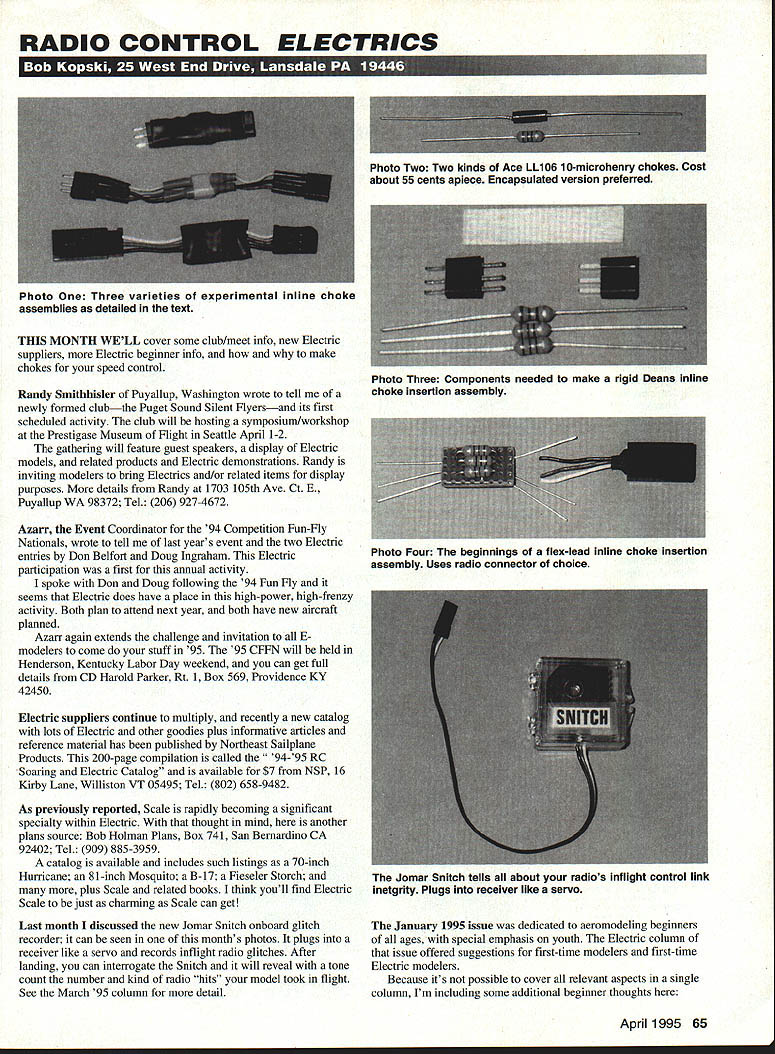
Photo One shows three inline or insertion choke assemblies I made for experimental purposes. I simply install one of these in the line from the speed control to the receiver. The three assemblies shown are electrically identical; they all use the same-value chokes. The chokes can also be permanently installed in the speed control lead itself, eliminating the need for additional connectors.
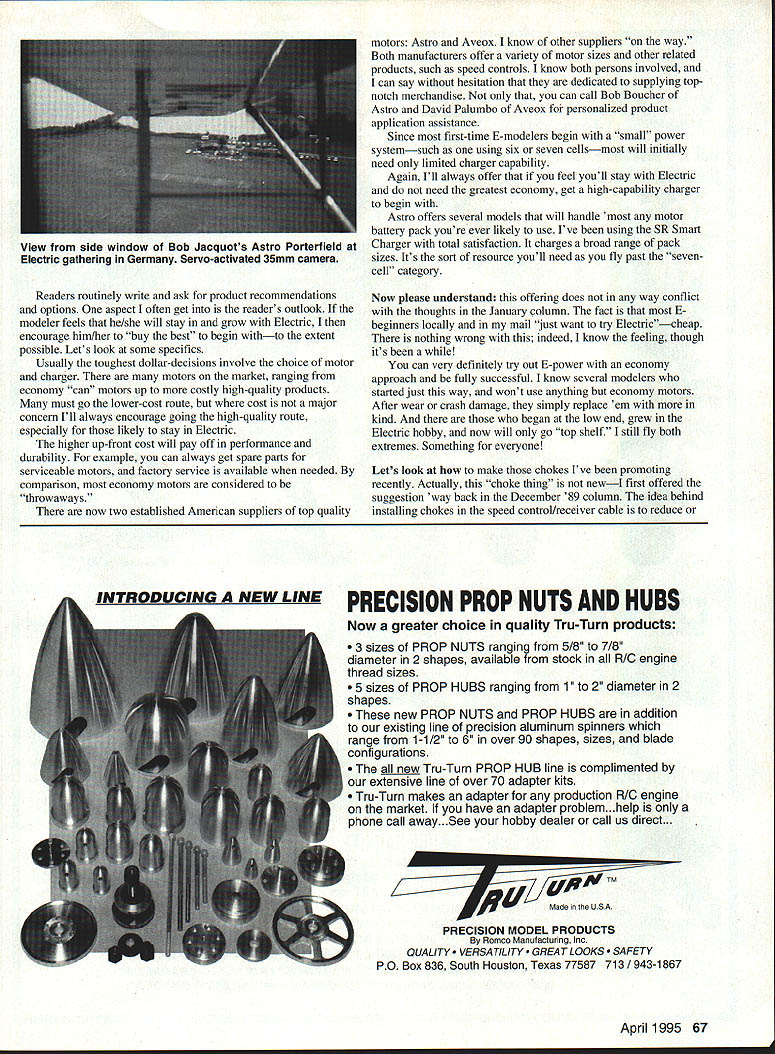
Photo Two is a closer look at two choke styles. These are both ACE part #LL106, 10-microhenry chokes, but they were purchased at different times. The two physical styles perform the same electrically, but I prefer the encapsulated one. It is smaller; the wire winding is protected with an overcoat; and the electrical size is marked in a color code similar to resistor color codes. The color code for 10 microhenrys is brown-black-black-silver, where the last color is tolerance. The open-winding style is unmarked, and you can get the wrong part without knowing it.
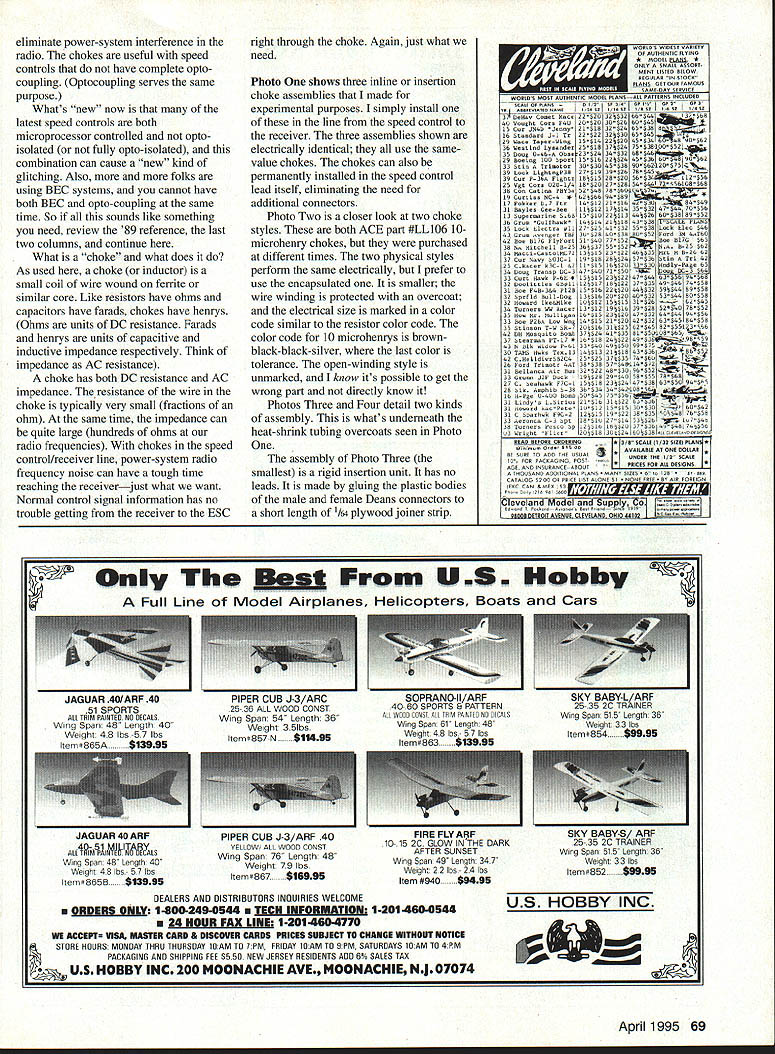
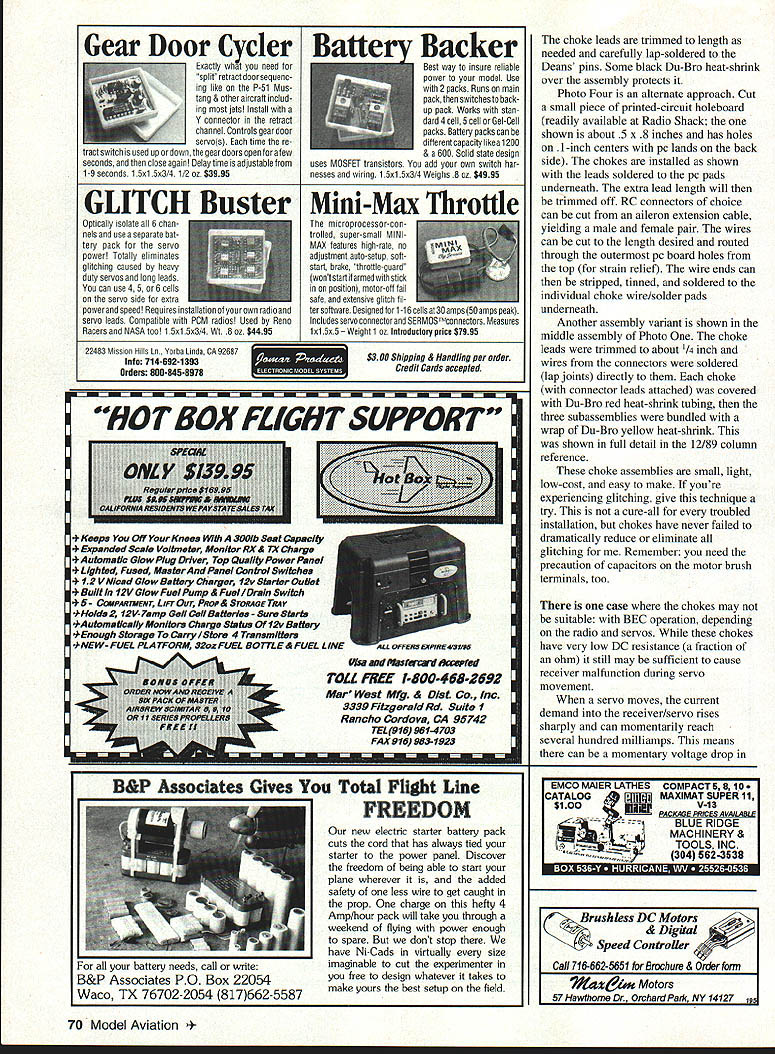
Photos Three and Four detail two kinds of assembly. This is what’s underneath the heat-shrink tubing overcoats seen in Photo One.
Choke assembly methods
- Rigid insertion unit (Photo Three)
- The smallest unit is a rigid insertion assembly with no leads.
- Make it by gluing the plastic bodies of the male and female Deans connectors to a short length of 1/16" plywood joiner strip.
- Flex-lead inline insertion (Photo Four)
- Trim the choke leads to length as needed and carefully lap-solder them to the Deans pins.
- Protect the assembly with black Du-Bro heat-shrink tubing.
- Printed-circuit board mount (alternative Photo Four approach)
- Cut a small piece of printed-circuit prototyping board (about 0.5 x 0.8 inches with 0.1-inch hole centers).
- Install the chokes and solder the leads to the pads underneath; trim extra lead length.
- Cut RC connectors from an aileron extension cable to obtain a male and female pair.
- Route the wires through the outermost holes for strain relief, strip, tin, and solder to the choke pads underneath.
- Simple bundled subassemblies (middle assembly of Photo One)
- Trim choke leads to about 1/4 inch and solder connector leads directly to them (lap joints).
- Cover each choke with Du-Bro red heat-shrink tubing, then bundle the subassemblies and wrap with Du-Bro yellow heat-shrink.
- This method was shown in the 12/89 column reference.
These choke assemblies are small, light, low-cost, and easy to make. If you're experiencing glitching, give this technique a try. This is not a cure-all for every troubled installation, but chokes have never failed to dramatically reduce or eliminate radio glitching for me. Remember: you need the precaution of capacitors on the motor brush terminals, too.
BEC considerations
There is one case where the chokes may not be suitable: with BEC operation, depending on the radio and servos. While these chokes have very low DC resistance (a fraction of an ohm), it still may be sufficient to cause receiver malfunction during heavy servo movement.
- When a servo moves, the current demand into the receiver/servo rises sharply and can momentarily reach several hundred milliamps. This can produce a momentary voltage drop in the positive and negative leads to the receiver during the surge. I've observed as much as 200 millivolts with an oscilloscope.
- Your particular receiver may not like this transient condition on its power leads.
- So far I've used BEC controls with chokes with the ACE Silver Seven, ACE Pro 810, Futaba, and Airtronics receivers, with no such problems. However, if you have a BEC system, be sure to carefully check your own radio system operation with chokes installed before flying.
- There should be no similar concern with non-BEC installations.
Glitch study follow-up
For those following the glitch study from previous columns: I now have three radios involved — my original ACE Silver Seven on 5.34 AM; an Airtronics Vanguard FM on Ch. 18; and a Futaba Conquest FM on Ch. 50. I've tallied 17 test flights of the nature previously described. This is a significant amount of data, and it’s still ongoing, though at a seasonally slower rate.
I can now confirm what I suspected: specific glitch count results can vary greatly with both the speed control and the radio. In general, my FM systems are much less glitch-prone than the AM ones with the microprocessor-controlled controls I have. However, the FM systems' performance differs between the two (varying with the specific ESC used), with some combinations being very glitchy. No matter the radio, ESC, and glitch count, chokes always make it better, normally to a level approaching zero counts.
This Spring-dated column was written between Thanksgiving and Christmas, with the worst of winter still to come. This gives me both a tantalizing and eerie feeling!
Please enclose a SASE with any correspondence for which you'd like a reply.
Happy, quiet, e-powerful landings, everyone.
Transcribed from original scans by AI. Minor OCR errors may remain.

