
RADIO CONTROL ELECTRICS
Bob Kopski, 25 West End Drive, Lansdale, PA 19446
This column will cover upcoming meets, some new companies/products, a new Electric Special Interest Group, thoughts on battery installation options, and a sacrilege (?)
Upcoming Meets
- Seventh Annual BCRCC Electric Fly — Saturday, May 20
Burlington County RC Club field, Bordentown, NJ (easy shot from the New Jersey Turnpike). Contact: Bob Afflerbach, 123 Harrington Circle, Willingboro, NJ 08046; Tel: (609) 871-8777. (If this name sounds familiar, Bob’s six-year-old E-flying son Richie appeared twice in the January issue.)
- Sixth Annual Memphis-in-May Electric Fun-Fly — May 20–21
Loaded with activity; a detailed mailer/map is available. Contact: Tom Ernst, 3112 E. Raines Rd., Memphis, TN 38118; Tel: (901) 362-2119.
- 1995 Southeastern Electrifly — June 10
North Georgia Flying Circus, Dallas, GA. Contact: Gene Norman, 1031 Pinecrest Dr., Forest Park, GA 30050; Tel: (404) 961-6036 (home) or (404) 888-6488 (work).
- Eighth Annual LVRCS Electric Fun-Fly — June 10–11
Lehigh Valley RC Society field near Easton, PA. Casual, friendly meet; recent attendance has exceeded 40, with many bringing two or more Electrics. Contact: Michael Stewart, 107 Taft Terrace, Washington, NJ 07882; Tel: (908) 689-6981. (The young lady with the Eclipse pictured in the January column is Mike’s six-year-old daughter Melissa.)
- Kansas City Regional Electric Meet — June 24–25
Includes several competitive events. Contact: Dick Hinckle, 6406 E. 140th Terrace, Grandview, MO 64030; Tel: (816) 763-7207.
- All Electric Duration Challenge (postal meet) — Saturday, June 17, sunup to sundown
Fly the longest single flight and report results. Anything goes except no connection to a ground power source and no slope flying. Entry fee $5. Entries must be postmarked no later than June 19. Award: one perpetual trophy and certificates. Contact: Jerry Smartt, Rt. 3, Box 300, Warsaw, MO 65355; Tel: (816) 438-5682; Fax: (816) 438-9573.
Note: I mention the young modelers above to encourage attendees to take a youth along. A single gesture might bring one kid into modeldom — imagine how great that would feel.
New Companies and Products
Modelair-Tech
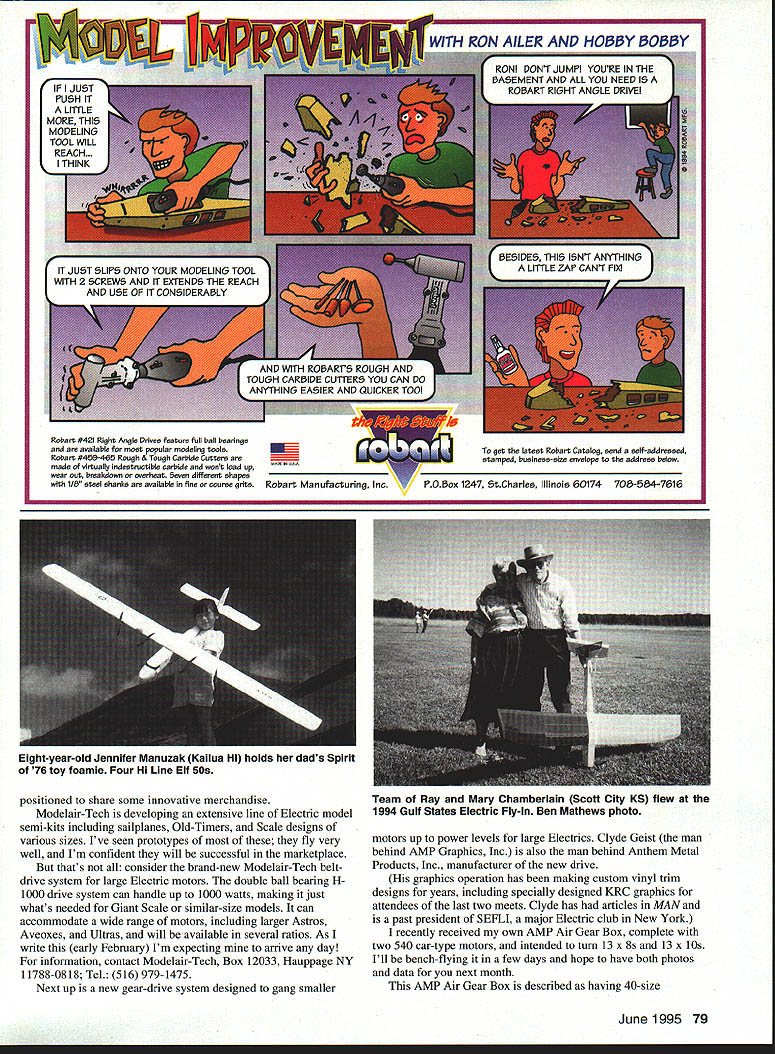
Modelair-Tech is a joint venture of Bob Aberle and Tom Hunt. They are developing an extensive line of electric model semi-kits (sailplanes, Old-Timers, and scale designs in various sizes). I’ve seen prototypes that fly very well and expect them to be successful in the market.
Modelair-Tech is also introducing a belt-drive system for large electric motors: a double ball-bearing H1000 drive rated up to 1000 watts, intended for giant-scale and similar-size models. It will be available in several drive ratios. Contact: Modelair-Tech, Box 12033, Hauppauge, NY 11788-0818; Tel: (516) 979-1475.
AMP / Anthem Metal Products
Clyde Geist (AMP Graphics, Inc.) is behind Anthem Metal Products, manufacturer of a new gear-drive system designed to gang smaller motors up to the power levels of large electrics. The AMP Air Gear Box can be used with two 540-type motors and accommodates various prop sizes and drive ratios (available up to 3.66:1; mine is 2.5:1). The basic idea can be expanded to gang three, four, or five motors—raising the total power to the equivalent of much larger motors. Motors can be wired in series or parallel depending on battery configuration; I’m setting mine up in series for 16–18 cells.
The AMP approach is an economy way to achieve large power systems. My particular unit lists at $119.95; the drive assembly alone is $59.95. These products will be available through distributors such as SR and Hobby Lobby. Contact: Anthem Metal Products, 42 Nancy St., W. Babylon, NY 11704; Tel: (516) 253-2702; Fax: (516) 253-3001.
SR Batteries / Larry Sbrinick
Larry Sbrinick (SR Batteries) has been active promoting electric activities (Night Fly at KRC, the KRC seminar). SR is advertising a new motor line that works well with drives like the AMP unit described above.
National Electric Aircraft Council (NEAC)
Larry Sbrinick has promoted a new Electric Special Interest Group within AMA: the National Electric Aircraft Council (NEAC). I was skeptical at first due to past disappointments with similar organizations, but Larry assures me NEAC is structured differently:
- No dues.
- No power.
- No politics (hopefully).
- Organized around member clubs, with one member representative per club.
- E-loners (not in a formal club) can be included in ways under consideration.
- Communication via e-mail.
NEAC aims to give a voice to the rapidly growing electric-modeling community without becoming another burdensome organization. More information: NEAC c/o Larry Sbrinick, Box 287, Bellport, NY 11713; Tel: (516) 286-0079; Fax: (516) 286-0901.
Battery Installation and Cooling
There is no single "right" approach to motor battery installation; techniques vary with personal preference and model type. Below are considerations and options that have worked for me and many others.
General precautions
- The motor pack is typically the heaviest single mass in an electric model. In the event of a crash, it can continue in motion and cause extensive internal damage. Don’t place speed controls, receivers, or other vulnerable components directly in front of the pack.
- It’s impossible to make a pack completely crash-proof; do take reasonable precautions to secure it so it won’t shift during normal handling and flight.
Common installation methods
- Wedging in foam: Many of my models use cut plastic foam packed around the battery so everything is snug. The pack is not fully enclosed in foam—just wedged so cooling air can still flow through the cells.
- Removable packs: A common approach for smaller systems (six- or seven-cell packs) is to provide a hatch or access for easy removal and replacement. Packs are often Velcroed in place on or just inside the hatch door. Many fliers carry several charged packs and swap them immediately after a flight so flying continues while a pack cools and is charged.
- Permanent packs: Some prefer not to remove packs between flights to assist with cooling or convenience. I usually leave packs in place unless temperatures are high.
Cooling airflow
- Cooling airflow during flight helps moderates pack temperature and improves performance, especially for designs with extended flight capability (sport planes and sailplanes), where long glides allow packs to cool.
- Some models (pylon racers, certain aerobatic models) fly full-on continuously, producing short but hot flights; these often require pack removal between flights.
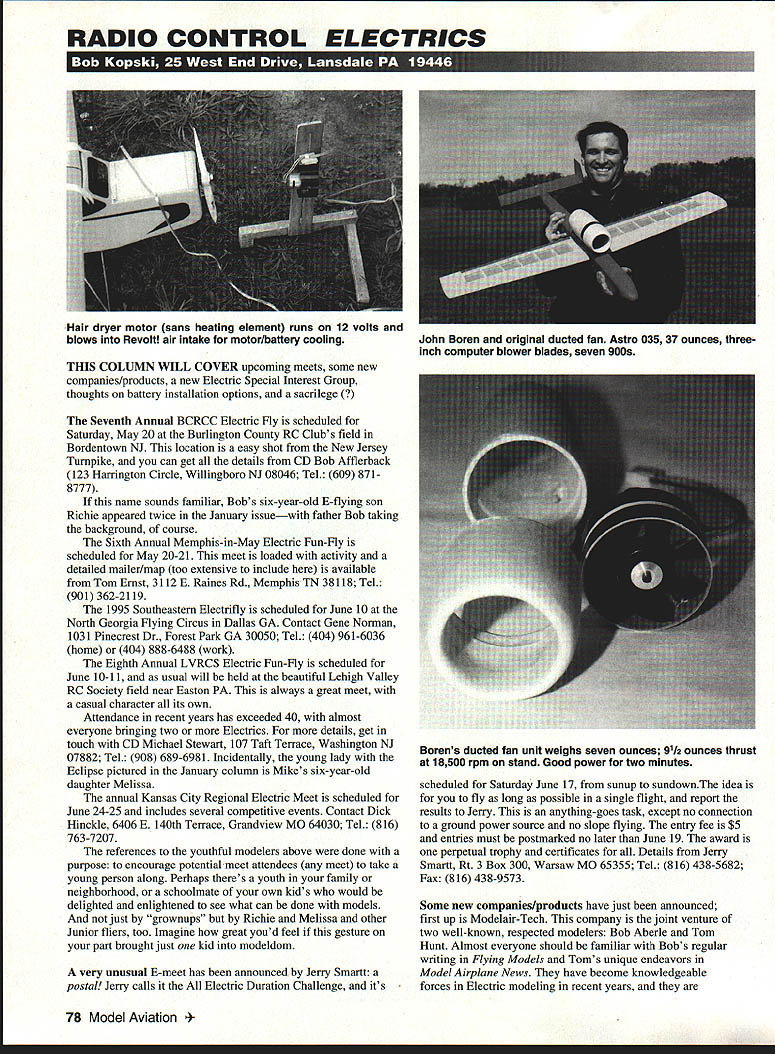
- My telemetry data (published in January 1994 Model Aviation) showed a significant difference in motor and battery temperature with normal cooling airflow versus a blocked intake. Even small amounts of airflow help; very hot batteries perform poorly and should not be charged until cooled.
- Always include both an adequate air intake and a suitably sized air exit. Air must enter, pass around/through the cells, and exit to be effective.
Practical tips
- If you remove packs between flights, place them beside the nose gear or tailwheel area for easy access, depending on the model.
- Use a small blower to force air into the model’s normal intake port to speed cooling on the ground if needed.
- Avoid placing sensitive electronics directly in the pack’s forward path should a crash occur.
Relevant past columns with photos/info on battery installation and cooling: 11/94, 9/93, 5/92, 7/91, 3/90, 5/90, 1/90, 4/88, 7/87, 5/87, 5/86, 3/86, 3/85, 2/85, 1/85, 11/84, 2/84, 12/83.
Sacrilege?
I respect all kinds of modeling even though my preferred focus is R/C electric. I started in free-flight gas in the 1950s and have participated in many forms of aeromodelling.
When I heard someone put a "15" in a Revolt!, my first reaction was, "Sacrilege!" Then I learned it was a wet .15 and almost immediately thought, "Great!" Whatever your modeling flavor—wet, electric, indoor, giant-scale jet—enjoy it. Aeromodelling is for fun.
A thought for those who encounter rejection for having an electric interest: embrace your hobby. Different strokes for different folks. And yes, I’ve heard the joke that one distinction between wet and electric fliers is that electric fliers can take a shower before they go flying.
Please enclose a SASE with any letter for which you’d like a reply. Meanwhile, happy, quiet, powerful, long-lasting electric flights to everyone!
Transcribed from original scans by AI. Minor OCR errors may remain.

