
RADIO CONTROL ELECTRICS
Bob Kopski, 25 West End Drive, Lansdale PA 19446
Obituary: Charlie Spear
My friend, fellow E-modeler and fellow E-columnist Charlie Spear of Mocksville, NC departed the flying field of life Monday, February 27 following a recent illness.
I first met Charlie at a KRC meet about a decade ago and had flown with him nearly every year since at KRC and/or the Annual Labor Day Vintage Reunion in Selinsgrove, PA. I always enjoyed our shared, happy times and will miss Charlie a great deal.
Charlie was a lifelong modeler, beginning with a rubber-powered twin pusher built from Popular Mechanics plans in 1931. He became very interested in free flight (FF) competition and dabbled in control line (CL) a bit too. Charlie also worked in full-scale aircraft as an employee of Curtiss-Wright, covering rudders for P-40 fighters.
In the early '50s Charlie entered RC and participated in some of the original Selinsgrove meets—the gathering place of the RC pioneers. He was a skilled graphic artist and photographer with his own darkroom, often making printed-circuit-board artwork for early RC equipment, including what may have been the first transistorized receiver.
As years passed Charlie took an interest in Electric flight and became well versed in the pursuit; he and Dr. John Mountjoy became co-authors of the electric column in RC Report several years ago. Charlie and John presented a paper at the '94 KRC Symposium. I received my copy of the '94 KRC video just two days after Charlie's passing; there he was, having a great E-time. Happy, silent flying forever, my friend.
Upcoming E-meets
- Mid-America Electric Fun-Fly (Ann Arbor Falcons & Electric Flyers Only)
- Date: July 15-16
- Location: Saline, MI
- Notes: One large E-weekend, viewed as two meets (each club hosts one day). Rapidly growing in size and attendance.
- Contacts: Ken Myers, 1911 Bradshaw Ct., Walled Lake, MI 48390; Tel.: (810) 669-8124. Keith Shaw (see meet mailer).
- Sixth Annual Voltaires Electric Fun-Fly
- Date: Same weekend (third weekend in July)
- Location: Central New York
- Notes: Annual event of the Voltaires; includes free flight activity (exclusively electric).
- Contacts: Jim McMaster, (315) 676-4870; Bill Griggs, (315) 697-8152; Tim Smarzo, (315) 673-1278.
- Annual Vintage Reunion (Vintage RC Society)
- Date: September 2-3
- Location: Delaware RC Club field, state park near Newark, DE (Selinsgrove facility not available in '95)
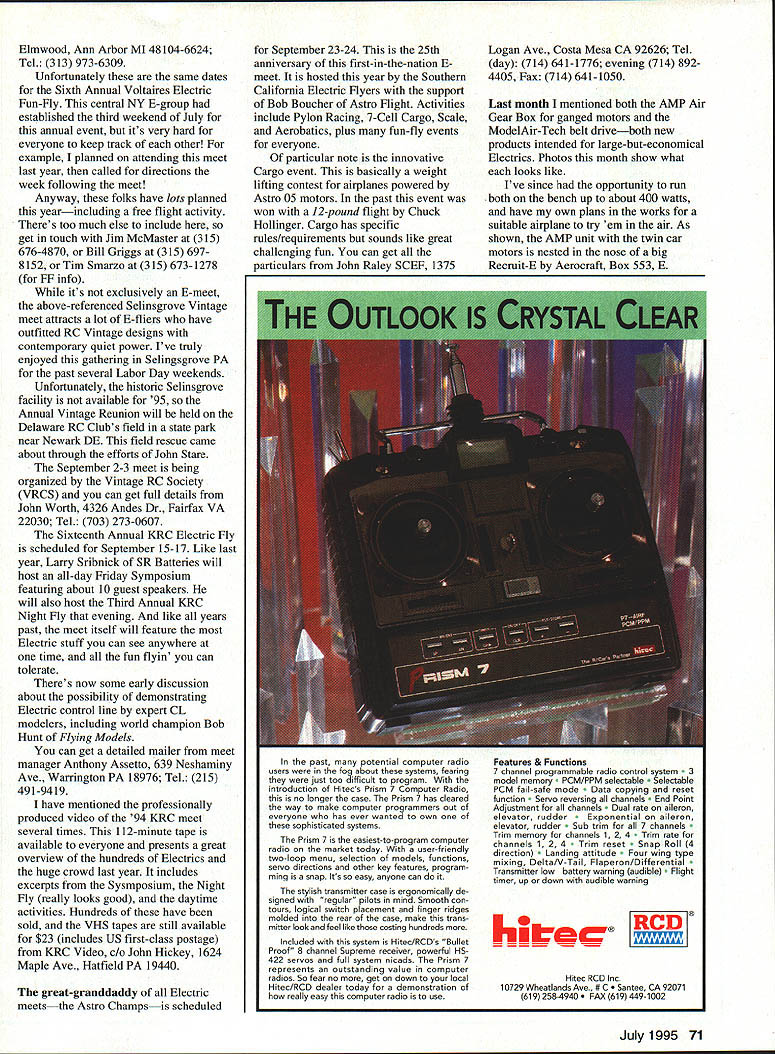
- Notes: Many E-fliers outfit vintage RC designs with contemporary quiet power. Field rescue arranged through John Stare.
- Contact: John Worth, 4326 Andes Dr., Fairfax, VA 22030; Tel.: (703) 273-0607.
- Sixteenth Annual KRC Electric Fly
- Date: September 15-17
- Notes: Larry Sribnick of SR Batteries will host an all-day Friday symposium with ~10 guest speakers and the Third Annual KRC Night Fly on Friday evening. Possible demonstrations of electric control-line models with CL experts including world champion Bob Hunt.
- Contact: Meet manager Anthony Assetto, 639 Neshaminy Ave., Warrington, PA 18976; Tel.: (215) 491-9419.
- Astro Champs (Southern California Electric Flyers)
- Date: September 23-24
- Notes: 25th anniversary of this first-in-the-nation Electric meet. Events include Pylon Racing, 7-Cell Cargo, Scale, Aerobatics, and many fun-fly events. Cargo is a weight-lifting contest for airplanes powered by Astro .05 motors; past winners have lifted heavy loads (e.g., a 12-pound flight).
- Contact: John Raley, SCEF, 1375 Logan Ave., Costa Mesa, CA 92626; Day Tel.: (714) 641-1776; Evening: (714) 892-4405; Fax: (714) 641-1050.
KRC '94 Video
A professionally produced video of the '94 KRC meet is available. This 1/2-inch tape presents a great overview of the hundreds of Electrics and the huge crowd, including excerpts from the Symposium, the Night Fly, and daytime activities. VHS tapes are available for $23 (includes U.S. first-class postage) from: KRC Video, c/o John Hickey, 1624 Maple Ave., Hatfield PA 19440.
New products and bench trials
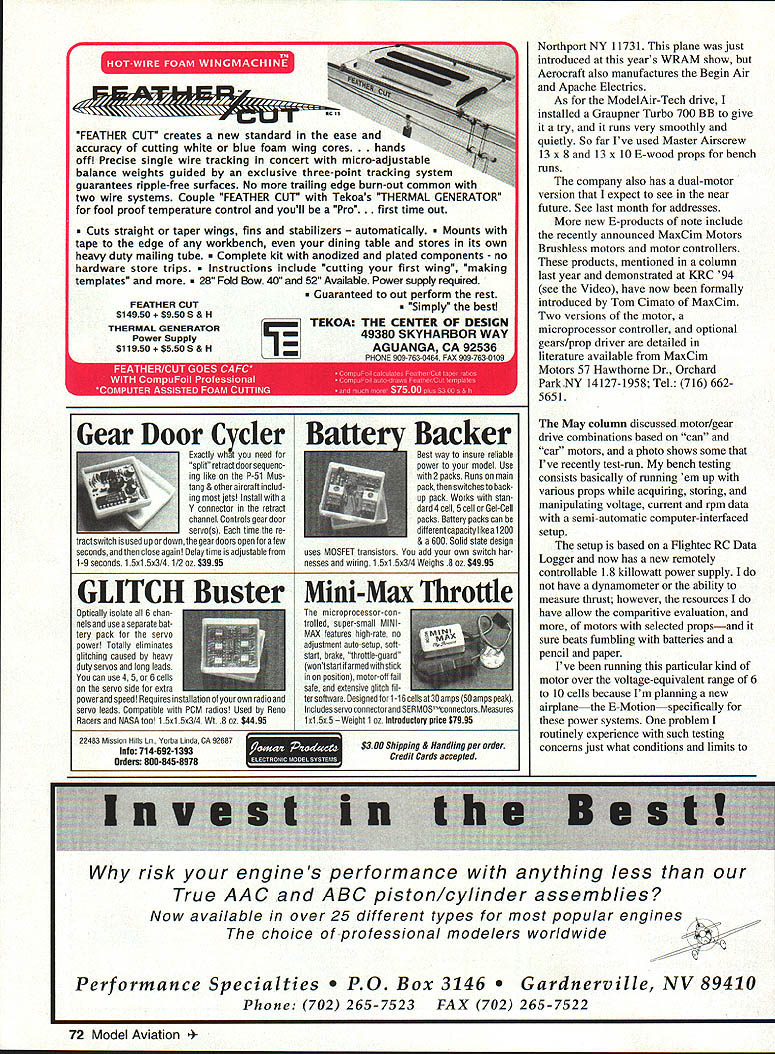
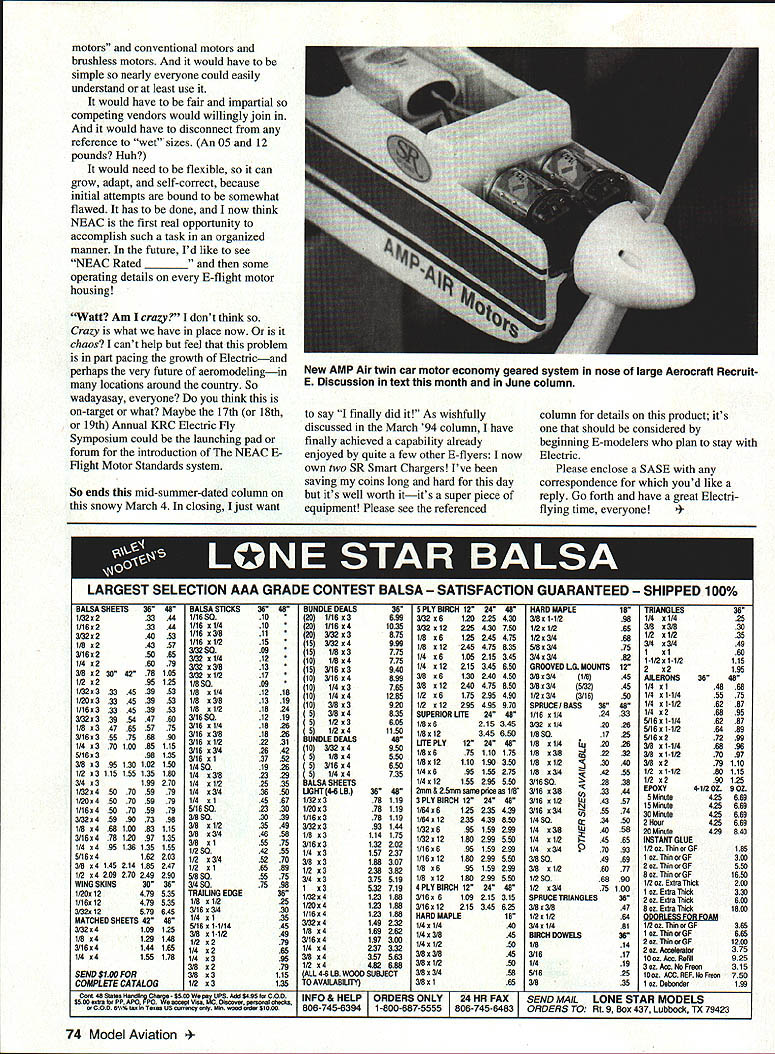
- AMP Air Gear Box and ModelAir-Tech belt drive
- Both are new products intended for large-but-economical Electrics. Photos show how each looks; the AMP unit (with twin car motors) can be nested in the nose of a big Recruit-E by Aerocraft.
- I have run both on the bench up to about 400 watts and plan to try them in a suitable airplane.
- ModelAir-Tech drive
- I installed a Graupner Turbo 700 BB for testing; it runs smoothly and quietly. Bench props used so far include Master Airscrew 13x8 and 13x10 E-wood props. A dual-motor version is expected.
- MaxCim Motors
- Recently announced: brushless motors and motor controllers from MaxCim, introduced by Tom Cimato. Two motor versions, a microprocessor controller, and an optional gears/prop driver are detailed in MaxCim literature.
- Contact: MaxCim Motors, 57 Hawthorne Dr., Orchard Park, NY 14127-1958; Tel.: (716) 662-5651.
Motor testing and "Watts it like?"
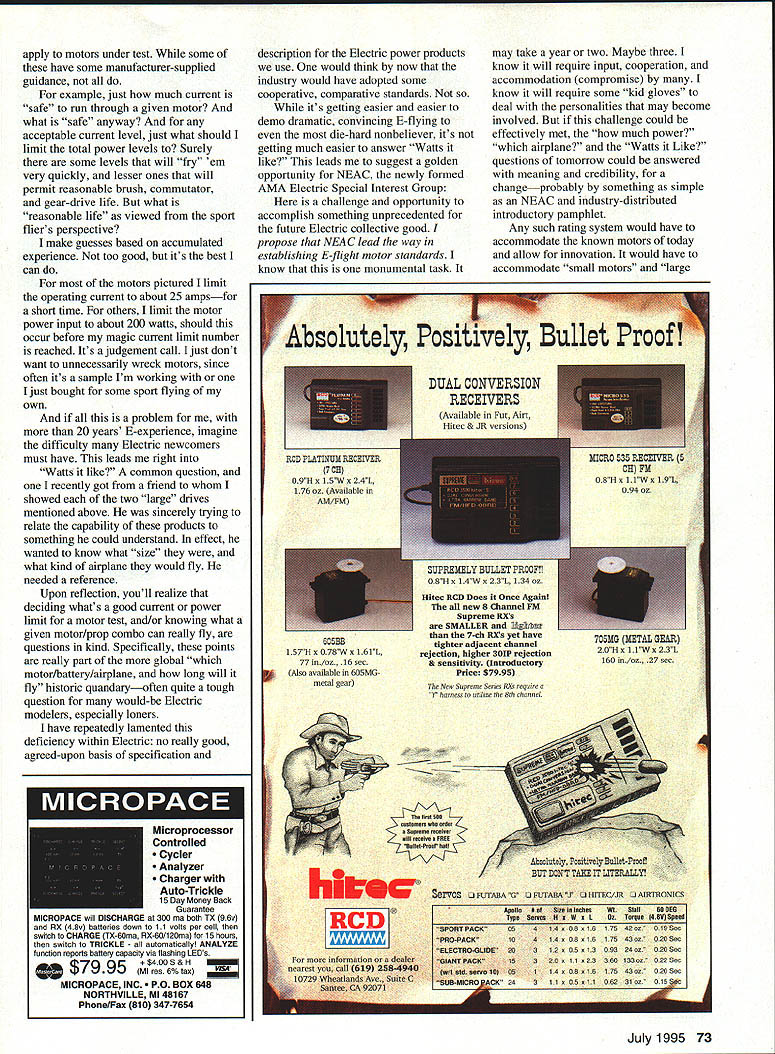
My bench testing consists of running motors with various props while acquiring, storing, and manipulating voltage, current, and rpm data with a semi-automatic computer-interfaced setup. The setup is based on a Flightec RC Data Logger and now includes a remotely controllable 1.8-kilowatt power supply.
I do not have a dynamometer or thrust-measurement capability; however, the resources I do have allow comparative evaluation of motors with selected props and avoid the hassle of batteries and pencil-and-paper notes.
Testing range and limits
- I typically run motors over the voltage-equivalent range of 6 to 10 cells for the kinds of motors I'm evaluating (planning a new airplane, the E-Motion, for these systems).
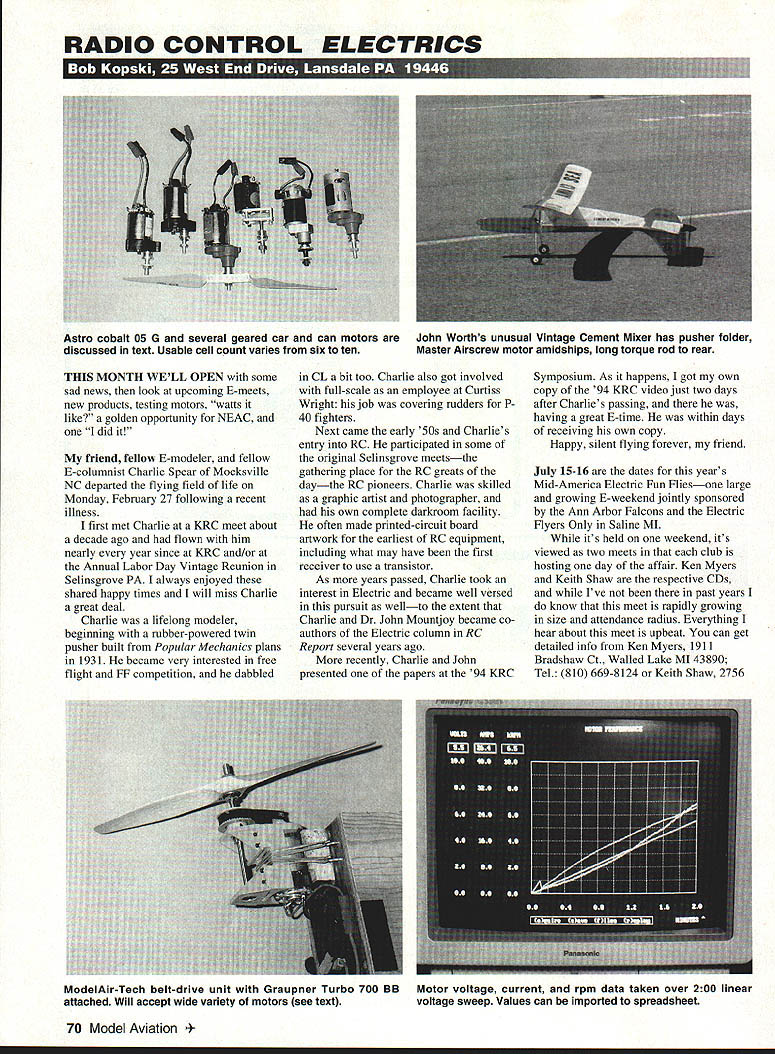
- Deciding safe operating limits is often a judgment call. For many motors pictured I limit operating current to about 25 amps for short durations. For others I cap input power to about 200 watts if that limit occurs before the current limit is reached.
- The goal is to avoid unnecessarily wrecking motors—often samples or motors intended for sport flying.
Common newcomer questions and "Watts it like?"
- New E-fliers often ask what size a motor/battery combo is and what kind of airplane it will fly, or how long it will fly. These are hard questions because there is no widely accepted, comparative standard of specification for electric power products.
- Determining safe current or power limits and predicting performance are tied into the larger question: "which motor/battery/airplane, and how long will it fly?"
Proposal: NEAC E-Flight Motor Standards
I propose a golden opportunity for NEAC (the newly formed AMA Electric Special Interest Group) to lead the way in establishing E-flight motor standards. Such a program would be a major undertaking but could provide meaningful, credible answers to "How much power?" and "Watts it like?"
A reasonable standards system should:
- Accommodate known motors of today and allow for future innovation.
- Cover small and large motors, conventional and brushless types.
- Be simple and easy to understand and use by most modelers.
- Be fair and impartial so competing vendors will join in voluntarily.
- Avoid reliance on obscure or confusing references (e.g., "wet" sizes).
- Be flexible so it can grow, adapt, and self-correct as needed.
If done well, future motors could be labeled "NEAC Rated ____" with clear operating details on the housing. This could be introduced at a symposium such as the KRC Electric Fly Symposium in a coming year.
Closing: "I finally did it!"
As wishfully discussed in the March '94 column, I finally acquired two SR Smart Chargers. I've been saving for them and they are well worth it—an excellent piece of equipment that beginning E-modelers who plan to stay with Electric should consider.
Please enclose a SASE with any correspondence for which you'd like a reply. Go forth and have a great electric-flying time, everyone!
Transcribed from original scans by AI. Minor OCR errors may remain.

