

RADIO CONTROL ELECTRICS
Bob Kopski, 25 West End Drive, Lansdale PA 19446
THIS MONTH WE'LL COVER
- The Electric Connection Service
- Additional MaxCim information
- Info on a potential symposium tape
- The rapid maturing of Electric
- Some motor/prop/battery basics
President Pete George of the just-formed St. Louis Chargers Electric club wrote to tell me of this new organization and to invite all interested to get in touch. You can reach Pete at 2127 Arsenal, St. Louis, MO 63118; Tel: (314) 664-6613. While the new club does not yet have a home field, most members are also members of other (non-E) clubs or have a permit to fly at a local park. Pete hopes to promote E-flying in the area by co-sponsoring activity with some other clubs.
As a reminder to all, this column's Electric Connection Service is designed to "hook you up" with other nearby Electric activity. Just write, and I'll get your info or request in an upcoming column.
Last month's column mentioned the new MaxCim brushless motors and controllers, and since that was written I've received some follow-up information from Tom Cimato, chief modeler at MaxCim. The motors, available in two versions, measure about 1 3/8" diameter and 2 1/2" long with a weight of 7.5 ounces. Since there are no brushes, there are no protruding brush holders to add to the above dimensions. As a rough guideline, these are very close in physical size to economy 550 can motors but dramatically exceed their performance capability.
The motor shaft is 3/16" diameter and MaxCim has a matching prop adapter and/or gear drives available separately. The associated MaxCim brushless controller measures about 0.8" x 1.5".
Larry Sribnick of SR Batteries tells me that ever since the KRC videotape of the '94 Electric Fly came out he's been getting inquiries questioning the availability of a tape covering the '94 KRC Symposium (which he ran). This is because the KRC meet tape contains brief excerpts of the day-long symposium, and has sparked interest.
Larry is tallying these inquiries, and if the interest grows large enough to warrant it, he'll put his own tape into production. I'm hoping that this does come about, because the symposium had a tremendous amount of information to offer. There were 12 speakers covering all kinds of Electric topics, plus topics of general modeling interest.
Give this your consideration, and add your name to Larry's "interest list." I was there all day and definitely would want one myself! Contact Larry at Box 287, Bellport NY 11713; Tel.: (516) 286-0079.
Occasionally I get a request to speak at a local club meeting, and in the course of preparing such a presentation I've been reflecting about Electric overall, and about the mere "two decades plus" of its existence.
Just when Electric "began" is a little fuzzy and even argumentative, but for me it was about 1972. That's when, with a reworked toy motor, homemade gears, special tiny radio, large superlight tissue-covered model and totally inappropriate batteries, I first experienced Electric—powered sink! But the next time out, it was—and continues to be—all up for me with Electric.
One thing is clear to me: Electric has come a long way in just two decades. I'm not sure there is similar growth in any other aspect of aeromodelling except possibly with radio itself. Twenty years ago it was a struggle to get an Electric-powered model through the air; now, in my view, if it flies at all, it can be flown Electric. Well...almost anything.
This is something I could never have imagined during that first sinking flight twenty-some years ago. Nor would I have been inclined to write these words a decade ago, or even five years ago. There are many very capable Electric motors and other products on the market, and many capable modelers using them.
The above is not a whim or wishful "someday" thinking on my part; it's the reality seen by walking the flightline at the KRC meet. In fact, at the last two or three meets the "anything goes" Electric point has been driven home very hard.
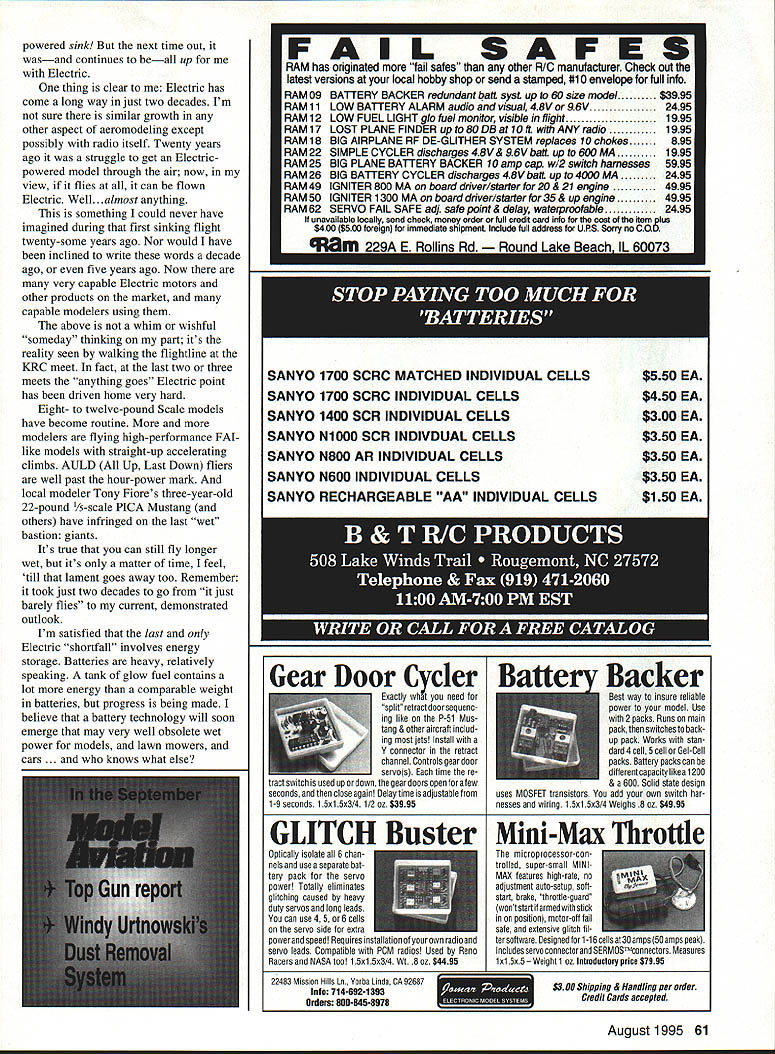
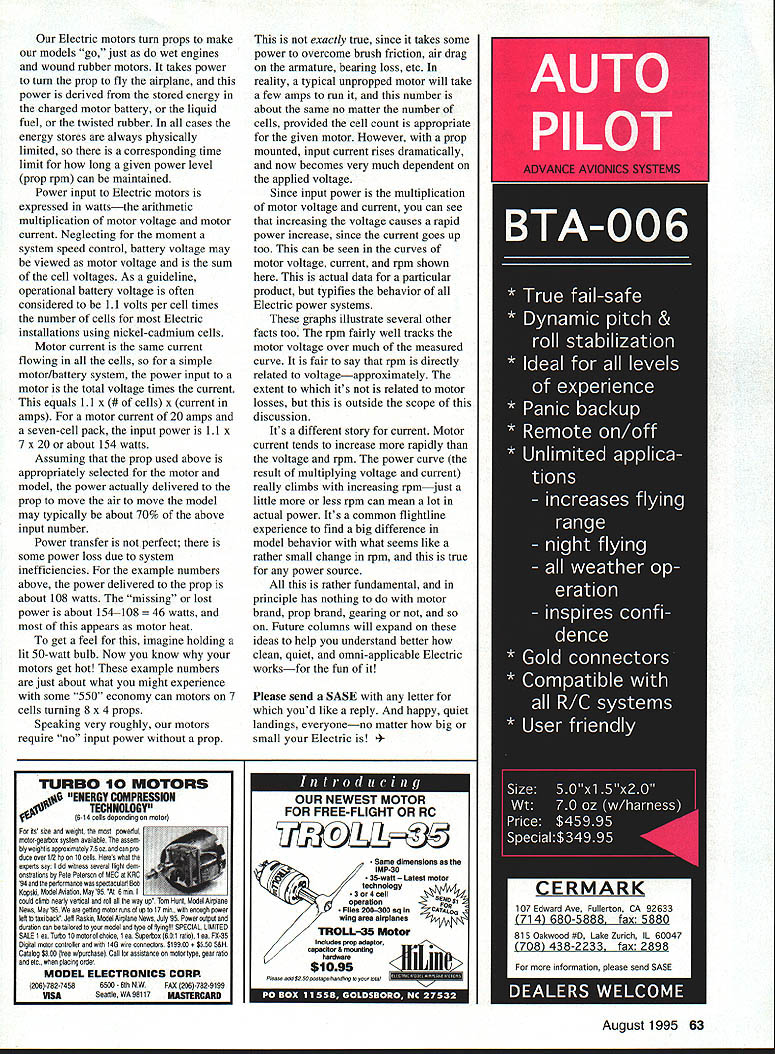
Eight- to twelve-pound scale models have become routine. More and more modelers are flying high-performance FAI-like models with straight-up accelerating climbs. AULD (All Up, Last Down) fliers are well past the hour-power mark. And local modeler Tony Fiore's three-year-old 22-pound 1/5-scale PICA Mustang (and others) have infringed on the last "wet" bastion: giants.
It's true that you can still fly longer on fuel, but it's only a matter of time, I feel, till that lament goes away too. Remember: it took just two decades to go from "it just barely flies" to my current, demonstrated outlook.
I'm satisfied that the last and only Electric "shortfall" involves energy storage. Batteries are heavy, relatively speaking. A tank of glow fuel contains a lot more energy than a comparable weight in batteries, but progress is being made. I believe that a battery technology will soon emerge that may very well obsolete wet power for models, and lawn mowers, and cars — and who knows what else?
I think there will be a day when our wet engines will have a hard time keeping up with Electric. All that's needed is rapidly rechargeable, high-current-density cells with more watt-hours per ounce (at the consumer level) since big, powerful motors are already reality. This will mean no more excuses and no more fields lost because of noise (an extrapolation of my never having heard of a field lost because of quiet).
Beginners (and sometimes experienced E-modelers) can have some confusion and misunderstanding about motor, battery, and prop operation. I see this in incoming mail and on the flightline. Some thoughts and guidelines:
From the discussion above, it's fair to think of the motor-battery as an Electric fuel tank—filled by charging and emptied when it feeds a motor/prop combination. The battery capacity ("tank size") is expressed in amp-hours rather than fluid ounces as is a wet-fuel tank. Taken literally, this expression of capacity is the physical description of how long the battery will deliver a given number of amps.
For example, a 1.4 amp-hour pack will deliver a (nominal) 1.4 amps for one hour, or 14 amps for 1/10 hour (six minutes)—until it "goes dry." It's easy to imagine other current-time combinations. This capacity rating also describes the amount of charge needed to fill a battery pack, although in actual practice it takes a little extra to "top it off"—due to some electrochemical inefficiency.
Note that in all the above the number of cells in the pack does not matter as long as they all have the same amp-hour rating and are connected in series (the standard way of wiring cells for our purposes). So a seven-cell 1.4 Ah pack has the same capacity as a 21-cell 1.4 Ah pack: both will deliver 28 amps for three minutes. Of course, the latter pack has three times the cell count, and has three times more total available energy (more on that later).
Our Electric motors turn props to make our models "go," just as do wet engines and wound rubber motors. It takes power to turn the prop to fly the airplane, and this power is derived from the stored energy—the charged motor battery, or the liquid fuel, or the twisted rubber. In all cases the energy stores are always physically limited, so there is a corresponding time limit for how long a given power level (prop rpm) can be maintained.
Power input to Electric motors is expressed in watts—the arithmetic multiplication of motor voltage and motor current. Neglecting for the moment a system speed control, battery voltage may be viewed as motor voltage and is the sum of the cell voltages. As a guideline, operational battery voltage is often considered to be 1.1 volts per cell times the number of cells for most Electric installations using nickel-cadmium cells.
Motor current is the same current flowing in all the cells, so for a simple motor/battery system, the power input to a motor is the total voltage times the current. This equals 1.1 x (number of cells) x (current in amps). For a motor current of 20 amps and a seven-cell pack, the input power is 1.1 x 7 x 20, or about 154 watts.
Assuming that the prop used above is appropriately selected for the motor and model, the power actually delivered to the prop to move the air to move the model may typically be about 70% of the above input number.
Power transfer is not perfect; there is some power loss due to system inefficiencies. For the example numbers above, the power delivered to the prop is about 108 watts. The "missing" or lost power is about 154 − 108 = 46 watts, and most of this appears as motor heat.
To get a feel for this, imagine holding a lit 50-watt bulb. Now you know why our motors get hot! These example numbers are just about what you might experience with some "550" economy can motors on 7 cells turning 8 x 4 props.
Speaking very roughly, our motors require "no" input power without a prop. This is not exactly true, since it takes some power to overcome brush friction, air drag on the armature, bearing loss, etc. In reality, a typical unpropped motor will take a few amps to run it, and this number is about the same no matter the number of cells, provided the cell count is appropriate for the given motor. However, with a prop mounted, input current rises dramatically, and now becomes very much dependent on the applied voltage.
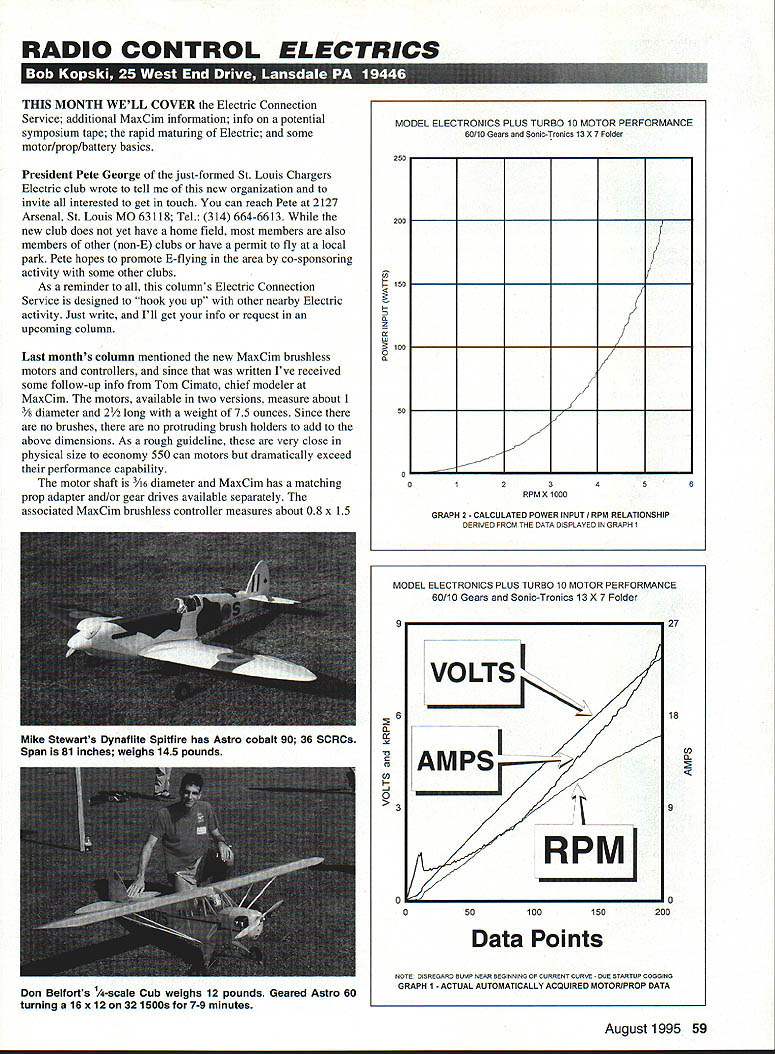
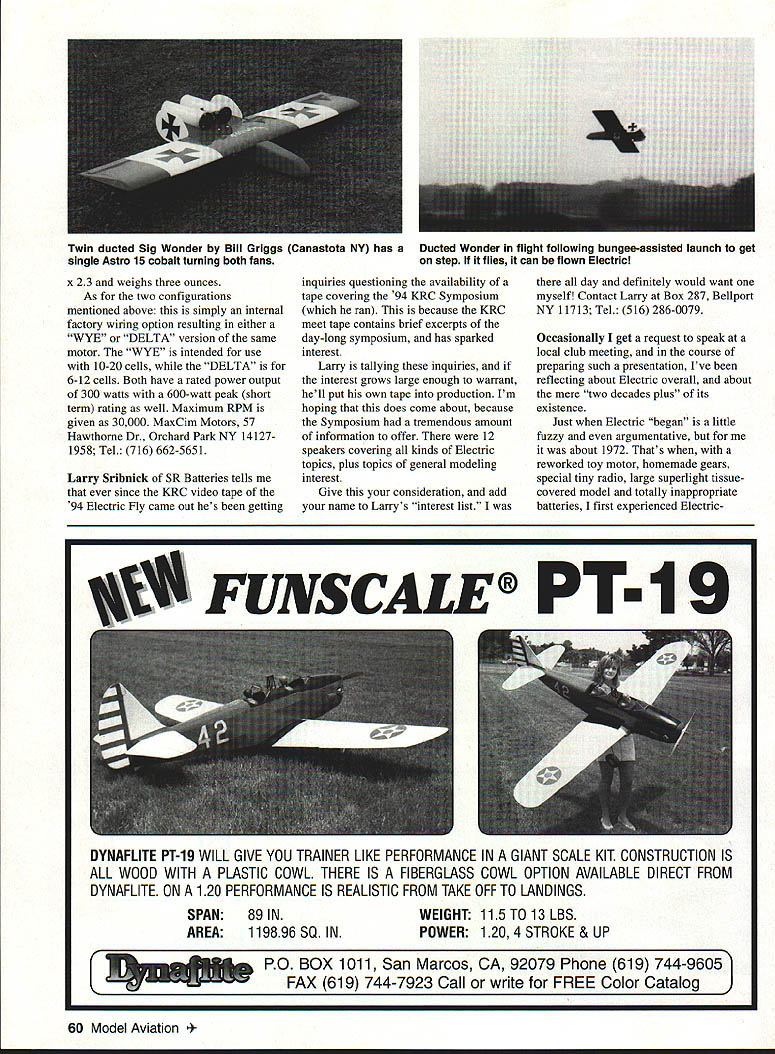
Since input power is the multiplication of motor voltage and current, you can see that increasing the voltage causes a rapid power increase, since the current goes up too. This can be seen in the curves of motor voltage, current, and rpm. This is actual data for a particular product, but typifies the behavior of all Electric power systems.
These curves illustrate several other facts too. The rpm fairly well tracks the motor voltage over much of the measured curve. It is fair to say that rpm is approximately directly related to voltage. The extent to which it's not is related to motor losses, but this is outside the scope of this discussion.
It's a different story for current. Motor current tends to increase more rapidly than the voltage and rpm. The power curve (the result of multiplying voltage and current) really climbs with increasing rpm—just a little more or less rpm can mean a lot in actual power. It's a common flightline experience to find a big difference in model behavior with what seems like a rather small change in rpm, and this is true for any power source.
All this is rather fundamental, and in principle has nothing to do with motor brand, prop brand, gearing or not, and so on. Future columns will expand on these ideas to help you understand better how clean, quiet, and omni-applicable Electric works—for the fun of it!
Please send a SASE with any letter for which you'd like a reply. And happy, quiet landings, everyone—no matter how big or small your Electric is!
Transcribed from original scans by AI. Minor OCR errors may remain.

