
Radio Control
Electrics
Bob Kopski
More electric writing
I want to open this column with a hearty "atta boy" and best wishes to Flying Models magazine and author Mike Charles, who introduced a new column on electric flight commencing with the June 1985 issue. This addition brings the total electric column count to five—or 100% of the popular monthly magazines our hobby is blessed with. It has been personally very interesting to witness the steady growth of electric interest over the decade, wherein three magazines, including MA, have installed dedicated columns in less than two years.
Electric OT competition
Last month's column included a short addendum announcing the addition of an electric event to the normal list of gas activities at the annual SAM 76 Old-Timers meet in Hatfield, PA—this year scheduled for July 14. (This is not to be confused with the annual KRC Electric Fly, also held in Hatfield, PA—this year on September 21–22.) I must say with some considerable personal satisfaction that my column of January 1985 may have helped this happen. In that column I commented on attending the affair last year and flying some electric demo there. I also suggested how natural a mix electric and OT is, and how simple approaches may be used to get more OT electric activity going throughout the country.
Well, the forward-thinking leaders of SAM Chapter 76 are doing just that—introducing electric into their annual schedule in a very easy and encouraging way. This year's event will be open to any SAM-recognized Antique or Old-Timer design, of any size, with any electric power system. The rules are very simple, and very encouraging—none! Entries will be able to fly out the battery charge on each of two flight attempts. A max flight time will be established by the CD to accommodate existing conditions. A flyoff will be held, if necessary. Period! Complete and utter first-time simplicity! This sort of "come just try your electric best" is just what's needed to help the electric cause—OT or otherwise—throughout most of our great country, where established electric activity does not now exist (which is just about everywhere).
While SAM (nationally) has an electric rules proposal before its membership, the attitude I sense around here is that if these particular proposals were actually put into effect for this first SAM 76 electric event, the participation would likely be a grand total of zero. Let's look more at this.
The proposed SAM electric rules include several seemingly complicated requirements, along with some that are straightforward. Examples of the complicated requirements include:
- no direct drive
- specific gear ratio limits
- a maximum prop diameter
- maximum rpm as measured with a tachometer (with allowed tach accuracy ±5%)
- minimum wing loadings
Examples of more normal-sounding rules include:
- cell count
- run time
The tachometer accuracy note is revealing: an allowed accuracy of ±5% is equivalent to an approximate 33% power spread, which makes the measurement rather dubious for meaningful regulation. Now, if someone can educate me as to the value or reasoning behind the first examples—convincingly—and providing it has nothing to do with specific product limitations or promotions, I'll be happy to pass the word along in a future column. But for now, the only thing I can see happening with these proposals is a near-certain slowing down of electric growth within OT.
As best I can ascertain, these suggested rules originate in the West, and I do know that region of the country is rather active in electric competitions—OT and otherwise. Perhaps the attitude of modelers there can readily accept and adapt to such a rules regimen (though I still don't know why!). More than likely, I suspect, these hard-to-believe "rules" are driven in part by the bickering electric industry—something I also mentioned in that January 1985 column.
Based on personal conversation and incoming mail related to experiences in areas of the country still woefully short of electric fliers and electric meets, this rules complexity won't help. No rules definitely will help—for starters, that's exactly what SAM 76 is giving a try.
Personally, I expect to see perhaps a handful of modelers give this event a try and have plenty of fun doing it. Then there'll be those who watch with keen interest and curiosity—at the very same time proclaiming "Wait till next year!" And next year the participating number will be somewhere around twice as many. And so on. (This sure beats zero!) I'll be there—participating—and then I'll faithfully report the results in this column for all to see how right—or wrong—I've called it! It is quite conceivable that this move by SAM 76 will put that group in a leadership position in electric OT on this coast. Best wishes to SAM 76.
Eleventh annual Astro Electric Championships
Next, I acknowledge with glee the eleventh anniversary of the Astro Electric Championships, this year held on multiple February weekends and sites in sunny California. Astro's president, Bob Boucher (pronounced "boo-shay"), has long advocated the promotion of electric competition. In fact, Bob is very high on the upcoming 1986 FAI Electric World Championships and is doing everything he can to encourage first-ever U.S. participation and—better yet—victory!
For the 1985 Astro Champs, Bob and Model Builder's Mitch Poling were kind enough to send me photos and information about the affair. This year there was a total of 90 entries in RC and 35 in FF and CL. (Yes—electric works just great in FF and CL.) Just to show you what can be done in an experienced, contest-oriented climate, the meet had seven RC contest categories. These included:
- Seven-Cell Sailplane
- Unlimited Sailplane
- Seven-Cell Old-Timer
- Unlimited Old-Timer
- Stand-Off Scale
- Aerobatics
- Seven-Cell Pylon
Now let's look at some of the seemingly natural and sensible electric rules used in this multi-event. For example, the glider event rules and tasks included one-minute motor runs, seven-minute pre-come glide duration, and spot landings. Makes sense. While even these criteria may be "too much" for relatively inexperienced areas with small electric populations attempting the first electric meet, they are no problem for locations such as out West, where this Astro meet is a well-established annual affair and there are plenty of experienced participants.
While I very strongly advocate and encourage an initial "no rules" approach to electric participation "for starters," I certainly do not discourage organized competition in established environments—if done sensibly. You see, my aim is the cause of promoting and sharing electric fun—at any level that's appropriate, but most especially at the start-up level.
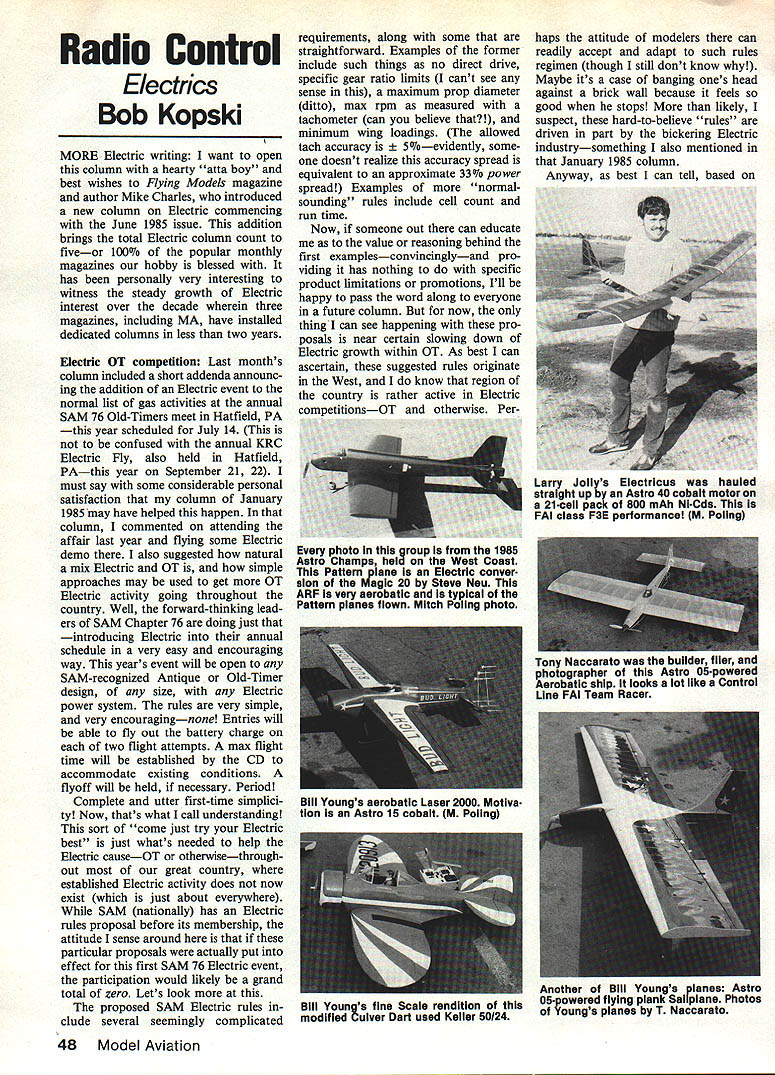
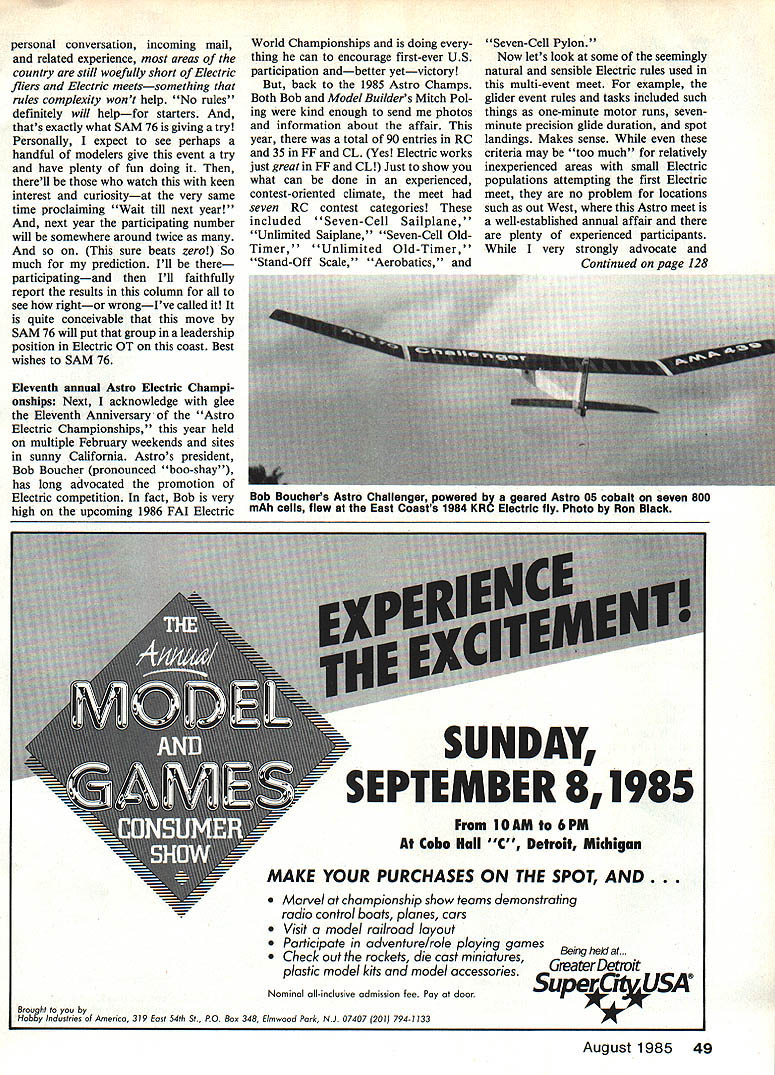
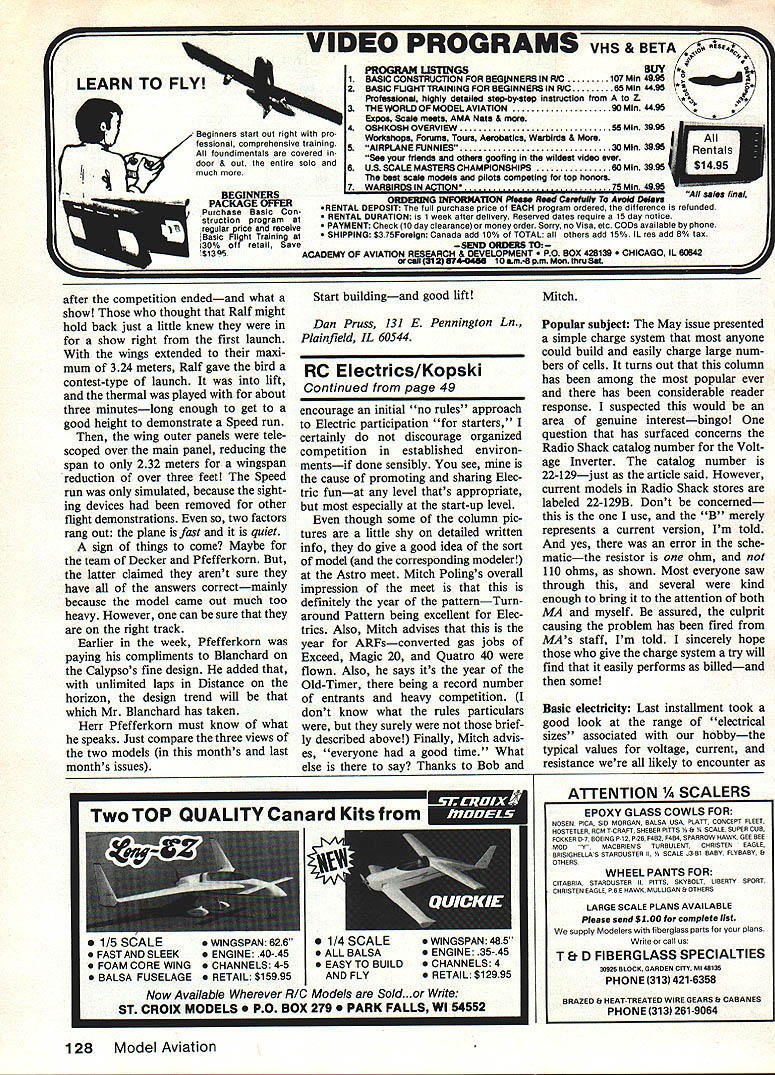
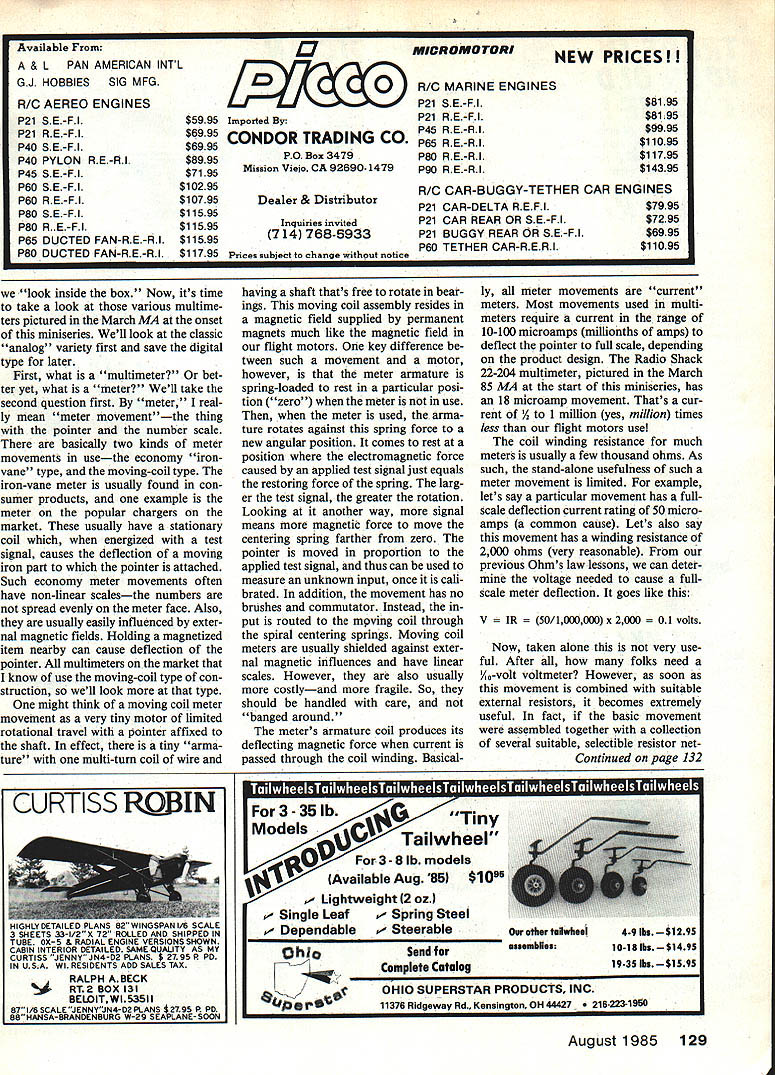
Even though some of the column pictures are a little shy on detailed written info, they do give a good idea of the sort of model and the corresponding modeler. At the Astro meet, Mitch Poling's overall impression was that this is definitely the year of the pattern—turning pattern being excellent for electrics. Also, Mitch advises that this is the year for ARFs—converted gas jobs of Exceed, Magic 20, and Quattro 40 were flown. He also says it's the year of the Old-Timer, there being a record number of entrants and heavy competition. Finally, Mitch advises, "everyone had a good time." What else is there to say? Thanks to Bob and Mitch.
Popular subject
The May issue presented a simple charge system that most anyone could build and that would easily change large numbers of cells. It turns out that this column has been among the most popular ever and there has been considerable reader response. I suspected this would be an area of genuine interest—bingo!
One question that surfaced concerns the Radio Shack catalog number for the voltage inverter. The catalog number is 22-129—just as the article said. However, current models in Radio Shack stores are labeled 22-129B. Don't be concerned—this is the one I use, and the "B" merely represents an extra version, I'm told. And yes, there was an error in the schematic—the resistor is one ohm, and not 110 ohms, as shown. Most everyone saw through this, and several were kind enough to bring it to the attention of both MA and myself. Be assured, the culprit causing the problem has been fired from MA's staff, I'm told. I sincerely hope those who give the charge system a try will find that it easily performs as billed—and then some!
Basic electricity
The last installment took a good look at the range of "electrical sizes" associated with our hobby—the typical values for voltage, current, and resistance we're all likely to encounter. In this installment we'll look at meter movements and how they relate to typical model-electronics measurements.
A moving-coil meter movement consists of a coil that is free to rotate in bearings. This moving coil assembly resides in a magnetic field supplied by permanent magnets, much like the magnetic field in our flight motors. One key difference between such a movement and a motor, however, is that the meter armature is spring-loaded to rest in a particular position ("zero") when the meter is not in use. Then, when the meter is used, the armature rotates against this spring force to a new angular position. It comes to rest at a position where the electromagnetic force caused by an applied test signal just equals the restoring force of the spring. The larger the test signal, the greater the rotation.
Looking at it another way: more signal means more magnetic force to move the centering spring farther from zero. The pointer is moved in proportion to the applied test signal, and thus can be used to measure an unknown input once it is calibrated. In addition, the movement has no brushes and commutator. Instead, the input is routed to the moving coil through the spiral centering springs. Moving-coil meters are usually shielded against external magnetic influences and have linear scales. However, they are also usually more costly—and more fragile. So they should be handled with care, and not "banged around."
The meter's armature coil produces its deflecting magnetic force when current is passed through the coil winding. Basically, all meter movements are current meters. Most movements used in multimeters require a current in the range of 10–100 microamps to deflect the pointer to full scale, depending on the product design. The Radio Shack 22-204 multimeter, pictured in the March 1985 MA at the start of this miniseries, has an 18 microamp movement. That's a current of 1/4 to 1,000,000 times less than our flight motors use!
The coil winding resistance for such meters is usually a few thousand ohms. As such, the stand-alone usefulness of such a meter movement is limited. For example, let's say a particular movement has a full-scale deflection current rating of 50 microamps (a common case). Let's also say this movement has a winding resistance of 2,000 ohms (very reasonable). From Ohm's law we can determine the voltage needed to cause a full-scale meter deflection:
V = I × R = (50 / 1,000,000) × 2,000 = 0.1 volts
Taken alone this is not very useful. After all, how many folks need a 0.1‑volt voltmeter? However, as soon as this movement is combined with suitable external resistors, it becomes extremely useful. If the basic movement is assembled together with a collection of several suitable, selectable resistors, it becomes a "multimeter"—many meters having very useful measurement ranges in one package. Later, we'll see how some resistors are used to make different voltage ranges and others are used to make current ranges. This insight into how multimeters work will make using them a snap—simply because it will all make sense. It will add greatly to your understanding of what really goes on in your airborne wiring, in your charger, and in many other electrical things as well.
Finally, for closing impact, consider the electrical power needed to move the example movement full-scale. We can get this from previous lessons:
P = V × I = 0.1 × (50 / 1,000,000) = 0.000005 watts
or five millionths of a watt. This is about one-half-a-billionth of the power of a typical .05 electric flight motor!
Daniel Boone Silent Fliers — Sixth Annual 2‑Meter Sailplane Contest (Electric event)
Here's another new electric event to add to your calendar. The Daniel Boone Silent Fliers have scheduled their Sixth Annual 2‑Meter Sailplane Contest for Saturday and Sunday, September 28 and 29, and this year are adding an electric event to the normal activities. Each day is independent, so you have two opportunities to show your electric stuff!
The electric event is a duration event open to all electrics, of any size, with any motor and any Ni-Cd battery. No "rules"!
The event will be flown in rounds just like the sailplanes, and you can fly out a full charge each flight. Flight maxes and possible tasks will be established by the CD. The idea is to promote electrics!
For more information, please contact Contest Director Jerry Zeigenfuse, 8 Craig Drive, Reading, PA 19606; telephone (215) 779-3229.
Please forward any questions with SASE to the author: Bob Kopski, 25 West End Dr., Lansdale, PA 19446.
And may many happy electric landings be yours!
Transcribed from original scans by AI. Minor OCR errors may remain.

