

RADIO CONTROL ELECTRICS
Bob Kopski, 25 West End Drive, Lansdale PA 19446
This month's topics
- Meet announcement
- Two reminders
- A new catalog
- E‑Motion, the large and small of it
- More on power systems
DEAF Ninth Annual Electric Fly‑in
The Dallas Electric Flyers (DEAF) has announced its Ninth Annual Electric Fly‑in, September 30–October 1, at the Dallas RC Field in Seagoville, TX (near Dallas). In addition to many events there will be a sell/swap bazaar, a free Saturday night buffet, and a free DEAF Fly‑In mug. (Electric folks are the friendliest!)
Get all the details from CD Frank Korman, 9354 Forrest Hills Blvd., Dallas TX 75218; Tel.: (214) 327‑8411.
Column input and club call
Please don't forget that you have it in your power to help shape this column for the future. In the September column I asked for your input on what your needs and interests are, and your likes/dislikes in this (or any) Electric column. Do you like/want new‑product announcements? meet announcements? meet reports? beginner stuff? high‑tech stuff? how‑to? or something I haven't thought of? Please let me in on your deepest, secret E‑column wishes—and who knows, they may even happen!
And please don't forget this column's "club call." Please see the September and October columns for details. Don't let your club be left out—November is on its way!
Hobby Lobby catalog
The folks at Hobby Lobby continue to outdo themselves. Every new HL catalog is a jam‑packed masterpiece of E‑content, and the HL folks have added numerous new electric items to their already extensive selection, including airplanes, motors, gear drives, a helicopter, and more. The cover is a work of art too.
Get the HL Catalog for $2.50 from Hobby Lobby International, 5614 Franklin Pike Circle, Brentwood TN 37027; Tel.: (615) 373‑1444.
E‑Motion design and testing
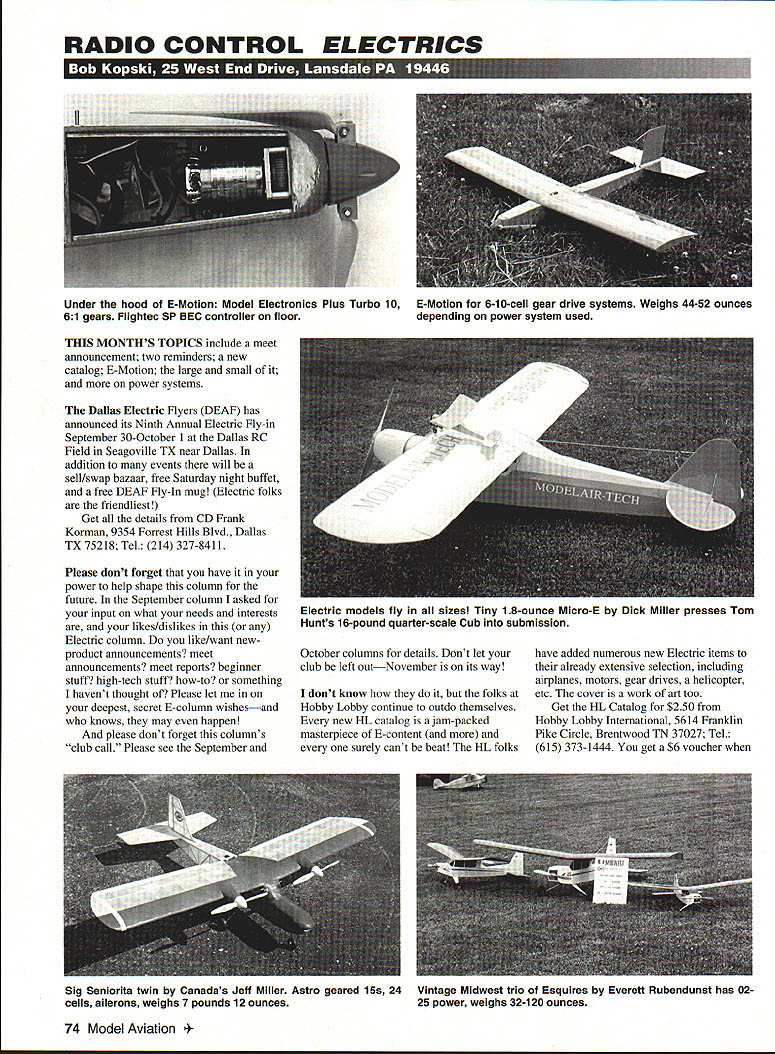
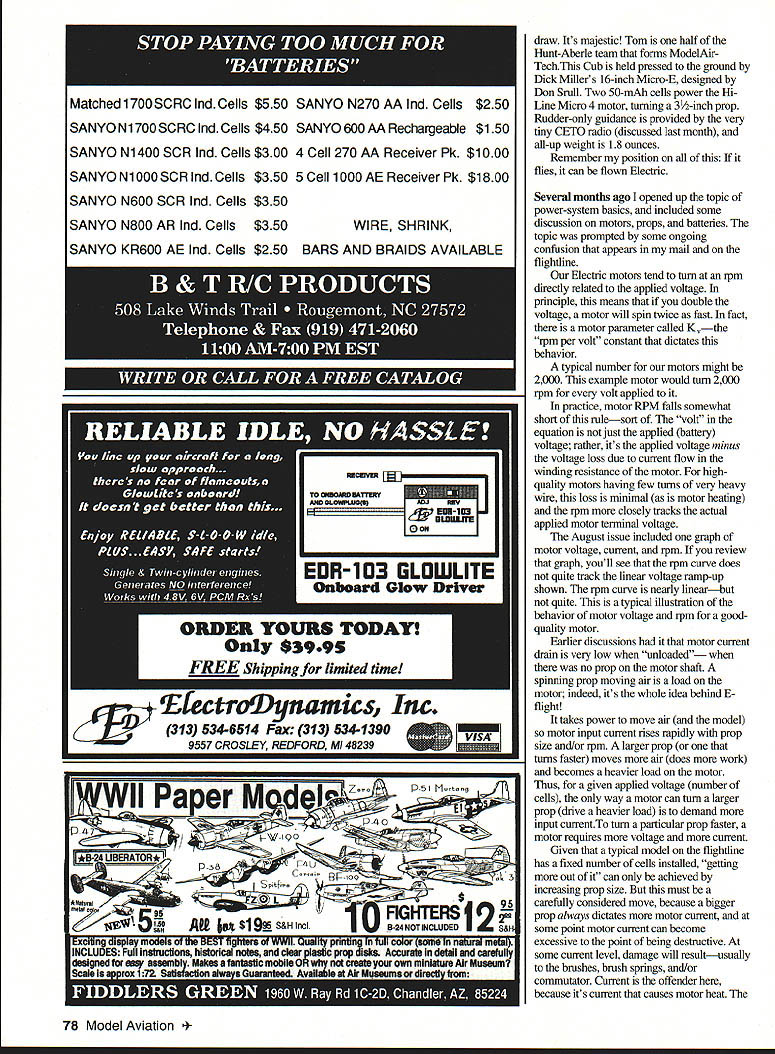
As mentioned in the May column, I've been working on a new six‑to‑ten‑cell electric design to use small geared systems on the market such as Master Airscrew, Model Electronics, American Fun Fly, Astro, and roll‑your‑own varieties based on car motors. The just‑finished E‑Motion (400 square inches) configuration looks somewhat like a slope soarer, has a NACA 2412 section, and rather large strip ailerons.
Before I had time to write, I had already checked out motor/prop mixtures over the 6–10 cell range, including Master Airscrews, home‑brew car motors, and the Model Electronics Turbo Plus 10 (6:1 ratio). Of particular note, the latter system on 10 cells with a Sonic‑Tronics 13 x 7 long‑hub prop climb was absolutely sizzling — a 49‑ounce ship climbed quite vertically. It's a bit docile and still very flyable; less‑impressive systems will have something for everybody, including growth opportunity. E‑Motion is very exciting from an experimental point of view, and I still have lots of power combos to try, including some Astros, American Fun Fly, and the new Aveox. That's what keeps the E‑xcitement going.
LVRCS Meet and the large and small of electric RC
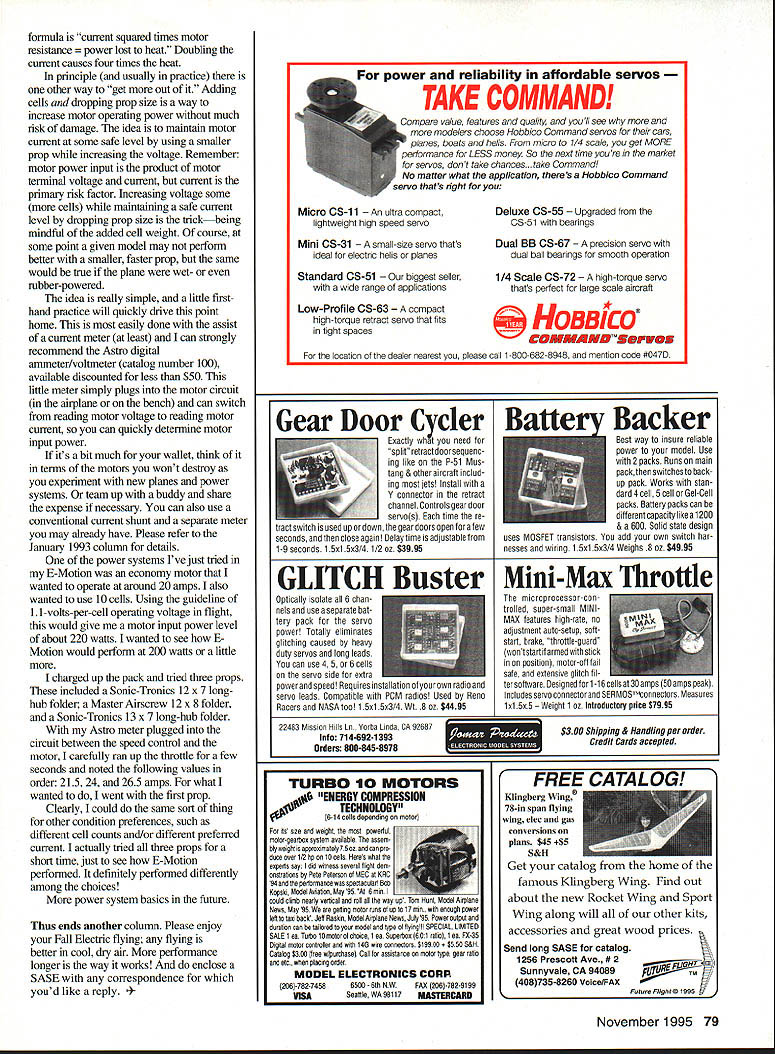
The June 1995 LVRCS Meet near Easton, PA, brought out its usual exciting attendance. This is a nice, casual meet run by fine folks on a great flying site. One photo in particular is in need of further comment: the two airplanes depicting the large and the small of electric RC.
This photo opportunity presented itself quite by coincidence, just after I finished writing the October column. That column offered some thoughts regarding just how large and just how tiny electric models can be!
Let's begin with the biggie. Tom Hunt outfitted a previously built Nosen quarter‑scale Cub with the ModelAir‑Tech dual‑motor belt‑drive unit, driven by two 12‑volt version Speed 700s (Hobby Lobby). No attempt was made to lighten this 16+ pound craft, which easily flies on 32 SR 1500s and a 20 x 11 fan. The latter turns at 4,000 rpm with a 20‑amp draw. It's majestic! Tom is one half of the Hunt‑Aberle team that forms ModelAir‑Tech.
At the other extreme, the Cub is held pressed to the ground by Dick Miller's 16‑inch Micro‑E, designed by Don Srull. Two 50‑mAh cells power the Hi‑Line Micro 4 motor, turning a 3‑1/2‑inch prop. Rudder‑only guidance is provided by the very tiny CETO radio (discussed last month), and all‑up weight is 1.8 ounces. Remember my position on all of this: if it flies, it can be flown electric.
Power‑system basics
Motor rpm and Kv
Our electric motors tend to turn at an rpm directly related to the applied voltage. In principle, if you double the voltage, a motor will spin twice as fast. There is a motor parameter called Kv — the "rpm per volt" constant — that dictates this behavior. A typical number for our motors might be 2,000, meaning the motor would turn 2,000 rpm for every volt applied.
In practice, motor rpm falls somewhat short of this rule. The "volt" in the equation is not just the applied (battery) voltage; it's the applied voltage minus the voltage loss due to current flow in the winding resistance of the motor. For high‑quality motors having few turns of very heavy wire, this loss is minimal (as is motor heating) and the rpm more closely tracks the actual applied motor terminal voltage.
If you review the August graph of motor voltage, current, and rpm, you'll see that the rpm curve is near linear with voltage but does not quite track it exactly. This is a typical illustration of the behavior for a good‑quality motor.
Motor load and current
Earlier discussions noted that motor current drain is very low when "unloaded" — when there is no prop on the motor shaft. A spinning prop moving air is a load on the motor; indeed, it's the whole idea behind electric flight!
It takes power to move air (and the model), so motor input current rises rapidly with prop size and/or rpm. A larger prop (or one that turns faster) moves more air (does more work) and becomes a heavier load on the motor. Thus, for a given applied voltage (number of cells), the only way a motor can turn a larger prop (drive a heavier load) is to draw more input current. To turn a particular prop faster, a motor requires more voltage and more current.
Given that a typical model on the flightline has a fixed number of cells installed, "getting more out of it" can only be achieved by increasing prop size — but this must be a carefully considered move, because a bigger prop always dictates more motor current and at some point motor current can become excessive to the point of being destructive. At some current level, damage will result — usually to the brushes, brush springs, and/or commutator. Current is the offender here, because it's current that causes motor heat. The formula is: power lost to heat = current squared times motor resistance. Doubling the current causes four times the heat.
Increasing voltage vs. prop size
There is another way to "get more out of it": add cells and drop prop size. This increases motor operating voltage while keeping current at a safe level by using a smaller prop. Remember: motor input power is the product of motor terminal voltage and current, but current is the primary risk factor. Increasing voltage somewhat (more cells) while maintaining safe current by reducing prop size is the trick — being mindful of the added cell weight. Of course, at some point a given model may not perform better with a smaller, faster prop, but the same would be true if the plane were wet‑ or rubber‑powered.
A little firsthand practice will quickly drive this home. This is most easily done with the assist of a current meter.
Measuring and testing
I can strongly recommend the Astro digital ammeter/volt meter (catalog number 100), available discounted for less than $50. This little meter simply plugs into the motor circuit in the airplane or on the bench and can switch from reading motor voltage to reading motor current, so you can quickly determine motor input power.
If it's a bit much for your wallet, think of it in terms of the motors you won't destroy as you experiment with new planes and power systems. Or team up with a buddy and share the expense. You can also use a conventional current shunt and a separate meter you may already have. Please refer to the January 1993 column for details.
E‑Motion test case
One of the power systems I tried in E‑Motion was an economy motor that I wanted to operate at around 20 amps on 10 cells. Using the guideline of 1.1 volts per cell operating voltage in flight, this would give a motor input power level of about 220 watts. I wanted to see how E‑Motion would perform at about 200 watts.
I charged up the pack and tried three props:
- Sonic‑Tronics 12 x 8 long‑hub folder
- Master Airscrew 12 x 8 folder
- Sonic‑Tronics 13 x 7 long‑hub folder
With my Astro meter plugged into the circuit between the speed control and the motor, I carefully ran up the throttle for a few seconds and noted the following current values in order: 21.5 A, 24 A, and 26.5 A. For what I wanted to do, I went with the first prop.
Clearly, you can do the same sort of thing for other cell counts and/or different preferred currents. I actually tried all three props for a short time, just to see how E‑Motion performed. It definitely performed differently among the choices.
More power‑system basics in the future.
Please enjoy your fall electric flying; any flying is better if the air is cool and dry. More performance, longer, is the way it works! And do enclose a SASE with any correspondence for which you'd like a reply.
Transcribed from original scans by AI. Minor OCR errors may remain.

