
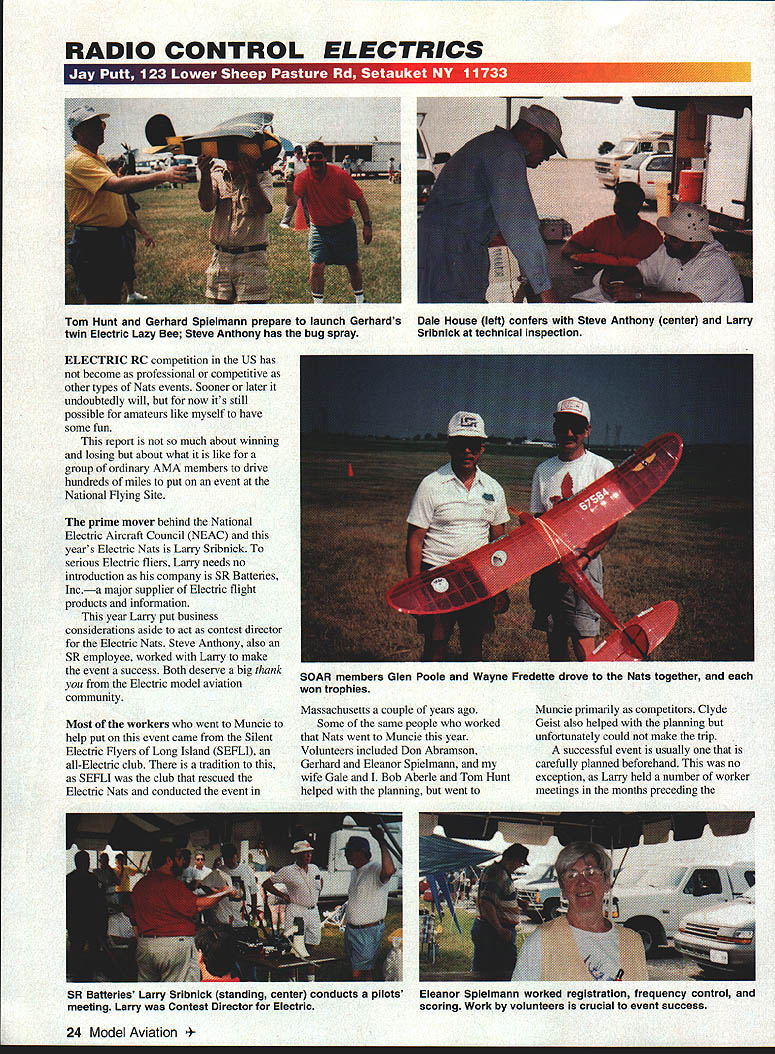
RADIO CONTROL ELECTRICS
Electric RC competition in the U.S. has not become as professional or competitive as some other Nats events. Sooner or later it undoubtedly will, but for now it's still possible for amateurs to have fun. This report is less about winning and losing than about what it is like for ordinary AMA members to drive hundreds of miles to put on an event at the National Flying Site.
Organization and volunteers
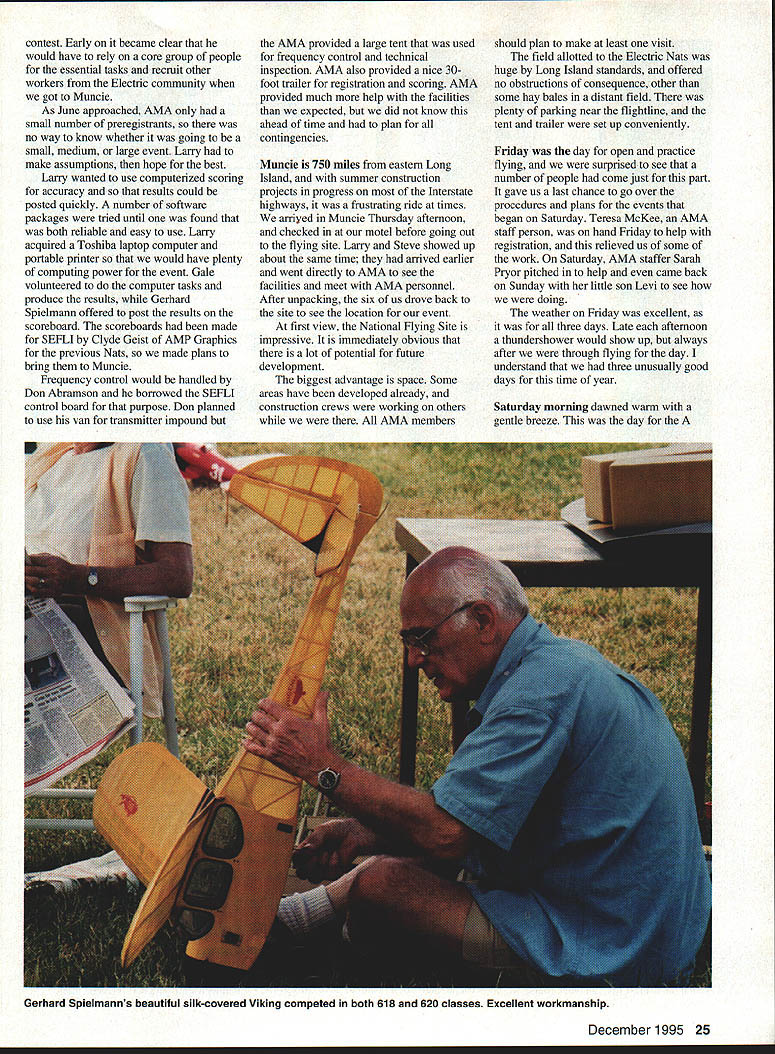
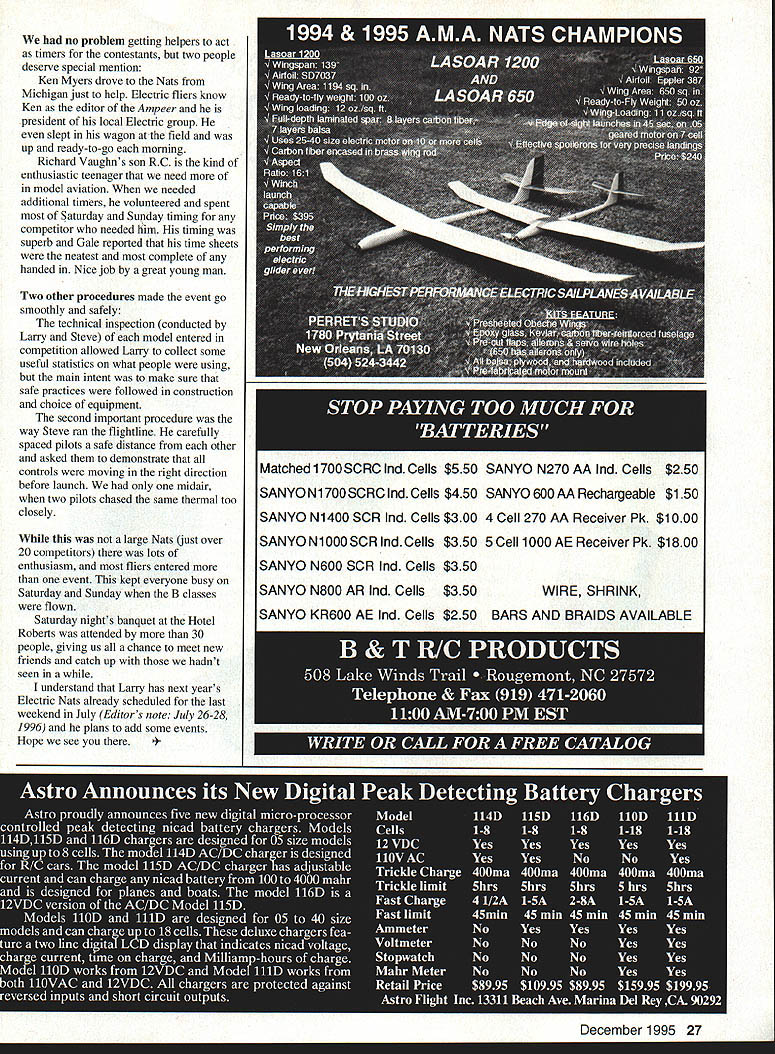
The prime mover behind the National Electric Aircraft Council (NEAC) and this year's Electric Nats was Larry Sribnick of SR Batteries, Inc. Larry served as contest director, with Steve Anthony (also an SR employee) helping to run the event. Both deserve thanks from the electric model aviation community.
Key volunteers included:
- Don Abramson — frequency control (borrowed SEFLI control board) and transmitter impound.
- Gerhard and Eleanor Spielmann — logistics and result posting.
- Gale (author’s wife) — computer tasks and timely results.
- Clyde Geist (AMP Graphics) — scoreboards.
- Don Abramson, Bob Aberle, Tom Hunt, Clyde Geist, and others helped with planning and execution.
- Additional helpers came from the Silent Electric Flyers of Long Island (SEFLI), the club that has supported the Electric Nats in the past.
A number of worker meetings were held in the months before the contest. Early planning identified a core group of people needed for essential tasks and a plan to recruit additional workers from the electric community once at Muncie.
Equipment and facilities
To provide fast, accurate scoring, Larry tested several software packages and acquired a Toshiba laptop and a portable printer. Gale handled the scoring computer work, and Gerhard posted results on the scoreboards Clyde brought. AMA provided:
- A large tent for frequency control and technical inspection.
- A 30-foot trailer for registration and scoring.
Contingency plans were made in case additional facilities or equipment were needed.
Travel and site
Muncie is about 750 miles from eastern Long Island, and summer highway construction made the trip slow at times. The group arrived Thursday, checked into motels, and inspected the flying site. The National Flying Site impressed with its space and potential for development. The area allotted for the Electric Nats was large, free of obstructions, with plenty of parking near the flight line; the tent and trailer were set up conveniently.
Friday was open practice. A surprising number of people arrived just for practice, which allowed the organizers a last walk-through of procedures. AMA staffers Teresa McKee and Sarah Pryor assisted with registration and helped throughout the weekend. The weather was excellent all three days, with only late-afternoon thundershowers after flying concluded.
Contest format
Saturday morning opened warm with a gentle breeze. The A seven-cell classes were:
- 610 for sailplanes
- 618 for Old-Timers
The contest schedule and rules:
- Old-Timers were flown in the morning to take advantage of lighter conditions; sailplane rounds were in the afternoon.
- Each event consisted of three one-hour rounds. Pilots were notified at the beginning and end of each round, and all three rounds counted.
- Scoring: the winner of each round received 1,000 points; other contestants’ scores were normalized as a percentage of the winning score to equalize changing conditions between rounds.
- Landing points were added after normalization to reduce the need for flyoffs.
- Precision rules required models to land at exactly eight minutes, with points lost for each second early or late. Landing circles were worth an extra 10 points.
Computerized scoring and prompt posting of results let contestants see standings immediately. There were flyoffs, and experienced competitors could plan strategy between rounds.
Results and notable competitors
Detailed results appear elsewhere in the magazine; highlights and notable entrants follow.
- Bob Aberle and Tom Hunt (Modelair‑Tech) — their new Defiant sailplane won the 610 class and placed second in 612.
- Richard Vaughn (Marietta, GA) — original design placed third in 610.
- Wayne Fredette, Paul Perrett Jr., and William Jenkins — winners or top finishers in various events.
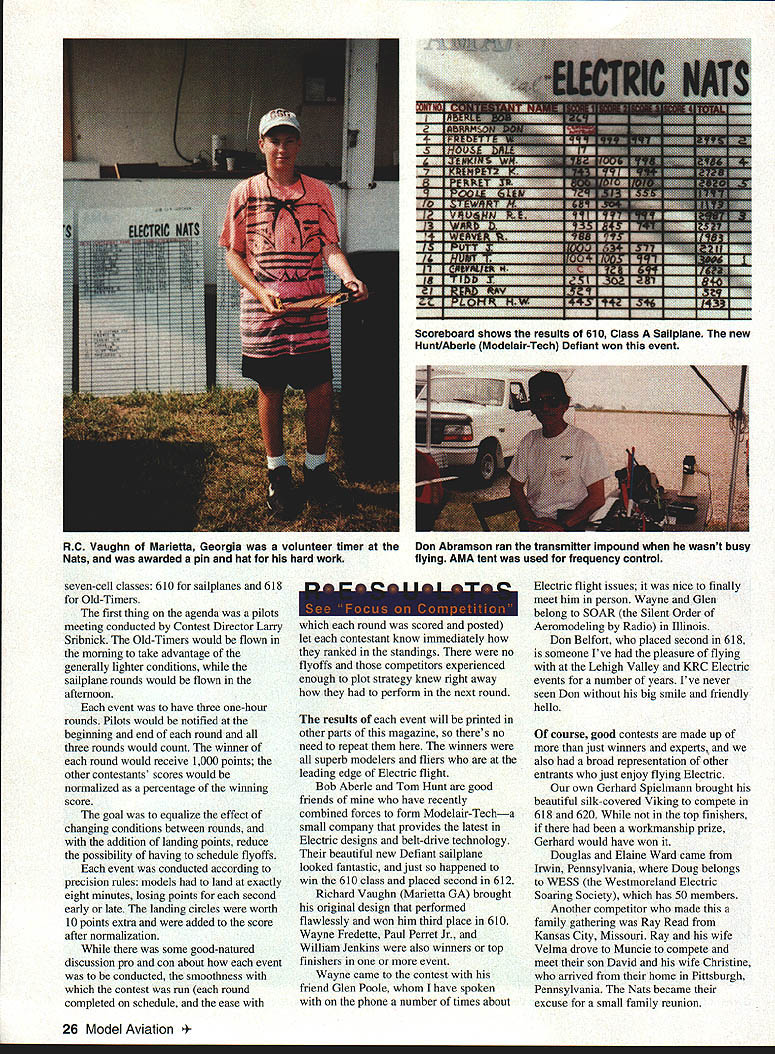
- Glen Poole (SOAR, Illinois) attended with Wayne Fredette.
- Don Belfort — placed second in 618.
- Gerhard Spielmann — flew a silk-covered Viking in 618 and 620; notable for workmanship.
- Douglas and Elaine Ward (WESS, Westmoreland Electric Soaring Society) traveled from Irwin, PA.
- Ray Read (Kansas City, MO) and his family used the Nats as a small reunion.
Although the event had just over 20 competitors, enthusiasm was high and many fliers entered multiple events.
Helpers and procedures
Timers and other helpers made the contest run smoothly:
- Ken Myers drove from Michigan to help; editor of the Ampeer and president of his local electric group.
- R.C. Vaughn (Richard Vaughn’s son) volunteered as a timer throughout the weekend; his time sheets were neat and complete.
Two procedures were especially important:
- Technical inspection (conducted by Larry and Steve) ensured safe construction and equipment choices and provided useful statistics on gear in use.
- Flightline management (run by Steve) maintained safe spacing between pilots and required control direction checks before launch.
There was only one midair, when two pilots chased the same thermal too closely.
Saturday night’s banquet at the Hotel Roberts was attended by more than 30 people and offered a chance to meet and catch up.
Looking ahead
Larry has the next Electric Nats scheduled for the last weekend in July (Editor's note: July 26–28, 1996) and plans to add some events. Hope to see more of the electric community there.
Transcribed from original scans by AI. Minor OCR errors may remain.

