
RADIO CONTROL ELECTRICS
Bob Kopski 25 West End Drive, Lansdale PA 19446
This month's topics
- The Electric Connection Service (ECS)
- Some exciting new E-products
- Brush dust
- Two electric points of view
Electric Connection Service
The September 1994 column offered an unusual Electric Connection Service listing: that of Ron Torrito and his Internet address, along with the invitation for anyone else interested to send me their Net address. Bill Jones of Wilkes-Barre, PA, can be found at his father's address: KEITHJONES@CROSERVE.COM. Please keep the ECS in mind; it's designed to help you find E-interest in your area. Just write me!
A number of readers have inquired why I'm not active in one net or another; there appears to be a lot of electric-related communication happening via that medium. While I'm very much E-interested, I just don't have the time to pursue yet another E-outlet.
Ordinarily, my regular column mail, the column itself, and the ongoing new E-things I want to pursue from my own interest and to share with you in this column are quite enough to fully occupy my available time. Perhaps this will change in the future, but for now I need to keep my hobby-related activity to this manageable level. I'm told there's plenty of E-conversation happening on CompuServe/Modelnet. Personally, I do use CompuServe e-mail to send my monthly columns to MA, but that's about the extent of my "on line" time each month.
New E-products overview
This has been a good year for new electric products and I want to share some information on a few: the new Astro 110D charger, new Aveox motors/controllers, some micro RC-E stuff, and a speed control from Steve Neu.
Astro 110D charger
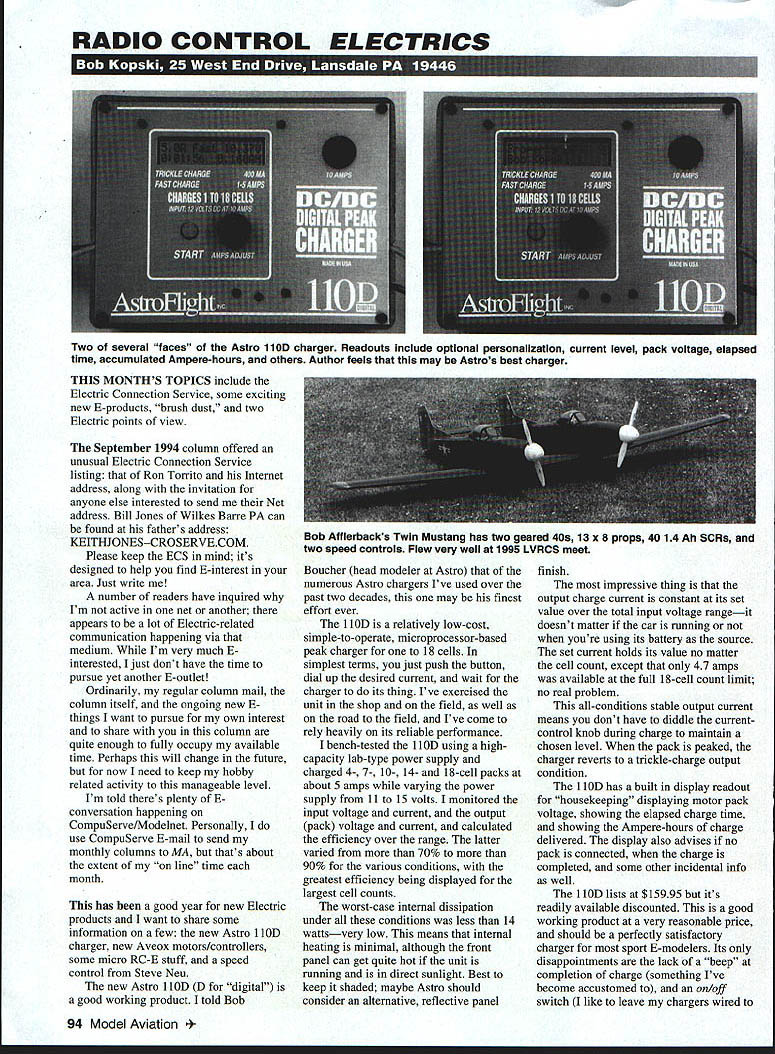
The new Astro 110D (D for "digital") is a good working product. I told Bob Boucher (head modeler at Astro) that over the past two decades, this one may be his finest effort ever.
The 110D is a relatively low-cost, simple-to-operate, microprocessor-based peak charger for one to 18 cells. In simplest terms, you just push the button, dial up the desired current, and wait for the charger to do its thing. I've exercised the unit in the shop and on the field, as well as on the road to the field, and I've come to rely heavily on its reliable performance.
Bench tests and observations:
- I charged 4-, 7-, 10-, 14-, and 18-cell packs at about 5 amps while varying the input from 11 to 15 volts.
- Calculated efficiency varied from more than 70% to more than 90%, with greatest efficiency for the largest cell counts.
- Worst-case internal dissipation was less than 14 watts, so internal heating is minimal. Note: the front panel can get quite hot if the unit runs in direct sunlight—keep it shaded.
- The output charge current is constant at its set value across the input voltage range; the set current holds regardless of cell count, except that only 4.7 amps was available at the full 18-cell limit.
- When the pack is peaked, the charger reverts to a trickle-charge condition.
Features:
- Built-in display readout showing pack voltage, elapsed charge time, and ampere-hours delivered.
- The display advises if no pack is connected, when charge is completed, and other incidental info.
- Optional customized display indicating ownership (mine reads "Property Bob Kopski")—about $20 additional if ordered direct from Astro.
Price and minor complaints:
- List price $159.95, usually available discounted.
- Lacks a completion "beep" and an on/off switch (I prefer chargers that can stay wired to car power). Supplied clips connect to an auto battery; input and output cords could be a bit longer—I added connectorized extensions.
Overall, a good working product at a reasonable price and suitable for most sport E-modelers.
Aveox brushless motors and controllers
It's "true confessions" time: my new Aveox 1409-2Y turning a Sonic-Tronics 15x7 via Astro gears in my 57-ounce E-Motion will take the airplane straight up—out of sight if I'd allow it. Except for my first electric successes twenty-some years ago, I've not felt such E-modeling excitement before. The vertical ascent is near-euphoria.
The motor and its companion controller are latest Aveox versions. I'm so delighted I now own two of them; I also fly a 1412-4Y. Aveox products recently took 8 of the top 12 places at the European Electric Champs. Some European manufacturers are pursuing brushless designs because conventional brushed motors have fallen from dominance—change or go under.
Product line notes:
- Aveox offers many product variations: several series of motors and corresponding controllers with similar winding options.
- Winding choices include "delta" or "wye" and different turn counts. Aveox can supply a listing/summary with typical performance for various props, voltages, and currents so you can "pick and choose" what's right.
- Brushless designs operate well over a large application range—much more flexible than conventional motors.
1409 specifics:
- Physical motor case size similar to popular "can" motors but much higher power handling: 900 watts rating. (1412 rated at 1200 watts.)
- "2" indicates two turns of magnet wire in each of the three windings, keeping resistance to an incredibly low 0.028 ohms.
- "Y" designates internal winding connection.
My setup:
- E-Motion uses 10 cells, peak current about 40 amps ⇒ ~400 watts input—well below the 900-watt rating.
- Nearly all power goes to the prop; motor/controller runs incredibly cool.
- Cooling air path is used, but a conventional motor in the same model running less input power gets too hot to touch.
- I also retrofitted a 1409 into my Sig Wonder—also goes vertical.
- Typical flight regimes (climb to speck, acrobatic glide, power up) yield flight times exceeding 10 minutes in dead air. Vertical performance remains strong because the motor stays cool and efficiency is high.
Thanks to Aveox head David Palombo—I'm sold on brushless. If you need help, call Aveox; the friendly folks there will assist.
Tiny RC Electrics
Dick Miller, the every-other-month E-columnist for Flying Models, is dedicated to tiny RC electrics and has lots of information and products for that specialty area. You can get a product/price list and an information sheet entitled "What Works" by sending a SASE to: Dick Miller 193 Huntinger Rd. Wernersville, PA 19565
This specialty of tiny E-RC is growing in popularity and I want to give it a try—just as soon as I come back to earth after my Aveox experience.
Steve Neu speed controls
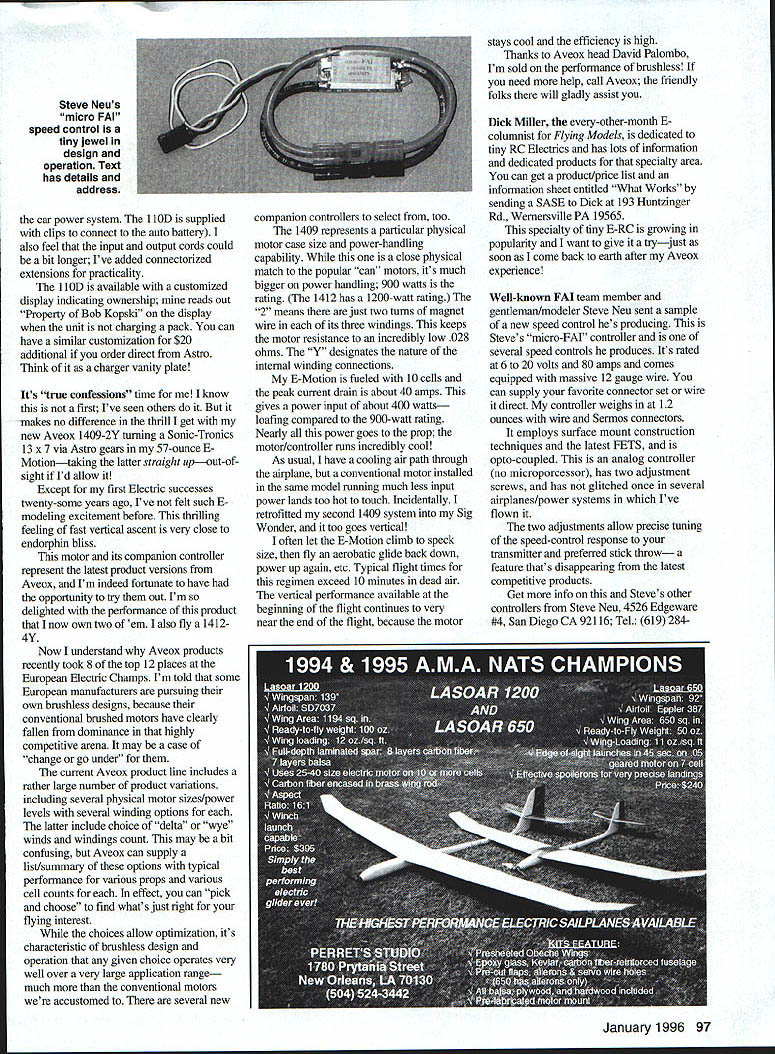
Well-known FAI team member and gentleman/modeler Steve Neu sent a sample of a new speed control he's producing. This "micro-FAI" controller is one of several he makes. Specs and notes:
- Rated at 60 volts and 80 amps.
- Comes equipped with heavy 12-gauge wire; you can supply your preferred connector set or wire it direct.
- My controller weighs 1.2 ounces with wire and S-connector.
- Employs four pulse-forming components and is opto-coupled.
- Analog controller (no microprocessor), with two adjustment screws, and has not glitched once in several airplanes/power systems I've tried it in.
- The two adjustments allow precise tuning of the speed-control response to your transmitter and preferred stick throw—a feature disappearing from many competitive products.
- Steve's philosophy is to produce the finest products rather than the cheapest. He does not use BEC, so his products do not include this option.
For more info and other controllers: Steve Neu 4526 Edgeware #4 San Diego, CA 92116 Tel: (619) 284-0816
Brush dust
Brush dust is the insidious superfine black powder that spews from conventional motor case openings and deposits itself like a fine paint all over anything in the motor compartment. It's actually brush material that wears off during motor operation.
If you've dealt with this, you know it does not want to come off; it seems to adhere especially to silicone-insulated high-flex wire and to balsa. A preemptive measure: coat new balsa in the motor compartment with Ambroid, then fine-sand and apply another coat. Collected brush dust wipes off more easily. Gray balsa is very disturbing!
Two electric points of view
Two recent experiences extended my view-screen of electric perspective:
- While thumbing through a popular modeling supply catalog, I came across—of all things—ear plugs! I take it these were not aimed at electric modelers.
- An old friend and former active modeler visited the field after several years' absence. I was flying my Juicy (a Daddy-sized E-Motion) with a geared Astro 25 on 15 cells. It's an aggressive performer with a variable-camber option, high angle of attack into a headwind, fine speed envelope, and aerobatic ability. My friend watched, then excitedly exclaimed how fantastic and impressive this was compared with years-ago electrics. Then, as if catching himself, he added "yeah, but" about how expensive it must be.
I don't know what "expensive" means—it's relative. One man's "cheap" is another's "expensive." No hobby escapes this. Friends of mine pursue amateur radio, fishing, photography, sports, full-scale aviation, sailing, gambling—any of these can be expensive depending on the point of view. High-performance electrics fit right in. Keep an open mind. Someday electric may be the best bargain of all for you—it may save your flying field. Tell me just how expensive a lost flying field is.
Closing
Thus ends the beginning-issue column of another year. Since you'll have this at just the right time, let me wish all of you a sincere happy holiday season and a great electric-flying New Year! Please enclose a SASE with any correspondence for which you'd like a reply.
Transcribed from original scans by AI. Minor OCR errors may remain.

