
RADIO CONTROL ELECTRICS
Bob Kopski, 25 West End Drive, Lansdale PA 19446
This column includes the Electric Connection Service, a meet announcement, a new electric book, a motor-mount improvement, charge connectors and arming switches, and a follow-up on speed-control chokes.
Electric Connection Service
Ken Cashion sent an unusual letter describing a new purpose within electric aeromodeling: electric flying for specific tasks. He and others are pursuing timed tasks, spot landings, etc.—much like the Silent Flight/soaring folks have done for years. This is part of the idea behind the League of Electric Soaring (LES). Ken would like to share information with anyone interested. Send three first-class stamps to:
- Ken Cashion, 157 Tennyson Cove, Picayune, MS 39466
- Tel.: (601) 798-5807
I suspect the concept will find wide appeal; many who attend the annual KRC meet show this inclination. For some of the pure soaring crowd, LES can be viewed as “soaring with a winch of a different kind.”
A number of readers have joined the Electric Connection Service network:
- Tom Anderson, 4448 Springdale St. NW, Washington, DC 20016 — Tom would like to use the Net to communicate with other E-modelers. Email: Tom_Anderson@rand.org
- David Alexander, 2905 Pebble Ln., Lawrence, KS 66047 — David and Gordon Tarling (England) are alternating an e-mail electric column for the magazine R/C Online (run by Randy and Julie Mullins). R/C Online contact: rconline@gatenet.net. David’s email: dalexander@alive.bio.ukans.edu
- Ron Torrito started the Internet listing idea in this column (Sept. 1995) and reported more than 50 responses within days of that issue.
If you’d like to participate or get information, feel free to write or contact the people above.
Electric meet announcement
The Las Vegas Radio Control Club (LVRC) has announced the Third Annual Electric Radio Control Fly-In for the weekend of February 24–25. The event will be held at Sam Boyd Stadium (site of the Tournament of Champions). LVRC’s goal is to make this the largest electric fly‑in in the West.
- Contact: Fred Reese, 2500 Teddy Drive #2, Las Vegas, NV 89102 — Tel.: (702) 876-4718
- Alternate contact: Dick Corby — Tel.: (702) 870-9522
New electric book
A new electric book by Bob Aberle, Clean and Quiet — The Guide to Electric Powered Flight, was recently released. Bob Aberle (longtime Flying Models technical editor) has come to electrics enthusiastically—he’s built many electrics and recently formed Modelair‑Tech with Tom Hunt to supply electric products.
Contents include:
- Advantages of electrics
- Flight systems, motors, props, batteries and chargers
- Speed controls, connectors and wires, fuses, switches and charging
- Radio systems, selecting powertrains, suitable aircraft, flying electrics
- Appendix listing suppliers and addresses
The book is easy to read, lighthearted in places, and includes drawings, photos, and cartoons by Don Bosquet. It’s available from:
- Douglas Charles Press, 440 Menton Road, N. Attleborough, MA 02760
- Tel.: (508) 761-5414
- Price: $12.95 + $3 shipping
Dealer inquiries are welcome; by the time you read this, the book should be available through several familiar E-modeling suppliers.
Motor-mount improvement: drywall sandpaper
I’ve long used a non-slip prop drive washer cut from drywall sandpaper (an open-coat, double-sided abrasive that looks like window screen). A washer placed between the prop hub and the motor drive washer gives a truly non-slip interface when the prop nut is tightened. I also use these washers between spinner backplates and the motor drive washer.
This technique is particularly valuable for large gear-drive systems turning big props. Alternating startup torque and braking can work a prop nut loose; the drywall-sandpaper washer prevents that.
More recently I’ve used drywall sandpaper on V-block motor mounts. Historically I used 7/16" single-stud foam tape to cushion and grip the motor, but large gear-drive systems still allowed the motor to slip its rotational orientation. Gluing fine drywall sandpaper to the V-block gives a much firmer grip. Taking it further, glue narrow strips of the sandpaper to the underside of brass draw straps; when tightened, the combination produces a very positive hold.
Drawbacks:
- You must make a good fit between the V-block/sandpaper shape and the motor — there’s little tolerance for mismatch (unlike foam tape).
- The sandpaper will mark (scratch) the motor housing.
If you’re having trouble keeping a motor in position or keeping props and spinners tight, try drywall sandpaper. It’s cheap and effective. Use “old” cutting tools to shape the material, since it will dull good cutting edges.
Charging connectors
Charging-connector choices are personal; many modelers use different connectors for different models. I’ve used the charge jack/plug combination introduced with Astro products for years. These parts are manufactured by Switchcraft and are high quality.
Since Astro changed to their own connector design, Switchcraft parts became less available through hobby sources, and many readers asked about alternates and arming switches.
Digi‑Key (electronics-parts distributor) stocks Switchcraft parts and C&K switches:
- Digi‑Key: 701 Brooks Ave. South, Box 677, Thief River Falls, MN 56701-0677
- Toll-free: (800) 344-4539
Switchcraft part numbers:
- Jack (female): SC1048-ND
- Plug (male): SC1051-ND
C&K DPDT arming switch:
- Digi‑Key part: CKN1035-ND
Small-quantity prices are modest (plugs/jacks under $3 each; DPDT switches under $6 each at the time of writing). Digi‑Key is excellent to deal with; they’re rarely out of stock and they accept small orders by phone. I normally order 10 of each item to cover my needs and friends’ needs and to exceed their $25 minimum (orders below that may incur a service charge).
Arming switches — avoid current Radio Shack mini toggles
I strongly discourage using current versions of Radio Shack’s miniature toggle switches for arming. In the past I used RS catalog #275-1546 (a DPDT toggle) with good results, but RS apparently changed suppliers and the newer switches fail in arming applications. As a practical distinction, earlier RS switches had a brown plastic housing; newer ones are blue.
Use quality C&K switches (available from Digi‑Key) for reliable arming-switch performance. I’ve used the Digi‑Key CKN1035-ND DPDT switch for over a year and it has not failed.
Some detailed photos and wiring diagrams for these connectors and DPDT arming-switch wiring appeared in the March and April 1991 columns. I will publish updated wiring information for these parts in the near future.
Speed-control chokes (follow-up)
The April 1995 column explained adding chokes in the leads of motor speed controls to reduce radio noise from the speed control or other parts of the power system. This is most useful with speed controls that are not optically coupled and/or are microprocessor-based.
Since that column I’ve heard from several readers who had success; I’ve not heard from anyone who did not benefit. While chokes won’t help radiated-noise problems (as opposed to conducted-noise problems), they have a high success rate for conducted-noise suppression. Chokes cost only pennies and are available from ACE R/C.
One speed‑control manufacturer (Jomar, now EMS) was impressed enough to design chokes into their Mini‑Max control.
Examples / reader notes
Some reader-conversion and installation notes received:
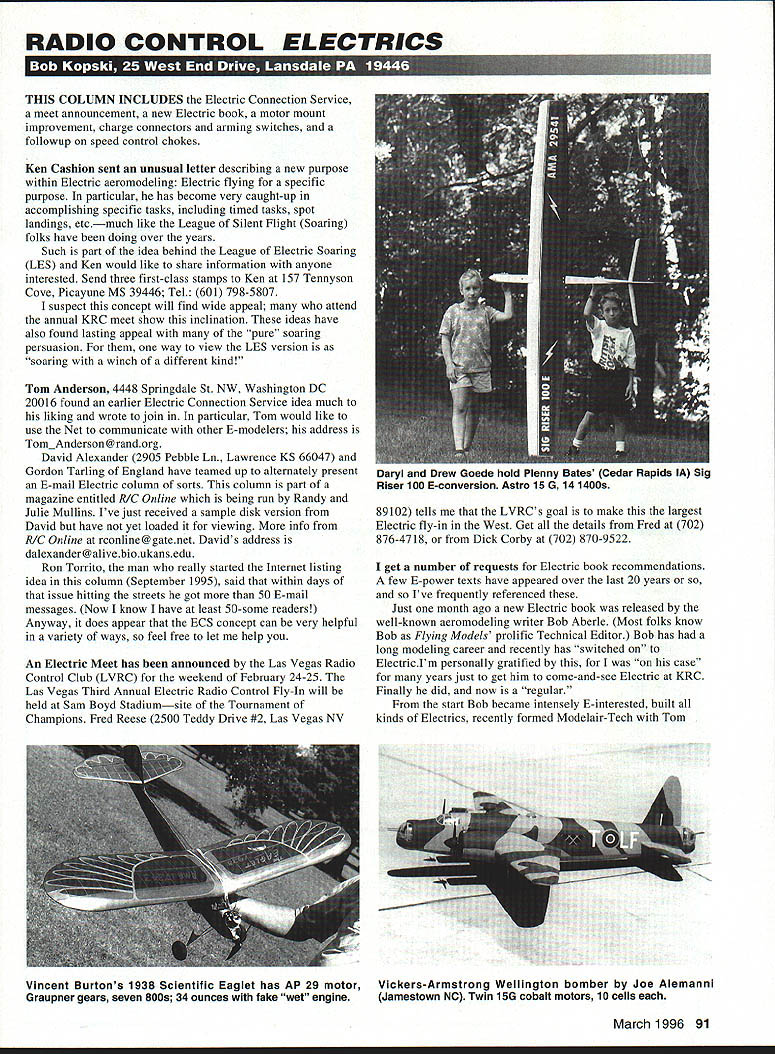
- Larry Bates, Cedar Rapids, IA — Sig Riser 100 e-conversion: Astro 15, G-14, 1400s
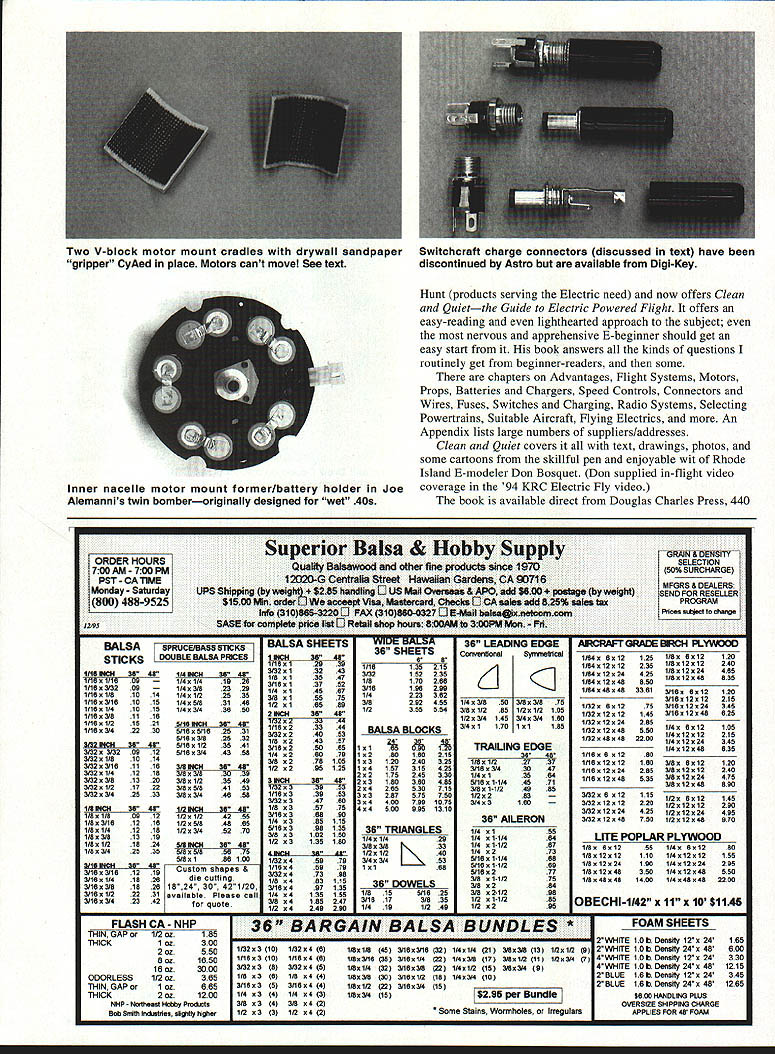
- Vincent Burton — 1938 Scientific Eaglet: AP 29 motor, Graupner gears, seven 800s, 34 ounces (mock wet-engine weight)
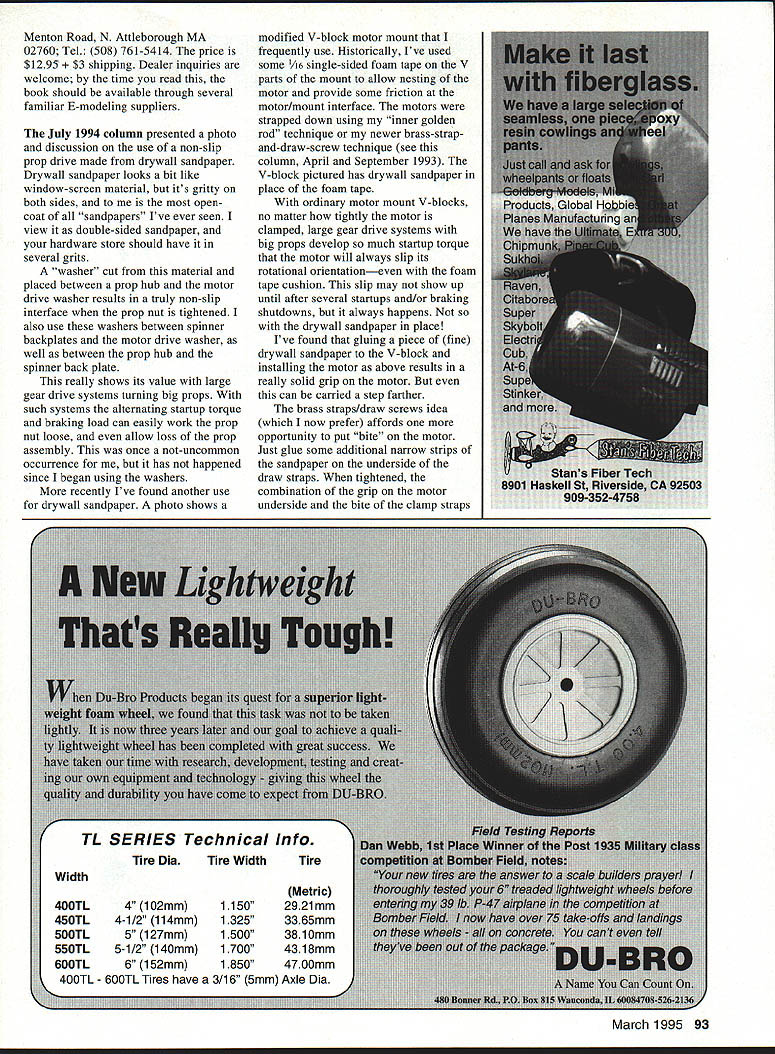
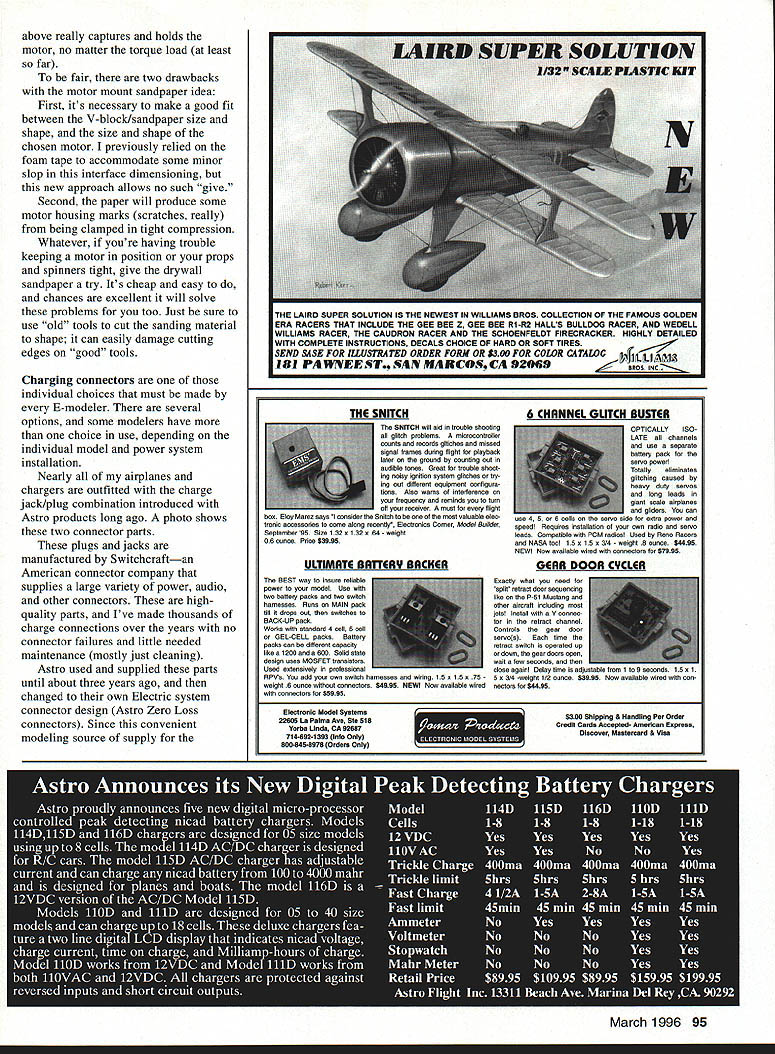
- Joe Alemanni, Jamestown, NC — Vickers-Armstrong Wellington bomber: twin 15G cobalt motors, 10 cells
(End of article content on this page.)
Please enclose an SASE with all correspondence for which you'd like a reply.
Transcribed from original scans by AI. Minor OCR errors may remain.

