
RADIO CONTROL: ELECTRICS
Bob Kopski 25 West End Drive, Lansdale PA 19446
Introduction
As with any aeromodeling specialty, a great deal can be said about electric flight, and no single column can cover it all. What follows are thoughts aimed at beginning modelers, newcomers to electric flight, and a few immediate recommendations for those starting in RC electrics.
Who Gets Into Electric?
Two kinds of electric newcomers can be distinguished:
- The person who is new to aeromodeling and to electric flight.
- The experienced modeler who is new (or returning) to electric flight.
Electric readily serves both groups. Many people begin both aeromodeling and electric flight at the same time and go on to become skilled builders and pilots. Equally common are longtime modelers who add electric flight to their previous interests — some eventually go totally electric, others retain mixed interests.
How People Get Hooked
Many modelers were first captivated simply by seeing models fly. A single visit to a flying field, a meet, or seeing an electric model in flight can spark a lifelong interest. Electric models attract attention for many reasons, not least because they are quiet and clean. That quietness has helped reclaim lost flying sites and attract newcomers who don’t want to deal with fuel.
Why Electric Appeals
Electric appeal takes many forms:
- Quiet operation — ideal where noise is a problem or where you want to fly “in the field down the street.”
- Cleanliness — no fuel to store or spill.
- Simplicity — many people perceive electrics as “easy; just flip the switch.”
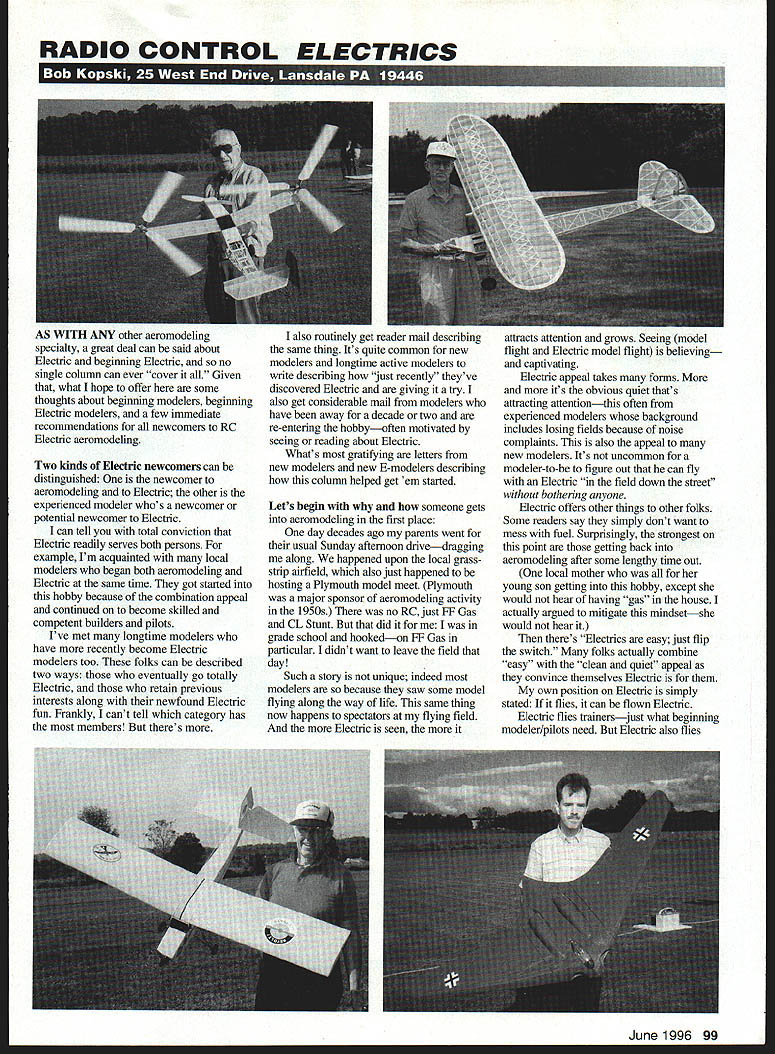
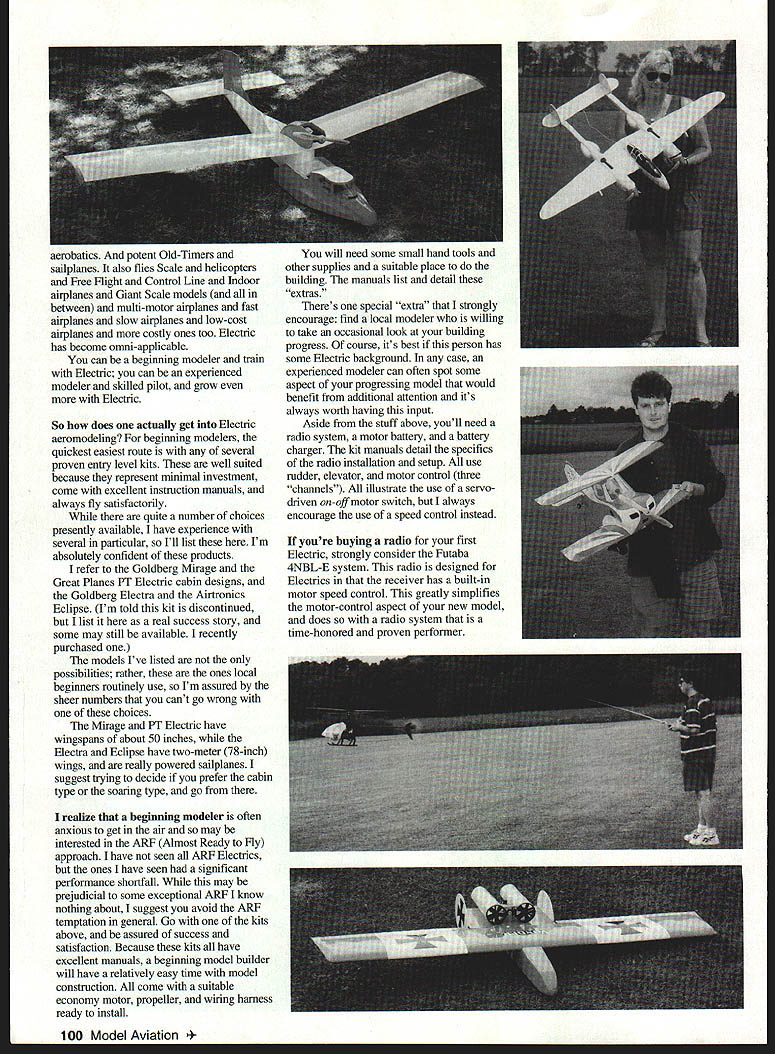
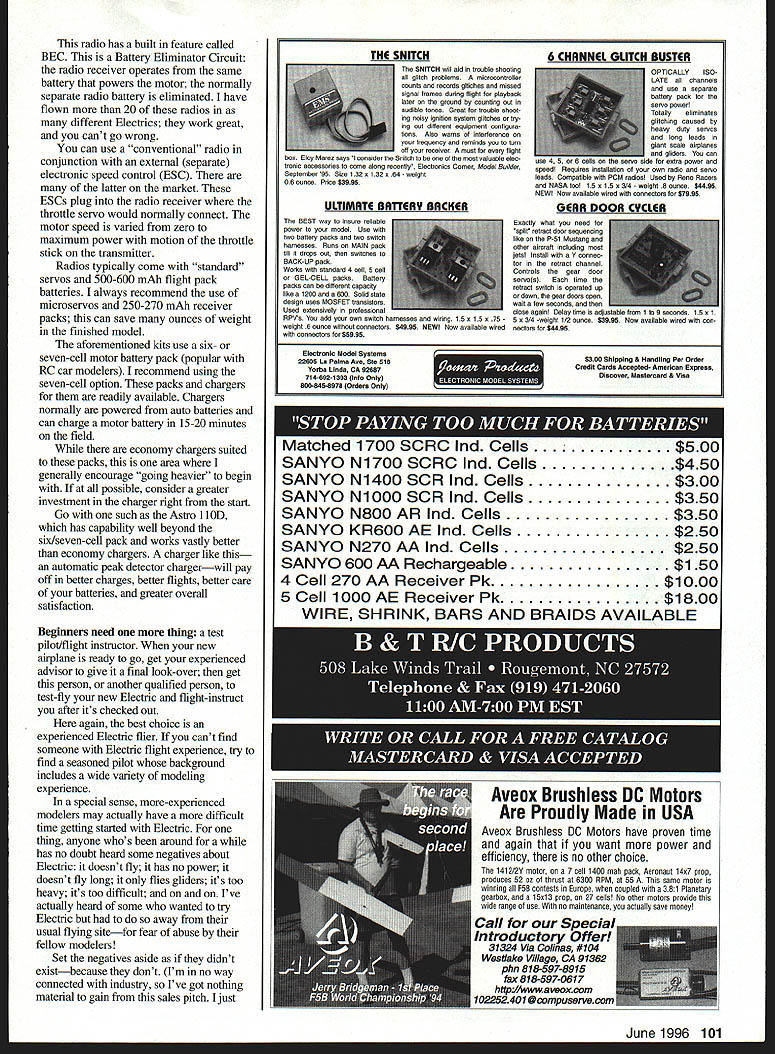
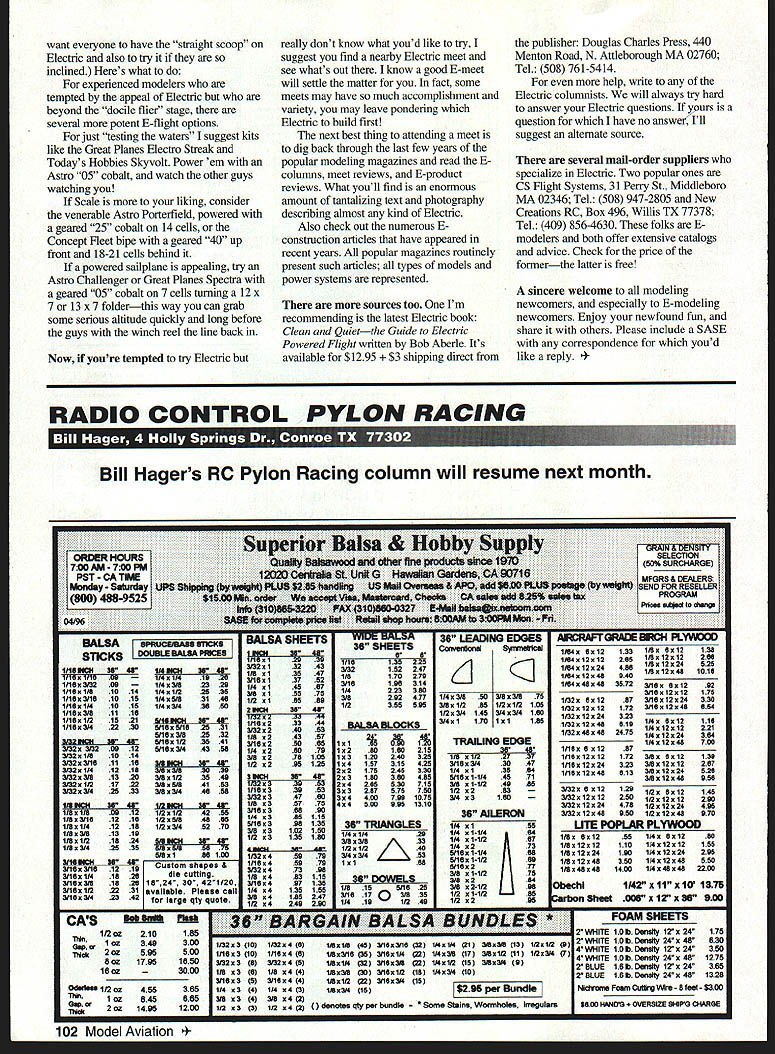
- Versatility — electric power works for trainers, aerobatics, scale, sailplanes, helicopters, indoor models, giant scale, multi-motor aircraft, fast and slow designs, and more.
If it flies, it can be flown electric. Electric serves beginners and advanced pilots alike.
Getting Started: Recommended Entry Kits
For beginning modelers, the quickest, easiest route is a proven entry-level kit. These kits represent minimal investment, have excellent instruction manuals, and fly satisfactorily. Recommended kits I have direct experience with:
- Goldberg Mirage (cabin type; ~50" wingspan)
- Great Planes PT Electric (cabin type; ~50" wingspan)
- Goldberg Electra (two-meter, ~78" wingspan; powered sailplane)
- Airtronics Eclipse (two-meter sailplane; success story though possibly discontinued)
Decide whether you prefer a cabin trainer or a soaring-type sailplane and choose accordingly. Local beginners routinely use these models, so you can be confident in their track record.
ARF vs. Kit
Almost-Ready-to-Fly (ARF) models are tempting, but in my experience many ARF electrics have had significant performance shortfalls. Go with one of the proven kits above for a higher likelihood of success and satisfaction. The kits come with suitable electric motors, propellers, and wiring harnesses, plus excellent manuals.
Tools, Help, and Extras
You will need:
- Small hand tools and supplies (listed in the kit manuals).
- A suitable place to build.
One special extra I strongly encourage: find a local modeler willing to review your building progress, preferably someone with electric experience. An experienced eye can catch issues early and make construction easier.
What Else You Need
Aside from the kit, you’ll need:
- A radio system.
- A motor battery (flight pack).
- A battery charger.
The kits typically require three channels: rudder, elevator, and motor control. While servo-driven on/off motor switches are illustrated in many manuals, I recommend using an electronic speed control (ESC) instead.
Radio, Servos, and Speed Control
Consider the Futaba 4NBL-E system for your first electric radio. The receiver has a built-in motor speed control and includes BEC (Battery Eliminator Circuit), allowing the receiver to run from the motor battery and eliminating a separate receiver pack. I have flown many models with this radio and recommend it.
Alternatively, you can use a conventional radio with an external ESC. The ESC plugs into the receiver where the throttle servo would normally connect and varies motor speed via the throttle stick.
Radio and battery suggestions:
- Radios usually come with standard servos and 500–600 mAh flight packs.
- I recommend microservos and 250–270 mAh receiver packs to save weight.
- Motor packs used in the kits are six- or seven-cell packs; I recommend the seven-cell option.
Batteries and Chargers
Motor packs and chargers are readily available. Field chargers powered from auto batteries can charge motor packs in 15–20 minutes. While economy chargers exist, consider investing in a higher-quality charger from the start. A recommended choice is the Astro 110D (an automatic peak-detector charger) — it offers capabilities beyond basic chargers and will result in better charges, longer battery life, and greater satisfaction.
Flying and Instruction
Beginners need an experienced test pilot/flight instructor. When your airplane is ready, have an experienced modeler give it a final check-over. Then have a qualified person test-fly the model and instruct you. The best choice is someone experienced with electric flight; if that’s not available, find a seasoned pilot with a broad range of modeling experience.
For Experienced Modelers New to Electric
Some experienced modelers hear negatives about electrics — “it doesn't fly,” “it has no power,” “it doesn’t fly long,” etc. Set those negatives aside: modern electric systems are capable and fun. If you’re beyond the docile-flier stage and want more potent options, consider the following kits and power setups.
Suggestions for Testing the Waters
- Great Planes Electro Streak — try with an Astro "05" cobalt motor.
- Today's Hobbies Skyvolt — try with an Astro "05" cobalt motor.
Scale and Larger Options
- Astro Porterfield — geared "25" cobalt on 14 cells.
- Concept Fleet biplane — geared "40" up front with "18–21" cells.
Powered Sailplanes
- Astro Challenger or Great Planes Spectra — geared "05" cobalt on 7 cells, turning a 12x7 or 13x7 folding prop for quick altitude.
Finding Out More
To learn more:
- Attend a nearby electric meet to see a wide variety of models and technology.
- Review recent issues of popular modeling magazines for electric columns, meet reviews, and construction articles.
- Read books such as Clean and Quiet — The Guide to Electric Powered Flight by Bob Aberle (publisher: Douglas Charles Press, 440 Menton Road, N. Attleborough MA 02760; Tel: (508) 761-5414). Price was $12.95 + $3 shipping when listed.
Mail-order electric suppliers that specialize in electric modelers:
- CS Flight Systems, 31 Perry St., Middleboro MA 02346; Tel: (508) 947-2805.
- New Creations RC, Box 496, Willis TX 77378; Tel: (409) 856-4630.
Both offer extensive catalogs and advice.
Closing
A sincere welcome to all modeling newcomers, especially those entering electric flight. Enjoy your newfound fun and share it with others. Please include a SASE with any correspondence for which you'd like a reply.
Transcribed from original scans by AI. Minor OCR errors may remain.

