
Radio Control: Electrics
Bob Kopski, 25 West End Drive, Lansdale PA 19446
This month's topics
This month’s column includes two meet announcements, an E-club listing, a new product, VRCS photo-contest results, some reader-survey followup, and basic motor-control suggestions.
Meet announcements
- The Voltaires of Central New York have announced their annual Electric Fun Fly for July 13–14 at the Grenadier Flying Field in Caughdenoy, NY. Details: Gordon Wheler, 4735 Ridge Rd., Cazenovia NY 13035; Tel.: (315) 655-9068; Fax: (315) 655-3824.
- A major change in the KRC Electric Fly has been announced. This year the meet will be held at a new location about 12 miles north of the historic Quakertown site — the Queen City Airport (not a model flying site per se). Meet dates are the traditional third (full) weekend of September: 9/21–9/22.
The new location offers much larger facilities than the already huge Quakertown field (which was overfull the past few years). Every aspect of the meet can now have more room—parking, vendors, flightline, airspace, and so on. On the downside, the field will not be open before 4 p.m. on Friday, September 20.
All details should be firmed up by the time you read this. You can get a detailed mailer from Assistant Meet Manager Anthony Assetto, 639 Neshaminy Ave., Warrington PA 18976; Tel.: (215) 419-9419. The meet manager is Jim Wolstenholme.
Electric-club listing (Electric Connection Service)
About eight months ago I solicited input from clubs interested in being part of a special Electric Connection Service listing. I was aware that many new E-clubs or clubs with mixed interest were forming around the country, and many individual E-modelers were seeking other individuals or clubs to connect with. Responses trickled in for several months; what follows is a compilation.
- Members of the Clarence Sailplane Society fly both pure sailplane and E-power and host an annual Electric Fun Fly. The club primarily serves the Buffalo and generally Western NY area. Contact: Lyn Perry, 123 Park Place, East Aurora NY 14052; Tel.: (716) 655-0775; E-mail: perryl@sstaff.sunyerie.edu.
- Hampshire County Radio Controllers (HCRC) is historically a glow-power group with more recent participation by E-modelers. Contact: Tyler West, 219 Bay Rd., Hadley MA 01035.
- Puget Sound Silent Flyers (PSST) Club flies Electrics, sailplanes, and rubber. The club field is part of a 100-acre tract; newcomers welcome. Contact: Club President Lyle Hegsted, 3301 46th Court SE, Olympia WA 98501.
- Rochester AeroModelling Society (RAMS) is a diverse group flying RC, CL, and FF. RAMS is an AMA Gold Leader Club actively seeking to help beginners. The club leases a 12-acre site and owns another 100 acres. Contact: Rochester AeroModelling Society, Box 89, Walworth NY 14568.
- Sarasota Silent Flyers club flies sailplanes and Electrics exclusively. This is an AMA-chartered club with about 32 members and open to more. Contact: John Williams, 658 Mourning Dove Dr., Sarasota FL 34236.
- Silent Electric Flyers Club of San Diego is dedicated to the promotion of electric propulsion in all types of aeromodelling. This club has a good newsletter and some high-profile membership because of participation in FAI activity. In particular, Steve Neu is well-known for his FAI E-flight accomplishments and demos. Contact: Steve Manganelli, 3296 Martinez St., San Diego CA 92106-2959.
- Zephyrhills CAN-AM Flyers fly both glow and Electric and welcome newcomers. The club field is near the south side of Zephyrhills, FL. Contact: Lu Dietterich, 38804 Alston Ave., Zephyrhills FL 33540; Tel.: (813) 788-1140.
This list is shorter than I expected; I know there are many more E-flying groups out there. I’d like to hear from both those listed clubs and from modelers contacting them about how this listing has worked. If I get adequate positive feedback, I’ll do this again—hopefully attracting more E-clubs to participate.
New product: Sky Sheen (P.E.P.)
Sparkling is an understatement about the eye-grabbing attraction of Sky Sheen — a new product from P.E.P., 111 E. Geneva, Tempe AZ 85282; Tel.: (602) 966-6384.
This is a high-visibility self-stick reflective material that’s thin and light. It’s intended for application on leading edges or other surfaces and is dazzling in sunlight. It’s not only appealing on the ground but can be quite beneficial in those “speck in the sky” flights where visual contact is marginal.
The product is from Phil Pearce and complements an earlier product called Sky Shine, which is similar but differs in appearance. Five dollars gets you a 2 x 48 strip of Sky Sheen or a 3 x 18 sheet of Sky Shine. P.E.P. offers other sizes/prices and custom cuts.
VRCS and Vintage electrics
In the May ’94 column I discussed the Vintage Radio Control Society (VRCS) and the E-fun I was enjoying. The VRCS is “an organization devoted to the preservation of our radio control history—the achievements of those electronic and airframe design pioneers that made RC the best hobby/sport in the world today.” These words were taken from the VRCS Newsletter, a superb publication edited by Art Schroeder, former editor of Model Airplane News.
VRCS members build and fly vintage RC designs that were kitted or published prior to 1970. Many VRCS members are the designers of these models. Vintage models are distinct from Old-Timers (which were originally free-flight designs dating up to about 1940).
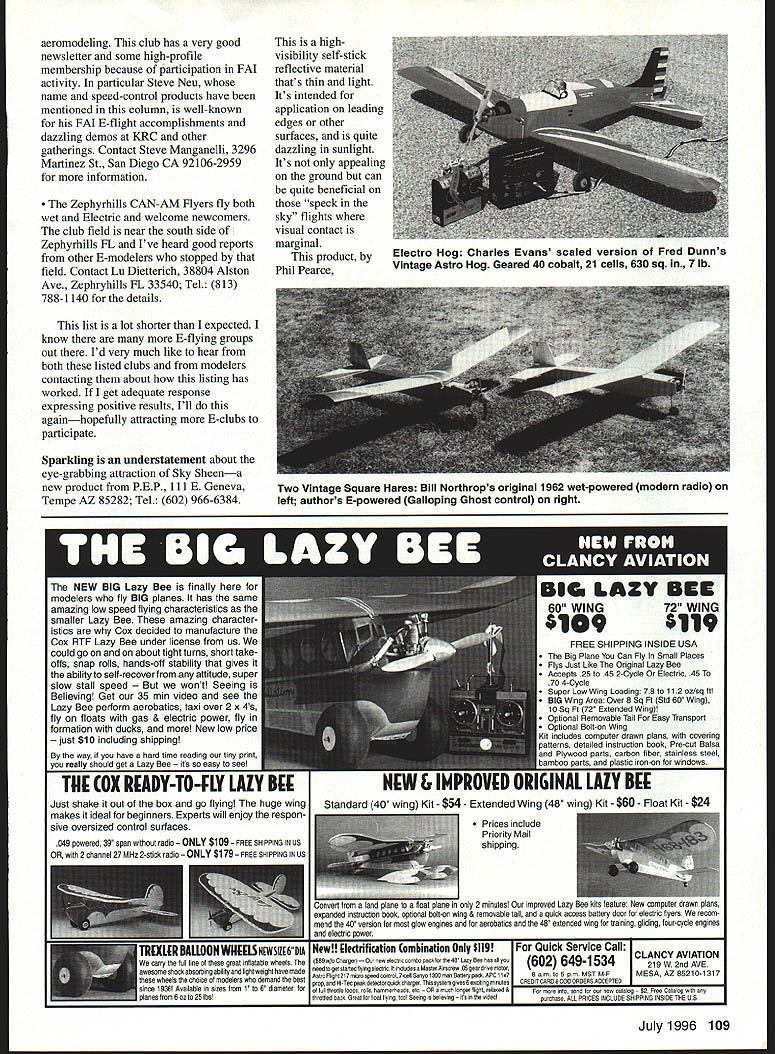
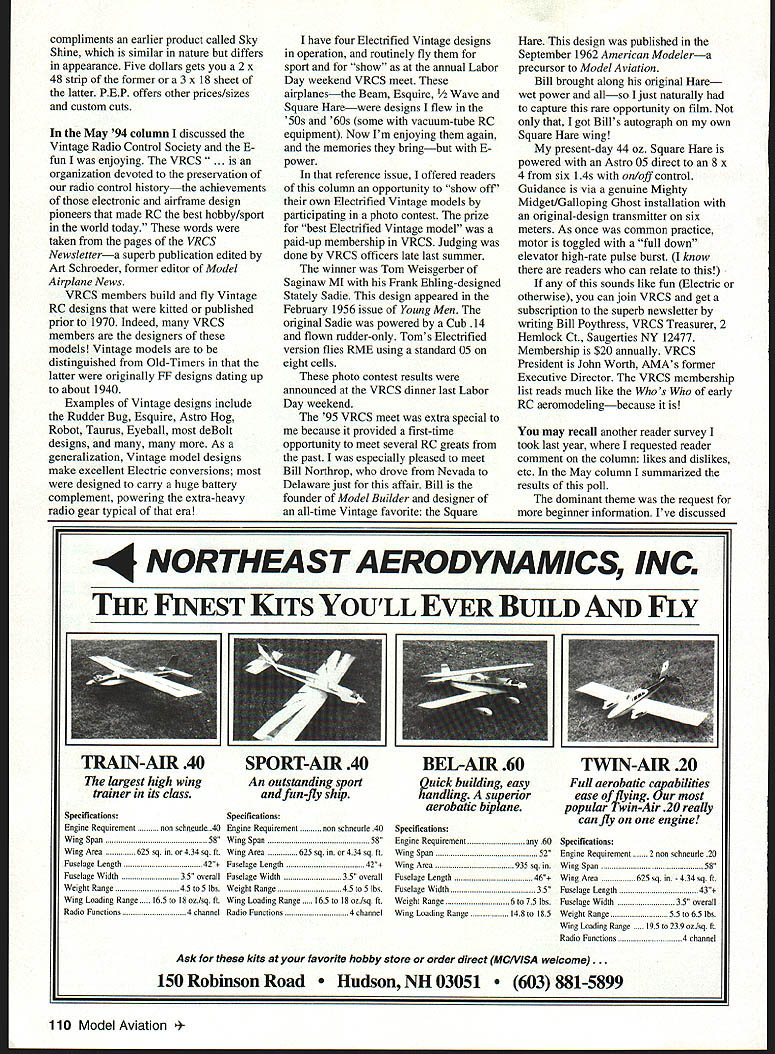
Examples of vintage designs include the Rudder Bug, Esquire, Astro Hog, Robot, Taurus, Eyeball, most deBolt designs, and many more. As a generalization, vintage model designs make excellent electric conversions: most were designed to carry a huge battery complement to power the extra-heavy radio gear typical of that era.
I have four electrified vintage designs in operation and routinely fly them for sport and for “show” at the annual Labor Day VRCS meet. These airplanes—the Beam, Esquire, “Z” Wave, and Square Hare—were designs I flew in the ’50s and ’60s (some originally with vacuum-tube RC equipment). Now I’m enjoying them again with electric power and the memories they bring.
VRCS photo-contest results
In the May issue I offered readers an opportunity to show off their electrified vintage models by participating in a photo contest. The prize for “best electrified vintage model” was a paid-up membership in VRCS. Judging was done by VRCS officers late last summer.
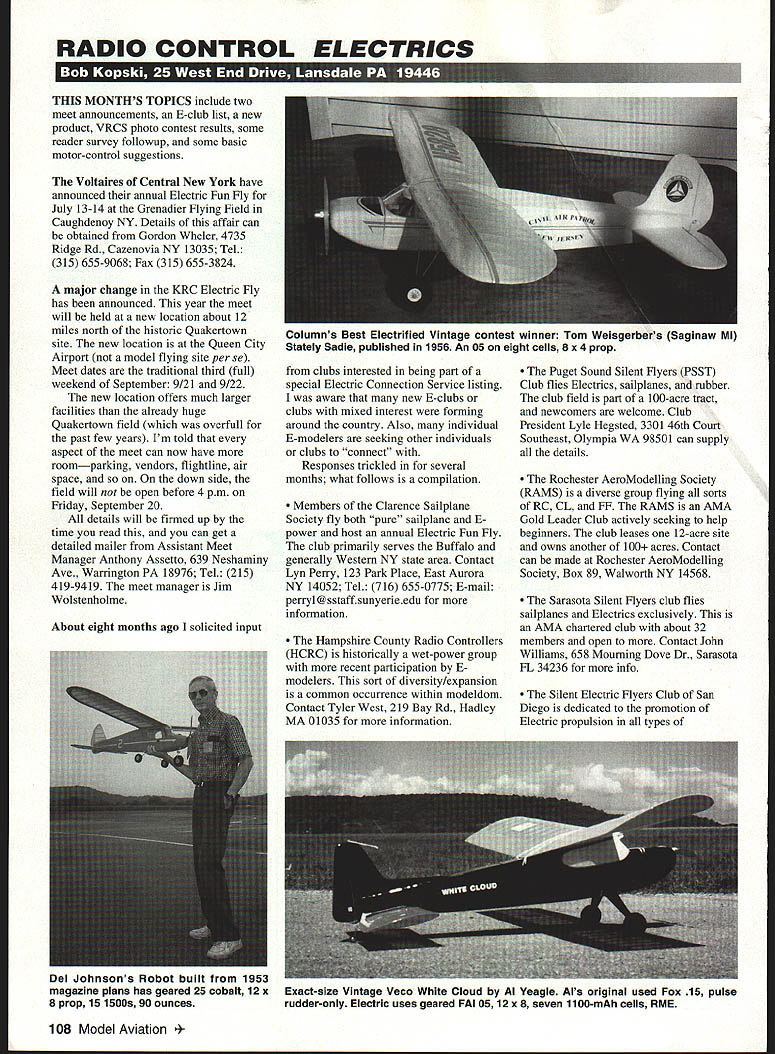
The winner was Tom Weisgerber of Saginaw, MI, with his Frank Ehling–designed Stately Sadie (originally published in the February 1956 issue of Young Men). The original Sadie was powered by a Cub .14 and flown rudder-only. Tom’s electrified version flies RME using a standard .05 on eight cells.
These contest results were announced at the VRCS dinner last Labor Day weekend.
Meeting some vintage RC greats
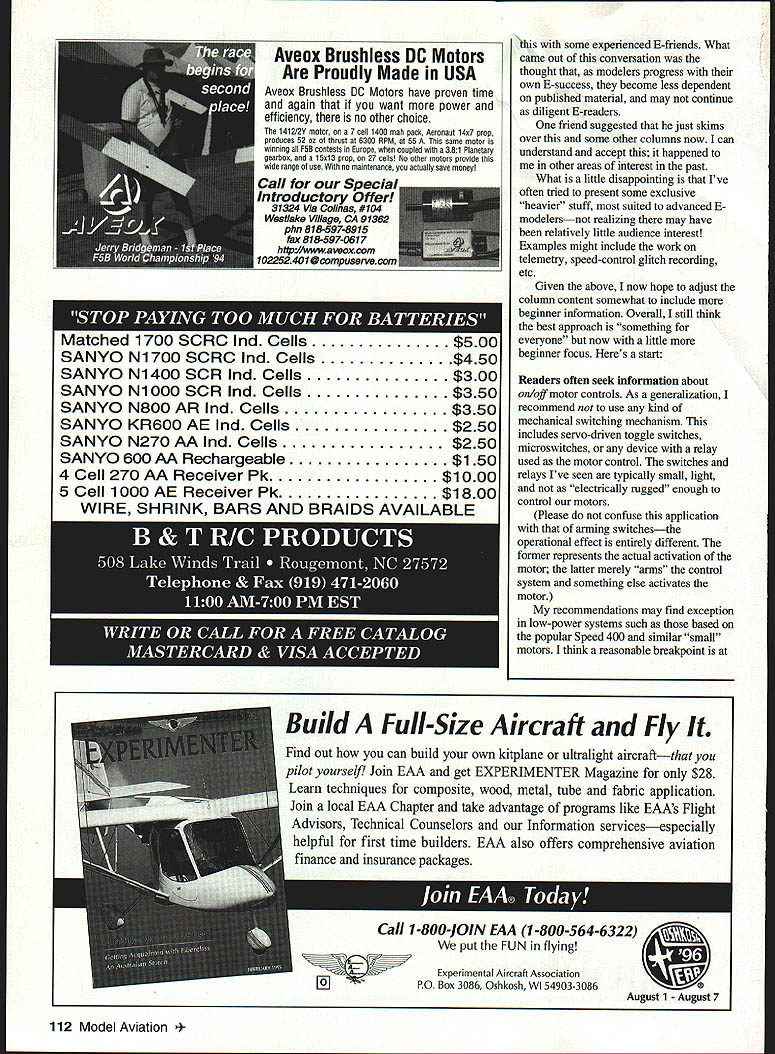
The ’95 VRCS meet was extra special to me because it provided a first-time opportunity to meet several RC greats from the past. I was especially pleased to meet Bill Northrop, who drove from Nevada to Delaware for the affair. Bill is the founder of Model Builder and designer of an all-time vintage favorite: the Square Hare (published in September 1962 in American Modeler, a precursor to Model Aviation).
Bill brought along his original Hare—wet power and all—so I captured the opportunity on film and obtained his autograph on my own Square Hare wing.
My present-day 44 oz. Square Hare is powered with an Astro .05 direct to an 8 x 4 prop. Guidance is via a genuine Mighty Midget/Galloping Ghost installation with an original-design transmitter on six meters. As once was common practice, motor is toggled with a “full down” elevator/high-rate pulse burst.
If this sounds like fun (electric or otherwise), you can join VRCS and get the newsletter by writing Bill Poythress, VRCS Treasurer, 2 Hemlock Ct., Saugerties NY 12477. Membership is $20 annually. VRCS President is John Worth, AMA’s former Executive Director. The VRCS membership list reads like the Who’s Who of early R/C aeromodeling—because it is.
Reader survey and column direction
You may recall a reader survey I ran last year requesting comments on the column: likes, dislikes, etc. In the May column I summarized the results. The dominant theme was a request for more beginner information. I’ve discussed some of those ideas in past columns and will pursue many of them in future columns.
One specific area that received a lot of attention was basic motor-control suggestions: selecting the right motor, matching props and gearing, and speed-control selection for different applications. This month I begin with some of those basics.
What came out of the survey was the thought that, as modelers progress with their own electric success, they become less dependent on published material and may not continue as diligent E-readers. One friend suggested he just skims some columns now. I understand and accept this; it has happened to me in other hobbies. What’s a little disappointing is that I’ve often tried to present some “heavier” material suited to advanced E-modelers—not realizing there may have been relatively little audience interest (examples: telemetry work, speed-control glitch recording).
Given this, I hope to adjust column content to include more beginner information. Overall, I still think the best approach is “something for everyone” but now with a little more beginner focus.
Basic motor-control recommendations
Readers often seek information about on/off motor controls. As a generalization, I recommend not using any kind of mechanical switching mechanism for motor activation. This includes servo-driven toggle switches, microswitches, or any device with a relay used as the motor control. The switches and relays I’ve seen are typically small, light, and not electrically rugged enough to control our motors.
(Do not confuse this application with arming switches—the operational effect is entirely different. An arming switch merely “arms” the control system; something else then activates the motor.)
My recommendations may find exception in low-power systems such as those based on the popular Speed 400 and similar small motors. I think a reasonable breakpoint is about 12–14 amps of motor current. Most E-power systems now operate at 20 or more amps, and that is simply too much for the switches and relays I’ve seen and used. Thus I always recommend the use of an electronic speed control (ESC) even if your application is strictly on/off.
Electronic speed controls do not use mechanical switching/contacts but rather solid-state devices called MOSFETs (Metal Oxide Semiconductor Field Effect Transistors). MOSFETs have no moving parts and turn motor current on and off electronically. There are no contacts to burn, weld together, or otherwise fail through continued use.
If yours is strictly an on/off application, consider a relatively lower-cost control such as the Astro 215 or 217 frame-rate designs. These are specified for use up to 14 cells and 30 amps. The two are similar except that the 215 has an electronic brake function built in. The brake is used with power systems using folding props and is generally a must for reliable blade folding following power shutdown.
These Astro controls originated as replacements for an earlier Astro on/off relay-equipped motor control switch. Of course, being speed controls, they can effect gradual motor speed change as you move the stick smoothly from off to on. Full off-to-on is really a variation of this: slam the stick all the way at once to simulate a switch.
The best (most efficient) speed controls are “high-rate” designs, and these are my first and strongest recommendation. Their higher efficiency (less loss) is most evident at midrange speeds; there is no difference between frame-rate and high-rate when both are full on.
Please enclose a SASE with any correspondence for which you’d like a reply. Enjoy those happy, quiet, clean, and powerful summertime electric flights, everyone!
Transcribed from original scans by AI. Minor OCR errors may remain.

