
RADIO CONTROL ELECTRICS
Bob Kopski, 25 West End Drive, Lansdale PA 19446
Overview
This column includes information on a fall meet, a new catalog, more reader mail regarding the E-Motion power system, and a new connector.
Gulf States Electric Fly
Paul Perret (1780 Prytania St., New Orleans LA 70130; Tel.: (504) 524-3442) is CD for the 8th Annual Gulf States Electric Fly. This year's meet, sponsored by the Ozone RC Club, is set for Oct. 26–27 at the Louisiana Polo Field near Goodbee, LA. Both days feature fun flying plus some serious competitive opportunity for those so inclined. The field will be open Friday for early arrivals.
Hobby Lobby Catalog #27
Hobby Lobby (5614 Franklin Pike Circle, Brentwood TN 37027; Tel.: (615) 373-1444) recently released their latest catalog (#27). As in the past it contains numerous new electric items. Highlights include:
- The venerable Telemaster configured as the Jr. Telemaster for electric.
- Several airplanes especially for the very popular Speed 400 motors.
- New motors, drives, and speed controls.
- Two new ducted fans—one for the Speed 400.
The catalog is $2, and Hobby Lobby service is excellent.
E-Motion: reader mail and flight profile
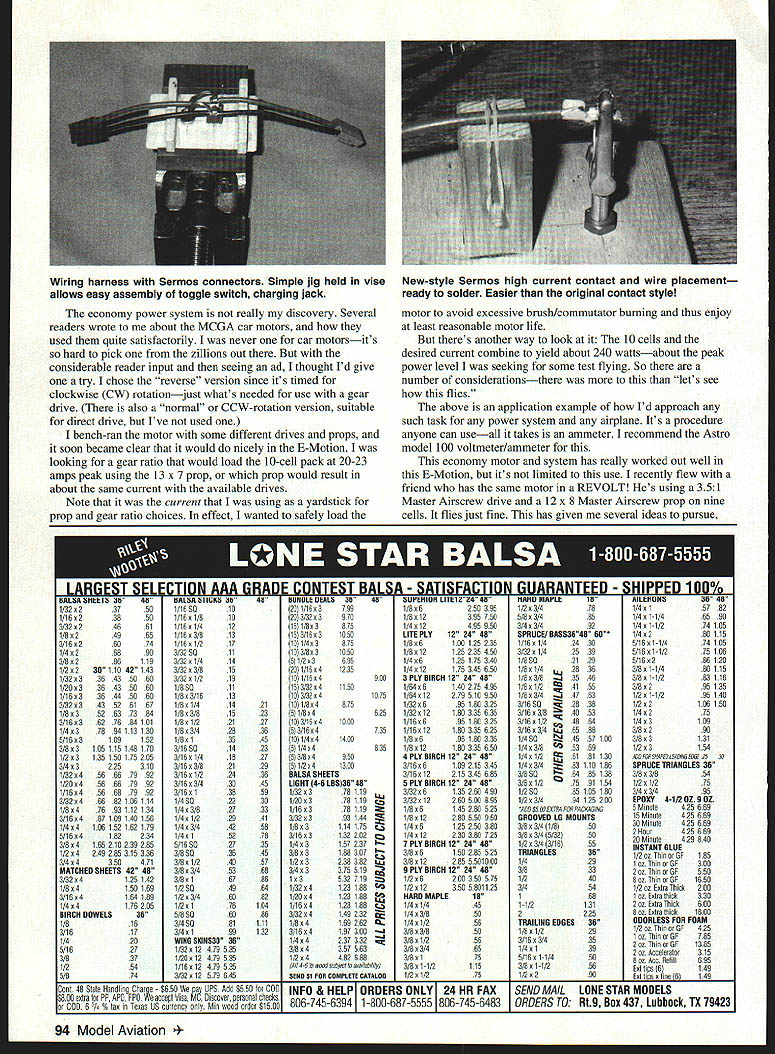
The E-Motion design (discussed in the 11/95 and 5/96 columns) is a 400-square-inch semi-symmetrical-section design that resembles a slope machine. It flies with aileron and elevator on a variety of 6–10-cell geared systems; I prefer the higher end.
The 5/96 column described one economy power system that performed very well; this brought in considerable reader mail. Questions have focused on system details, application variations, where to buy, and flight time.
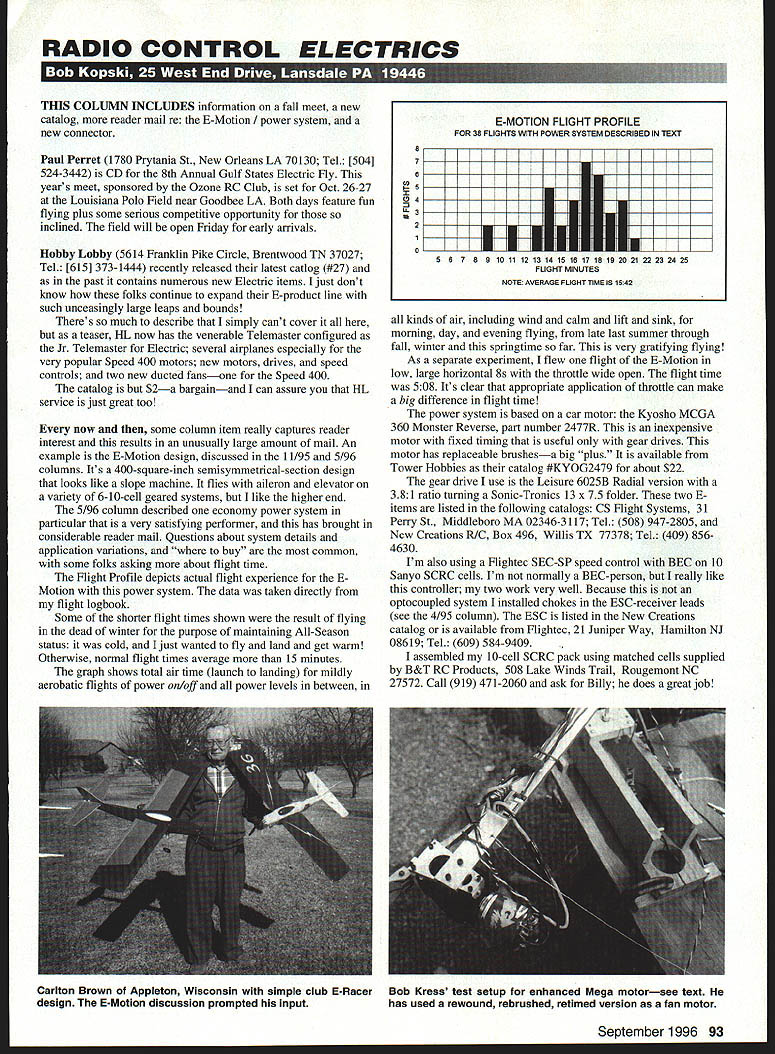
The Flight Profile reflects actual flight experience for the E-Motion with this power system. Data was taken directly from my flight logbook. Some shorter flight times were due to winter flying for All-Season status (cold conditions). Otherwise, normal flight times average more than 15 minutes.
The profile data represent total air time (launch to landing) for mildly aerobatic flights (power on/off and all levels in between) in varied air conditions—wind, calm, lift, sink—across morning, day, and evening flying from late last summer through fall, winter, and spring. This is very gratifying flying!
As a separate experiment, I flew one flight in low, large horizontal 8s with the throttle wide open. Flight time was 5:08, showing that throttle application greatly affects flight time.
Power system details
The power system is based on a car motor: the Kyosho MCGA 360 Monster Reverse, part number 2477R. This inexpensive motor has fixed timing and is useful only with gear drives. It has replaceable brushes (a big plus). It is available from Tower Hobbies as catalog #KYO G2479 for about $22.
Gear drive: Leisure 6025B Radial version with a 3.8:1 ratio turning a Sonic-Tronics 13 x 7.5 folder.
I used a Flightec SEC-SP speed control with BEC on 10 Sanyo SCRC cells. I prefer BEC systems and like this controller; my two work very well. Because this is not an optocoupled system, I installed chokes in the ESC–receiver leads (see the 4/95 column). The ESC is listed in the New Creations catalog or is available from Flightec.
I assembled my 10-cell SCRC pack using matched cells supplied by B&T RC Products.
On the bench I tested different drives and props; I looked for a gear ratio that would load the 10-cell pack at about 20–23 amps peak using the 13 x 7 prop (or a prop that would result in similar current with available drives). I used current as the yardstick for prop and gear ratio choices to avoid excessive brush/commutator burning and to maintain reasonable motor life.
Another perspective: the 10 cells and the desired current combine to yield about 240 watts—roughly the peak power level I was seeking for test flying. The above outlines my general approach for matching power systems to airplanes; a simple ammeter is the only essential tool (I recommend the Astro model voltmeter/ammeter).
This economy system has worked well in the E-Motion but is not limited to it. A friend used the same motor in a REVOLT! with a 3.5:1 Master Airscrew drive and a 12 x 8 Master Airscrew prop on nine cells. It flies fine and has given me several ideas to pursue.
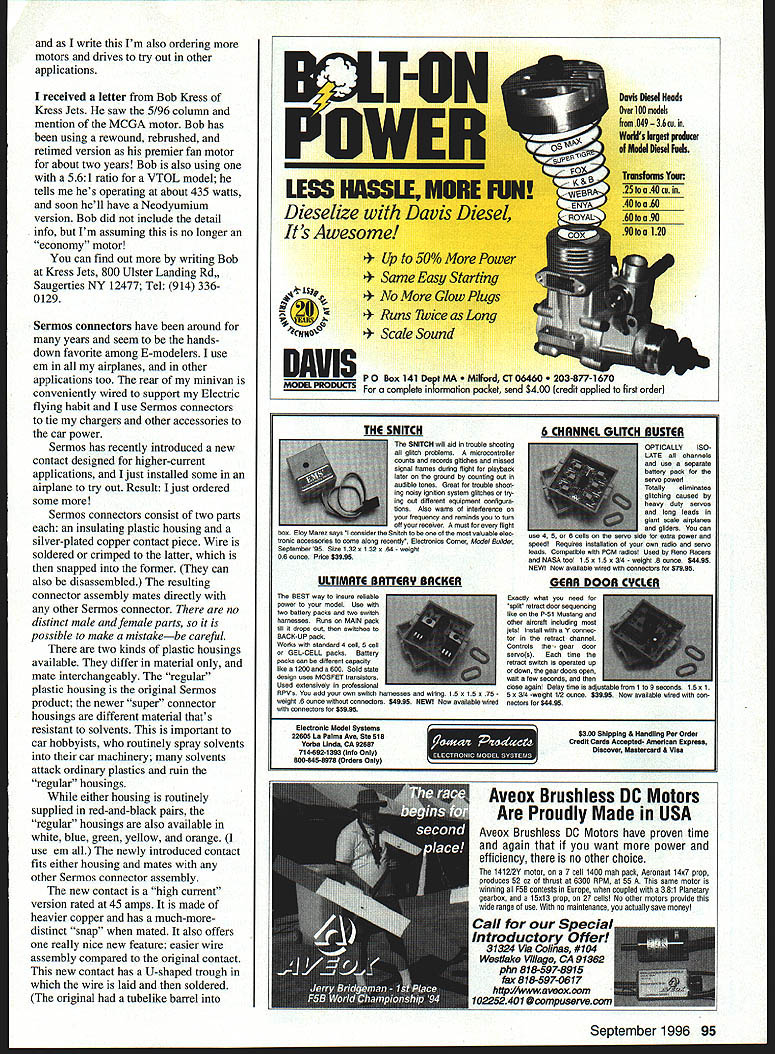
I received a letter from Bob Kress of Kress Jets. He has been using a rewound, rebrushed, and retimed version of the MCGA as a premier fan motor for about two years, and one with a 5.6:1 ratio for a VTOL model operating at around 435 watts. He will soon have a Neodymium version. Contact: Kress Jets, 800 Ulster Landing Rd., Saugerties, NY 12477; Tel.: (914) 336-0129.
Wiring and assembly notes
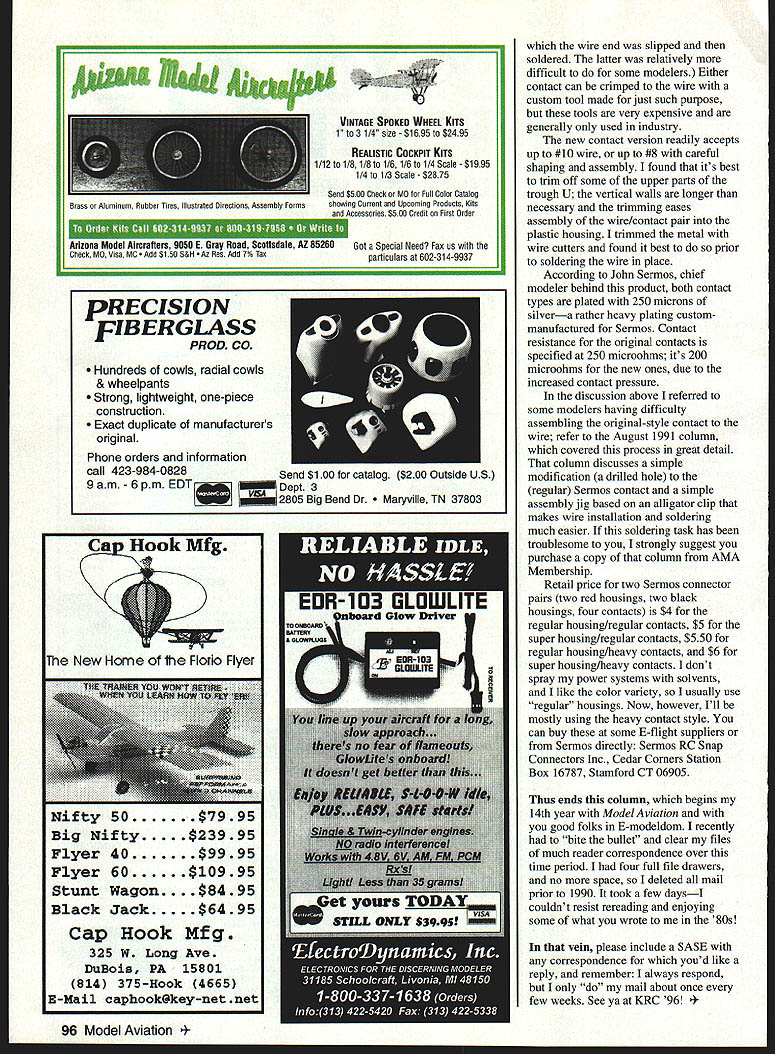
Wiring harness with Sernos connectors: a simple jig held in a vise allows easy assembly of toggle switch and charging jack. New-style Sernos high-current contact and wire placement—ready to solder. Easier than the original contact style!
I bench-ran and selected props/drives to achieve safe current loading. The procedure—measure current, choose prop/drive for desired peak amps—is applicable to any system.
Vendors and suppliers
- Kyosho MCGA 360 Monster Reverse (part #2477R): Tower Hobbies, catalog #KYO G2479.
- Gear drives and props: CS Flight Systems, 31 Perry St., Middleboro, MA 02346-3117; Tel.: (508) 947-2805.
- New Creations R/C, Box 496, Willis, TX 77378; Tel.: (409) 856-4630.
- Flightec SEC-SP ESC: Flightec, 21 Juniper Way, Hamilton, NJ 08519; Tel.: (609) 584-9409.
- Matched Sanyo SCRC cells: B&T RC Products, 508 Lake Winds Trail, Rougemont, NC 27572; Tel.: (919) 471-2060 (ask for Billy).
Sernos connectors (new high-current contact)
Sernos connectors have long been popular among electric modelers. I use them in all my airplanes and other applications. I wire my minivan to support electric flying and use Sernos connectors for chargers and accessories.
Sernos connectors consist of two parts:
- An insulating plastic housing.
- A silver-plated copper contact piece. Wire is soldered or crimped to the contact, which snaps into the housing. The assembly mates directly with any other Sernos connector. There are no distinct male and female parts—be careful to avoid mistakes when assembling.
There are two housing materials:
- Regular housing: original product; available in red/black pairs and also in white, blue, green, yellow, and orange.
- Super housing: newer material resistant to solvents (important for car hobbyists). Both housings mate interchangeably and are supplied in red-and-black pairs; the regular housings are available in additional colors.
New high-current contact:
- The new contact is rated at 45 amps, made of heavier copper, and has a more distinct snap when mated.
- It features easier wire assembly: a U-shaped trough where the wire is laid and soldered (the original used a tubelike barrel).
- Either contact can be crimped with custom tools (expensive and typically industrial).
- The new contact readily accepts up to #10 wire, or up to #8 with careful shaping. I recommend trimming some of the vertical trough walls before soldering to ease insertion into the plastic housing.
Plating and contact resistance:
- Both contact types are plated with 250 microinches of silver (custom-manufactured).
- Contact resistance: original contacts specified at 250 microohms; new heavy contacts at 200 microohms due to increased contact pressure.
If you had trouble assembling the original contact, see the August 1991 column, which covered the process in detail (including a simple drilled-hole modification and an alligator-clip assembly jig). That column is available from AMA Membership.
Retail prices (pairs: two red housings, two black housings, four contacts):
- Regular housing / regular contacts: $4.00
- Super housing / regular contacts: $5.00
- Regular housing / heavy contacts: $5.50
- Super housing / heavy contacts: $6.00
You can buy these at some E-flight suppliers or from: Sernos RC Snap Connectors Inc., Cedar Corners Station Box 16787, Stamford, CT 06905.
Closing
This column begins my 14th year with Model Aviation and with you good folks in E-modeldom. I recently had to clear my files of much reader correspondence accumulated over the years. I had four full file drawers and no more space, so I deleted all mail prior to 1990. It took a few days—I couldn't resist rereading and enjoying some of what you wrote in the '80s!
Please include a SASE with any correspondence for which you'd like a reply. I always respond, but I only “do” my mail about once every few weeks. See ya at KRC '96!
—Canton Brown, Appleton, Wisconsin
Transcribed from original scans by AI. Minor OCR errors may remain.

