
Radio Control: Electrics
Bob Kopski 25 West End Drive, Lansdale PA 19446
This month's topics
- Meet announcement
- New catalog
- Some new Electrics (ready-built and kits)
- Follow-up on last month's motor power discussion
- Noisy Electrics (yes, really)
- A plea to Futaba
Meet announcement
Chuck Hill wrote to tell me of an Electric Fun-Fly scheduled for Sunday, October 20 at the BARCS field in Richmond, CA (near San Francisco and Oakland). The meet is jointly sponsored by the Concord Model Engineers and the Bay Area Radio Control Society. Contact Chuck for details: 1382 Deerfield Ct., Concord, CA 94521; Tel.: (510) 685-1546.
New catalog — Kress Jets
Bob Kress of Kress Jets (800 Ulster Landing Rd., Saugerties, NY 12477; Tel.: (914) 336-8149) sent his latest catalog. The $3 catalog lists a variety of electric ducted-fan assemblies, motors, airplanes, and design software for the ducted-fan enthusiast. Bob also supplied drafts of articles he's developing on related topics. Electric ducted flying remains a very viable form of E-enjoyment; each year the KRC meet brings out several new ducted designs.
Ready-built Electrics and kits
Readers often ask for Electric ARF (Almost-Ready-to-Fly) model suggestions to avoid the building chore. I generally discourage the ARF approach because many ARFs I've seen over the years would tend to discourage electric pursuit rather than help it—though there are exceptions. Electric kits such as the Goldberg Mirage, Electra, and Great Planes PT Electric, among others, generally fly acceptably well.
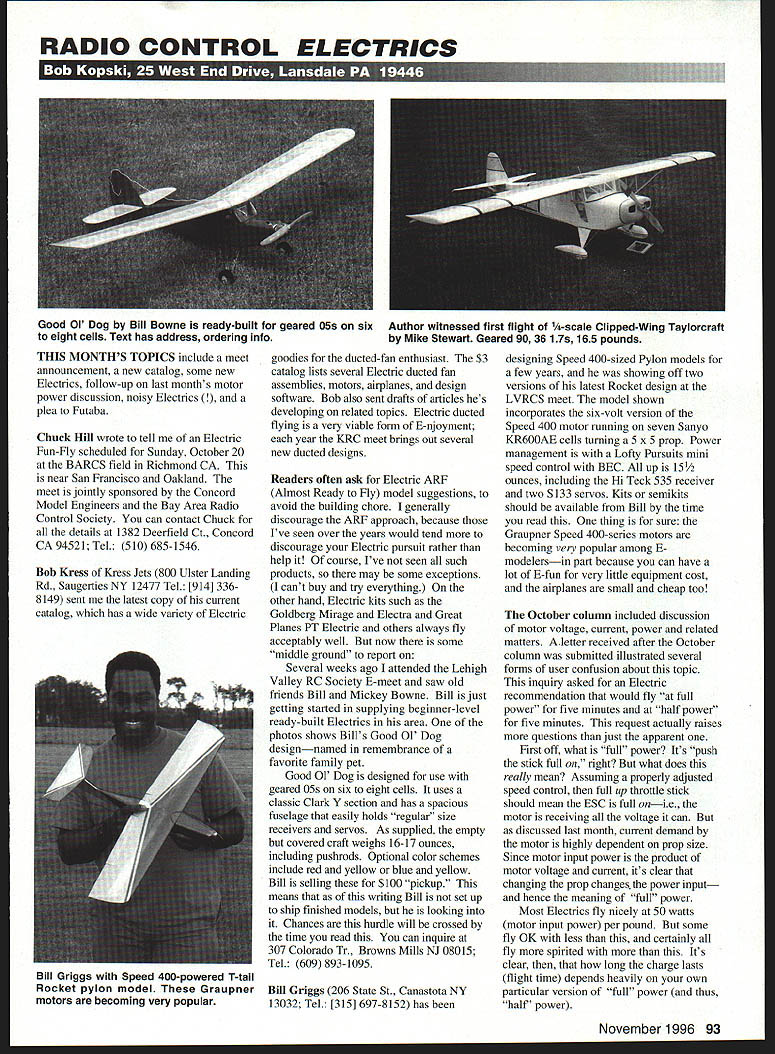
There is some middle ground: several weeks ago I attended the Lehigh Valley RC Society E-meet and saw Bill and Mickey Bowne. Bill is beginning to supply beginner-level ready-built Electrics in his area.
#### Good Ol' Dog (Bill Bowne)
- Designed for geared .05s on six to eight cells.
- Classic Clark Y airfoil, roomy fuselage for regular-size receivers and servos.
- Covered, empty weight (including pushrods): 16–17 ounces.
- Optional color schemes: red/yellow or blue/yellow.
- Price: $100 (pickup). Bill is exploring shipping finished models.
- Contact: 307 Colorado Tr., Browns Mills, NJ 08015; Tel.: (609) 893-1095.
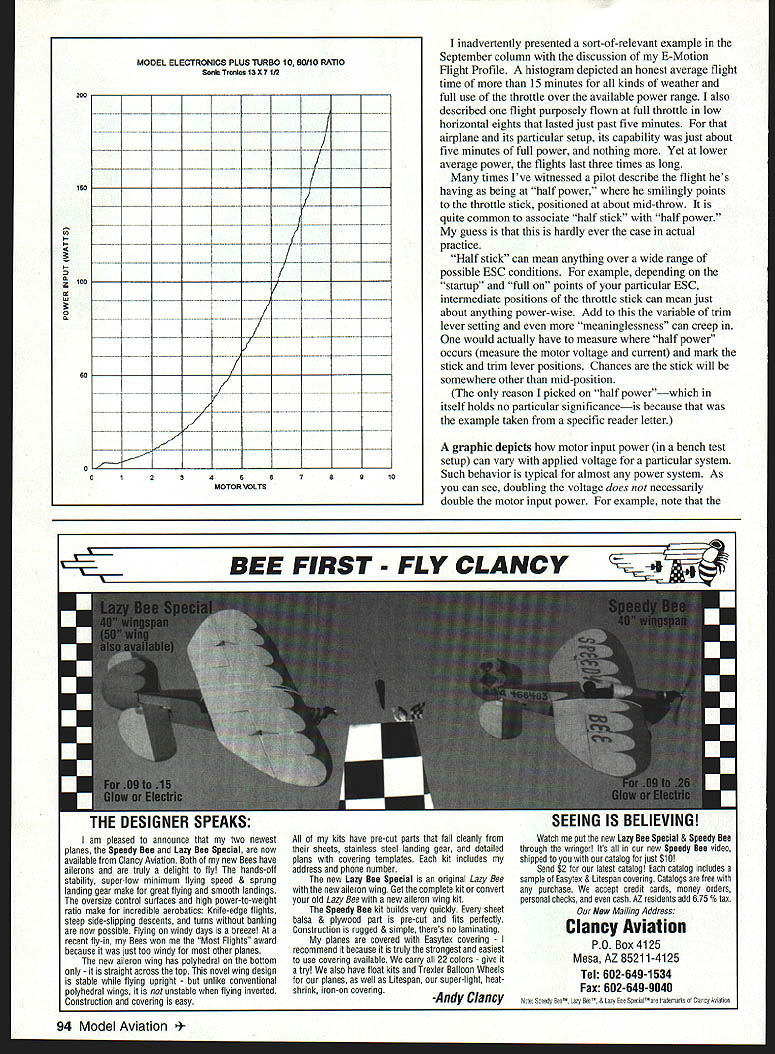
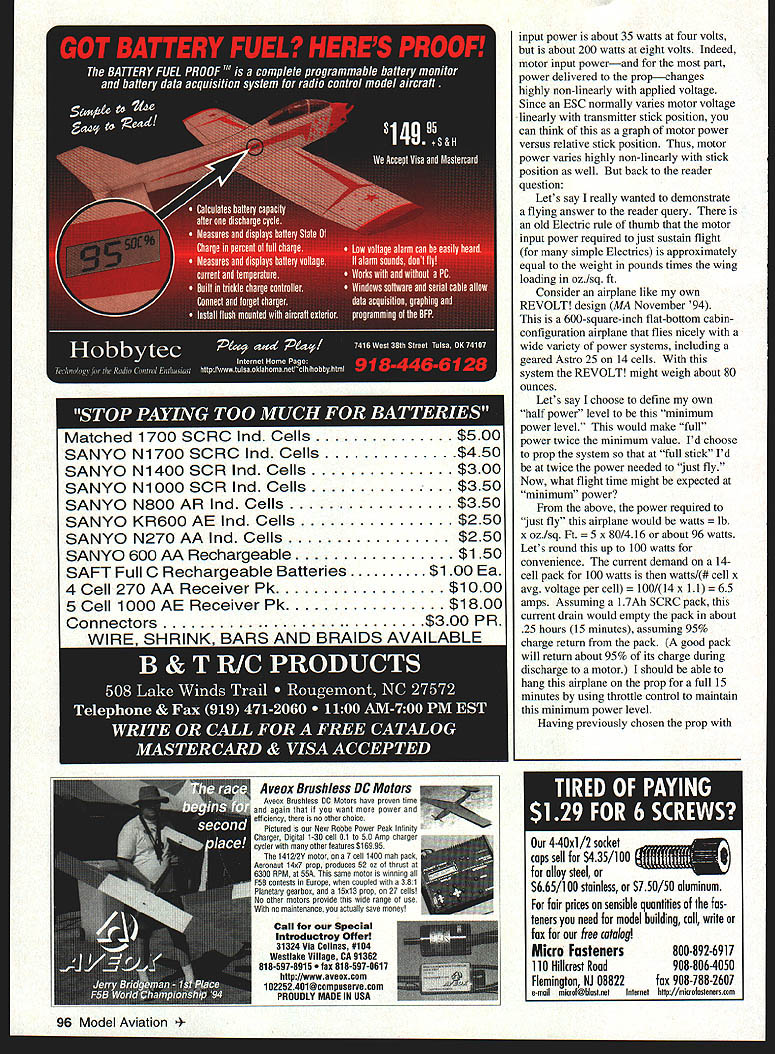
#### Bill Griggs — Speed 400 pylon models Bill Griggs (206 State St., Canastota, NY 13032; Tel.: (315) 697-8152) has designed Speed 400–sized pylon models for a few years. At the LVRCS meet he showed two versions of his latest Rocket design. One model used the six-volt Speed 400 running on seven Sanyo KR-600AE cells turning a 5x5 prop. Power management was a Lofty Pursuits mini speed control with BEC. All-up weight was 15½ ounces, including a Hi-Tec 535 receiver and two S133 servos. Kits or semi-kits should be available from Bill in time.
Graupner Speed 400–series motors are becoming very popular because you can have a lot of electric fun for relatively low equipment cost; the airplanes are small and inexpensive.
Follow-up: motor voltage, current, power (clarifying "full" and "half" power)
A letter after the October column illustrated user confusion about motor voltage, current, and power. One reader asked for a setup that would fly "full power" five minutes and "half power" five minutes. That request raises several questions, beginning with "What is 'full' power?"
- With a properly adjusted ESC, full-up throttle should mean the ESC is fully on and the motor receives battery voltage. However, current draw (and thus input power = voltage × current) depends heavily on prop size. Changing the prop changes the meaning of "full" power.
- Many electrics fly nicely at about 50 watts of motor input per pound. Some need less; some fly more spiritedly with more power.
- "Half stick" is rarely equal to "half power." ESC behavior (startup point, full-on point, trim lever setting) means stick position does not map linearly to motor power. To know where "half power" really is you must measure motor voltage and current and mark stick/trim positions accordingly.
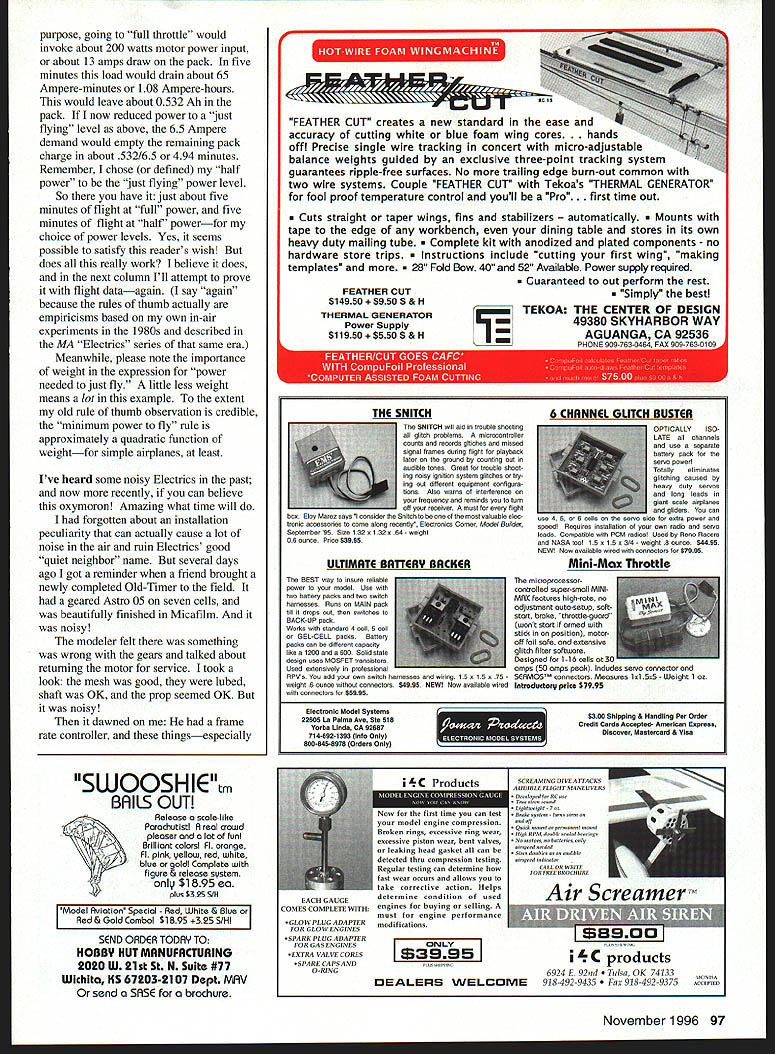
A bench-graph characteristic example: motor input power changes highly nonlinearly with applied voltage (and thus with stick position if the ESC varies voltage linearly). Doubling voltage does not necessarily double input power.
#### A worked example (REVOLT! airplane) Consider my REVOLT! design (MA November '94): a 600 sq. in. flat-bottom cabin-contour airplane that can weigh about 80 ounces with a geared Astro 25 on 14 cells.
- Rule of thumb: motor input power required to just sustain flight ≈ weight (lb) × wing loading (oz/sq ft). For this airplane, the minimum "just-fly" power is about 96 watts; we round to 100 W.
- Pack voltage: with 14 cells at average cell voltage ≈ 1.1 V, pack voltage ≈ 14 × 1.1 = 15.4 V.
- Current for 100 W: 100 / 15.4 ≈ 6.5 A.
- With a 1.7 Ah SCRC pack and assuming a 95% usable charge return: usable charge ≈ 1.7 × 0.95 = 1.615 Ah. At 6.5 A this gives ≈ 0.2485 h or ≈ 15 minutes of flight at the minimum power level.
- If we define "half power" as this "just-fly" level, then "full power" is twice that (≈200 W). At full power (200 W) the current would be ≈ 13 A.
- Five minutes at full power draws 13 A for 5 minutes = 65 A·min = 1.083 Ah. Subtracting that from the usable charge (1.615 Ah) leaves ≈ 0.532 Ah.
- At the just-fly rate (6.5 A), that remaining 0.532 Ah will last 0.532 / 6.5 ≈ 0.082 h ≈ 4.94 minutes.
So, by this choice of definitions and prop selection, you can achieve about five minutes at full power and five minutes at "half" power (where "half" is defined as the minimum power to sustain flight). The precise numbers depend strongly on weight, prop, battery condition, and the chosen definition of "half power." Note also the "minimum power to fly" is very sensitive to weight; small weight reductions can yield substantial endurance gains. The rule of thumb for minimum power tends to scale roughly quadratically with weight for simple airplanes.
I plan to follow up next column with flight data to verify these empiricisms from my 1980s in-air experiments.
Noisy Electrics — frame-rate controllers and gear noise
I've heard noisy electrics before, and recently I was reminded of an installation-caused noise problem. A friend brought a nicely finished Old-Timer with a geared Astro .05 on seven cells. It was noisy, and the modeler thought the gears were defective. Mesh, lubrication, shaft, and prop were all fine.
The culprit was a frame-rate speed controller. Frame-rate controllers switch the motor on and off at the transmitter frame rate (usually about 50 Hz). The motor and gearbox get hammered at that rate, producing an audible whining or buzzing that sounds like mechanical gear noise—but isn't. This audible switching:
- Is hard on gears and causes wear.
- Destroys electrics' "quiet neighbor" reputation.
- Is unnecessary given today's options.
There is virtually no excuse to use frame-rate controllers as speed controls except as simple on/off switches for very basic uses. Modern high-frequency (high-rate) ESCs eliminate most of this noise and operate more efficiently, especially at mid-speeds. If you have a choice, use a high-rate ESC.
A plea to Futaba
The Futaba Electric radio has been a popular product for many years, but the design is getting old. I'd like to see Futaba update their electric receiver line to include:
- An FM receiver with a built-in high-rate ESC capable of handling up to 12-cell systems and the most demanding motors in that range.
- A soft-brake option.
- Popular servo connectors and adequately heavy wire supplied with the product.
This would combine beginner simplicity with modern ESC performance and eliminate the need for separate, noisy frame-rate controls.
Closing notes
There are no columns in the December issue because of Nats coverage. Frank Korman of the Dallas Electric Aircraft Fliers will provide coverage of Electric at the Nats.
Please include a SASE with any correspondence for which you'd like a reply. And don't forget: electrics fly just great in the winter, too!
Transcribed from original scans by AI. Minor OCR errors may remain.

