
RADIO CONTROL ELECTRICS
Frank Korman 9354 Forest Hills Blvd., Dallas TX 75218-3633 FrankKorman@DCCCD.edu
A record turnout. Friendly-but-spirited competition. Pilot-centered management. New, low-cost, low-tech events. The Muncie site, this sixth try at an Electric Nationals, was the most successful yet and suggests we may have discovered an anomaly: a high-energy DC circuit with no negative poles.
Events
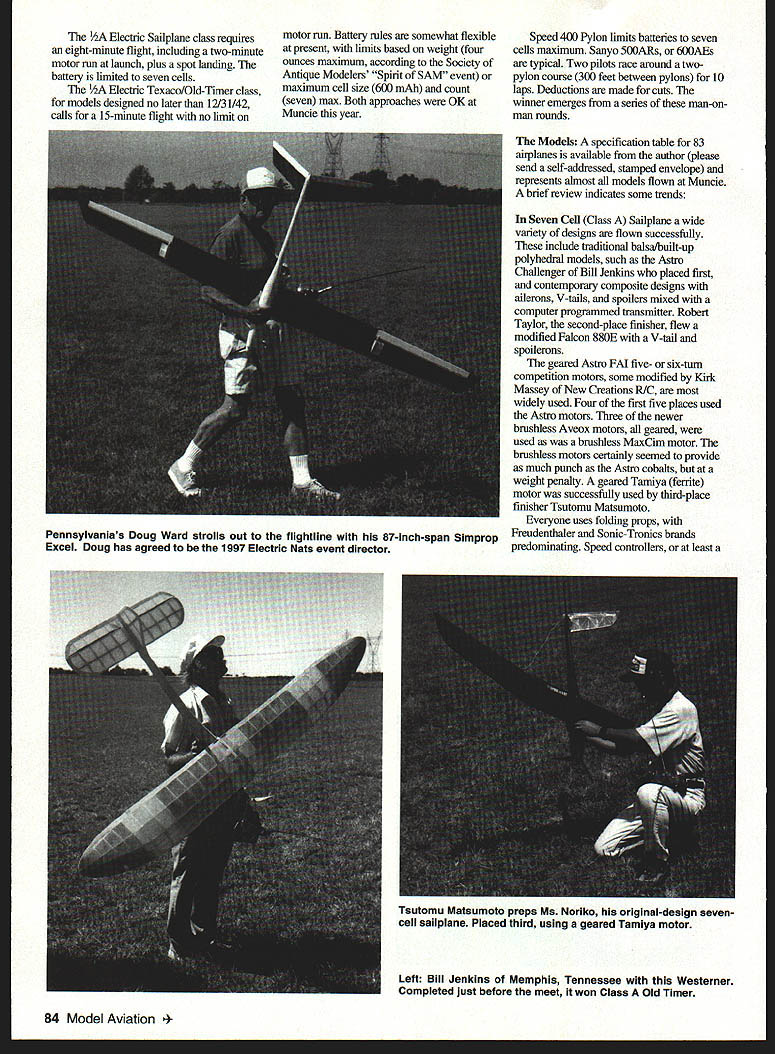
Seven events were conducted, each with a director, all under the genial guidance of Ken Myers. Four AMA rule-book events were scheduled for Saturday and Sunday, while three demonstration events and sport flying were scheduled for Monday.
Limited Motor Run Soaring (AMA rule-book events)
Limited Motor Run Soaring represented the four AMA rule-book events. Each requires a precision flight time on a limited motor run. The motor run may or may not be included in the flight time, at the Event Director's discretion; it was included at Muncie. The motor may not be turned on after the end of the launch. A spot landing may be required (as was the case this year). Typically, three rounds are flown, with the winner determined by adding a point for each second of flight up to eight minutes, with points deducted for each second over eight minutes. Points (20 at Muncie) are awarded for spot landings.
The four Limited Motor Run classes are:
- Class A Sailplane: no airframe-design restriction; battery limited to seven Sub-C cells maximum. Motor run time is 45 seconds maximum at launch.
- Class B Sailplane: no airframe-design restriction; batteries may include up to 30 Sub-C cells maximum. Motor run is 30 seconds maximum at launch.
- Class A Old-Timer: limited to models designed and published no later than 12/31/1942; battery may not exceed seven Sub-C cells. Motor run time is 60 seconds maximum at launch.
- Class B Old-Timer: limited to models designed and published no later than 12/31/1942; battery may not exceed 30 Sub-C cells. Motor run time is 45 seconds maximum at launch.
Speed 400 Demonstration Events
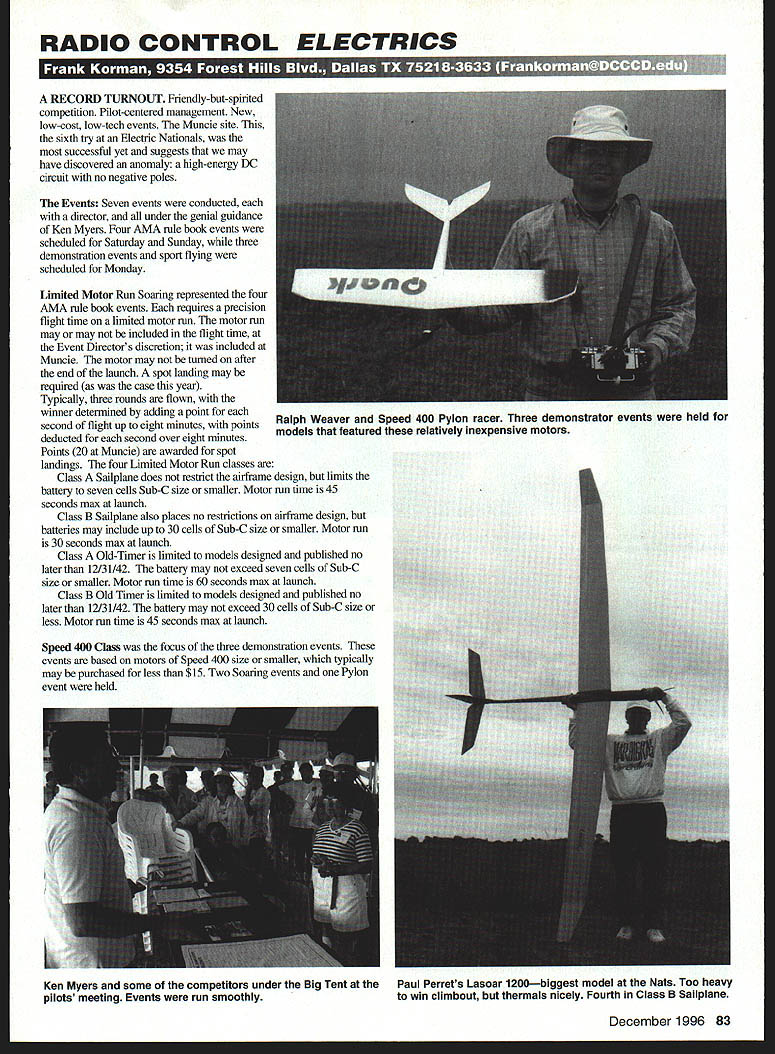
Speed 400 Class was the focus of the three demonstration events. These events are based on motors of Speed 400 size or smaller, which typically may be purchased for less than $15. Two Soaring events and one Pylon event were held.
Speed 400 Pylon limits batteries to seven cells maximum. Sanyo 500ARs and 600AEs were typical. Two pilots race around a two-pylon course (300 feet between pylons) for 10 laps. Deductions are made for cuts; the winner emerges from a series of man-on-man rounds.
Seven-Cell Sailplane (Speed 400 Soaring demo) drew a wide variety of successful designs, from traditional balsa polyhedral models to contemporary composite designs with ailerons, V-tails, and spoilers flown with computer-programmed transmitters.
1/2A Classes
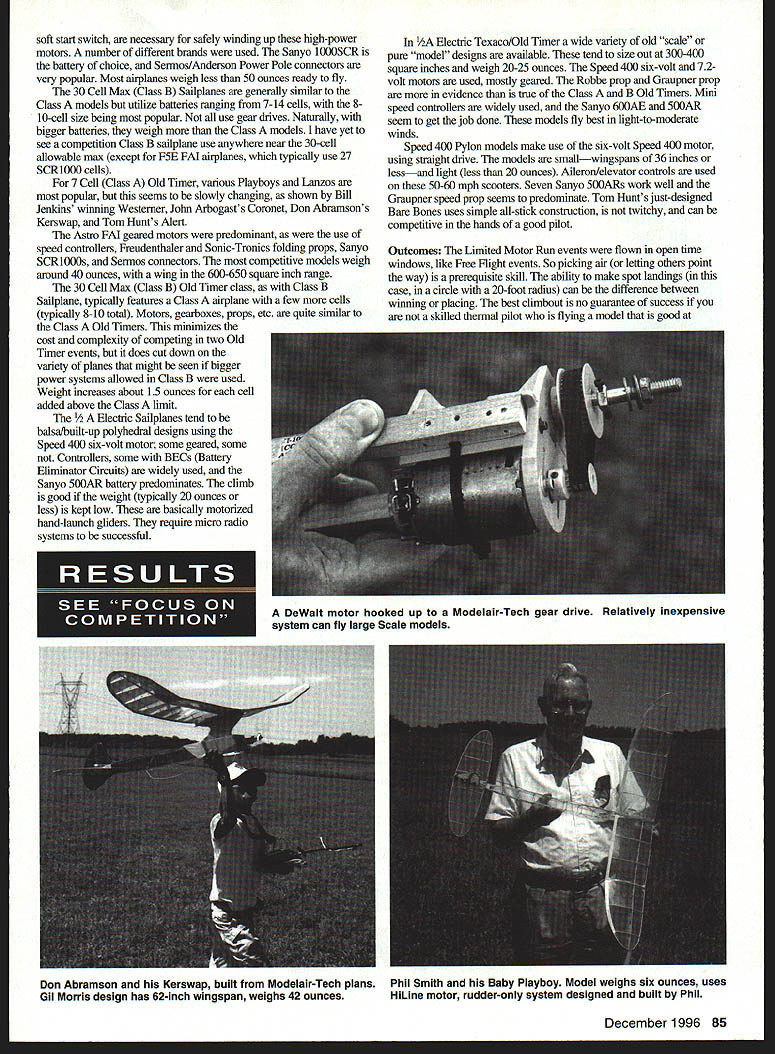
- 1/2A Electric Sailplane: requires an eight-minute flight, including a two-minute motor run at launch, plus a spot landing. Battery limited to seven cells. These are typically balsa/built-up polyhedral designs using the Speed 400 six-volt motor. Controllers (some with BECs) are widely used; the Sanyo 500AR battery predominates. Typical ready-to-fly weight is 20 ounces or less; micro radio systems are required.
- 1/2A Electric Texaco/Old-Timer: for models designed no later than 12/31/1942. Calls for a 15-minute flight with no limit on motor run. Battery rules are somewhat flexible, with limits based on either weight (four ounces maximum battery, per the Society of Antique Modelers' "Spirit of SAM" event) or maximum cell size and count (600 mAh cells, seven max). Both approaches were accepted at Muncie this year. These models tend to size out at 300–400 square inches and weigh 20–25 ounces. Speed 400 six-volt motors (mostly geared) are used; Robbe and Graupner props are common. Mini speed controllers and Sanyo 600AE or 500AR batteries are typical.
Models
A specification table for 83 airplanes is available from the author (please send a self-addressed, stamped envelope) and represents almost all models flown at Muncie. A brief review indicates several trends.
Seven-Cell (Class A) Sailplane
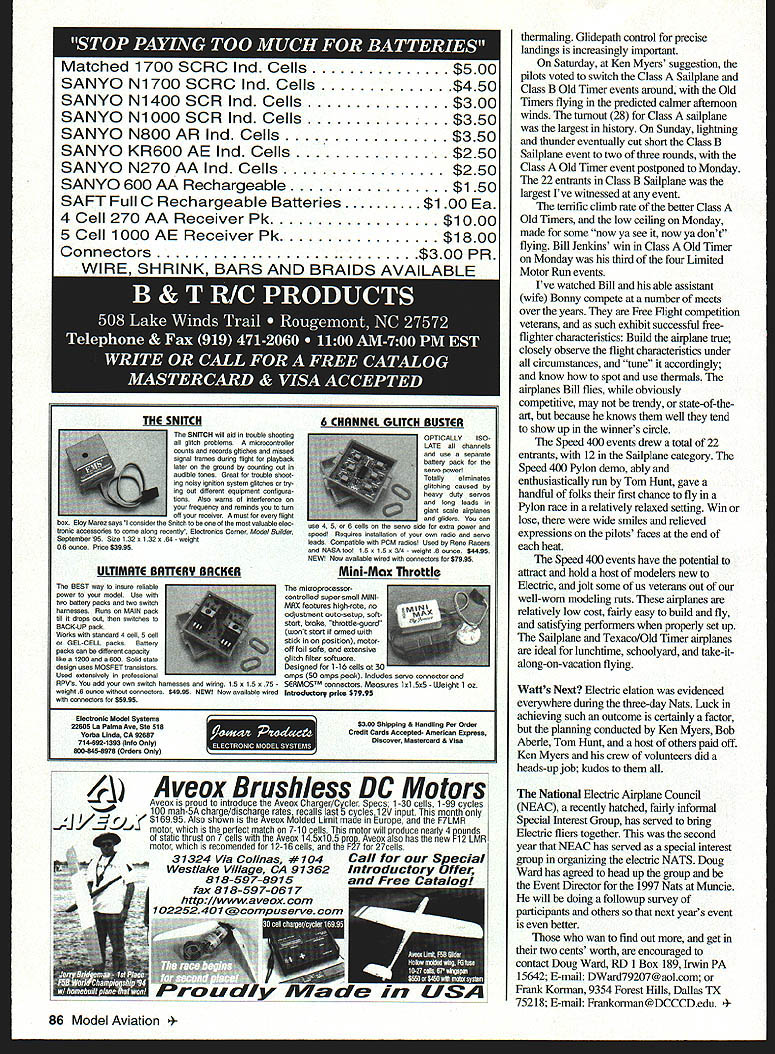
A wide variety of designs were flown successfully. Traditional balsa/built-up polyhedral models (for example, Bill Jenkins' Astro Challenger) placed well, as did contemporary composite designs with ailerons, V-tails, and spoilers flown with computer-programmed transmitters. Robert Taylor, the second-place finisher, flew a modified Falcon 880E V-tail with "spoilerons" geared to an Astro FA (five- to six-turn) competition motor; some motors were modified. Kirk Massey of New Creations R/C provided many motors.
The geared Astro FA five- or six-turn competition motors were most widely used—four of the first five places used Astro motors. Three newer geared brushless Aveox motors and a brushless MaxCim motor were used; brushless motors provided much punch but often with a weight penalty compared to Astro Cobalts. A geared Tamiya ferrite motor was used successfully by third-place finisher Tsutomu Matsumoto.
Everyone uses folding props; Freudenthaler and Sonic-Tronics brands predominated. Speed controllers—or at least a soft-start switch—were necessary. The Sanyo 1000SCR is widely used for batteries, and Anderson Power Pole connectors are very popular. Most contest airplanes weigh less than 50 ounces ready to fly.
30-Cell Max (Class B) Sailplane
Class B sailplanes are generally similar to Class A models but use larger batteries (typically 7–14 cells, with 8–10 cells most popular). Not all use gear drives. With bigger batteries, they weigh more than Class A models. Few competition Class B sailplanes approach the 30-cell maximum in practice (except for F5E FAI airplanes, which typically use about 27 SCR1000 cells).
7-Cell (Class A) Old Timer
Popular models include various Playboys and Lanzos, though the scene is evolving—examples at Muncie included Bill Jenkins' Westerner (winning), John Arbogast's Coronet, Don Abramson's Kerswap, and Tom Hunt's Alert. The Astro FA geared motors were predominant, as were speed controllers, Freudenthaler and Sonic-Tronics folding props, and Sanyo SCR1000 batteries. Most competitive models weigh around 40 ounces and have wing areas in the 600–650 square inch range.
30-Cell Max (Class B) Old Timer
Typically features a Class A airplane fitted with a few more cells (usually 8–10 total). Motors, gearboxes, and props are similar to Class A Old Timer setups. This minimizes cost and complexity for competitors entering both Old Timer events, but it reduces variety by discouraging use of much larger power systems. Weight increases about 1.5 ounces for each cell added above the Class A limit.
1/2A Electric Sailplane and Texaco/Old Timer
1/2A sailplanes tend to be balsa/built-up polyhedral designs using the Speed 400 six-volt motor (some geared). Controllers with BECs are common; Sanyo 500AR batteries predominate. These models perform well if weight is kept low.
1/2A Texaco/Old Timer models include a wide variety of old-scale and pure model designs sized at 300–400 square inches and weighing 20–25 ounces. Speed 400 motors (mostly geared), Robbe and Graupner props, mini speed controllers, and Sanyo 600AE or 500AR batteries are typical. They fly best in light-to-moderate winds.
Speed 400 Pylon Models
Speed 400 Pylon models use six-volt Speed 400 motors in straight drive. The models are small (wingspans of 36 inches or less) and light (less than 20 ounces). Aileron/elevator controls are used on these 50–60 mph scooters. Sanyo 500AR batteries and Graupner speed props were common. Tom Hunt's Bare Bones design uses simple stick construction, is not twitchy, and can be competitive in the hands of a good pilot.
Outcomes
Limited Motor Run events were flown in open time windows, like Free Flight events. Picking air (or following others to lift) is a prerequisite skill. The ability to make spot landings (in this case, within a 20-foot radius circle) can be the difference between winning or placing. The best climbout is no guarantee of success if you are not a skilled thermal pilot flying a model that circles well. Glidepath control for precise landings is increasingly important.
On Saturday, at Ken Myers' suggestion, pilots voted to switch the Class A Sailplane and Class B Old Timer events so that Old Timers would fly in the predicted calmer afternoon winds. The turnout of 28 for Class A Sailplane was the largest in history. On Sunday, lightning and thunder eventually cut short the Class B Sailplane event to two of three rounds; the Class A Old Timer event was postponed to Monday.
The 22 entrants in Class B Sailplane was the largest the author has witnessed at any event. The terrific climb rate of the better Class A Old Timers, combined with a low ceiling on Monday, produced many marginal "now you see it, now you don't" flights. Bill Jenkins' win in Class A Old Timer on Monday was his third of the four Limited Motor Run events.
Bill and his able assistant (wife) Bonny are Free Flight competition veterans and exhibit successful free-flighter characteristics: build the airplane true, closely observe flight characteristics under all conditions and tune accordingly, and know how to spot and use thermals. Bill's airplanes, while not always trendy, are well known to him and consistently show up in the winner's circle.
The Speed 400 events drew 22 entrants total, with 12 in the Sailplane category. The Speed 400 Pylon demo, ably and enthusiastically run by Tom Hunt, gave a handful of pilots their first chance to race in a relatively relaxed setting. Win or lose, pilots left heats with wide smiles and relieved expressions.
Speed 400 events have the potential to attract many new modelers to electric flight and to jolt veterans out of established modeling ruts. These airplanes are relatively low cost, fairly easy to build and fly, and satisfying when properly set up. The Sailplane and Texaco/Old Timer airplanes are ideal for lunchtime, schoolyard, and take-it-along-on-vacation flying.
Looking Ahead
Watt's Next?
Electric interest was evident everywhere during the three-day Nats. Luck plays a role, but the planning by Ken Myers, Bob Aberle, Tom Hunt, and many others clearly paid off. Ken Myers and his crew of volunteers did a terrific job; kudos to them.
The National Electric Airplane Council (NEAC), a recently formed, informal Special Interest Group, has helped bring electric flyers together. This was the second year NEAC has served as a special interest group in organizing the electric Nats. Doug Ward has agreed to head up the group and be the Event Director for the 1997 Nats at Muncie. He will be conducting a follow-up survey of participants and others so next year's event is even better.
To get more information or to contribute ideas, contact:
- Doug Ward
RD 1 Box 189, Irwin PA 15642 Dward79@aol.com
- Frank Korman
9354 Forest Hills Blvd., Dallas TX 75218-3633 FrankKorman@DCCCD.edu
Transcribed from original scans by AI. Minor OCR errors may remain.

