
RADIO CONTROL ELECTRICS
Bob Kopski 25 West End Drive, Lansdale PA 19446
This Month's Topics
- KRC '96 overview
- Related new product information
- Update on an upcoming charger accessory
KRC '96 Overview
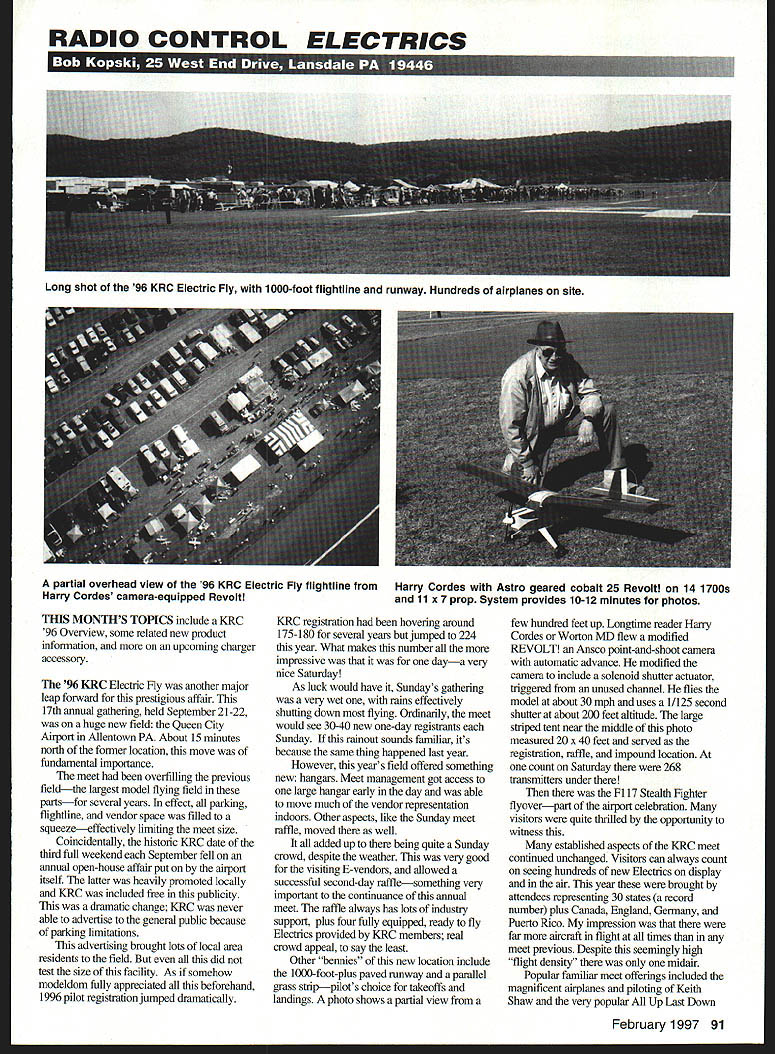
The '96 KRC Electric Fly was another major leap forward for this prestigious affair. This 17th annual gathering, held September 21–22, was on a huge new field: the Queen City Airport in Allentown, PA—about 15 minutes north of the former location. This move was of fundamental importance.
The meet had been overfilling the previous field—the largest model flying field in these parts—for several years. Parking, flightline, and vendor space had been squeezed, effectively limiting the meet size. Coincidentally, the historic KRC date (the third full weekend each September) fell on an annual airport open-house. The airport heavily promoted the open-house locally and included KRC free in its publicity. This was a dramatic change; KRC had never been able to advertise to the general public because of parking limitations.
The advertising brought many local residents to the field. Even so, 1996 pilot registration jumped dramatically. KRC registration had been hovering around 175–180 for several years but jumped to 224 this year. What makes this number more impressive was that it was for one day—a very nice Saturday.
As luck would have it, Sunday’s gathering was a very wet one, with rains effectively shutting down most flying. Ordinarily the meet would see 30–40 new one-day registrants each Sunday. If this rainout sounds familiar, it's because the same thing happened last year.
Field, Facilities, and Logistics
This year's field offered something new: hangars. Meet management gained access to one large hangar early in the day and was able to move much of the vendor representation indoors. Other aspects, like the Sunday meet raffle, moved there as well. It all added up to a sizable Sunday crowd despite the weather. This was very good for the visiting E-vendors and allowed a successful second-day raffle—something important to the continuance of the annual meet. The raffle always has lots of industry support, plus four fully equipped, ready-to-fly electrics provided by KRC members; real crowd appeal, to say the least.
Other benefits of the new location include a 1,000-foot-plus paved runway and a parallel grass strip—pilots’ choice for takeoffs and landings.
The large striped tent near the middle of the field measured 20 × 40 feet and served as the registration, raffle, and impound location. At one count on Saturday there were 268 transmitters under the tent.
There was also an F-117 Stealth Fighter flyover as part of the airport celebration. Many visitors were thrilled by the opportunity to witness this.
Attendance, Flights, and Events
Many established aspects of the KRC meet continued unchanged. Visitors can always count on seeing hundreds of new electrics on display and in the air. This year brought attendees representing 30 states and abroad, including Canada, England, Germany, and Puerto Rico. My impression was that there were far more aircraft in flight at all times than at any previous meet. Despite this high flight density, there was only one midair.
Popular familiar meet offerings included magnificent airplanes and skilled piloting by Keith Shaw, and the very popular All-Up Last-Down (AULD) event. AULD saw 20 airplanes launched simultaneously. Jim McCullough of Raleigh, NC, was first to land; his last flight lasted 1 hour 43 minutes, beating Karl Benson’s 1 hour 37 minutes.
Aspects of the affair will likely be revised in future years. A Saturday night KRC social merged with a scheduled social put on by the airport. Modelers’ comments on Sunday showed a preference for the classic KRC Electric social familiar from years past; this will be addressed in next year’s planning.
Two years ago KRC produced a professionally made video of the year’s meet and sold hundreds of copies. KRC arranged the same video production company to film this year’s meet. Videos of the 1994 and 1996 KRC Electric Fly are available from Real-Tour Productions, Box 466, Perkasie, PA 18944; Tel: (800) 958-4336. Price is $23 (including shipping) for each VHS cassette.
SR Batteries Electric Flight Symposium
The KRC meet weekend was preceded by the SR Batteries Electric Flight Symposium on Friday at the Allentown Hilton—an in-town hotel with large facilities a few miles from the field. The Symposium presented about nine topics by guest speakers during the day. Friday evening brought the first SR Indoor E-fly in the hotel, which replaced the Night Fly held in recent years because of the field change.
I was one of the guest speakers and chose the topic of electric vintage conversions. I queried the audience about their RC experience by decade and was amazed at the showing of hands for each decade. Electric appeal and participation truly reach back deep in time.
I spoke with Larry Sribnick, president of SR and Symposium director, and learned there were 135 Symposium attendees this year. Larry plans to expand this activity in the future and possibly occupy two large banquet rooms with simultaneous presentations. The entire ’96 Symposium was videotaped, and Larry is evaluating how to make tapes available.
Trends and New Products
My impression is that scale and "big" continue to grow in popularity, with more and larger electrics showing up each year. I also heard one very satisfied vendor describing how he’s selling fewer seven-cell things; folks are catching on to the fact that "seven" is only a beginning.
At the low end, Speed 400–sized products showed up in force. This area is getting very popular. Perhaps the most impressive sign of this was Keith Shaw’s flight of a tiny Zlin, powered by the single existing prototype of Astro’s new brushless "02"—loaned to Keith for testing and display at KRC. Watch for this new product in the near future.
The KRC meet has long been a great place to meet other E-modelers, including better-known names in the hobby—vendors, manufacturers, authors, and so on. Something new was added this year: more and more modeling activity, including electric activity, is going on online; many people who had "met" via that medium met each other in person on the flightline for the first time. A common reaction: "Gee, you don’t look like I pictured you!" Looks like another fun dimension to the Electric Fly has been established.
Notable Flights and Exhibits
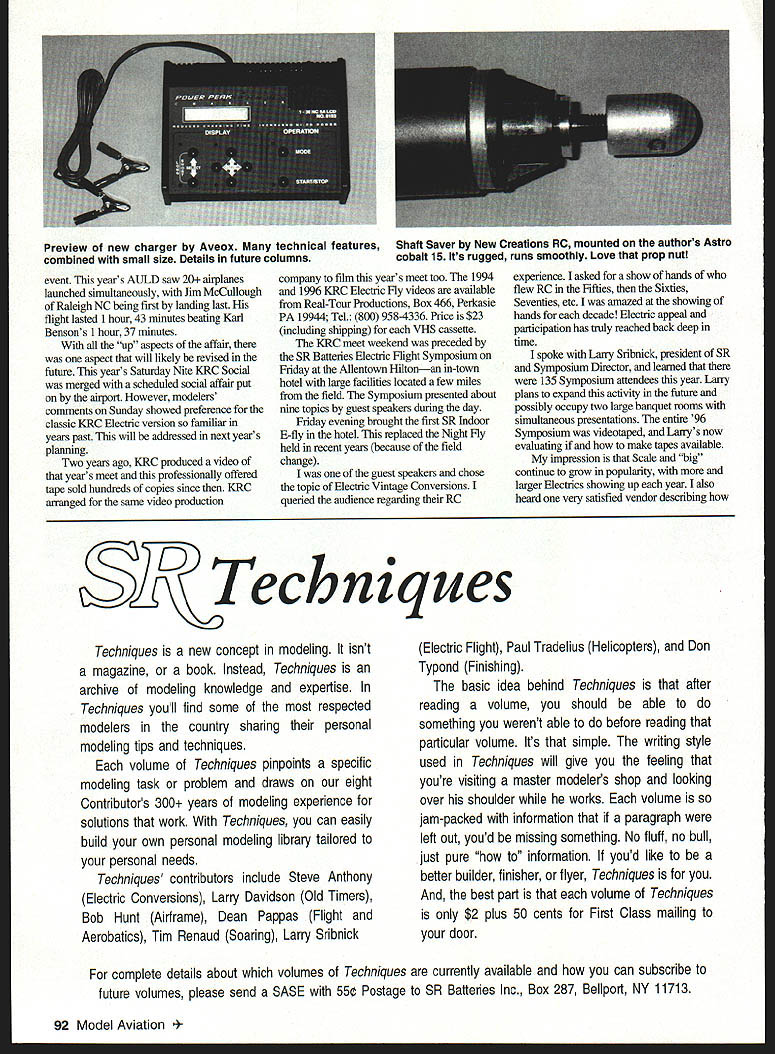
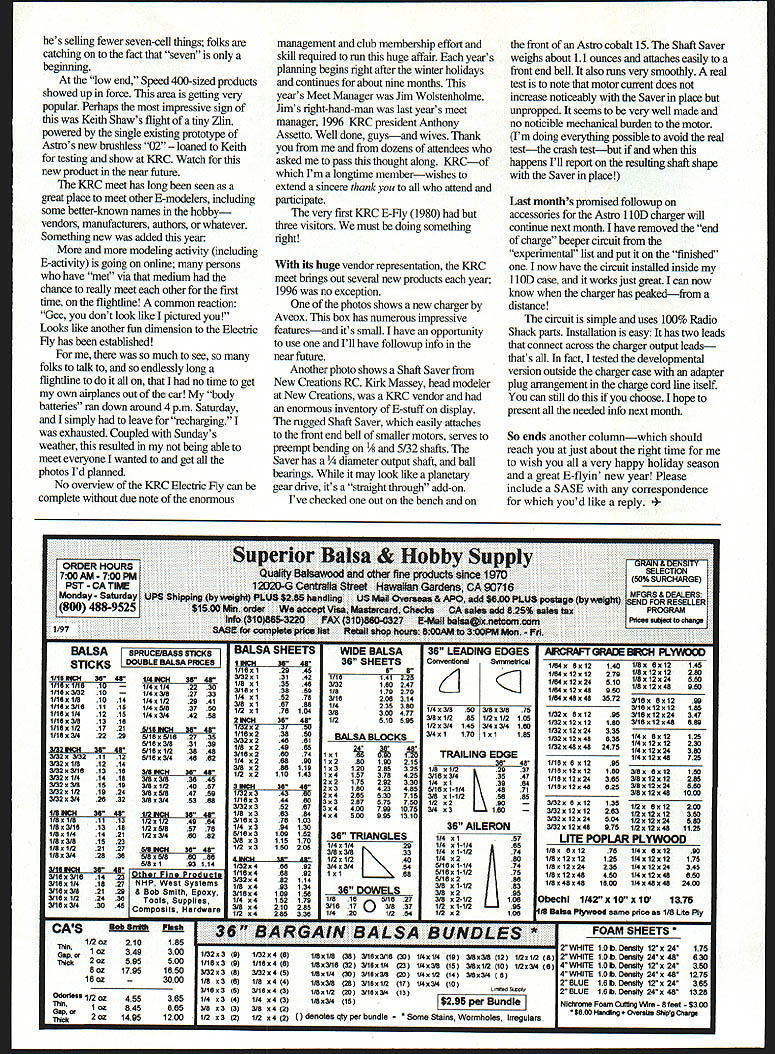
Longtime reader Harry Cordes of Worton, MD flew a modified REVOLT! with an Ansco point-and-shoot camera with automatic advance. He modified the camera to include a solenoid shutter actuator, triggered from an unused channel. He flies the model at about 30 mph and uses a 1/125 second shutter at about 200 feet altitude.
One of the photos shows a new charger by Aveox. This box has numerous impressive features—and it’s small. I have an opportunity to use one and will have follow-up information in the near future.
Another photo shows a Shaft Saver from New Creations RC. Kirk Massey, head modeler at New Creations, was a KRC vendor and had an enormous inventory of E-stuff on display. The rugged Shaft Saver, which easily attaches to the front end bell of smaller motors, prevents bending on 1/8 and 5/32 shafts. The Saver has a 1/4-inch diameter output shaft and ball bearings. While it may look like a planetary gear drive, it’s a straight-through add-on. I’ve checked one on the bench and on the front of an Astro Cobalt 15. The Shaft Saver weighs about 1.1 ounces and attaches easily to a front end bell. It also runs very smoothly. A real test is that motor current does not increase noticeably with the Saver in place but unpropped. It seems very well made and imposes no noticeable mechanical burden on the motor. I’m doing everything possible to avoid the real test—the crash test—but if and when this happens I’ll report on the resulting shaft shape with the Saver in place.
Accessories and Charger Update
Last month’s promised follow-up on accessories for the Astro 110D charger will continue next month. I have removed the "end of charge" beeper circuit from the "experimental" list and put it on the "finished" one. I now have the circuit installed inside my 110D case, and it works great. I can now know when the charger has peaked—from a distance!
The circuit is simple and uses 100% Radio Shack parts. Installation is easy: it has two leads that connect across the charger output leads—that’s all. In fact, I tested the developmental version outside the charger case with an adapter plug arrangement in the charge cord line itself. You can still do this if you choose. I hope to present all the needed info next month.
Personal Notes and Thanks
For me, there was so much to see, so many folks to talk to, and so endlessly long a flightline to do it all on, that I had no time to get my own airplanes out of the car! My "body batteries" ran down around 4 p.m. Saturday, and I simply had to leave for "recharging." I was exhausted. Coupled with Sunday’s weather, this resulted in my not being able to meet everyone I wanted to or get all the photos I’d planned.
No overview of the KRC Electric Fly can be complete without due note of the enormous management and club effort and skill required to run this huge affair. Each year’s planning begins right after the winter holidays and continues for about nine months. This year’s meet manager was Jim Wolstenholme. Jim’s right-hand man was last year’s meet manager and 1996 KRC president Anthony Assetto. Well done, guys—and wives. Thank you from me and from dozens of attendees who asked me to pass this thought along. KRC—of which I’m a longtime member—wishes to extend a sincere thank you to all who attend and participate.
The very first KRC E-Fly (1980) had but three visitors. We must be doing something right!
Closing
So ends another column—which should reach you just about the right time for me to wish you all a very happy holiday season and a great E-flyin’ new year! Please include a SASE with any correspondence for which you’d like a reply.
Transcribed from original scans by AI. Minor OCR errors may remain.

