
Radio Control: Electrics
Bob Kopski
25 West End Drive, Lansdale, PA 19446
This month's topics
- Meet announcement
- Speed control discussion for beginners
- An advanced developmental motor power response (shaped throttle response)
- A related proposal to equipment manufacturers
LVRCS Electric Funfly announcement
Michael Stewart (107 Taft Terrace, Washington, NJ 07882; Tel.: (908) 689-6981) sent an announcement for the Tenth Annual LVRCS Electric Funfly scheduled for June 7–8 at the LVRCS field near Easton, PA. This is one terrific meet and I’ve been to all but one over the years.
The Lehigh Valley Radio Control Society is a mixed-interest club (much like KRC) which includes representative electric interest. This group does a fine job with this low-key gathering by offering open-field use most of the weekend and several competitive challenges for those inclined. The field is excellent, and if recent trends are an indicator you can expect about 50–60 registrants. The meet is early enough that you can still see many new electric projects just emerging from the winter shop.
Motor controls and the current marketplace
Motor controls include variable speed controls and simple on/off switches. Nowadays these are virtually all electronic; relatively few mechanical/switch types remain in use. While thumbing through the New Creations R/C catalog, I was struck by the extensive listing of motor speed and on/off controls: 48 individual model numbers, not including those for brushless motors.
The list included some manufacturer names I’m not familiar with, and some unfamiliar products from familiar industry names. No wonder I get considerable reader mail seeking help in this subject area—I simply don’t know how to sort out the offerings from a catalog listing.
This column has often mentioned ESCs that I use; any I routinely use are, effectively, recommendations. That’s fine so far as it goes—but I may be automatically excluding unfamiliar product that’s very good as well. There’s nothing I can do about that—I’d go broke trying every available design.
I’ll always try to recommend an ESC in response to any application or question presented, but the answer will be based on products I use myself or have seen in enough local use. If you inquire about a specific product that I have no reference for, I’ll say so. That’s not necessarily a negative response—most likely it’s neutral.
A sample ESC and buyer caution
Several months ago I received a sample ESC in the mail with no cover letter, no contact name, and no follow-up. I assumed it was a sample for evaluation, but lacking personal communication I was reluctant to invest much time in it. I did look the ESC over and read the instructions—to my dismay.
This ESC was made by a company not known in the aeromodeling world. I suspect it may be a first E-flight product attempt, and it appeared to be designed with no significant E-flight experience behind it. It was relatively large and heavy and used "bullet" connectors—common in RC cars but not flight applications. Despite my extensive cable collection, I could not easily connect to it without buying unconventional wiring parts.
The design seemed limited to 7–8 cell applications—a unique limitation in my experience. Further, the product was not inexpensive. Without even powering it up, the item appeared noncompetitive with many other E-flight ESCs. But how would a beginner know this?
I can understand newcomers buying such an item based on advertising, but this is an example where eventual disappointment seems likely. I’d much rather recommend choices where disappointment would be extremely unlikely. I am not saying this particular product doesn’t work; I’m saying there is more to a choice than merely “it works.” Every ESC has a feature set, and the total picture influences my choices.
Advice for newcomers
If there are no locals flying electric and the hobby shop doesn’t know how to sell electric, write to me or any other E-columnist. Describe your application (airplane, motor, battery, etc.). We will respond with suggestions that should both work well and be long-term satisfying. Ask more than one of us—no one knows all the answers, and you’re more likely to learn about more of the available product spectrum. You might get divergent opinions; seek a third opinion or avoid the item altogether. Chances are you’ll wind up with multiple good choices and some not-so-good ones.
Building your own speed control
Readers frequently express interest in building their own speed controls and have asked for ESC circuits or sources. Several local modelers have dug through many years of Model Aviation to an early work: the Jomar SC-1, published so long ago that I don’t have easy access to it. As far as I know, it’s been a very long time since any ESC construction articles appeared in the magazine.
Given that I enjoy building modeling electronics, I’ve been toying with an original ESC design that might be an article candidate in the future. This is an analog design (no microprocessor) and features both low-end and high-end adjustment screws that do not interact significantly. Experienced E-modelers will immediately notice this unique feature. Beyond this is something much more sophisticated: a shaped throttle response.
Throttle response background
The November 1996 column discussed throttle response (motor power level as a function of transmitter stick position). A graph of real data on a typical motor/prop combination showed a severely nonlinear power input vs. stick position relationship. The meaning (or lack thereof) of “half throttle” or “half stick” and similar terms was also discussed.
After that column I had an unrelated conversation with Keith Shaw, who tried a new model that had the usual nonlinear power response. That sparked my interest in the basic nonlinear nature of power control in our models. Much of my professional life in defense electronics deals with nonlinear circuit transfer functions, so I was well-primed to explore this.
From the 11/96 column you’ll see that at the beginning of throttle stick motion it takes a lot of stick to get any significant motor power. Near the high end of the power range, relatively little stick motion makes a huge change in motor power. Both ends of the stick throw can have an undesirable “feel”—soft at the low end and very touchy at the high end. This is reminiscent of exponential control on flight surfaces—soft around neutral and strong with increasing deflection. But whereas exponential is advantageous for control surfaces, the same behavior on throttle is not desirable.
It seemed to me that what’s needed is a transmitter throttle stick response that’s the opposite of exponential—an anti-exponential or pseudo-log response. Alternatively, such a response might be built into the speed control.
Development: an "emphasis" control experiment
I tested the idea and found that a “bent” throttle response is very nice to fly. The effect is so dramatic on my sport models that I don’t want to fly with conventional throttle response anymore. Winter limited my flight testing, but I did bench and limited-flight work.
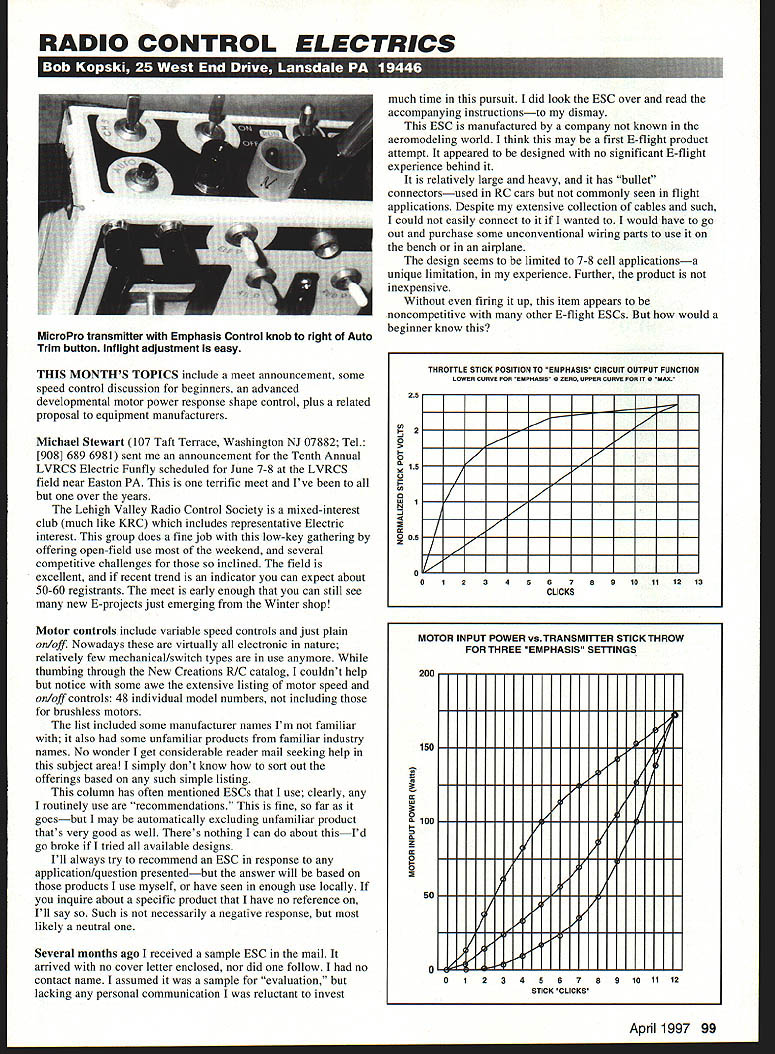
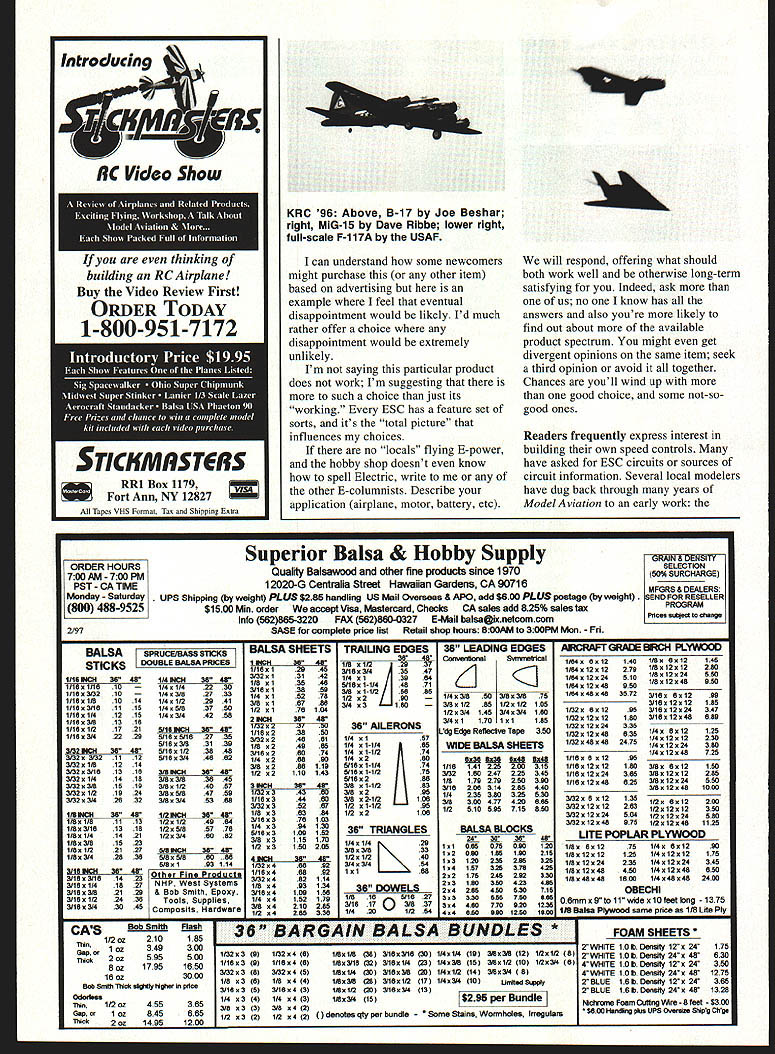
I have an Ace MicroPro transmitter—a very easy-to-work-on box. I installed a developmental circuit on the throttle stick and an associated control knob on the box top—an “emphasis control.” The adjustment knob is smoothly variable from 0 to max; over this range the degree of the circuit influence is smoothly selectable. The accessory circuit and its control knob “bend” (bow) the otherwise-linear throttle stick response.
The full-down and full-up stick positions are fixed and repeatable—throttle “full-off” and “full-on” are always the same. As the emphasis is advanced, the rate of change of stick effect sharply increases just above “off” and gradually slows as “full-on” is approached. The stick response looks like a log response of varying strength as the emphasis control is advanced.
The fully emphasized transfer function is a segmented piecewise synthesis approximating a log transfer characteristic. The emphasis knob effectively blends the linear curve and the emphasized curve to produce an intermediate resultant curve; an infinite number of transfer curves is possible.
Motor power tests and results
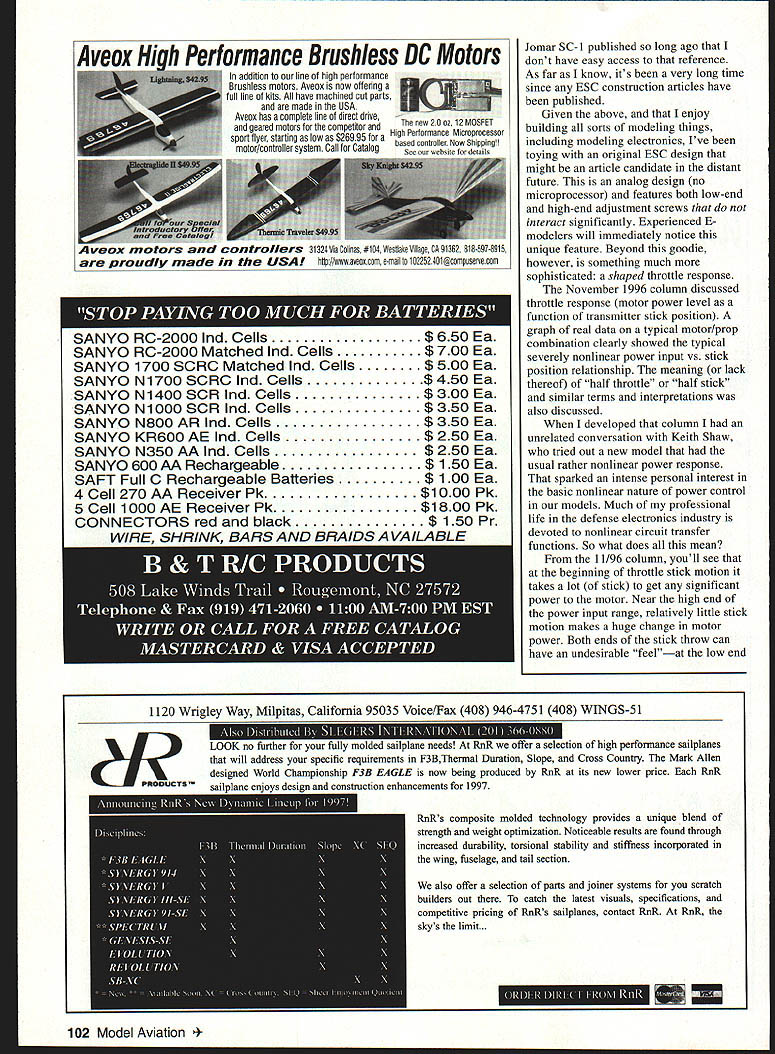
I tested motor power curves with a geared car motor turning a 10 x 6 prop from a 10-volt supply. Motor control used a transmitter, receiver, and an analog linear speed control. I adjusted the speed control end points so the motor just started one stick click up and maxed out at the last stick click.
- With the emphasis control fully off, the power curve showed the familiar highly nonlinear motor power vs. stick throw.
- With the emphasis control at an intermediate setting, the power response was much less nonlinear.
- With the emphasis control at max, the power curve nonlinearity actually reversed shape.
Because the emphasis control is smoothly variable, an infinite set of intermediate power response curves is attainable.
Flight presentation with this shaping is excellent: very smooth, non-sensitive power control with none of the low-end limp feeling or the high-end “hairy” feeling. I’ve tried this on several sport airplanes and power systems; the right feel can be dialed in on the emphasis control in flight.
Proposal to manufacturers
Recognizing that transmitter throttle sticks are nonlinear and that a shaped response improves flight feel, it seems appropriate to incorporate such nonlinear shaping into ESCs or transmitters. This should be relatively easy in microprocessor-controlled ESCs and possible, though more difficult, in analog units. I have two development versions in use now where the ESC response is shaped to match the desired throttle-stick curve.
ESC manufacturers might consider programmable shaped responses in their controls. Radio manufacturers might consider adding a pseudo-log (anti-exponential) transfer shape option for the throttle stick. This is like the exponential option used on surface controls, but opposite in effect.
Betcha someday this “power response shape” feature becomes routine in many ESCs and transmitters. Remember—you read it first in Model Aviation. OK, industry: who will be first to market?
Please enclose a SASE with any correspondence for which you’d like a reply.
Transcribed from original scans by AI. Minor OCR errors may remain.

