
RADIO CONTROL ELECTRICS
Bob Kopski, 25 West End Drive, Lansdale PA 19446
This month's topics
- Two meet announcements
- Follow-up on a Speed 400 motor mount
- Photo detail and installation notes on the throttle "emphasis" function discussed last month
- Mega-motor substitute (Magnetic Mayhem Reverse) and bench-test comparison
- A developmental slow charger for large packs
Meet announcements
Bassett/Brown Commemorative Meet
- Dates: June 28–29
- Location: Near Reading, PA
- Sponsor: Cocalico Prop Dusters
- Event: One-design for the Miss Philadelphia OT, with many competition opportunities including an Electric option
- Contact: Contest Director Paul Ahnert, 442 West Marion, Lititz PA 17543
Land of Lincoln Electric Fly
- Dates: June 28–29
- Sponsor: Knights of the Air RC Club
- Location: Club field near Springfield, IL
- Notes: Plenty for the whole family; a good family vacation opportunity
- Contact: Tim McDonough, 127 S. Oaklane Road, Springfield IL 62707; Tel: (217) 523-8625; email tpm@inwnet.net; web: http://www.inwnet/~tpm
Tim reports strong positive response to his proposal for an Electric event for 1997 following last year’s column.
Speed 400 motor mount
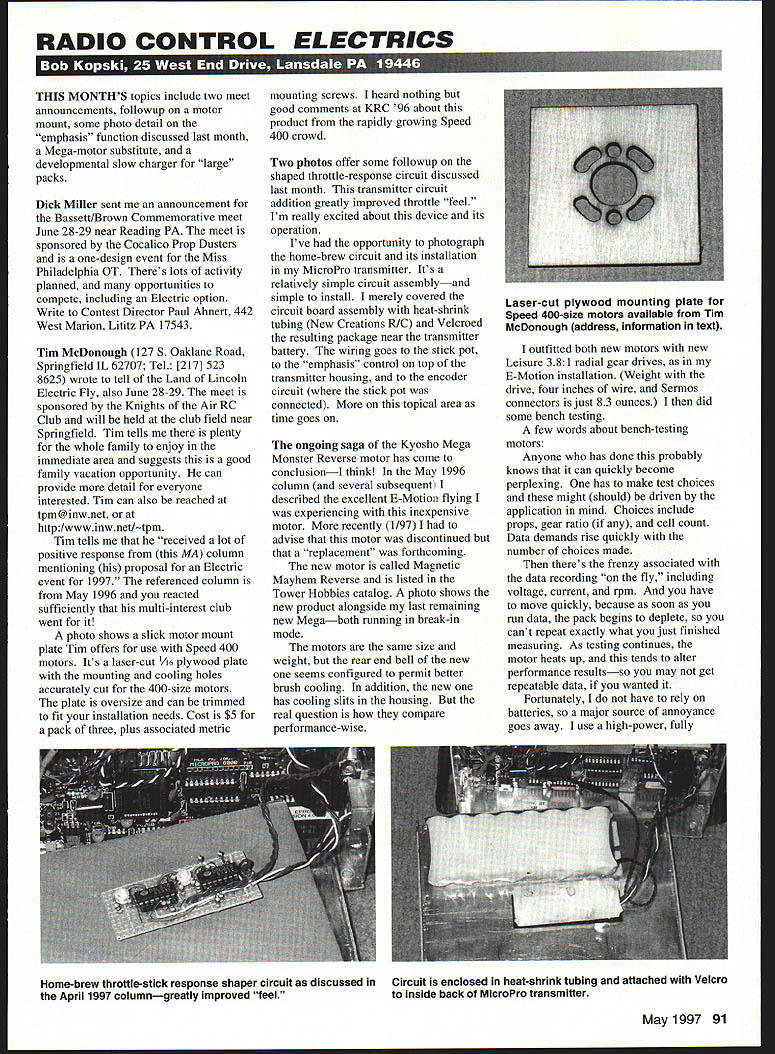
- Product: Laser-cut 1/16" plywood mount plate for Speed 400 motors
- Features: Accurate mounting and cooling holes; oversize so you can trim to fit your installation
- Cost: $5 for a pack of three (plus associated metric mounting screws)
- Notes: Widely praised at KRC '96 by the growing Speed 400 crowd
Throttle-response ("emphasis") circuit — follow-up
- The shaped throttle-response circuit discussed last month greatly improved throttle "feel."
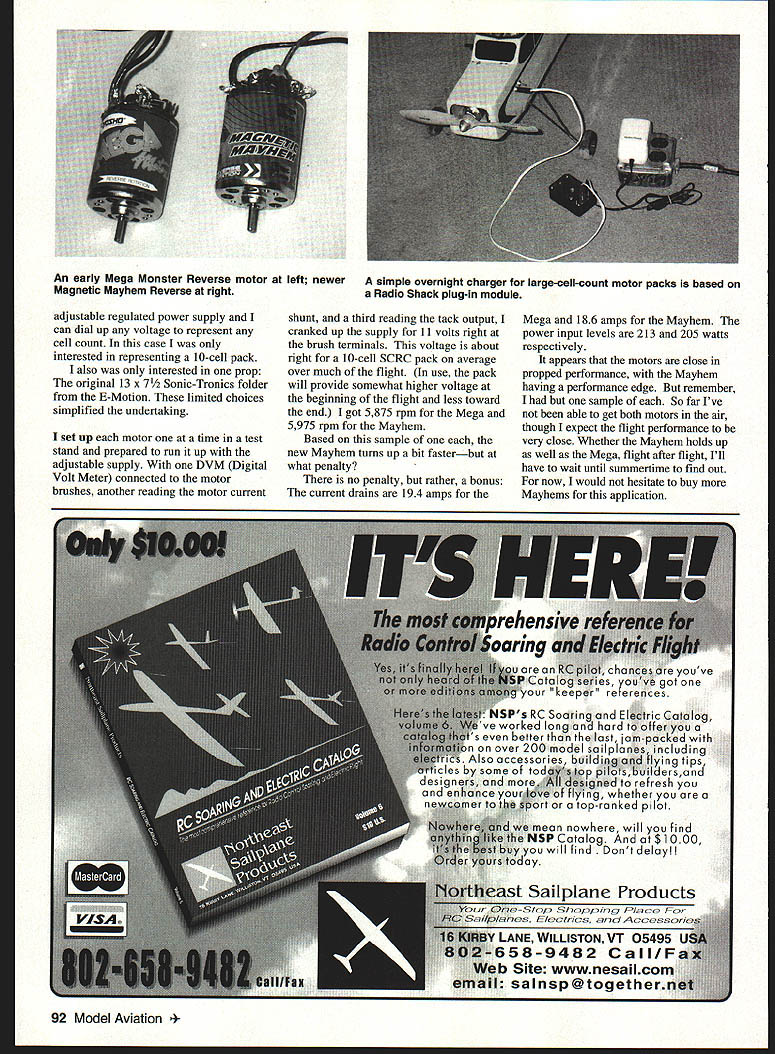
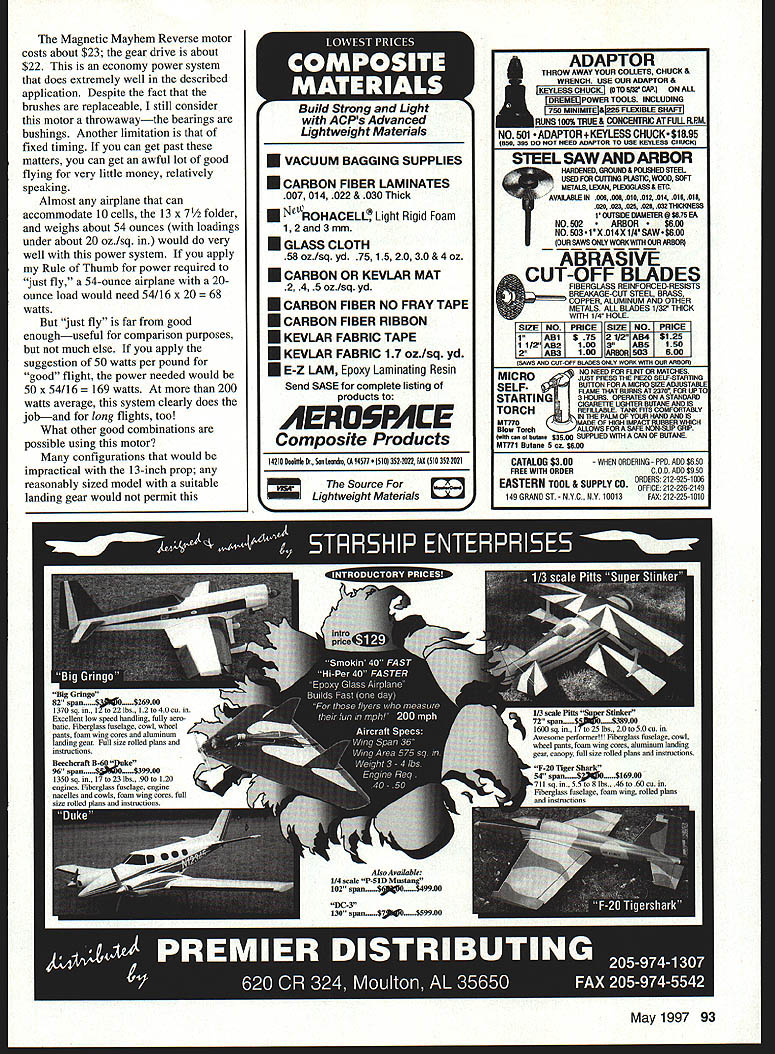
- Photo and installation notes: I photographed a home-built circuit installed in my MicroPro transmitter. The assembly is relatively simple.
- Installation summary:
- I covered the circuit board with heat-shrink tubing and Velcroed the package near the transmitter battery.
- Wiring runs to the stick potentiometer, to an "emphasis" control on top of the transmitter housing, and to the encoder circuit (where the stick pot was connected).
- More on this topic as developments and feedback continue.
Kyosho Mega Monster → Magnetic Mayhem Reverse motor
Background
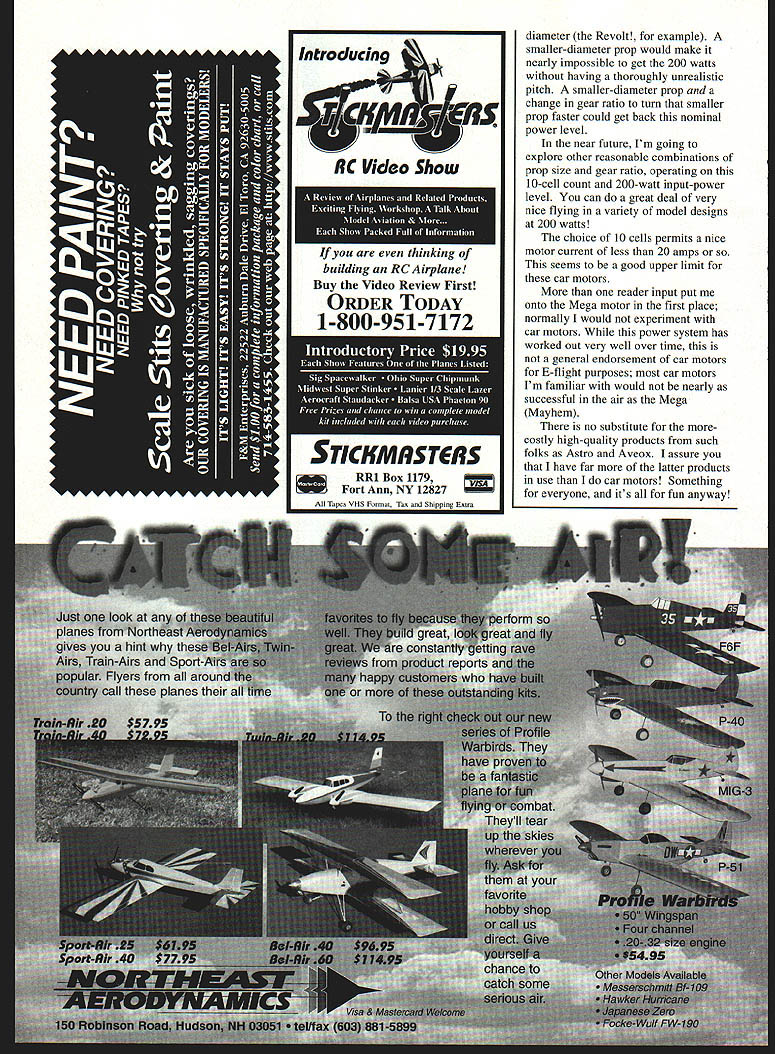
- I previously recommended the inexpensive Kyosho Mega Monster Reverse motor for E-Motion flying. The Mega was later discontinued; a replacement called Magnetic Mayhem Reverse is now listed in the Tower Hobbies catalog.
- Physical differences: Same size and weight; the Mayhem’s rear end bell appears configured for better brush cooling and the housing has cooling slits.
Test setup and method
- Drive: Both motors fitted with Leisure 3.8:1 radial gear drives (as used on my E-Motion installation).
- System weight: With the drive, four inches of wire, and Sermos connectors — 8.3 ounces.
- Power source: High-power, fully adjustable regulated power supply (avoids battery depletion variables).
- Measurements: DVM on the motor brushes (voltage), a separate meter for motor current, and a tachometer for rpm.
- Test voltage: 11 volts at the brush terminals (represents average voltage for a 10-cell SCRC pack during much of a flight).
- Prop: 13 x 7-1/2 Sonic-Tronics folding prop (the original recommended prop for the E-Motion).
Results (single-sample each)
- Mega: 5,875 rpm, 19.4 A, 213 W input
- Mayhem: 5,975 rpm, 18.6 A, 205 W input
Observations
- The Mayhem turned slightly faster and drew slightly less current—resulting in a modest performance edge in bench tests.
- Both motors produced similar propped performance; flight results so far are very close.
- Durability: The motors use replaceable brushes but have bushing bearings and fixed timing—so I consider them more or less throwaway units despite brush replacement.
- Cost: Magnetic Mayhem Reverse motor about $23; gear drive about $22 — an economical power system that performs well for the described application.
Suitable applications and power guidance
- Typical recommended airplane: Any plane that can accommodate 10 cells, the 13 x 7-1/2 folder, and weighs about 54 ounces with a loading under about 20 oz./sq. in.
- Rule-of-thumb "just fly" power (author's rule): For a 54-ounce airplane with a 20-ounce load:
- Calculation: (54 / 16) × 20 = 68 watts (just enough to fly)
- “Good” flight power suggestion: 50 watts per pound:
- Calculation: 50 × (54 / 16) = 169 watts
- This motor system delivers more than 200 watts average, so it provides strong, long flights and performance well beyond "just fly."
Prop and gear considerations
- The 13-inch prop works well for many designs, but some airframes (due to landing gear or clearance) cannot accommodate that diameter—for example, certain models like the Revolt.
- Using a smaller diameter prop makes obtaining 200 watts more difficult unless you change the gear ratio to spin the smaller prop faster (or accept an unrealistic pitch).
- I plan to explore other prop diameter and gear ratio combinations for 10-cell, ~200-watt operation. Many very usable model configurations are possible at the 200-watt level.
Caveats
- While this specific car-motor-derived system has worked well, this is not a general endorsement of car motors for electric flight—most car motors won't perform as well in the air.
- There is no substitute for higher-cost, high-quality motors from makers such as Astro and Aveox for applications that demand it.
Bench-testing motors — brief notes and cautions
- Bench testing can become complex quickly: choices of props, gear ratios, and cell count drive the data you must record.
- Batteries deplete and motors heat up, altering performance and harming repeatability if you rely on batteries; a regulated power supply simplifies testing by holding voltage constant.
- Important measurements during tests: voltage at the brushes, motor current (shunt), and rpm (tachometer). Work quickly and note that pack state and motor temperature affect results.
Slow charger for large packs
- Background: In June 1993 I presented some personal electronics projects, including a home-brew adjustable slow charger for overnight charging/equalization of large motor packs.
- I hesitated to publish full details then because the design involved internal AC line wiring, which could be hazardous for some builders.
- New simplified design:
- Uses a plug-in telephone-answering-machine-style power supply (readily available from Radio Shack and other sources).
- The low-voltage output wires feed a simple circuit that develops a constant 150–160 mA output current for charging 1 to 22 cells.
- The current is steady regardless of cell count.
- Suitability:
- The selected current is appropriate for my packs (1.4 Ah SCRC and 1.7 Ah SCRCs).
- The circuit can be adapted to other currents by changing a resistor.
- Future development:
- Exploring versions with output adjustability and multiple outputs to charge more than one pack simultaneously.
- Trying to keep parts "all Radio Shack" for simplicity of sourcing.
- I expect follow-up and possibly a full feature presentation on this charger.
Closing
Please continue enjoying the powerful-but-quiet thrill, joy, and pure exhilaration of electric flight. If you send correspondence and would like a reply, please enclose a SASE.
Transcribed from original scans by AI. Minor OCR errors may remain.

