
RADIO CONTROL ELECTRICS
Bob Kopski, 25 West End Drive, Lansdale PA 19446
Introduction
This month's column is devoted to beginning Electric modelers — which includes beginners in aeromodeling as well as aeromodelers beginning in Electric. We present an overview of Electric power, what it has to offer, and suggestions for getting more information about this relatively new and very appealing aspect of our hobby.
Electric is almost self-defining, just like "Gas" and "Rubber" — one of several common power sources for model flight. This column is primarily focused on RC Electrics, but the basic power source is fully applicable to Free Flight and Control Line.
Electric can be flown indoors and out, and can power models ranging in size and weight from tiny one- or two-ounce craft to 20-plus pounds' worth of Giant Scale. There is no aeromodel type I know of that cannot be flown with Electric power.
Components of an electric power system
A typical Electric power system includes:
- a suitable motor
- a battery
- a motor controller
This is often compared to a typical glow or gas installation of engine, fuel tank, and servo-driven throttle control. There is direct functional similarity here.
There are large numbers of Electric motors available for aeromodel application, and the numbers are steadily increasing. There are small through large motors, and economy and high-quality motors.
Motor battery makeup can be quite varied: cell count and cell "size" can be selected for the model and flight task at hand. Motor batteries are typically made of nickel-cadmium cells that are of a kind suited to the high current demands of motors, while still being quickly field-rechargeable.
All kinds of motor-control devices are also readily available. Commonly known as Electronic Speed Controls (ESCs), these devices install between the motor battery and motor, with a third connection to the radio. ESCs control the motor from off smoothly through the speed range to full on via the RC transmitter "throttle" stick.
This wealth of available Electric product is quite different from the early days (just 20–25 years ago) when the total Electric product count on the market could be done on your fingers. In fact, this huge selection can often confuse first-time E-modelers.
Why Electric is appealing
While Electric is similar to other model power sources in that it's useful on all kinds of models, it also differs in many ways, and these differences often make Electric appealing.
Some attractions are obvious:
- Low noise
- Cleanliness
- Convenience
The quiet of Electric flight can (and does) save fields threatened by noise problems.
Many modelers say the cleanliness is most appealing — no liquid fuel or smoky exhaust/oily residue to deal with. More and more Scale modelers find the cleanliness of Electric to be a real advantage. From another viewpoint, one can fire up the largest E-power systems inside the home at full bore for long periods with no environmental consequence.
Electric has opened up nearby field opportunities for those who cannot travel far to fly. Examples include local school and athletic fields "down the street," as well as some fields previously lost to noise problems.
Other readers describe Electric's ease of use and maintenance as most important. Some physically challenged folks very much appreciate the "just flip the switch" simplicity of E-power.
Some modelers enjoy the challenge of something new. Longtime aeromodelers who have grown up with wet power sometimes like to take what they are used to flying and fly it with E-power. No modeler category I've seen is excluded from flying Electric.
Many beginners of all ages get their start in aeromodeling with E-powered RC craft. I categorically reject the notion that Electric is no good for beginners — my club has many such members.
I've also seen experienced wet-power modelers extend their hobby by adding Electric craft to their hangar. I am now a totally Electric modeler, but there were many years when I flew both power sources, often at the same outing.
There are aeromodeling "returnees" — many who were into aeromodeling in their younger years, dropped out for some time (often decades), and now have a redeveloping interest in the hobby. It's quite common to receive letters from modelers who state they'd like to return to the hobby because they've just discovered Electric.
Limitations and perceptions
I must caution that Electric power is still disadvantaged by its "newness" — E-power flight is still not nearly as widespread and popular as established gas powered models. As a consequence, it's often difficult to find local E-modelers and E-help in many clubs, flying fields, and hobby shops.
Some readers have told of being discouraged by hobby shops and rejected on the flightline because they had Electric interest. It's typical to find an "Electrics for gliders" attitude. I view this as simply a consequence of lack of knowledge.
Seeing is believing. For many who have not witnessed good E-flying there is no such thing as an Electric that flies well. In Electric's earliest days, E-flight did leave a lot to be desired performance-wise, but this simply is no longer the case. If it flies, it can be flown Electric — and flown well.
There is one foolproof approach to dispel any cautious view of Electric: seeing it. It's very hard for even the most unconvinced to remain so after attending a typical Electric meet. More and more E-meets are cropping up all over the country, and it's getting easier to witness the fun and performance that contemporary E-power affords.
An option to visiting a meet is to view one on tape. Two that show a large number of E-models and E-modelers are the 1994 and 1996 KRC Electric Fly videos. KRC is the largest E-meet in the country (and possibly the world) and these tapes show it all. Virtually anything you want to see as an Electric can be found in this resource. Each tape is about 1½ hours long and shows huge amounts of static and inflight E-accomplishment.
You can purchase these tapes from:
- Reel-Tour Productions, Box 466, Perkasie PA 18944; Tel.: (800) 958-4336. Price is $23 each, including postage and handling.
Printed and book resources
While the written word may be of limited value to the unconvinced, it can be all-important to those pursuing an Electric interest. My standard recommendation is to find as many years' worth of aeromodelling magazines as possible and go through their Electric columns. If you can come up with the last several years' worth of all the magazines, you've got a massive reference library on Electric. The only drawback is that it's disorganized, since all sorts of E-subjects are covered in a rather random manner.
The value in digging through it all is that you'll have an overview of what's out there and can refer to a given subject as the need arises. I believe that if you were totally isolated from all of modeldom but had access to these years of columns and the needed supplies, you could be quite comfortably successful in Electric.
Out of the hundreds of columns presented over the years, there are two "special cases" from the two previous "beginner issues" of Model Aviation dated January 1995 and June 1996. While some of this overlaps with the words you're reading, there is lots of beginner info there not contained here. (This advisory applies to all of the column and feature content of those issues — not just Electric.) You can easily obtain reprints of any column by contacting Dick Kennison at the AMA Museum.
Besides the regular magazine E-columns, all popular magazines routinely present Electric feature articles. So even though the relative "newness" of Electric may make it hard to find in your locale, there's plenty in print to suggest that Electric is well established.
Recommended books:
- Clean and Quiet — The Guide to Electric Powered Flight by Bob Aberle (very useful to beginners and everyone interested in E-flight)
- Electric Motor Handbook by Bob Boucher of AstroFlight (subject-specific; "A Must for the High-Tech Hobbyist")
- Entering Electric by Harry Higley
- Building and Flying Electric Powered Model Aircraft by Mitch Poling
These and other publications are available from several dedicated E-suppliers, including:
- C/S Flight Systems, 31 Perry St., Middleboro MA 02346; Tel.: (508) 947-2805
- New Creations RC, Box 496, Willis TX 77378; Tel.: (409) 856-6300
Get these companies' catalogs — they are an education in their own right!
Another catalog in kind:
- Hobby Lobby, 5614 Franklin Pike Circle, Brentwood TN 37027; Tel.: (615) 373-1444
Photos and closing
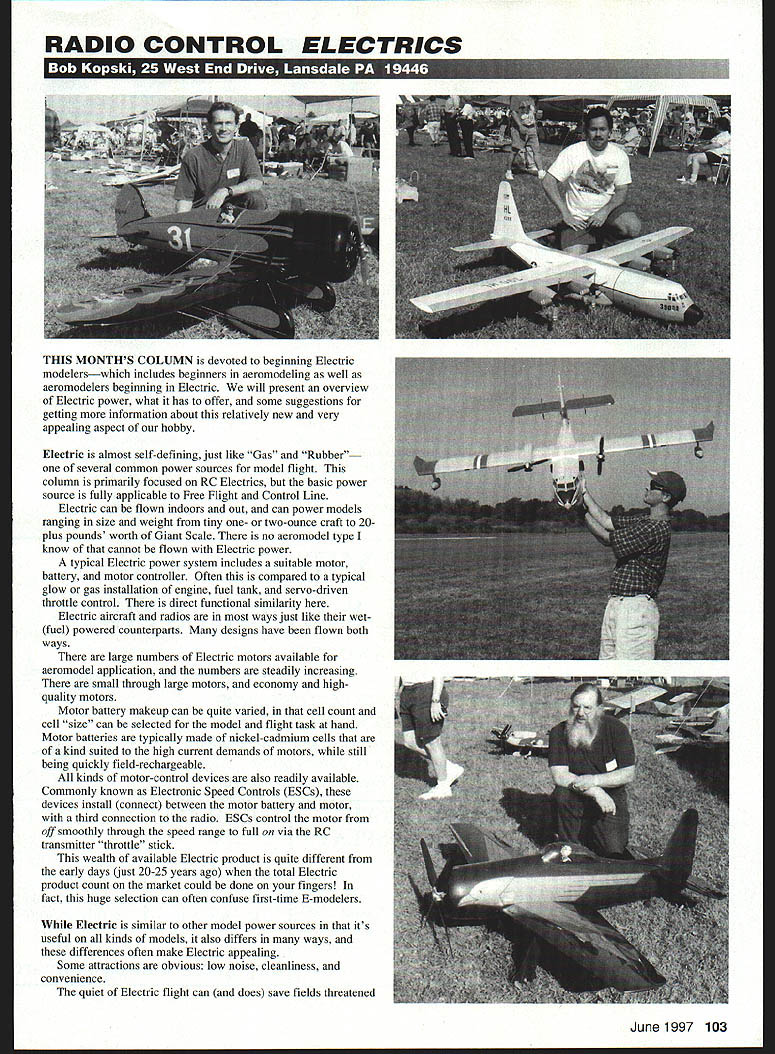
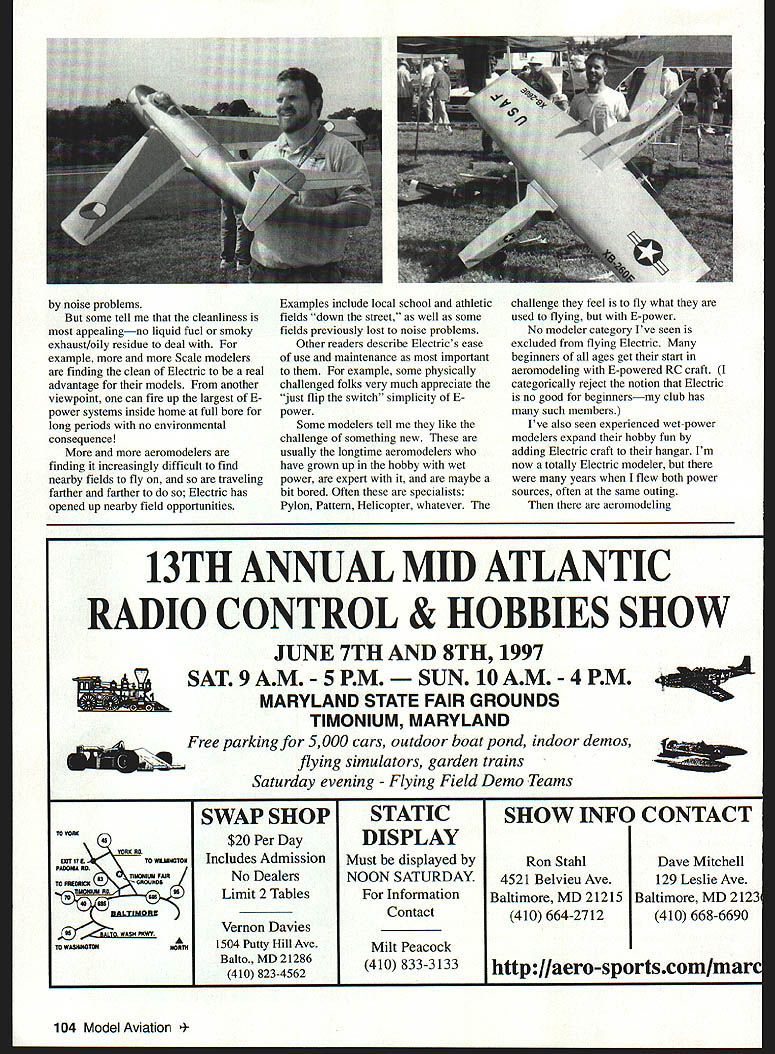
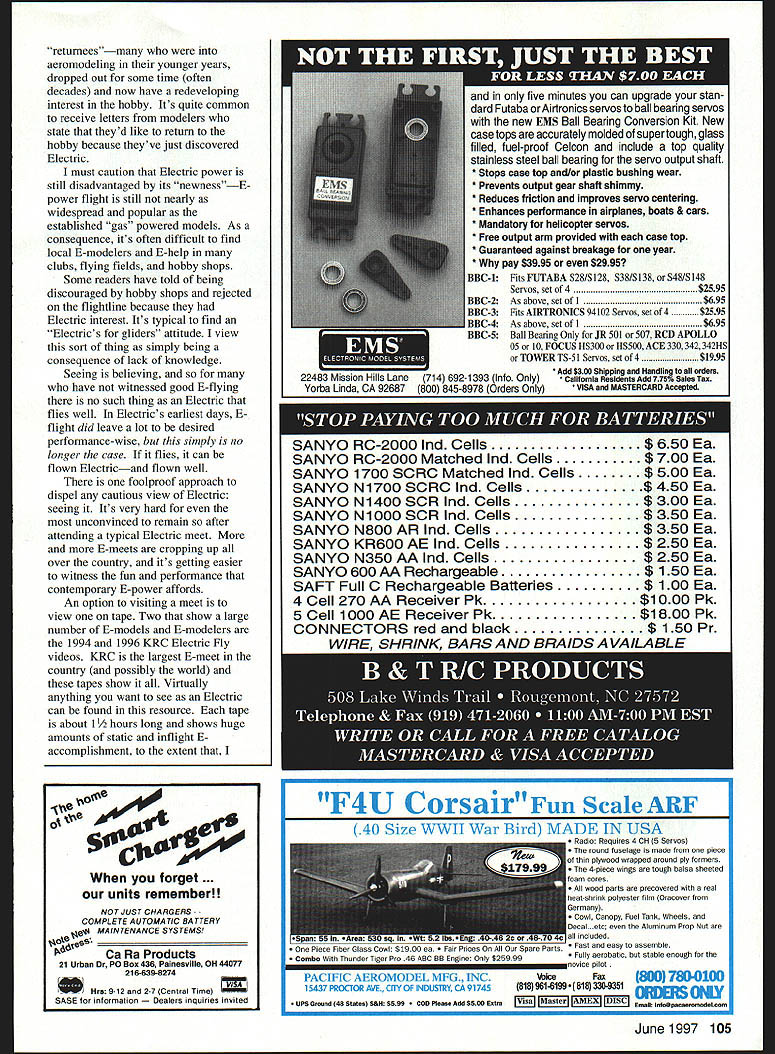
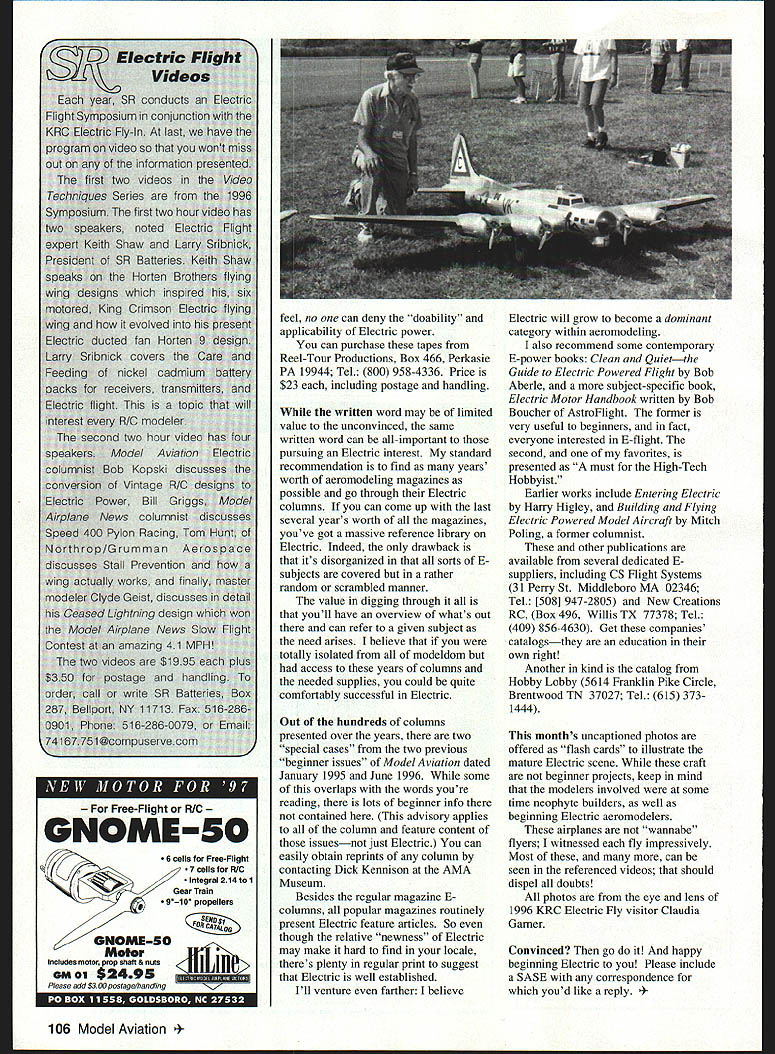
This month's uncaptioned photos are offered as "flash cards" to illustrate the mature Electric scene. While these craft are not beginner projects, keep in mind that the modelers involved were at some time neophyte builders, as well as beginning Electric aeromodelers. These airplanes are not "wannabe" flyers; I witnessed each fly impressively. Most of these, and many more, can be seen in the referenced videos; that should dispel all doubts!
All photos are from the eye and lens of 1996 KRC Electric Fly visitor Claudia Garner.
Convinced? Then go do it! And happy beginning Electric to you! Please include a SASE with any correspondence for which you'd like a reply.
Transcribed from original scans by AI. Minor OCR errors may remain.

