
RADIO CONTROL ELECTRICS
Bob Kopski
25 West End Drive, Lansdale PA 19446
This month's topics include meet announcements, some industry and new product information, and reader reactions to past topics.
Meet announcements
- Voltaires Club Annual Electric Fun Fly (Central NY)
- Date: July 19–20 (this year's meet)
- Contact: Gordon Wheeler, 5 Old Farms Lane, Cazenovia NY 13035-9444; Tel.: (315) 655-9068; Fax: (315) 655-3824.
- Note: Last year's meet drew attendees from six states.
- 1997 Mid-America Electric Flies (back-to-back meets)
- Dates: July 12–13, 1997
- Format: Low-key fun-fly with some competitive activities; potluck picnic Saturday evening. Electric fliers of all skill levels welcome.
- Site: Midwest Radio Control Society field, Northville Township, MI.
- Contacts: Ken Myers, 1911 Bradshaw Ct., Walled Lake MI 48390; Tel.: (810) 669-8124; E-mail: 10257534.107@compuserve.com. Also Keith Shaw, 2756 Elmwood, Ann Arbor MI 48104-6624; Tel.: (313) 973-6309.
- Concord Model Engineers Second Annual Electric Fun Fly
- Date: September 21, 1997
- Site: Bay Area Radio Control Society (BARCS) field.
- Contact: Chuck Hill, 1382 Deerfield Court, Concord CA 94521.
- Note: Last year's meet drew a wide variety of electrics (Speed 400 to Astro 90-powered craft) and many spectators.
- 18th KRC Electric Fly
- Dates: September 19–21 (this year)
- Site: "New" Queen City Airport site, Allentown PA. Large site—1996 attendance was 224 participants.
- Contacts: Meet Manager Jim Wolstenholme, 211 Colonial Rd., Perkiomenville PA 18704; Assistant Manager Anthony Assetto, 639 Neshaminy Ave., Warrington PA 18976; Tel.: (215) 491-9419.
- More info: KRC Home page: http://ourworld.compuserve.com/homepages/george_poos_2
Suppliers and new-product notes
- B&T RC Products (508 Lake Winds Trail, Rougemont NC 27572; Tel.: (919) 471-2060)
- My preferred supplier of Sanyo cells for motor packs—best pricing and service I've found.
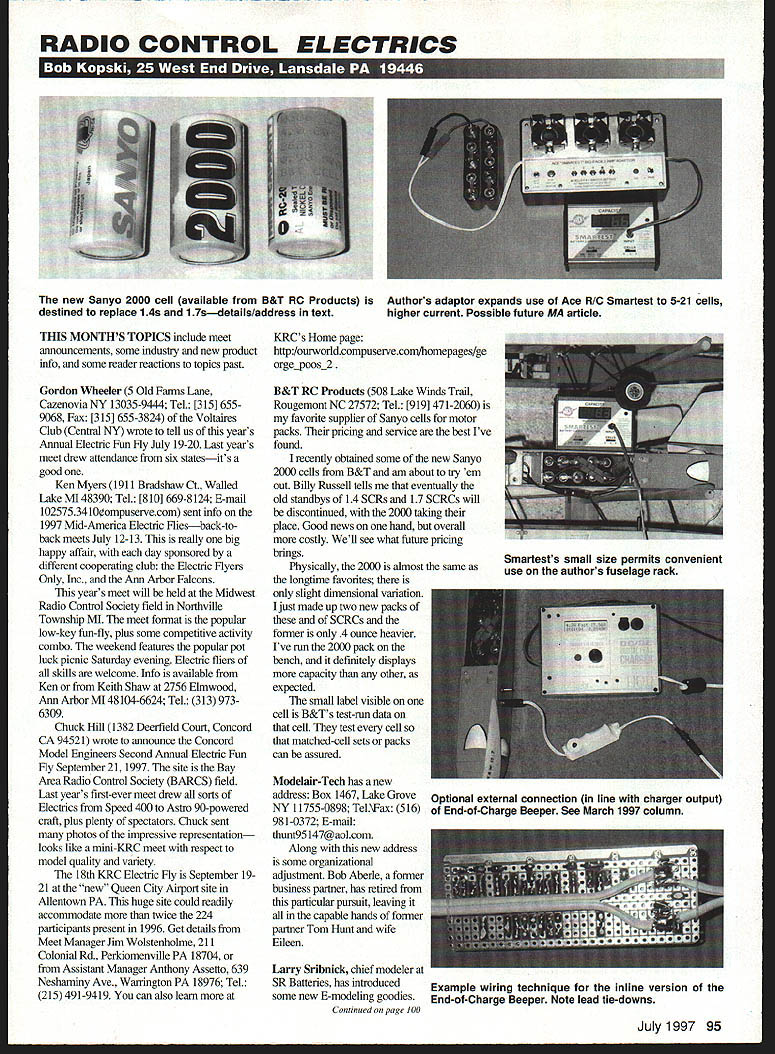
- I recently obtained Sanyo 2000 cells from B&T. These are expected to replace the older 1.4 SCRs and 1.7 SCRCs eventually. Physically the 2000s are almost the same size as the longtime favorites; two new packs I made up were only about 4 ounces heavier for the 2000 pack. Bench testing shows the 2000 pack displays more capacity than others, as expected.
- B&T tests every cell and provides the test-run label so you can get matched-cell sets or packs.
- Modelair-Tech
- New address: Box 1467, Lake Grove NY 11755-0898; Tel/Fax: (516) 981-0372; E-mail: thunt95@aol.com.
- Organizational change: Bob Aberle has retired from this pursuit; Tom Hunt and wife Eileen are now handling operations.
- SR Batteries, Inc. (Box 287, Bellport NY 11713; Tel: (516) 286-0079; Fax: (516) 286-0919; E-mail: 7416775!@compuserve.com)
- New offerings from Larry Sribnick, chief modeler:
- Publications: "RC Techniques" and "Electric Flight Techniques." Available individually or by subscription; a new volume is published monthly with categories alternating. Printed 8½ x 11, prepunched for three-ring binders on high-quality paper. These topical inserts can be compiled into reference "books" that are updated over time. Authors are knowledgeable specialists in their fields.
- Airplane: X440 — a 442-square-inch ARF e-sailplane (geared motors of the 400 and similar size category). SR calls it a "Custom Built" model. The airplane comes covered and ready for equipment installation and is also offered in a "complete package" version (radio, motor, etc.). More E-airplanes are planned.
Smartest battery tester (Ace R/C) and my adaptor
- Smartest (Ace R/C)
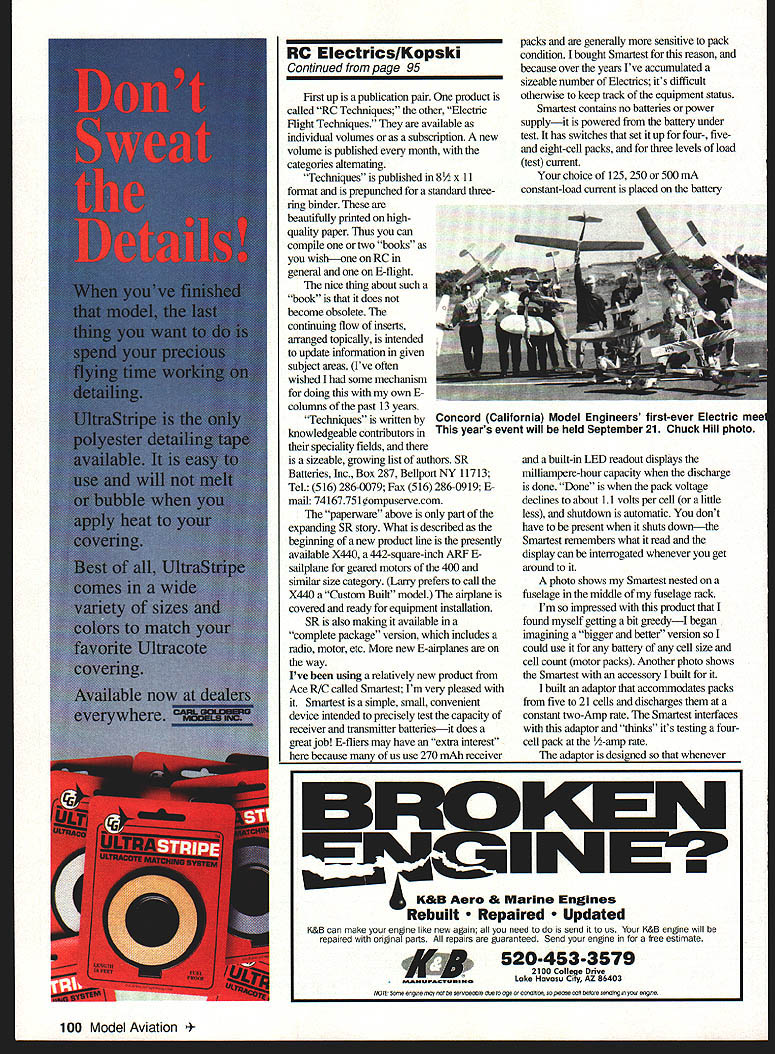
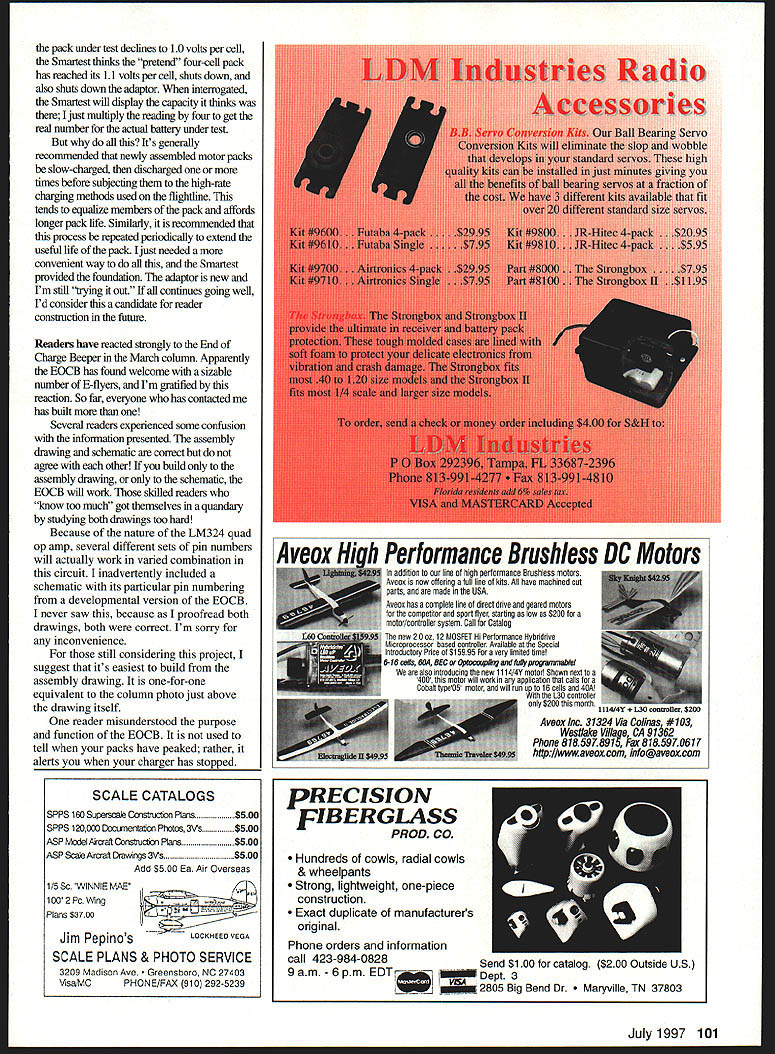
- A small, convenient device to precisely test the capacity of receiver and transmitter batteries. No internal batteries or power supply; it is powered by the battery under test. Switches configure it for four-, five-, and eight-cell packs and for three levels of constant-load current (125, 250, 500 mA). When the discharge reaches about 1.1 volts per cell (shutdown is automatic), a built-in LED readout displays the milliampere-hour capacity. The Smartest remembers the reading and the display can be checked later. Ace R/C sells the Smartest—check with them for price.
- My homebrew adaptor for higher-cell motor packs
- I built an adaptor that accommodates packs from five to 21 cells and discharges them at a constant two-amp rate. The Smartest interfaces with this adaptor and "thinks" it's testing a four-cell pack at the 500 mA rate. The adaptor is preset to the pack's total voltage (e.g., preset to the voltage corresponding to 12 cells, then set Smartest for four cells). When the Smartest shuts down (thinking the four-cell pack has reached 1.1 V per cell), it also shuts down the adaptor. The Smartest will display the capacity it thinks was there; multiply that reading by four to get the real capacity for the actual battery under test.
- Why do this? Newly assembled motor packs are generally slow-charged then discharged one or more times before high-rate flightline charging; this equalizes pack members and extends pack life. Periodic repetition of this conditioning is also recommended. The adaptor is my homebrew device and is not for sale, but it provides a convenient means to condition and test larger packs using the Smartest as the foundation.
Reader reactions and clarifications
- End of Charge Beeper (EOCB) — March column reactions:
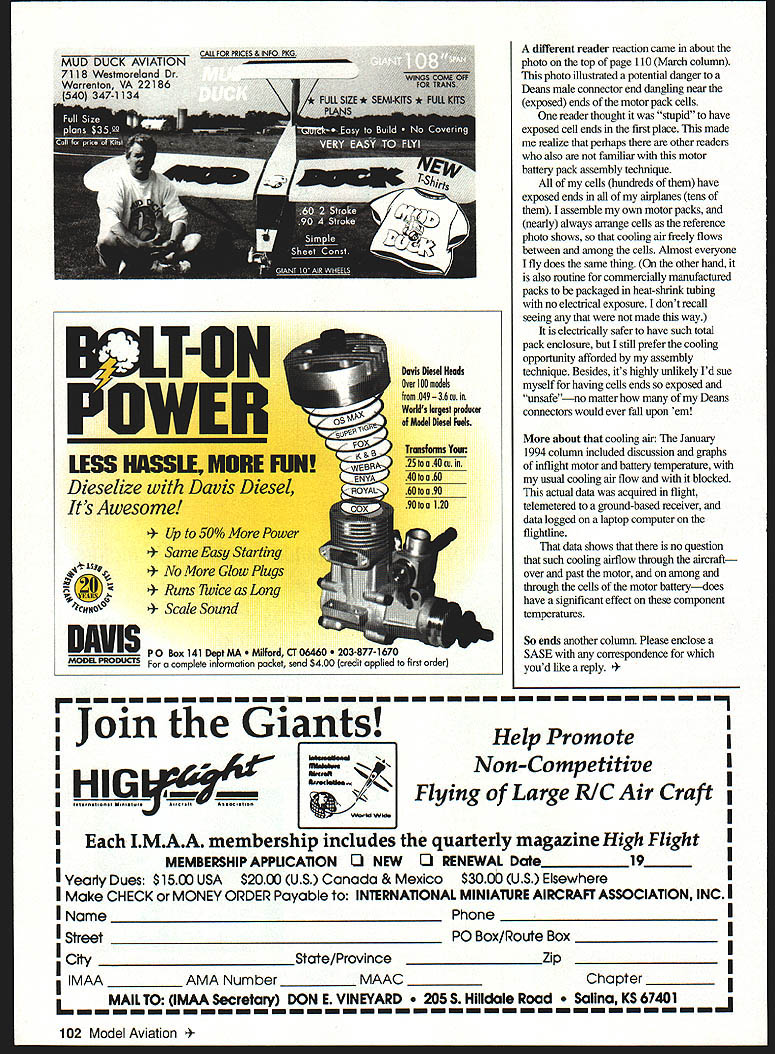
- The EOCB has been well received; many readers built more than one. Some readers were confused because the assembly drawing and the schematic did not agree in pin numbering. Both the assembly drawing and the schematic are correct but used different pin-numbering conventions for the LM324 quad op amp. If you build only from the assembly drawing or only from the schematic, the EOCB will work. For simplicity, I recommend building from the assembly drawing (it is one-to-one with the column photo above the drawing).
- Clarification of purpose: The EOCB does not tell when your packs have peaked; it alerts you when your charger has stopped.
- Exposed cell ends and connector safety — reader comment on March photo:
- One reader objected to a photo showing a Deans male connector dangling near exposed motor pack cell ends and suggested it was unsafe to have exposed cell ends at all. Many modelers (including me) assemble motor packs with exposed cell ends and arrange cells so cooling air can flow between them. I prefer this assembly technique for its cooling benefits. Commercially manufactured packs are often enclosed in heat-shrink tubing with no exposed electrical contacts, which is electrically safer, but I still favor good airflow. The photo was intended to illustrate a potential danger of a metal connector end near exposed cells, not to endorse unsafe practices.
- Cooling airflow data:
- In the January 1994 column I published flight-acquired data (telemetered to the ground and logged) showing inflight motor and battery temperatures with and without the usual cooling airflow. That data clearly shows cooling airflow through the aircraft—over and around the motor and among the battery cells—has a significant effect on component temperatures.
So ends another column. Please enclose a SASE with any correspondence for which you'd like a reply.
Transcribed from original scans by AI. Minor OCR errors may remain.

