
RADIO CONTROL ELECTRICS
Bob Kopski 25 West End Drive, Lansdale PA 19446
This month's topics
- SR Batteries 1996 Symposium videotapes
- Good Ol' Dawg update
- New book: Guide to Computer Radio Control Systems
- Reader reaction to the End-Of-Charger Beeper (EOCB)
- Kyosho Magnetic Mayhem / Mega motors testing and setups
- Throttle-emphasis experiments and industry responses
- Special reader input and closing notes
SR Batteries — 1996 Symposium videotapes
Larry Sribnick of SR Batteries has produced videotapes of the 1996 SR Symposium, held on the Friday of the annual KRC Electric Fly weekend. Four hours of proceedings are distributed on two two-hour tapes.
- Volume One:
- Keith Shaw's presentation on the early development of Horton multi-engine wings and his development of electric models, including the King Crimson quad-powered wing.
- Larry Sribnick's presentation on care and feeding of NiCd cells.
- Volume Two:
- Bill Griggs on Speed 400–powered pylon racers and related computer-aeromodeling topics.
- Clyde Geist on the design philosophy behind his slow-flight, contest-winning electric design.
- Tom Hunt (Northrop/Grumman / Modelair-Tech) on stall prevention in design and flight.
- A demonstration of vintage electric RC designs (’50s/’60s), including operational Galloping Ghost systems.
Price: $19.95 per tape plus $3.50 shipping (same shipping charge for one or both). Order from: SR Batteries, Box 287, Bellport NY 11713; Tel: (516) 286-0079.
Good Ol' Dawg update
The November 1996 column featured the Good Ol' Dawg, a ready-built electric designed by Bill Bowne. Demand exceeded Bill's production capacity, and he has transferred the rights to Elliot Boulous of the Institute of Silent Flight.
- Elliot Boulous — Institute of Silent Flight
Box 430, Morgantown PA 19543; Tel: (610) 286-5129
Elliot plans to produce kits and some ARFs as originally intended, and he supplies various electric-related items and custom building services.
New book: Guide to Computer Radio Control Systems — Don Edberg
Don Edberg's Guide to Computer Radio Control Systems (180 pages) is an excellent plain-language reference on modern RC radio systems. It includes about 100 illustrations and two dozen tables.
- Audience: anyone confused by advertising terminology or owners of sophisticated systems who want to use them confidently.
- Price: $17.95 postpaid (U.S.)
- Order from: Dynamic Modelling, 4922-3P Rochell Ave., Irvine CA 92604-2941; Tel: (714) 552-1812.
Reader reaction: End-Of-Charger Beeper (EOCB)
Readers have responded strongly to the EOCB accessory circuit described in the March column.
- One reader, who had never built electronics before, asked if I sold EOCBs. I do not; instead I suggested he ask his club's electronics hobbyist for help. A few weeks later he wrote back that he had built the EOCB himself and was very proud of his first electronic accomplishment.
- Other readers experienced difficulties; diagnosing problems by letter or phone proved nearly impossible. I reassured many that others had succeeded, which encouraged them to try again.
- In response to the positive reaction, I contacted Bob Boucher at AstroFlight to suggest he consider such features in future chargers and sent him a sample EOCB. If you want product enhancements like this, tell the manufacturers.
Kyosho Magnetic Mayhem / Mega motors — bench and flight testing
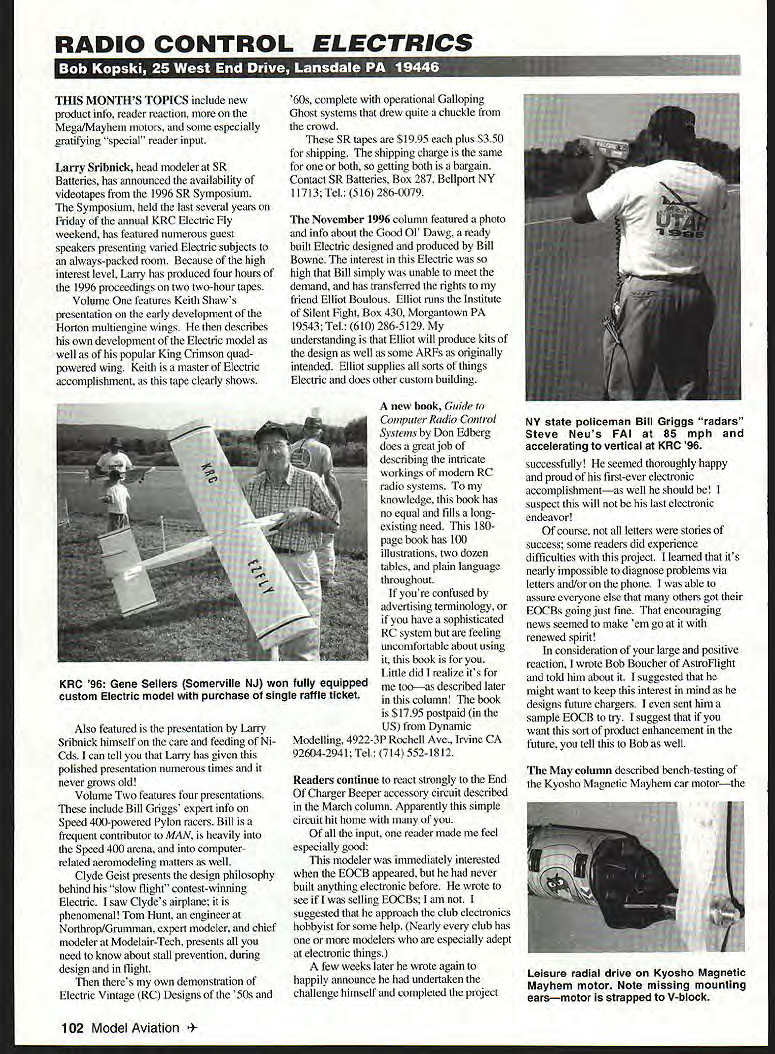
The Kyosho Magnetic Mayhem car motor (replacement for the discontinued Mega) is a satisfactory substitute. The tests described use the "reverse" version of the motor — it is timed to run clockwise and is usually used with gearboxes that reverse the rotation so props turn counterclockwise as normal. These motors are often sold as "truck" motors and are available from Tower and some hobby shops.
Typical and alternative setups tested:
- Original setup (May 1996 column):
- Motor: Mega/Mayhem (reverse)
- Gear drive: Leisure 3.8:1 radial gear drive
- Prop: Sonics Tronics 13x4x7 folder
- Battery: 10 cells
- Performance: I like running this motor at about 200 W (≈20 A from a 10-cell pack).
- Alternative prop/gear combos to obtain similar operating conditions:
- 11 x 6 prop with a 3:1 ratio
- 9 x 7 or 10 x 5 prop with a 2.5:1 ratio
These smaller props running faster suit a wider variety of models. I flew both lower-ratio options in a RevoIII; both performed well, with a slight edge to the higher-ratio/larger-prop combo. Example flight data:
- All-up weight: 6 lb
- Flight time: >15 minutes using a 10-cell pack of 1.7 Ah SCRCs from B&T
- Ground handling/takeoff from grass: excellent
- Two other pilots flew the same airplane with similar results
Mounting note: Leisure radial drives with the motor attached are intended to be mounted against a firewall or front former using three screws through molded-in lugs. I prefer to remove those lugs and mount the motor/gear drive by nesting the motor on a V-block with tie-down straps.
Parts and gear drives: New Creations R/C, Box 496, Willis TX 77378; Tel: (409) 856-4630.
The "throttle emphasis" concept (term used here) modifies the throttle-stick response shape (or the ESC control curve) from a linear response to a reverse-exponential (shaped) curve. The goal is to achieve a more linear perceived power response as the throttle stick is advanced — smoothing out the usual soft low-end and the bunching near the high end.
Industry and product developments:
- Aveox (brushless motor leader) provided a prototype brushless controller with a built-in nonlinear (emphasized) throttle response. I received a sample shortly after the April column and have been flying it while discussing the design with David Palombo (Aveox).
- Joe Utasi (early pioneer in speed-control design, formerly of Jomar) called about a new ESC incorporating the emphasis concept. Joe, now consulting for Electronic Model Systems (EMS) which produces Jomar-branded speed controls, indicated the emphasis idea will be designed into future EMS/Jomar speed controls.
- To my knowledge, Aveox is first to market with shaped throttle response for brushless, and Jomar/EMS is first for conventional motors. Microprocessor-controlled ESCs can incorporate this technique at essentially no added cost; analog controls will find it harder to implement.
- I'd like to hear from anyone using the new Aveox or Jomar products about their impressions of the modified stick response.
Additional notes:
- A reader pointed out that the decade-old Artronics Vision transmitter can shape throttle response; he included reproduced text from the manual. Apparently that transmitter can be programmed for normal or reversed curve shapes, useful for some engines.
- My Guide to Computer Radio Control Systems indicates other transmitters have this feature, though it appears more common in higher-end helicopter transmitters.
- Keith Shaw is reported to be incorporating adjustable emphasis into one of his transmitters.
Closing
So ends another column. Please have a great electric-flying summer. If you send correspondence for which you'd like a reply, please enclose a self-addressed stamped envelope (SASE).
Transcribed from original scans by AI. Minor OCR errors may remain.

