
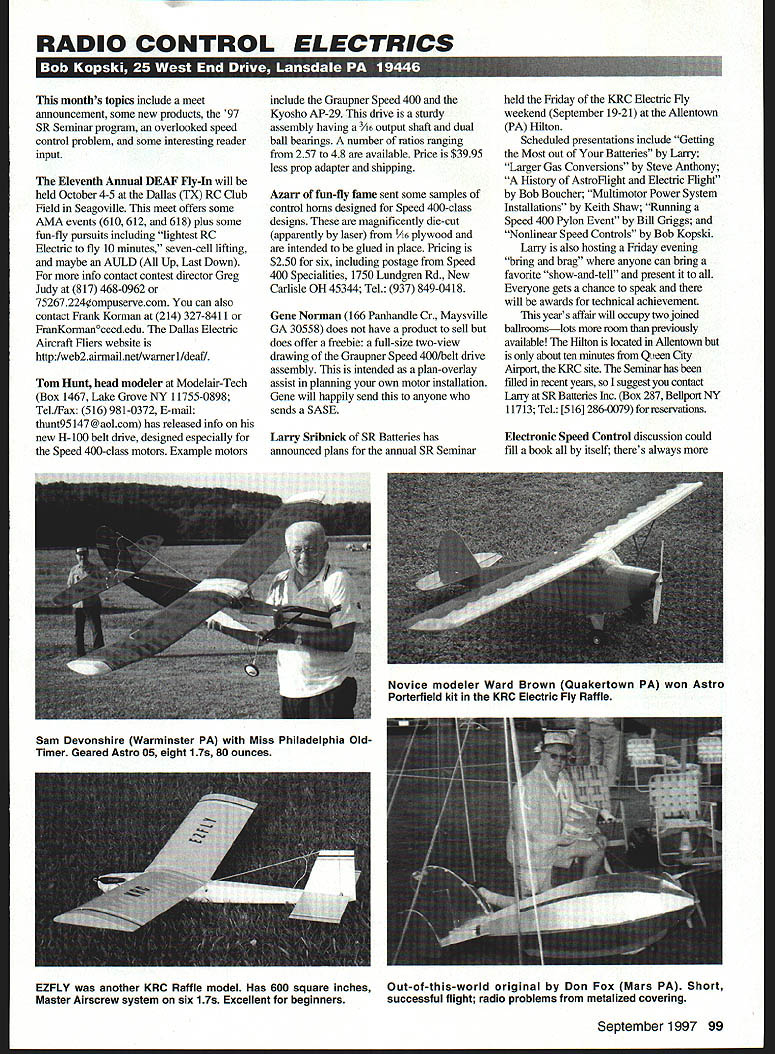
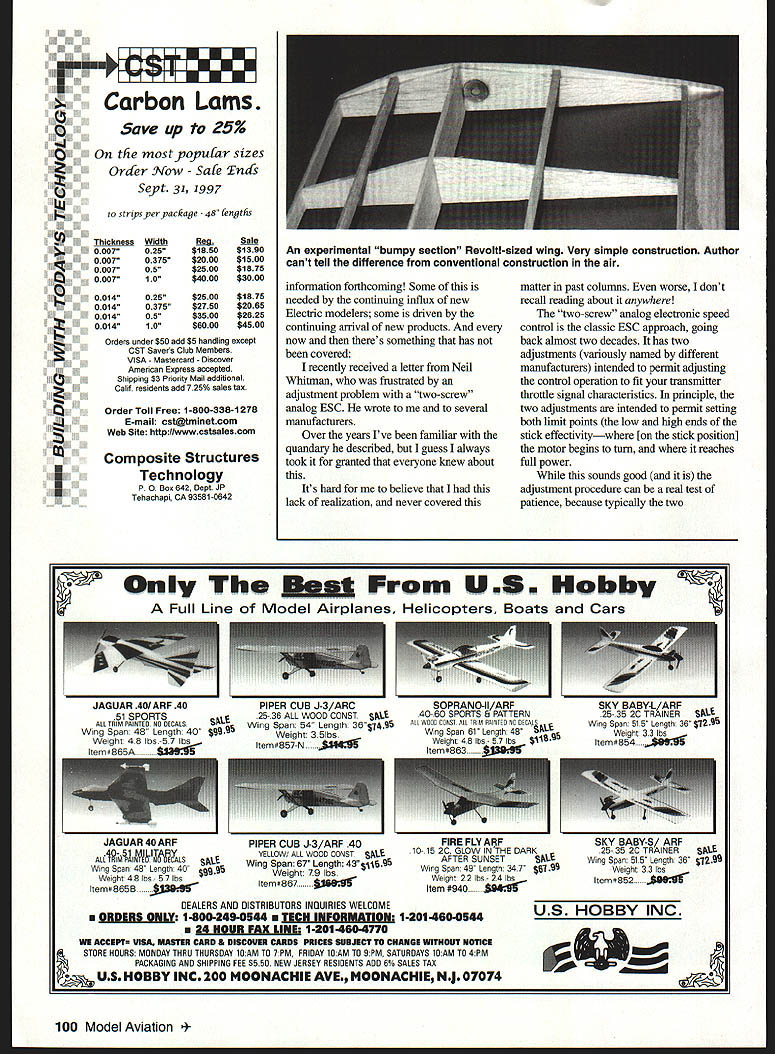
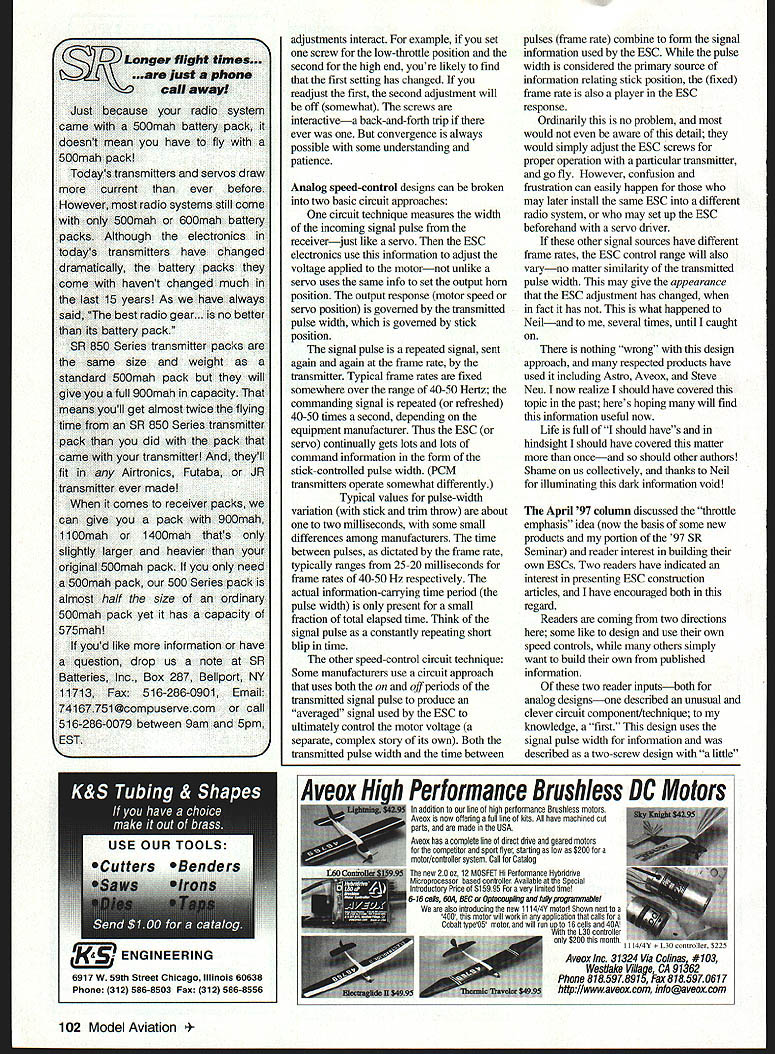
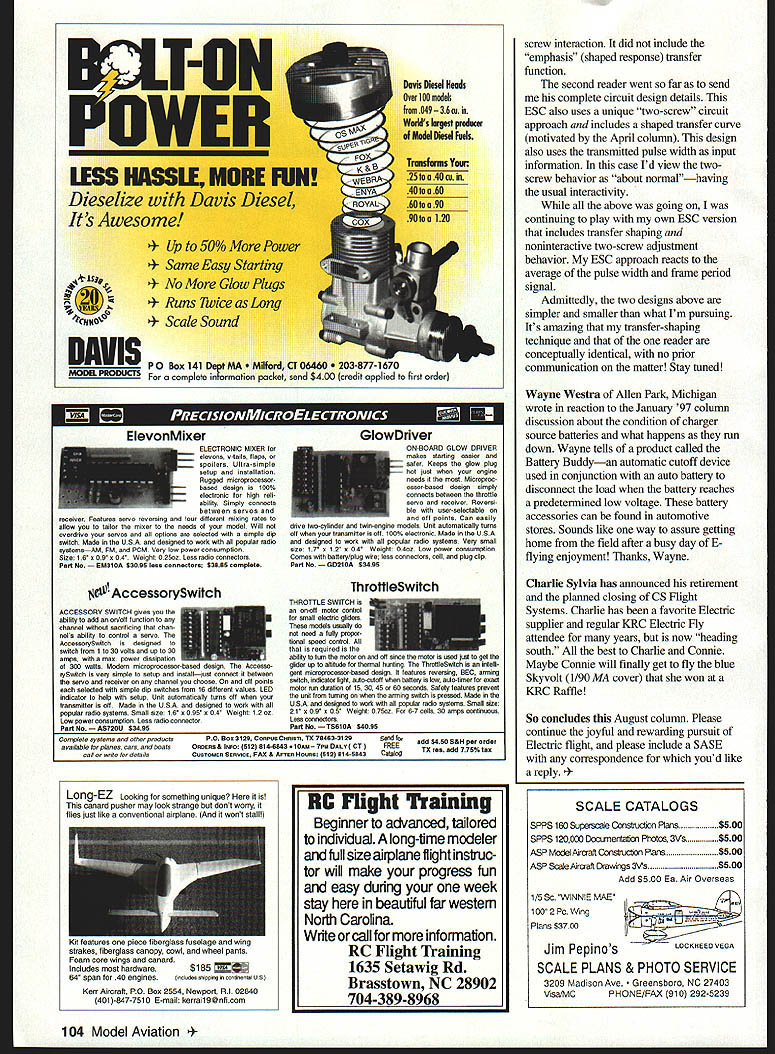
Radio Control: Electrics
Bob Kopski 25 West End Drive, Lansdale PA 19446
This month's topics include a meet announcement, some new products, the '97 SR Seminar program, an overlooked speed‑control problem, and some interesting reader input.
DEAF Fly‑In (Eleventh Annual)
- When: October 4–5
- Where: Dallas (TX) RC Club Field, Seagoville
- Events: AMA events (610, 612, and 618) and fun‑fly pursuits including "lightest RC Electric to fly 10 minutes," seven‑cell lifting, and possibly an AULD (All Up, Last Down).
- Contacts:
- Greg Judy — (817) 468‑0962, 75267224@compuserve.com
- Frank Korman — (214) 327‑8411, FrankKorman@cccd.edu
- Website: http://web2.airmail.net/warner1/deaf/
New Products and Supplies
- Tom Hunt — Modelair‑Tech
- Contact: Box 1467, Lake Grove NY 11755‑0898; Tel./Fax: (516) 981‑0372; E‑mail: thunt95147@aol.com
- Product: H‑100 belt drive for Speed 400‑class motors (examples: Graupner Speed 400, Kyosho AP‑29). Features a 3/16" output shaft and dual ball bearings. Available ratios range from 2.57 to 4.8. Price: $39.95 (prop adapter and shipping extra).
- Azarr / Speed 400 Specialties — Control horns
- Die‑cut (laser) from 1/16" plywood, intended to be glued in place.
- Price: $2.50 for six (including postage).
- Contact: Speed 400 Specialties, 1750 Lundgren Rd., New Carlisle OH 45344; Tel.: (937) 849‑0418.
- Gene Norman — free plan overlay drawing
- Offer: Full‑size two‑view drawing of the Graupner Speed 400/belt drive assembly to assist motor installation planning. Sent on request with a SASE.
- Contact: Gene Norman, 166 Panhandle Cr., Maysville GA 30558.
SR Seminar (Annual) — SR Batteries
Larry Sribnick of SR Batteries announced the annual SR Seminar, held the Friday of the KRC Electric Fly weekend (September 19–21) at the Allentown (PA) Hilton.
Scheduled presentations include:
- "Getting the Most out of Your Batteries" — Larry Sribnick
- "Larger Gas Conversions" — Steve Anthony
- "A History of AstroFlight & Electric Flight" — Bob Boucher
- "Multimotor Power System Installations" — Keith Shaw
- "Running a Speed 400 Pylon Event" — Bill Griggs
- "Nonlinear Speed Controls" — Bob Kopski
Additional details:
- Friday evening "bring and brag": attendees may present a favorite show‑and‑tell; everyone gets a chance to speak and awards will be given for technical achievement.
- Venue: two joined ballrooms at the Allentown Hilton (about ten minutes from Queen City Airport, the KRC site).
- Reservations: SR Batteries Inc., Box 287, Bellport NY 11713; Tel.: (516) 286‑0079.
Electronic Speed Controls — The Two‑Screw Adjustment Problem
Electronic speed control (ESC) discussion could fill a book; there's always more to cover as new modelers arrive and products change. One matter that commonly frustrates modelers is the adjustment behavior of the classic "two‑screw" analog ESC.
I recently received a letter from Neil Whitman describing his frustration with a two‑screw analog ESC. Over the years I've seen the same problem, and I now realize I should have covered it earlier.
The two‑screw analog ESC design has two adjustments intended to set the low and high stick limits (where the motor begins to turn and where it reaches full power). In practice the two adjustments usually interact: turning one screw affects the other, and setting both precisely becomes a back‑and‑forth task. Convergence is possible with patience and understanding of why the interaction occurs.
Two basic analog speed‑control circuit approaches
- Pulse‑width measurement (servo‑style):
- The ESC measures the width of the incoming signal pulse from the receiver (like a servo).
- The ESC uses that pulse‑width information to set motor voltage.
- The output response is governed primarily by the transmitted pulse width, which represents stick position.
- Averaging on/off periods (pulse + frame period):
- The ESC uses both the on and off periods of the transmitted pulse to produce an averaged signal that controls motor voltage.
- Both the pulse width and the time between pulses (the frame period or frame rate) combine to form the information the ESC uses.
Important timing facts
- Typical transmitter frame rates are roughly 40–50 Hz (refreshing the command 40–50 times per second).
- Typical pulse‑width variation for stick and trim is about 1–2 milliseconds.
- Frame periods are therefore about 25–20 milliseconds for 40–50 Hz respectively. The information‑carrying pulse is a short blip relative to the frame period.
Why the two screws interact (and why adjustments can seem to change)
- If an ESC design uses the frame period (or the average over on/off times) as part of its input, then changing the signal source (different transmitter, different frame rate, or a servo driver with a different refresh rate) will change the ESC's effective control range even if pulse widths are similar.
- As a result, you may adjust the ESC for one radio and later find it behaves differently with another radio — giving the appearance that the ESC has "changed" when it is actually reacting to a different frame rate. This is what happened to Neil.
There is nothing inherently wrong with either circuit approach; many respected products (including designs from Astro, Aveox, and Steve Neu) have used them successfully. The key is to understand the basis of the ESC's input so you can set adjustments appropriately and expect how the ESC will behave when moved between systems.
Reader Input and ESC Design Notes
- April '97 column: discussed the "throttle emphasis" idea (now the basis of some new products and my portion of the '97 SR Seminar) and prompted reader interest in building ESCs. Two readers offered to present ESC construction articles.
- Reader designs:
- One reader described an unusual, clever circuit that uses the actual pulse width as input. It was a two‑screw design with "a little" screw interaction and did not include the emphasis (shaped response) transfer function.
- A second reader sent a complete circuit design that also uses pulse width input and includes a shaped transfer curve (motivated by the April column). The two‑screw behavior in that design was about normal — with the usual interactivity.
- My work: I have been developing an ESC that includes transfer shaping and noninteractive two‑screw adjustment behavior. My approach reacts to the average of the pulse width and frame period signal. Interestingly, my transfer‑shaping technique and that of one reader are conceptually identical despite no prior communication.
Stay tuned for more on ESC construction and circuit approaches.
Other Reader Notes
- Wayne Westra (Allen Park, MI) wrote about the "Battery Buddy" — an automatic cutout device used with an automotive battery to disconnect the load when battery voltage reaches a predetermined low level. These accessories are available at automotive stores and can help ensure you get home from the field after a busy day of electric flying.
- Charlie Sylvia announced his retirement and the planned closing of CS Flight Systems. Charlie and Connie have been longtime favorites in the electric community and at the KRC Electric Fly. Best wishes to them both — and maybe Connie will finally get to fly the blue Skybolt she won at a KRC raffle!
Please continue the joyful and rewarding pursuit of electric flight. Include a SASE with any correspondence for which you'd like a reply.
Transcribed from original scans by AI. Minor OCR errors may remain.

