
RADIO CONTROL: ELECTRICS
Frank Korman, 9354 Forest Hills Blvd., Dallas TX 75218
Overview
Another record turnout, tougher competition, advancing technology, and smooth management made the 1997 Electric Nats a notable event. The meet included AMA LMR events (seven-cell and 30-cell limits) for Sailplane and Old-Timer classes, plus three provisional National Electric Aircraft Council (NEAC) Speed 400 events (sailplane, old-timer, and pylon). Weather ranged from light showers and cloudy, windy conditions to near-perfect lift with clear skies.
Rules and tasks
- AMA events used LMR (Limited Motor Run) format and followed the AMA rule book, including the option to count motor run times in flight time.
- Landing circle: 40-foot diameter; precision target was eight minutes; landing in the circle earned 20 points. A perfect flight time plus landing was scored as 500 points.
- NEAC Speed 400 events were limited to Speed 400-type motors:
- Speed 400 sailplane: eight-minute precision flight, 20-point landing, 90-second motor run, seven-cell battery limit. Three rounds.
- Speed 400 old-timer: Texaco-style task calling for a 15-minute flight with no motor run restrictions (spot landing allowed); battery max 7,600 mAh. Two rounds.
- Speed 400 pylon (seven cells max): 10 laps on a triangular course (300-foot legs, 60-foot base). Heats were man-on-man double elimination.
Schedule
- Saturday (8/2): Three rounds — Class A Sailplane and Class B Old-Timer.
- Sunday (8/3): Three rounds — Class B Sailplane and Class A Old-Timer.
- Monday (8/4): Three provisional NEAC Speed 400 events (three rounds for sailplane, two for old-timer, pylon double-elimination).
Seven-cell LMR Sailplane (Class A)
- Entrants: 39.
- Conditions: Light showers early, then mostly cloudy with 10–15 mph winds.
- Performance: High scoring; several pilots were within 99% of a perfect three-round score. Landings were challenging in the wind.
- Top finishers:
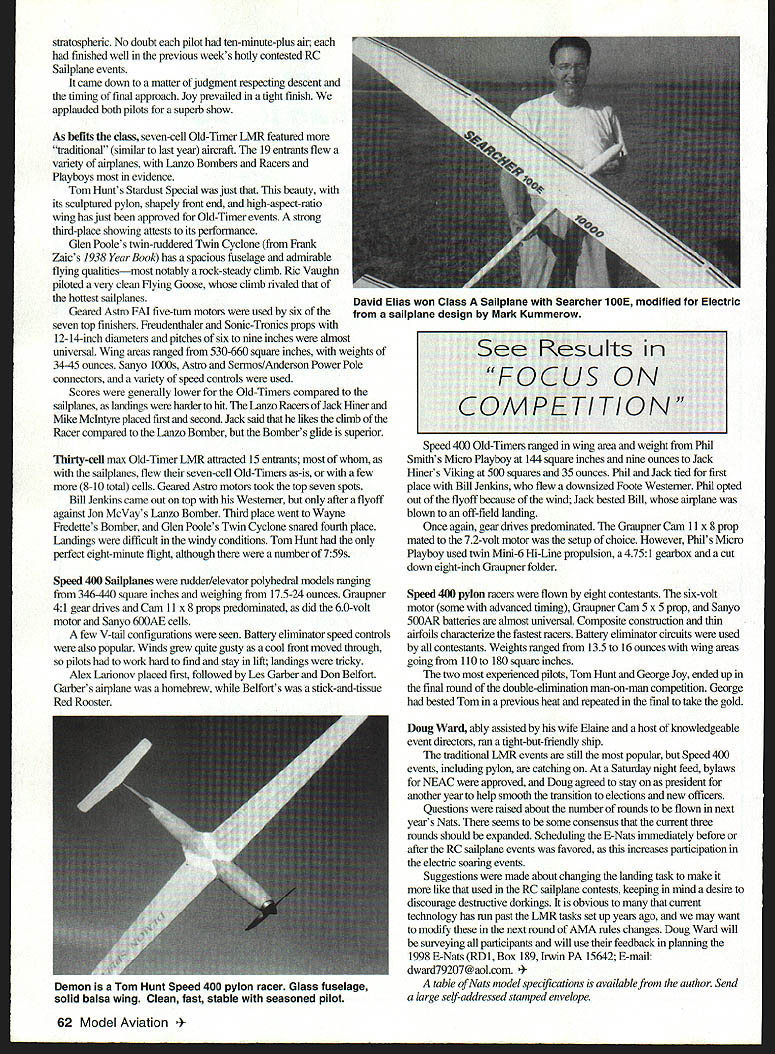
- 1st: David Elias
- 2nd: Paul Perret
- 3rd: George Joy
- Notable: Tom Hunt missed a landing that reduced his score; Bill Jenkins (last year’s winner) placed ninth.
- Observations:
- Top pilots typically achieved near-perfect flight scores; landings determined placements.
- Multifunction composite-construction models with flaps/ailerons/ruddervators had an advantage for precise landings in wind over traditional rudder/elevator designs.
Thirty-cell max Sailplane (Class B)
- Entrants: 35 (most flew seven-cell models as-is; some added cells for extra power).
- Conditions: Near perfect — light winds, clear skies, good lift.
- Performance: Airplanes went out of sight at the end of 30-second motor runs; some pilots shut motors early when specked out.
- Results:
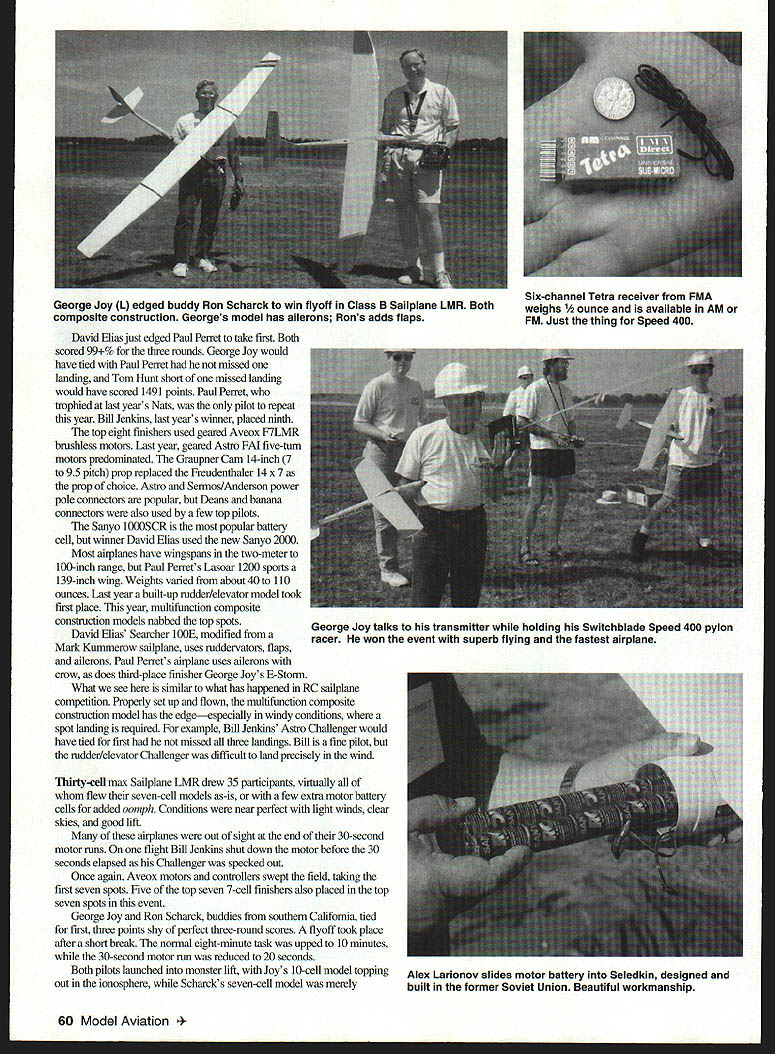
- George Joy and Ron Scharck tied for first (three points shy of perfect); a flyoff decided the winner.
- Five of the top seven finishers in the seven-cell event also placed in the top seven here.
- Equipment and trends:
- Geared Aveox motors and controllers dominated the top placements.
- Graupner Cam 14-inch props replaced Freudenthaler 14 x 7 as a popular choice.
- Popular battery cell: Sanyo 1000SCR; winner David Elias used the newer Sanyo 2000.
- Connectors: Astro/Sermos and Anderson Powerpole popular; some used Deans banana connectors.
Seven-cell Old-Timer LMR
- Entrants: 19.
- Aircraft: Traditional appearance—Lanzo Bombers, Racers, Playboys common.
- Notable aircraft:
- Tom Hunt’s Stardust Special (approved for Old-Timer events) finished a strong third.
- Glen Poole’s Twin Cyclone exhibited a rock-steady climb.
- Ric Vaughn flew a clean Flying Goose with impressive climb.
- Results:
- 1st: Jack Hiner (Lanzo Racer)
- 2nd: Mike McIntyre (Lanzo Racer)
- 3rd: Tom Hunt (Stardust Special)
- Equipment trends:
- Six of top seven used geared Astro FAI five-turn motors.
- Props: Freudenthaler and Sonic-Tronics, 12–14 inch diameters, 6–9 inch pitches.
- Wing areas: ~530–660 sq in; weights: 34–45 oz.
- Batteries: Sanyo 1000s common; various speed controls used.
Thirty-cell max Old-Timer LMR
- Entrants: 15 (many flew seven-cell airframes as-is or with modest additional cells).
- Results:
- 1st: Bill Jenkins (Westerner) — won after a flyoff against Jon McVay (Lanzo Bomber)
- 2nd: Jon McVay (Lanzo Bomber)
- 3rd: Wayne Fredette (Bomber)
- 4th: Glen Poole (Twin Cyclone)
- Notes: Landings were difficult in windy conditions. Tom Hunt recorded the only perfect eight-minute flight; several others had 7:58 scores.
NEAC Speed 400 Events
Speed 400 Sailplane
- Aircraft: Rudder/elevator polyhedral models, wing areas 346–440 sq in, weights 17.5–24 oz.
- Equipment: Graupner 4:1 gear drives, Cam 11 x 8 props, 6.0-volt motors, Sanyo 600AE cells; battery eliminator speed controls used by some.
- Conditions: Gusty winds during a cool front; lift was variable and landings tricky.
- Results:
- 1st: Alex Larionov
- 2nd: Les Garber
- 3rd: Don Belfort
Speed 400 LMRs / Old-Timers (small scale)
- Range: Phil Smith’s Micro Playboy at 144 sq in / 9 oz up to Jack Hiner’s Viking at 500 sq in / 35 oz.
- Equipment: Gear drives predominated; Graupner Cam 11 x 8 on 7.2-volt motors common. Phil Smith used twin Mini 6 Hi-Line with a 4.75:1 gearbox and a cut-down 8-inch Graupner folder in his Micro Playboy.
- Results:
- Tie involving Phil Smith (Micro Playboy), Jack Hiner (Viking), and Bill Jenkins (downsized Foote Westerner). Phil opted out of the flyoff; Jack bested Bill in the flyoff.
Speed 400 Pylon
- Entrants: 8 contestants.
- Typical setup: Six-volt motor (some with advanced timing), Graupner Cam 5 x 5 prop, Sanyo 500AR batteries, battery eliminator circuits.
- Aircraft: Composite construction, thin airfoils, weights 13.5–16 oz, wing areas 110–180 sq in.
- Results:
- Final (double-elimination man-on-man): George Joy defeated Tom Hunt to take gold.
Equipment and construction trends
- Motors: Geared Aveox F7 LMR brushless dominated many top finishes; geared Astro FAI five-turn motors also widely used among Old-Timers.
- Props: Graupner Cam series (11 x 8, 14 in variants) gained popularity; Freudenthaler props still in use.
- Batteries: Sanyo cells (1000SCR, 600AE, 500AR); Sanyo 2000 used by David Elias.
- Connectors: Astro/Sermos and Anderson Powerpole popular; some pilots used Deans banana connectors.
- Aircraft types: Multifunction composite-construction sailplanes with flaps/ailerons/ruddervators had an edge in windy conditions and for spot landings compared with traditional built-up rudder/elevator models.
- Typical spans and weights:
- Sailplanes: Most around two meters (~100 in) wingspan; some larger (e.g., Paul Perret’s Lasoar 1200 with a 139 in wing). Weights ranged roughly 40–110 oz for full-scale sailplanes.
- Speed 400 models: very light—weights 9–35 oz depending on class.
Organization, discussion, and future planning
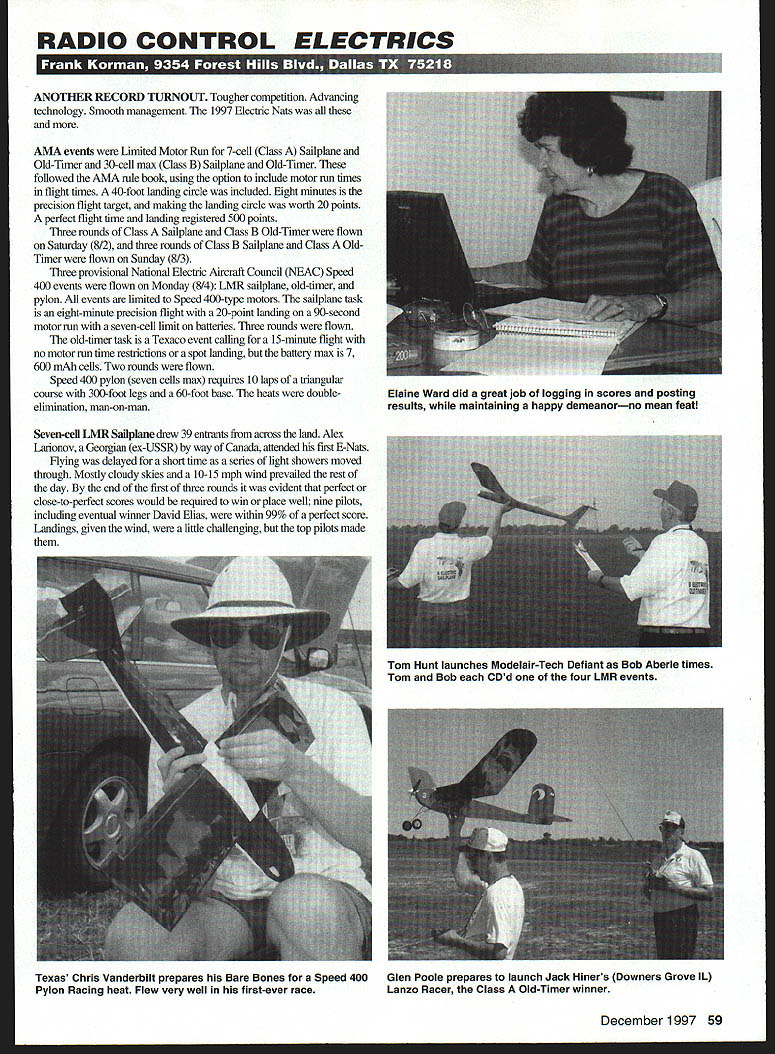
- Event management: Doug Ward, aided by Elaine Ward and a team of event directors, ran a tight, friendly meet.
- NEAC business: At a Saturday night session, bylaws for NEAC were approved and Doug Ward agreed to continue as president for another year to assist with transition and elections.
- Community feedback and suggestions:
- Consider increasing the number of rounds at future Nats (some consensus to expand beyond three).
- Scheduling the E-Nats immediately before or after RC sailplane events is favored to boost participation.
- Suggestions to modify landing tasks to better align with RC sailplane contest procedures while discouraging destructive behavior.
- Recognition that modern technology has outpaced some older LMR task definitions; AMA rule changes may be appropriate.
- Feedback collection: Doug Ward will survey participants and use responses to plan the 1998 E-Nats (RDI). Contact: Box 189, Irwin, PA 15642; E-mail: dward79207@aol.com.
Notes and model specifications
- A table of Nats model specifications is available from the author. Send a large self-addressed stamped envelope to the author’s address above.
Transcribed from original scans by AI. Minor OCR errors may remain.

