
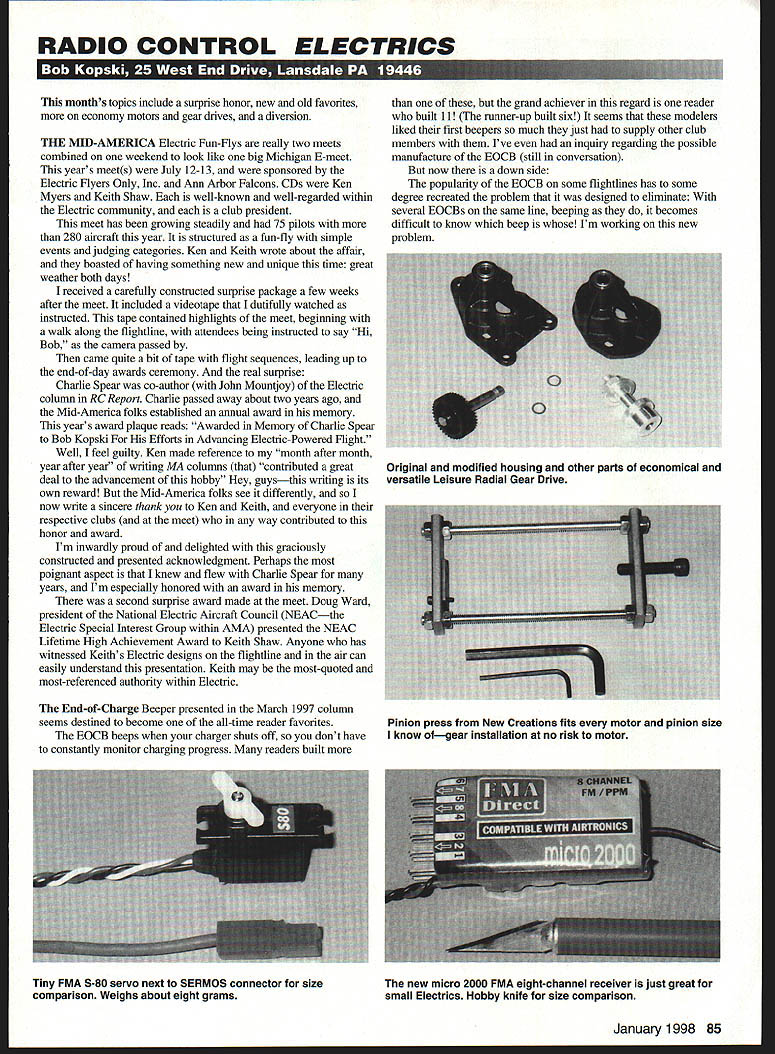
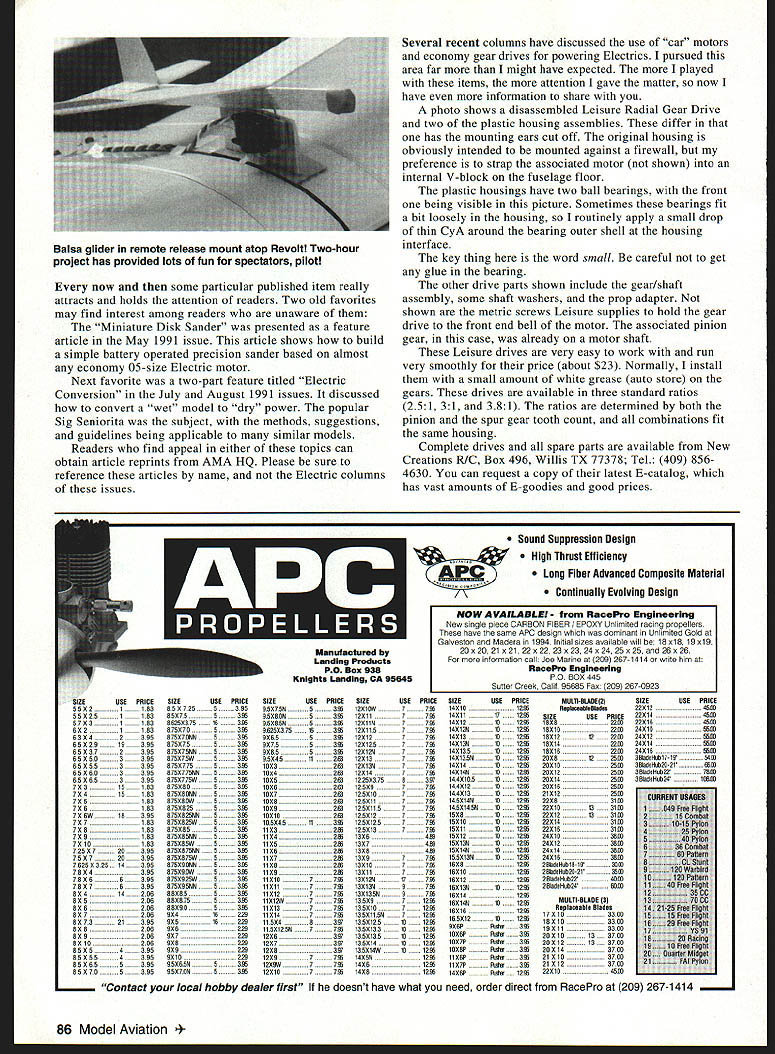

Radio Control Electrics
Bob Kopski 25 West End Drive, Lansdale PA 19446
This month's topics include a surprise honor, new and old favorites, more on economy motors and gear drives, and a diversion.
Mid-America Electric Fun-Flys
The MID-AMERICA Electric Fun-Flys are really two meets combined on one weekend to look like one big Michigan E-meet. This year's meets were July 12–13, and were sponsored by Electric Flyers Only, Inc. and Ann Arbor Falcons. Contest Directors were Ken Myers and Keith Shaw. Each is well-known and well-regarded within the electric community, and each is a club president.
This meet has been growing steadily and had 75 pilots with more than 280 aircraft this year. It is structured as a fun-fly with simple events and judging categories. Ken and Keith wrote about the affair, and they boasted of having something new and unique this time: great weather both days!
I received a carefully constructed surprise package a few weeks after the meet. It included a videotape that I dutifully watched as instructed. The tape contained highlights of the meet, beginning with a walk along the flightline, with attendees being instructed to say "Hi, Bob," as the camera passed by. Then came flight sequences leading up to the end-of-day awards ceremony.
Awards and Honors
The real surprise: Charlie Spear was co-author (with John Mountjoy) of the Electric column in RC Report. Charlie passed away about two years ago, and the Mid-America folks established an annual award in his memory. This year's award plaque reads: "Awarded in Memory of Charlie Spear to Bob Kopski For His Efforts in Advancing Electric-Powered Flight."
I felt guilty. Ken made reference to my "month after month, year after year" of writing MA columns that "contributed a great deal to the advancement of this hobby." Hey, guys—this writing is its own reward! But the Mid-America folks see it differently, and so I now write a sincere thank you to Ken and Keith, and everyone in their respective clubs (and at the meet) who in any way contributed to this honor and award.
I'm inwardly proud of and delighted with this graciously constructed and presented acknowledgment. Perhaps the most poignant aspect is that I knew and flew with Charlie Spear for many years, and I'm especially honored with an award in his memory.
There was a second surprise award at the meet. Doug Ward, president of the National Electric Aircraft Council (NEAC—the Electric Special Interest Group within AMA) presented the NEAC Lifetime High Achievement Award to Keith Shaw. Anyone who has witnessed Keith's electric designs on the flightline and in the air can easily understand this presentation. Keith may be the most-quoted and most-referenced authority within electric flight.
End-of-Charge Beeper (EOCB)
The End-of-Charge Beeper presented in the March 1997 column seems destined to become one of the all-time reader favorites. The EOCB beeps when your charger shuts off, so you don't have to constantly monitor charging progress. Many readers built more than one of these, but the grand achiever built 11 (the runner-up built six). It seems these modelers liked their first beeper so much they supplied other club members with them. I've even had an inquiry regarding possible manufacture of the EOCB (still in conversation).
But there is a downside: The popularity of the EOCB on some flightlines has to some degree recreated the problem it was designed to eliminate. With several EOCBs on the same line, beeping as they do, it becomes difficult to know which beep is whose. I'm working on this new problem.
Old Favorite Articles (reprints available)
Every now and then some particular published item really attracts and holds readers' attention. Two old favorites that may interest readers unaware of them:
- "Miniature Disk Sander" — Feature article in the May 1991 issue. Shows how to build a simple battery-operated precision sander based on almost any economy .05-size electric motor.
- "Electric Conversion" — Two-part feature in the July and August 1991 issues. Discusses how to convert a "wet" model to "dry" power. The popular Sig Seniorita was the subject, with methods and guidelines applicable to many similar models.
Readers who find appeal in either topic can obtain article reprints from AMA HQ. Please reference these articles by name, not by the Electric columns of those issues.
Car Motors and Economy Gear Drives
Several recent columns have discussed the use of "car" motors and economy gear drives for powering electrics. I pursued this area more than expected. The more I experimented, the more attention I gave the matter, and now I have additional information to share.
A Leisure Radial Gear Drive disassembled shows two plastic housing assemblies; one had the mounting ears cut off. The original housing is intended to be mounted against a firewall, but my preference is to strap the associated motor into an internal V-block on the fuselage floor.
The plastic housings have two ball bearings, with the front one visible. Sometimes these bearings fit a bit loosely in the housing, so I routinely apply a small drop of thin CA around the bearing outer shell at the housing interface.
- Key caution: use a very small amount of CA and be careful not to get any glue into the bearing.
Other drive parts include the gear/shaft assembly, shaft washers, and the prop adapter. Leisure supplies metric screws to hold the gear drive to the front end bell of the motor. The associated pinion gear may already be on a motor shaft.
These Leisure drives are easy to work with and run smoothly for their price (about $23). I normally install a small amount of white (automotive) grease on the gears. These drives are available in three standard ratios:
- 2.5:1
- 3:1
- 3.8:1
The ratios are determined by both the pinion and spur gear tooth counts, and all combinations fit the same housing.
Complete drives and spare parts are available from:
- New Creations R/C, Box 496, Willis, TX 77378; Tel.: (409) 856-4630.
- You can request a copy of their latest E-catalog, which has a large selection of electric items at good prices.
Prop, Shaft, and Gear Damage — Causes and Remedies
Parts availability is fortunate because it's relatively easy to bend the prop adapter and/or output shaft, or to damage the plastic spur gear. Here's how this happens:
- Props used with these drives and various "car" motors range from about 10x6 to 13x7, folder and fixed-blade types. Wooden fixed-blade props and seven-strand fiber props are strong and unyielding; contact with the ground will often bend the prop adapter and/or shaft long before the prop breaks. Folders rarely cause these problems.
- If a prop touches the ground or scrapes taller grass at full power (for example, on takeoff), you can damage the spur gear. A momentary stall of the prop will cause the brass pinions to eat spur gear teeth. You'll hear a distinctive "click, click, click" sound.
This is often more of an annoyance than a serious expense. Normally I just replace the $1 spur gear and go fly. At worst, there may be a few-dollar expense for the shaft or prop adapter—a small price to pay for the fun and versatility these drives provide. They permit a wide range of motor-gear-prop-model combinations and plenty of learning.
It is entirely possible to get very good flight performance from relatively cheap power systems—beyond the Mega (Mayhem) systems discussed in recent columns. The experience also shows the need for more-durable drive assemblies with a broad range of ratio options. I'd be happy to pay double (or more) for drives with more-durable gears, shafts, and adapters.
There is much more about this subject than I can fit in one column, so I'll continue this topic in the future. I think many readers will be surprised at some results I've obtained.
Glider Launches from a Revolt!
While searching for something different to do, I tried launching small balsa gliders from a Revolt! This was a perfect application for one of my tiny new FMA S-80 servos.
I made a simple assembly taped onto the wing, with an S-80 taped to it. A 12-inch balsa glider was fitted with a wire hook that engages the servo output arm. Deflecting the servo arm releases the glider. The Revolt! seems oblivious to this payload, and the released glider has provided lots of fun for spectators on the field. So far I've had more than 50 launches and no glider losses! Glider flights have often been long enough for me to land the Revolt! and watch the glider land too.
Consider this for your next club family picnic. If there is enough reader interest, I'll detail the design specifics in a future column.
Closing
So ends one more column. Please enclose a SASE with any correspondence for which you'd like a reply. Let me sincerely wish all of you a happy holiday season and a great Electrifyin' New Year!
Transcribed from original scans by AI. Minor OCR errors may remain.

