
RADIO CONTROL ELECTRICS
Bob Kopski, 25 West End Drive, Lansdale PA 19446
San Diego Mid-Winter Electrics (Feb 13–15, 1998)
The San Diego Mid-Winter Electrics is a meet sponsored by the Silent Electric Flyers of San Diego and is scheduled for February 13–15, 1998. Scheduled activities include:
- Fun-fly events
- F5B exhibition flying
- Speed 400 pylon
- Scale exhibition
- AULD (All Up, Last Down)
There will be dealer booths, a Saturday banquet, and a tour of the Aerospace Museum. For more info contact the club Web site: www.sefsd.org, or Russ Schuppner at rushup@juno.com or (619) 469-2820.
End‑Of‑Charge Beeper (EOCB)
The most discussed item at the KRC meet was the End‑Of‑Charge Beeper. Last month I reported one modeler had built 11 EOCBs; at KRC that number was raised to 14. Doug Ward, President of NEAC, mentioned the tally on the flightline—apparently everybody wants an EOCB.
Many attendees showed me their versions and expressed appreciation. Several requested variations or demonstrated modifications:
- Louder units used in addition to charger beepers for those with hearing deficiencies.
- A switch option to choose between the standard beep and a steady tone that must be turned off manually.
- A modification that produces a series of repetitive beeps.
- The innovation winner: a modeler from central Pennsylvania who replaced the beeper with a solid‑state recorder that plays his voice saying, “It’s time to fly! It’s time to fly!”
Last month I noted the problem of too many indistinguishable beeps on the flightline; many folks have already addressed this with creative variations. I’ll continue to seek simple approaches and modifications you can use to add variety and make beeps distinguishable.
I also spoke with interested parties at KRC about manufacturing the EOCB. That remains a strong possibility; if it materializes I’ll share the details.
Large Pack Slow Charger and Discharger
Several attendees commented on the Large Pack Slow Charger (featured in July 1997). One reader liked his so much he wanted a second; I suggested powering both with a single Radio Shack plug‑in AC/AC adapter, which he did. Another attendee showed his independent version of the large‑pack discharger I described (to adapt the Ace Smartest for larger motor packs and higher currents). Both solutions were independently developed and represented different circuit approaches.
Nonlinear Speed Controls
I was one of the speakers at the KRC Symposium and presented on Nonlinear Speed Controls. The talk drew questions about the possibility of a speed‑control construction article. I can’t promise one yet, but it’s under consideration.
Joe Utasi (former owner of Jomar Products, now a consultant) called to discuss the nonlinear concept and later said he was incorporating it into design revisions. Minutes before my presentation, Mark Swieng, owner of EMS (which bought Jomar), showed me two new EMS speed controls that incorporate the concept; the first production run had just finished.
I have no hands‑on experience with these new products yet, so this is not an endorsement. Jomar/EMS products have historically been very good, and I’m eager to see how E‑modelers react.
I expect a trend toward controllers that regulate “power” or “torque” rather than raw “speed,” which should greatly improve throttle feel. However, this trend raises practical issues for a construction article: many modern controllers use surface‑mount technology with tiny parts that demand microscopes and special soldering skills. Any DIY article would likely need to use classic, larger components, resulting in bigger controllers. Readers: how do you feel about that?
New products and developments seen at KRC
- AstroFlight
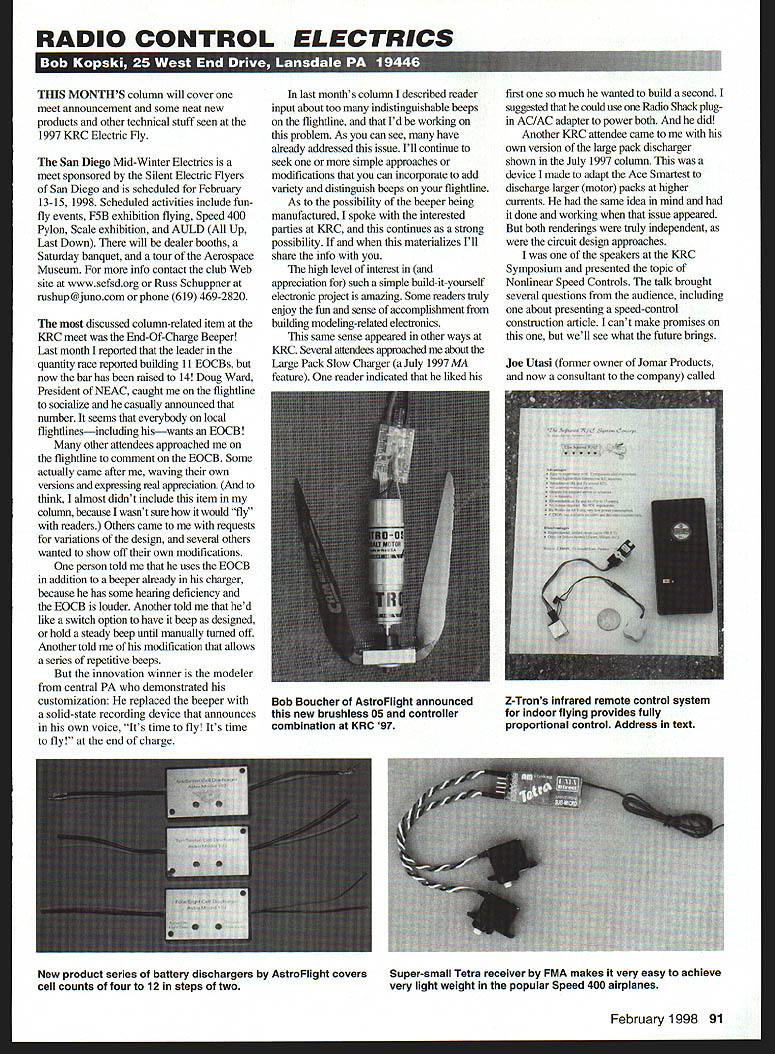
- Announced a new brushless “05” controller combination; photos showed how tiny the controller is relative to the motor/gearbox assembly.
- Showing a series of battery‑pack dischargers (models 102, 103, 104) covering four to twelve cells in steps of two.
- FMA
- Displayed a very small receiver, the Tetra, shown next to their tiny S‑80 servos for scale. The Tetra will be available in essentially the same form for both AM and FM.
- Plans for a new line of transmitters were also mentioned.
- Indoor proportional RC (IR/C)
- Sergio Zigras demonstrated an indoor proportional RC system adapted from an ordinary TV remote (infrared link rather than radio). Interest was high; contact ZE‑Tron, 171 Arnold Rd, Paramus NJ 07652 for info.
- Beepo
- A small flight‑time beeper that sticks to your transmitter, jacket, or cap and beeps out a time count so you can track flight time without looking at a clock.
- Variable‑pitch prop (Kresslets)
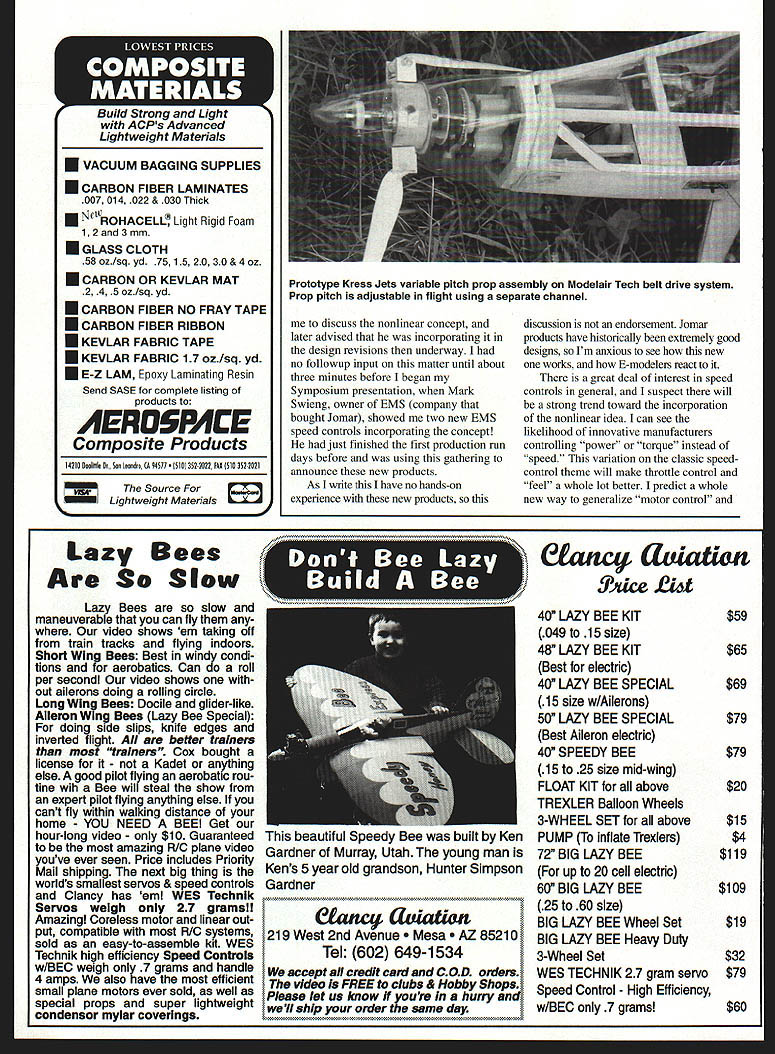
- A prototype variable‑pitch prop by Bob Kress was shown on Tom Hunt’s (ModelAirTech) MidiWatt. Pitch can be independently controlled in flight using a separate transmitter channel and a servo that runs a pushrod through a hollow prop shaft.
- A higher‑tech approach under development uses a microprocessor to adjust prop pitch automatically using motor current as a sensor to maintain a chosen power level throughout maneuvers.
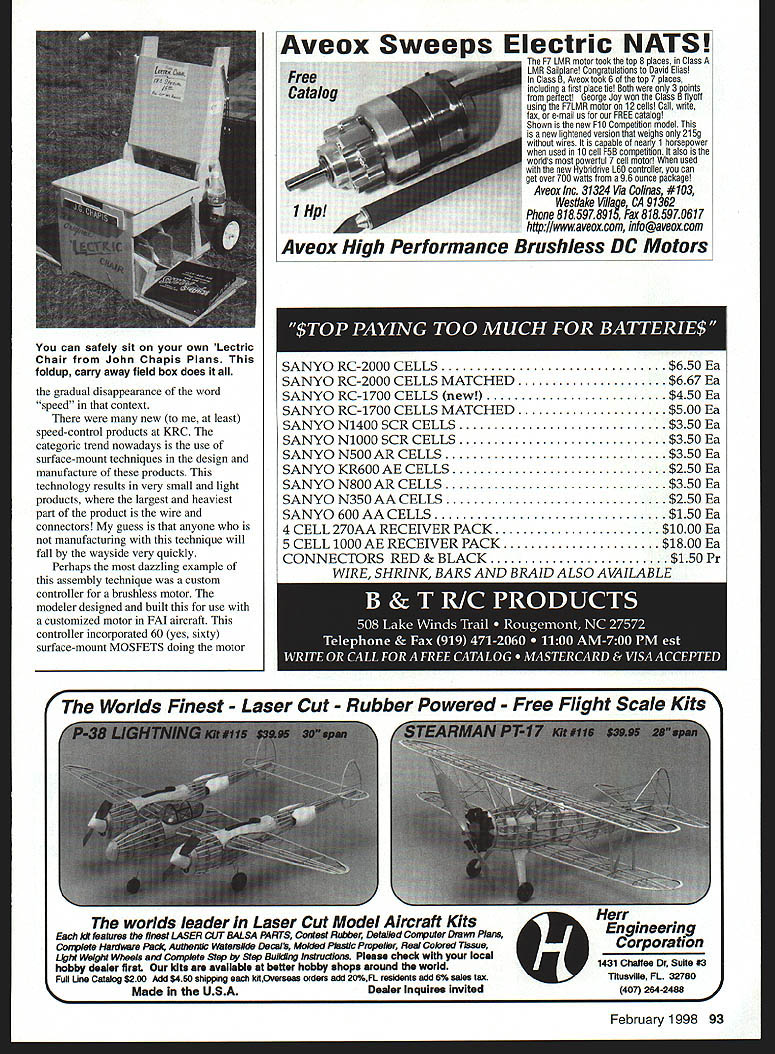
- Electric Chair field box
- An eye‑catching fold‑up carry‑away field box designed by John Chapis (John Chapis Plans, RD5, Seaford DE 19973; Tel.: (302) 629‑6373). Plans are available and he sells a variety of E‑model plans.
- Speed 400 trend
- Speed 400 airplanes were everywhere at ’97 KRC and their popularity is clearly growing. The new Astro “02” brushless changes the perception of these models as merely “small and cheap” by offering significant power in a very small package.
Please enclose a SASE with any correspondence for which you’d like a reply, and do continue to enjoy the clean, quiet, powerful aeromodelling pleasure that electric flight brings!
Transcribed from original scans by AI. Minor OCR errors may remain.

