
RADIO CONTROL ELECTRICS
Bob Kopski, 25 West End Drive, Lansdale PA 19446
This month's discussion covers two meet announcements, some varied electric products and supplier info, NEAC, follow-up on the Large Pack Slow Charger, and more on the End-of-Charge Beeper (EOCB).
Meets and Events
- Exclusively Electric Fly-In
- CD: Joe Beshar
- Hosted by: Old Time Eagles
- Date: May 16, 1998
- Location: Club field, Hope, NJ
- Notes: A gathering to promote all kinds of electric-powered models. Club welcomes participants, spectators, and vendors. Prizes and surprises are planned. Plan on charging from your car and bring your own food.
- Contact: Joe Beshar, 198 Merritt Drive, Oradell NJ 07649; Tel.: (201) 261-1281; Fax: (201) 261-0223
- Land of Lincoln Electric Fly
- CD: Tim McDonough, Knights of the Air RC Club
- Date: June 13–14
- Location: Springfield, IL
- Notes: Last year's meet drew attendance from seven states; strong regional interest expected.
- Contact: Tim McDonough, 127 S. Oaklane Rd., Springfield IL 62707; E-mail: tpm@inw.net
Speed 400 and Small High-Performance Models
I bought some Speed 400 gear last fall to try this rapidly expanding area of e-modeling. One very appealing airplane in the February 1998 Flying Models is the Shrike 400 by Joe Beshar — a 24½-inch, 15-ounce delta-type that really zips around. I've seen it at meets and have ordered plans.
If "zipping around" appeals to you, check out Speed 400 Pylon designs. Many were represented at KRC '97.
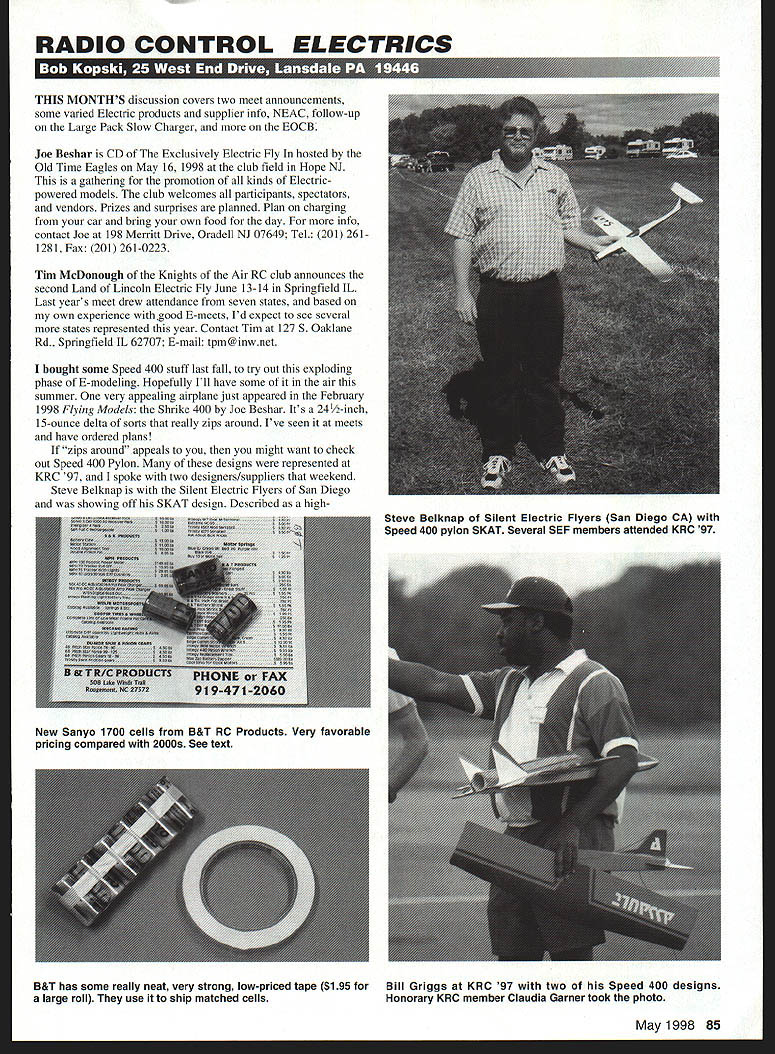
- SKAT (Steve Belknap / Silent Electric Flyers of San Diego)
- Description: A high-performance pylon/sport racer; 28-inch, 14-ounce, highly specialized (fiberglass/epoxy/carbon fuselage; balsa/carbon/foam wings). Not for beginners.
- Supplier: Diversity Model Aircraft, 10223 Kaiser Place, San Diego CA 92126; Tel./Fax: (619) 693-8188; E-mail: letfly@aol.com
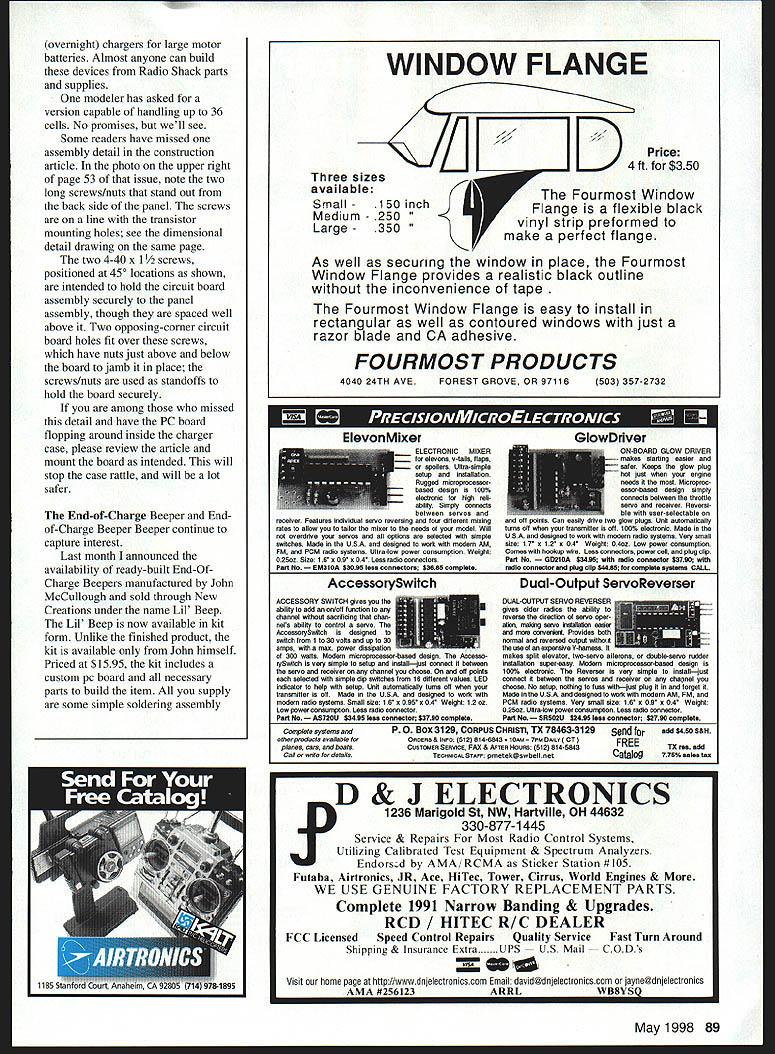
- Bill Griggs Models
- Notes: Offers Speed 400 Pylon and other designs, advice, kits, and supplies; active in the Speed 400 community.
- Contact: Bill Griggs Models, RR2 Box 64, Canastota NY 13032; Tel.: (315) 697-8152
Small and Low-Power Electrics (under ~100 watts)
For this column I roughly categorize "small" and "low power" electrics as less than 100 watts. Between one and 100 watts there is a vast domain of E-flight possibilities.
- Video: Small Electric Flying Models
- Length: 110 minutes
- Presenter: Dave Rees of Hi-Line Models
- Content: Covers getting started, sizing a model to a motor, batteries and charging, advanced projects, and Hi-Line's product range (from Speed 400 size down to several-watt designs).
- Price/Ordering: $19.95 + shipping
- Hi-Line, Box 11558, Goldsboro NC 27532; Tel.: (919) 778-6653
- Robin's View Productions, Box 68, Stockertown PA 18083 (can handle credit card orders)
B&T RC Products
Two new products from B&T:
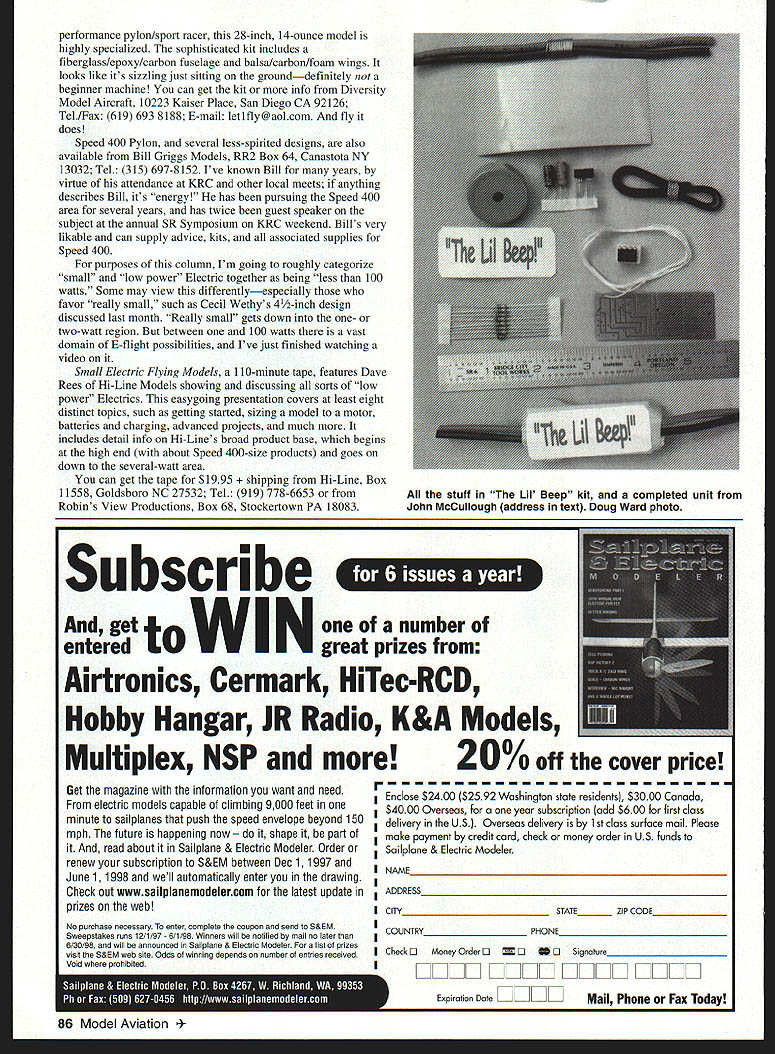
- Sanyo 1700 cell
- Appearance: Different from the previous "all black" label (now discontinued).
- Price: $4.50 per unmatched cell (compared with $6.50 for the 2000s).
- Note: I have used B&T matched cells for years and recommend them.
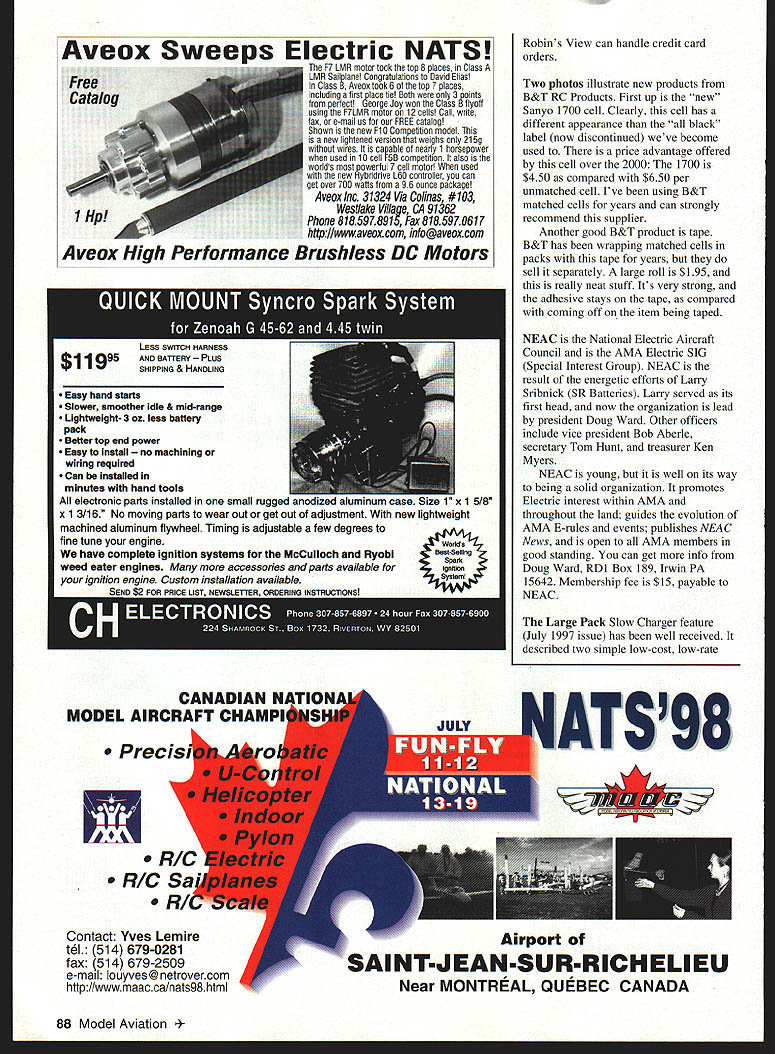
- B&T tape
- Price: Large roll $1.95
- Notes: Strong tape with adhesive that stays on the tape rather than transferring to the taped item. B&T has used this tape for wrapping matched cells and sells it separately.
NEAC (National Electric Aircraft Council)
NEAC is the AMA Electric Special Interest Group (SIG). It grew from the efforts of Larry Sribnick (SR Batteries), who served as its first head. Current officers:
- President: Doug Ward
- Vice President: Bob Aberle
- Secretary: Tom Hunt
- Treasurer: Ken Myers
NEAC promotes electric interest within AMA and beyond, guides AMA E-rules and events, and publishes NEAC News. Membership is open to AMA members in good standing.
- Contact: Doug Ward, RDI Box 189, Irwin PA 15642
- Membership fee: $15, payable to NEAC
Follow-up: Large Pack Slow Charger
The Large Pack Slow Charger discussed previously is essentially an "overnight" charger for large motor batteries. Almost anyone can build these devices from Radio Shack parts and supplies.
- A reader requested a version capable of handling up to 36 cells. No promises, but it's being considered.
- Assembly detail (important): Some readers missed a mounting detail in the construction article. In the photo (upper right of page 53 in that issue) note the two long screws/nuts that stand out from the back side of the panel. The screws align with the transistor mounting holes; see the dimensional detail drawing on the same page.
- The two 4-40 x 1/2 screws, positioned at the 45° locations shown, are intended to hold the circuit board assembly securely to the panel assembly, though they are spaced above it. Two opposing-corner circuit board holes fit over these screws, which have nuts just above and below the board to jam it in place; the screws/nuts act as standoffs to hold the board securely.
- If your PC board is flopping around inside the charger case, review the article and mount the board as intended. This will stop case rattle and is safer.
End-of-Charge Beeper (EOCB) and Beeper Keeper
The End-of-Charge Beeper and the End-of-Charge Beeper Keeper continue to generate interest.
- Lil' Beep (ready-built)
- Manufactured by John McCullough and sold through New Creations; previously announced as available ready-built.
- Beeper kit
- Now available from John McCullough (not through New Creations).
- Price: $15.95
- Includes: Custom PC board and all necessary parts to build the unit.
- You supply: Basic soldering skills plus wiring and whatever connectors are suited to your system.
- Contact: John McCullough, 5020 Stockton Dr., Raleigh NC 27606; Tel.: (919) 851-3538; E-mail: jenn11@mindspring.com
Known issues and recommendations:
- Compatibility: One modeler found the Beeper does not work with TRC chargers. TRC chargers reportedly use a "burp" charge technique (periodic reverse-polarity pulses) that can confuse the Beeper.
- High cell counts: Some users reported malfunction near the end of charge with 21-cell packs, while others (including myself) have used it on 21 cells successfully. The issue is not simply cell count but the actual voltage the Beeper "sees," which depends on charge rate, pack temperature, cell condition, voltage loss in cords and connectors, etc.
- I recommend using the Beeper as designed up to about 30 volts (roughly 18–20 cells, depending on variables).
- To extend reliable operation, change two resistor values:
- R1: from 1K to 3.3K (Radio Shack part 271-1329)
- R2: from 15K to 22K (Radio Shack part 271-1339)
- Make both changes together to permit proper Beeper operation up to about 40 volts (roughly 24 cells, depending on variables).
- Because of the many variables, check voltages for your particular high cell-count situations. Extending this basic Beeper design beyond the ~40-volt limit appears unreasonable.
- Sound options: Many users request "more sounds" (locomotive, fog horn, police whistle, louder beeps for hearing-impaired users, or to compete with noisy flightlines). The original design uses a simple Radio Shack piezo beeper device, which limits sound diversity.
- A more generalized sound solution is conceivable but will be more complex, larger, and costlier.
- Parts availability is a constraint for published electronics projects; I try to use Radio Shack parts, but broader sound options may require mail-order suppliers. How do readers feel about using mail-order parts?
- Manufacture: Early discussions are underway about possible manufacture of the latest Beeper-Beeper version. If that happens, I will report it.
That's it for this month. Have a great electric-flyin' spring! Please enclose a SASE with any letter for which you'd like a reply.
Transcribed from original scans by AI. Minor OCR errors may remain.

