

Radio Control: Electrics
Bob Kopski, 25 West End Drive, Lansdale PA 19446
This Month's Topics
- Meet announcements
- Continuing End-of-Charge Beeper (EOCB) information
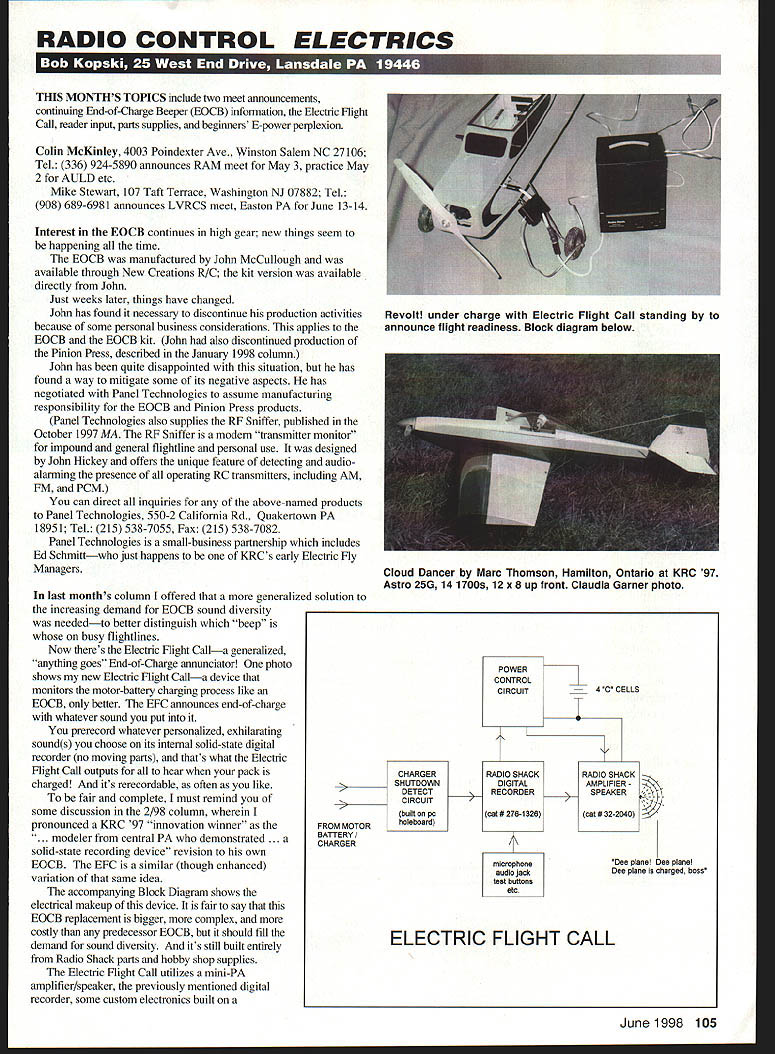
- The Electric Flight Call
- Reader input and parts supplies
- Beginners' E-power perplexion
Meet Announcements
- Colin McKinley, 4003 Poindexter Ave., Winston-Salem, NC 27106; Tel.: (336) 924-5890 — announces RAM meet for May 3; practice May 2 for AULD, etc.
- Mike Stewart, 107 Taft Terrace, Washington, NJ 07882; Tel.: (908) 689-6981 — announces LVRCS meet, Easton, PA for June 13–14.
End-of-Charge Beeper (EOCB) Update
Interest in the EOCB continues in high gear; new developments keep appearing.
The EOCB was manufactured by John McCullough and was available through New Creations R/C; the kit version was available direct from John. Just weeks later, things have changed. John has found it necessary to discontinue his production activities because of some personal business considerations. This applies to the EOCB and the EOCB kit. (John had also discontinued production of the Pinion Press, described in the January 1998 column.)
John has been disappointed by this situation, but he has mitigated some of its negative aspects. He has negotiated with Panel Technologies to assume manufacturing responsibility for the EOCB and Pinion Press products.
Panel Technologies also supplies the RF Sniffer (published in the October 1997 MA). The RF Sniffer is a modern "transmitter monitor" for impound, general flightline, and personal use. It was designed by John Hickey and offers the unique feature of detecting and audio-alarming the presence of all operating RC transmitters, including AM, FM, and PCM.
You can direct all inquiries for any of the above products to: Panel Technologies, 550-2 California Rd., Quakertown, PA 18951; Tel.: (215) 538-7055; Fax: (215) 538-7082.
Panel Technologies is a small-business partnership that includes Ed Schmitt — one of KRC's early Electric Fly Managers.
The Electric Flight Call (EFC)
In last month's column I suggested a need for more sound diversity in EOCBs to better distinguish which "beep" belongs to whom on busy flightlines. Now there's the Electric Flight Call — a generalized, "anything goes" End-of-Charge annunciator.
The Electric Flight Call monitors the motor-battery charging process like an EOCB, only better. It announces end-of-charge with whatever sound you record into it. You prerecord your personalized sound(s) on its internal solid-state digital recorder (no moving parts), and the EFC plays that sound for all to hear when your pack is charged. The recorder is rerecordable as often as you like.
To be fair and complete, this idea revisits a concept I mentioned in the 2/98 column: a modeler from central PA had demonstrated a solid-state recording-device revision to his own EOCB. The EFC is a similar, though enhanced, variation of that idea.
The EFC is larger, more complex, and more costly than previous EOCBs, but it should fill the demand for sound diversity. It is still built entirely from Radio Shack parts and hobby shop supplies.
Key features:
- Mini-PA amplifier and speaker
- Solid-state digital recorder
- Custom electronics built on a universal PC board (similar to the original EOCB)
- Single long-lasting battery pack (four C cells)
- Housed in a speaker box
- Works with motor packs from 4 to 40 cells
- Plays back up to 20-second-duration sounds
- Accepts voice, music, synthesized, random, or other sounds via microphone and/or signal connector
- Adjustable loudness
This is a preliminary look to test reader interest. If enough readers are interested, I will detail the design in a future presentation.
Electronic Speed Controls (ESCs) and Parts Suppliers
Several columns ago I discussed reader interest in home-built Electronic Speed Controls (ESCs). I noted the lack of recent published material for the build-your-own enthusiast and that building simple electronic projects related to RC has notable interest (evidenced by acceptance of the EOCB). Developing an ESC construction article would take time — probably a year or more — to choose what to develop and how to present it in print.
Another question concerned using mail-order parts suppliers for simple electronic projects. Radio Shack stores are convenient to many readers, but their parts selection is limited and changes often. It's difficult to do a good electronic design based solely on that supplier.
I don't yet have your reaction, but I have tried an "in-between" parts option: Radio Shack Unlimited (RSU). RSU is a catalog extension of your neighborhood Radio Shack, but you still deal with your local store. In the current RS store catalog you'll see parts with an RSU prefix. These items are stocked centrally and can be ordered through your local Radio Shack store. Parts are not stocked in stores, but you can order and pay for them at the counter; they are then shipped to your door.
My experience: the operation was friendly, fast, and flawless. I ordered a pair of RSU parts on a Sunday afternoon; the order was processed on the spot with immediate printed feedback from the out-of-state warehouse regarding inventory. Most parts were shown "in stock"; two were backordered. I received the basic order four days later via U.S. Mail, and the backordered parts a few days after that.
This was very pleasing. Based on this, I encourage you to use this resource. The RSU option significantly expands the familiar Radio Shack store's parts selection, with only a few days' delay. It's a practical alternative compared with other, much-less-convenient choices.
Astro Super Box and Motor Discussion
Several months ago I purchased one of the newer Astro Super Boxes — a high-ratio, high-quality all-metal gearbox. The box is Astro #711, with a 4.36:1 ratio for the Astro 035 Cobalt motor.
An .035 sounds "small" when viewed from wet-engine nomenclature (for example, comparing to a .049 wet engine). The Astro .035 weighs only a few ounces and is typically powered with five or six cells.
The .035 is characterized as operating at about 150–200 watts input when turning appropriate props direct drive, with currents less than 30 amps. However, with the gearbox in place, using a 12×8 or 13×8 prop and 11 or 12 cells, a power input in the range of 300–400 watts for about the same operating current can be expected.
One might easily conclude that the gearbox "made the motor twice as powerful." Using the familiar rule of thumb of 50 watts per pound for good electric flight, this power system should fly an eight-pound model. Would you normally think of such an airplane for your wet .049? Probably not.
So just how much on earth does ".035" mean? In practical terms, not much by itself. The simple numeric designation doesn't fully describe usable power in real setups. I have frequently lamented the lack of easy-to-understand motor description and utilization standards. While progress has been made, this "beginner's challenge" remains a gray cloud over an otherwise bright model-flying experience.
Advice to Beginners
For many, the "power" question is hard to understand and manifests as the "which motor/which airplane" quandary. But things are getting better; there are more and more breaks in the cloud cover.
Suggestions:
- Collect as many electric-flight columns as possible from popular aeromodeling magazines — these monthly packets of E-knowledge collectively offer much helpful information.
- Watch for electric construction articles — they give insight into what works motor/model-wise.
- Attend E-meets — great sources of practical E-information.
Remember that at one time wet power was comparably problematic; people had to improvise and learn. If you haven't been successful with electric flight despite your best efforts, you likely haven't yet collected all the info, insight, and help you need.
There is no such thing as an E-failure anymore; just "not-quite-yet" E-success.
Correspondence
Please enclose a SASE with any correspondence for which you'd like a reply. Send your questions — I’ll always try to help, and if I can I’ll say so.
Happy Summertime E-landings, everyone.
Transcribed from original scans by AI. Minor OCR errors may remain.

