
Radio Control: Electrics
Bob Kopski
Electric Activities
This summer was distinctly different from summers past. Folks in and around this part of the East had the opportunity to visit and participate in several organized electric events — KRC Electric Fly is no longer the only game in town. Below is a brief look at two recent meets.
SAM 76 Electric event (Hatfield, PA — July 14)
Two weeks after the annual SAM 76 Old-Timer meet, the group ran its first-ever Electric event alongside the regular O‑T gas categories. The day was very hot and very windy, and the steady wind reduced the total amount of flying. Several electric and gas planes remained in cars. Still, four electric entries flew and battled the steady wind — and there were no crashes.
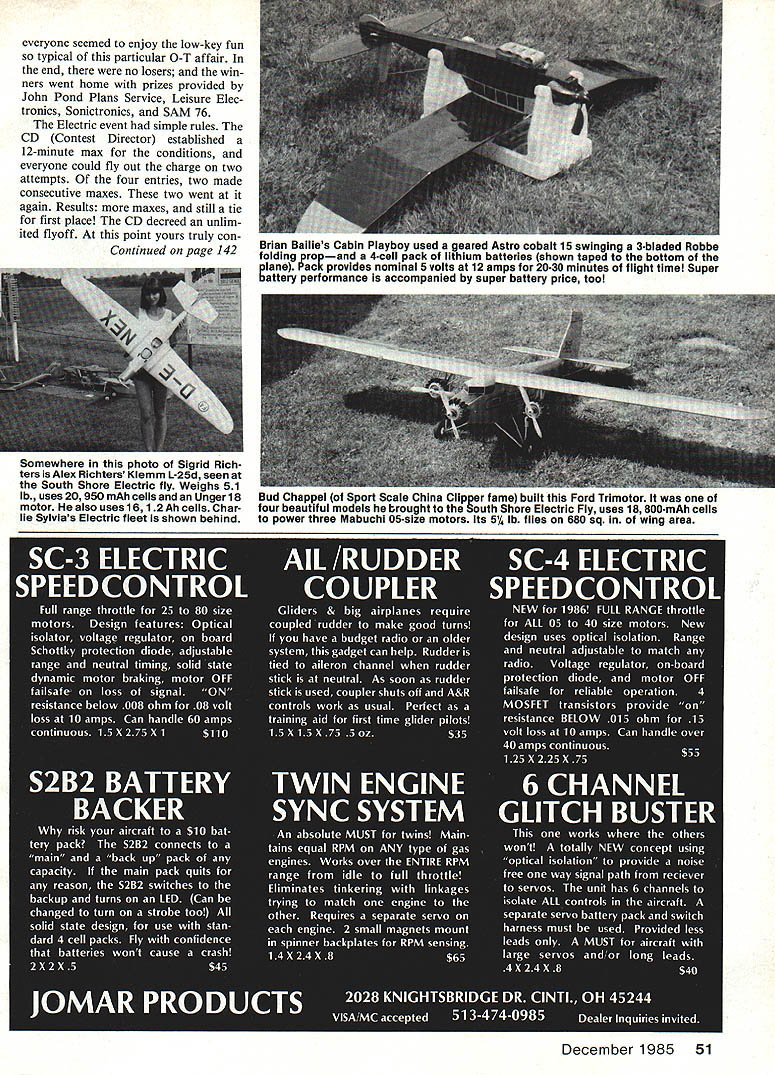
Herb Dirks flew a Leisure-powered Cabin Playboy. Because of the steady high wind, the contest director allowed hand-launches. Herb maxed his flight and took third in the Electric event.
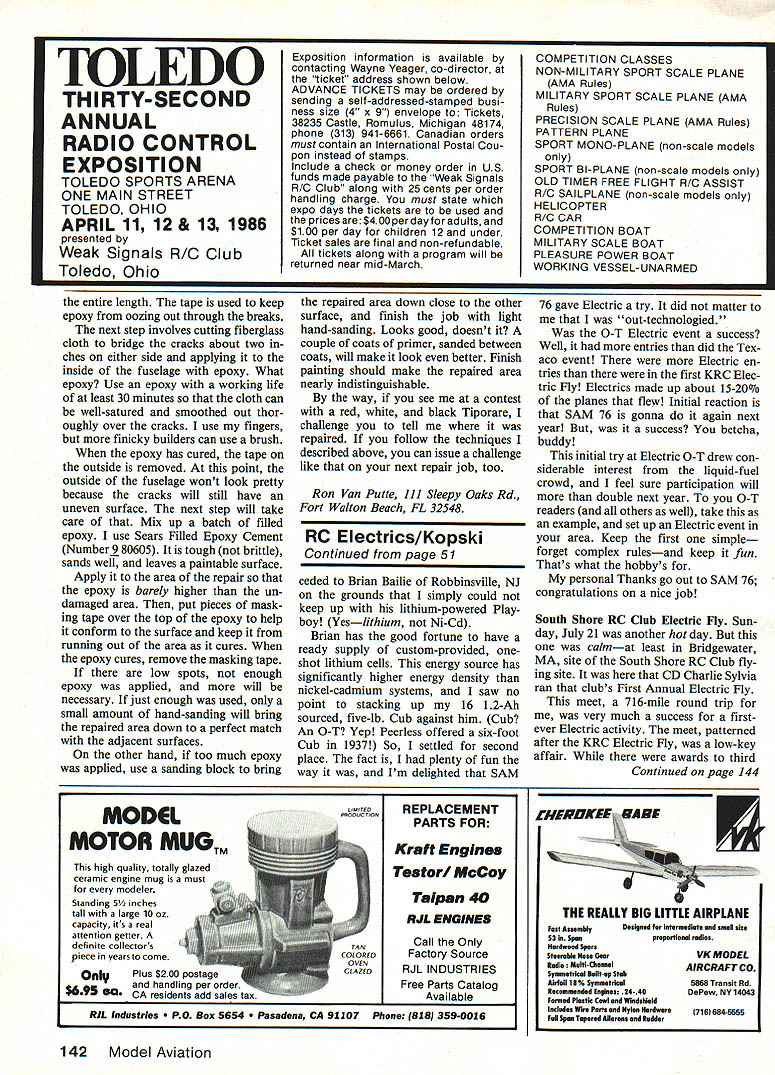
Part of Holley’s Silent Flight inventory (Bethel, CT) was on display. Dwight and Mary Ann Holley showed a large selection of electrics, RC sailplane kits (including the Etude kit Dwight used to capture the 1982 World Championship), motors, batteries and accessories. Prizes were provided by John Pond Plans Service, Leisure Electronics and Sonictronics.
SAM 76 — simple rules and results
The CD established a 12‑minute max so conditions would allow everyone to fly out; entrants were allowed two attempts. Of the four entries, two made consecutive maxes and two flew again. Results remained a tie for first place, and the CD decreed an unlimited flyoff.
At that point I conceded to Brian Bailie of Robbinsville, NJ — I simply could not keep up with his lithium‑powered Playboy. Brian had access to custom one‑shot lithium cells, which have significantly higher energy density than nickel‑cadmium systems, so I settled for second place. Peerless even offered a six‑foot Cub as an O‑T in 1937, so yes — a Cub can be an Old‑Timer!
Was the SAM 76 Electric event a success? Absolutely. It had more electric entries than some previous events, and electrics made up about 15–20% of the planes that flew. Initial reaction is that SAM 76 will do it again next year. The electric O‑T drew considerable interest from the liquid‑fuel crowd; I expect participation will increase next year. My thanks to SAM 76 for a nice job.
South Shore RC Club Electric Fly (Bridgewater, MA — Sunday, July 21)
This First Annual Electric Fly was another hot day but calm at the site. The meet was patterned after the KRC Electric Fly and was a low‑key, well‑run affair. Prizes were awarded in three judged categories — there was no “tooth‑and‑nail” competition.
Judges and categories:
- Best Plane
- Most Aerobatic (judge: AMA District I VP Don Krafft)
- Longest Flight (structured as man‑on‑man flyoffs)
Additional surprise prizes were given for farthest traveled (me), largest plane, etc.
In all, 10 participants flew a total of 22 electrics of all sorts throughout the day. Some models were positively beautiful. There were no serious mishaps, and everyone had a great time.
The South Shore site is excellent — on the grounds of a medium‑security penitentiary with plenty of room, a separated spectator area, a well‑separated pit area, and a well‑groomed grass strip suitable for electric ROGs (rise‑off‑ground). CD Charlie plans to run it again next year.
Electric supplies
My trip to Bridgewater included a delightful stop with Dwight and Mary Ann Holley in Bethel, CT. Dwight, the 1982 RC Soaring World Champion, became very interested in electric flight after attending the 1984 KRC Electric Fly and has since established Holley’s Silent Flight to supply quiet‑flight needs.
I was amazed at the electric inventory Dwight amassed in just a few months: kits, motors, accessories, and batteries of all sizes (including a new 950 mAh size that I’ll report on later). If you’ve been frustrated by the lack of electric supplies at local hobby shops, check Dwight’s ad and catalog — you’ll find a wealth of supplies and knowledgeable, helpful service. For supply questions, write Dwight.
Charger time switches — again
I discussed charger time switches in the last column (October 1985), and the subject has reappeared. There have been reports of sticky timers lately — resulting in smoked batteries in some cases. My advice:
- Reread the previous column on timer chargers.
- Test a new charger/timer with several dry runs on the bench before trusting it with costly batteries.
- Exercise your warranty if a unit fails, but don’t immediately fault the manufacturers — most use quality timers from major suppliers and normally work well.
Please assure yourself that new charger timers are reliable before leaving them unattended charging valuable cells.
Basic Electricity
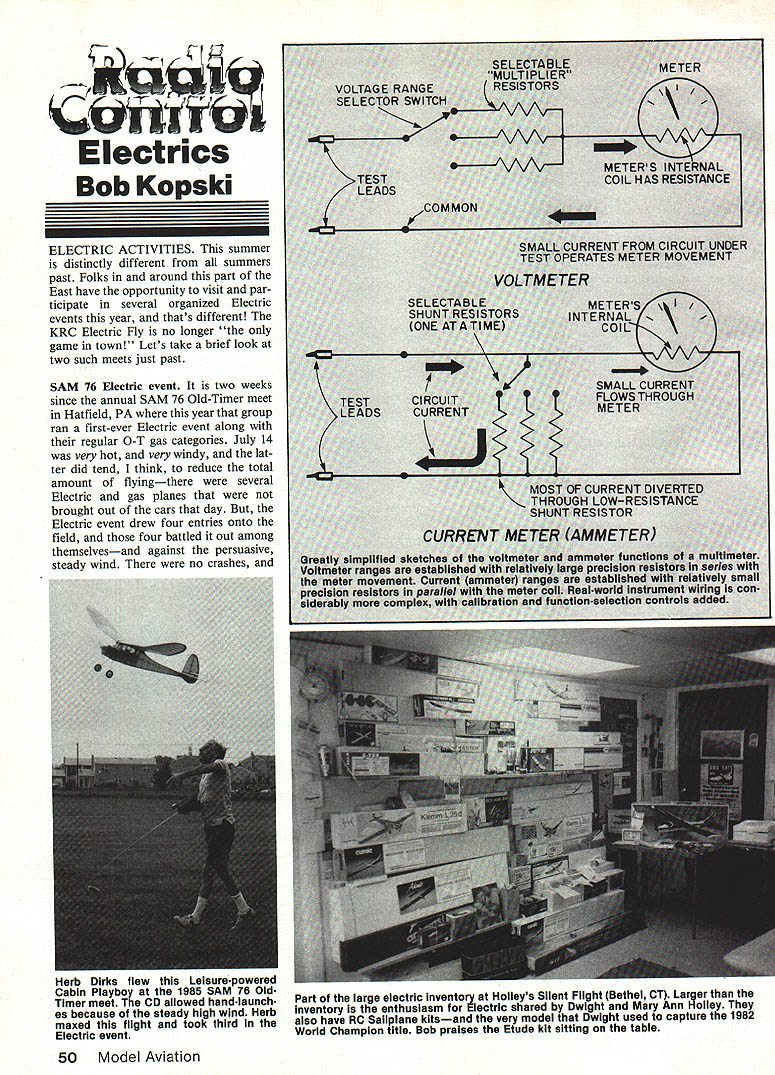
The last installment of this short course discussed multimeters, in particular the voltmeter function. A basic meter movement is a very sensitive device combined with switch‑selectable external resistors called multipliers to create different voltage ranges (e.g., 2.5 V scale for a single Ni‑Cd cell, 50 V scale for a 20‑cell aerobatic motor battery).
Most multimeters also include current (ammeter) and resistance (ohmmeter) functions with multiple ranges. Current ranges are scaled using low‑value resistors called shunts, which differ from the high‑value multipliers used for voltage ranges.
Why low‑value shunts?
- The meter movement requires very little current to deflect full scale, while motors draw many amperes.
- The shunt is placed in parallel with the meter movement so most current bypasses the movement.
- The small portion of current through the movement is a known fraction of total current, producing an accurate reading.
Example (illustrative):
- Suppose a shunt of 10 milliohms (0.010 Ω) is placed in series with a motor.
- If the motor draws 10 A, the voltage across the shunt is V = I × R = 10 A × 0.010 Ω = 0.1 V.
- A meter movement that deflects full scale at 0.1 V, connected across this shunt, will read 10 A. Marking the scale 0–10 A yields a working 10‑amp range.
Practical notes:
- The meter movement typically has a couple thousand ohms of internal resistance and doesn’t significantly affect a very low‑value shunt. For small current ranges (mA), the shunt value approaches the movement resistance and interaction affects accuracy.
- Current meters must be connected in series with the circuit being measured (current must flow through the meter). Voltmeters are always connected across (in parallel with) the component being measured.
- Connecting a current meter across a charged battery would short it and damage the meter or activate protection. Current meters have very low internal resistance.
- Current‑meter voltage drop (burden or insertion drop) is typically 0.1–0.3 V at full scale and may slightly change motor rpm when inserted.
- Voltmeters draw a small current (loading). In high‑current electric power circuits this is negligible, but in small‑signal/high‑resistance circuits it can be significant.
Understanding how multimeters work and appreciating wiring and connection losses will help you assess power installations. Later installments will cover how to extend meter ranges (e.g., measuring currents above 10 A or creating a 40 V range from a 20 V range) and practical use of voltage and current functions.
Next month’s "Basic Electricity" will continue with more on using multimeters and the ohmmeter ranges.
Please forward any questions (include a SASE) to: Bob Kopski 25 West End Dr. Lansdale, PA 19446
Transcribed from original scans by AI. Minor OCR errors may remain.

