
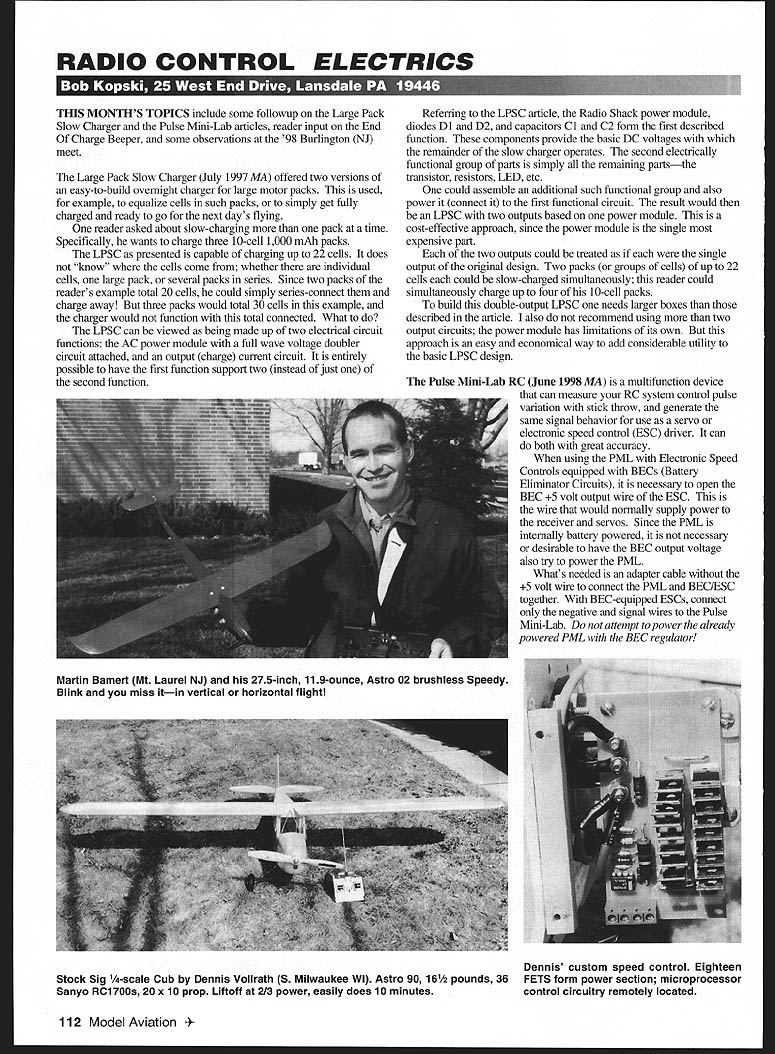
RADIO CONTROL ELECTRICS
Bob Kopski 25 West End Drive, Lansdale PA 19446
THIS MONTH'S TOPICS include:
- Followup on the Large Pack Slow Charger and the Pulse Mini-Lab articles
- Reader input on the End-of-Charge Beeper
- Observations at the 1998 Burlington (NJ) meet
Large Pack Slow Charger (LPSC) — followup
The Large Pack Slow Charger (July 1997 MA) presented two versions of an easy-to-build overnight charger for large motor packs. It is useful for equalizing cells in large packs or simply getting them fully charged and ready for the next day's flying.
One reader asked about slow-charging more than one pack at a time. Specifically, he wanted to charge three 10-cell, 1,000 mAh packs.
Key points and solution:
- The LPSC as presented is capable of charging up to 22 cells total. It does not distinguish between individual cells, a single large pack, or multiple packs in series.
- Two 10-cell packs in series equal 20 cells; the charger would charge them fine. Three 10-cell packs in series equal 30 cells, which exceeds the LPSC limit.
- The LPSC can be viewed as two electrical functional groups:
- The AC power module (with full-wave voltage doubler) formed by the Radio Shack power module, diodes D1 and D2, and capacitors C1 and C2. This provides the basic DC voltages.
- The output (charge) current circuit: the remaining parts (transistor, resistors, LED, etc.).
- It is practical to build a single power-module assembly and add two separate output (charge) circuits to it. That yields a double-output LPSC: one power module driving two independent outputs.
- Each output can be treated like the original single output, so two packs (or groups of cells) of up to 22 cells each could be slow-charged simultaneously. In the reader's example, that means up to four 10-cell packs charged at once if arranged as two parallel outputs.
- Construction notes and cautions:
- Use larger enclosures than those in the original article to accommodate the extra output circuitry.
- Do not recommend more than two output circuits on a single power module; the power module has practical limitations.
- This approach is cost-effective because the power module is the most expensive part.
Pulse Mini-Lab RC (PML) — clarification and corrections
The Pulse Mini-Lab RC (June 1998 MA) is a multifunction device that can measure RC system control pulse variation with stick throw and generate the same signal behavior to drive a servo or electronic speed control (ESC). It performs both functions with good accuracy.
Using the PML with ESCs that have BECs:
- When using the PML with ESCs equipped with BECs (Battery Eliminator Circuits), you must isolate the BEC +5 V output from the PML.
- The BEC +5 V wire (the wire that normally powers the receiver and servos) must be opened/removed in the adapter cable.
- The PML is battery-powered internally; it should not be back‑fed by the ESC BEC regulator.
- Build an adapter cable that omits the +5 V lead; connect only the negative and signal wires between the PML and the ESC.
Corrections and assembly notes:
- A reader found an omission in the Circuit Board Jumpers drawing (p. 29). Compare that drawing with the Circuit Board Assembly drawing on the same page: the wire from Q4 collector to elsewhere on the board appears in the Assembly drawing but was omitted from the Jumpers drawing.
- Diode installation: all diodes are installed with the black marking band against the board. The anode leads from the top of the standing diodes go to the other points shown in the drawings.
Reader feedback:
- One reader expressed appreciation for the PML—helpful for testing a nonlinear speed control idea.
End-of-Charge Beeper (EOCB / EOCBB)
Reader reactions to the End-of-Charge Beeper:
- Some flightline members are annoyed by the beeping sound and would prefer silence.
- Some feel electric flight should be quiet and that beeping is inconsistent with that ideal.
- One reader who is deaf reported that beeping is useless to him.
- Two readers suggested a flashing strobe light indicator.
- One reader suggested a flag indicator.
- No promises, but these suggestions will be considered for future alternatives.
Applicability and operation:
- There is misunderstanding about the applicability of the EOCB and EOCBB. These circuits work with peak-detect chargers and with timer-controlled chargers. They are not limited to peak-detect chargers.
- In general, when any charger shuts off—regardless of method—the battery terminal voltage under charge drops because charging current stops. The end-of-charge circuit senses this voltage drop to indicate charge completion.
Burlington (NJ) County RC Club — 1998 Electric Meet observations
The Burlington County RC Club held its annual Electric meet on the weekend of May 30. It was a well-run event with good flying. CD Paul Boxmeyer and his crew did a fine job, and attendees were complimentary. If anything, the meet could be expanded to two days instead of one.
General impressions:
- Like KRC, BCRC is primarily a glow-power club with healthy Electric interest and the foresight to field an annual Electric meet.
- Meets are excellent places to see a wide variety of Electrics, share information, and learn from other modelers.
- Combined with reading E-columns and feature articles, attending meets provides a lot of useful information to help you get in the air trouble-free the first time.
Event specifics:
- The meet had about 29 participants averaging two to three airplanes each, covering a broad range of Electric models—from small, light, and docile to quite large and very powerful.
- Approximately 70 aircraft were present.
- The standout was Martin Barnet's new Speedy, a 400-size pylon racer. It is an 11.5-ounce composite ship powered by an Astro 02 brushless system. It appears to push the state of the art in 400 pylon performance.
- Many 400-size craft were present, most using can-type 400 motors (low cost and popular) while the brushless 02 offered superior performance.
- Typical installations observed: Astro 02 motor with FMA S80 or S90 servos. Receivers included very small imported units; speed controllers observed included the Jeti 05 and Sprite 20.
- Several lower-power craft were flown all day in calm conditions (e.g., Bill Grigg's Bleriot was particularly enjoyable).
Trends:
- The smaller, lower-power end of the Electric model spectrum seemed to dominate attendance. Several modelers had set aside their larger 40- and 60-size power setups in favor of smaller craft. The 400-size trend is apparent.
Miscellaneous — shunts, Skyvolt, E-Motion
Shunts:
- Steve Kowalski (the "shunt man") attended BCRC. Several years ago he began making current shunts to let modelers measure high currents with an ordinary digital voltmeter (see January 1993 column). He still makes shunts; they are available from New Creations and SR Batteries.
Feedback on past designs:
- Several modelers approached me to report successful experiences with the Skyvolt design (MA, January 1990), both in original form and scaled up for larger motors.
- Others asked about the E-Motion project (described in November 1995 and May 1996 columns) and requested another E-Motion article.
- One modeler showed his attempt to duplicate E-Motion from memory after seeing it two years earlier.
Future projects:
- I have begun toying with the concept of Skyvolt II and presenting the E-Motion design again. These projects take time; we’ll see how they progress.
Copies of past articles:
- Copies of past articles are available from AMA HQ (ext. 506) at reasonable cost. You can inquire about specifics and obtain articles you wish you had saved but didn’t.
Thus ends another column. Enjoy the pleasure and reward Electric aeromodelling brings. Please enclose a SASE with any correspondence for which you'd like a reply.
Transcribed from original scans by AI. Minor OCR errors may remain.

